• Home
  • Completed Costumes/Impressions
  • Emma and Her Dresses
  • Free Patterns and Instructions

Kitty Calash

~ Confessions of a Known Bonnet-Wearer

Kitty Calash

Tag Archives: dress

Always the Lady’s Maid, Never the Lady…

26 Thursday Sep 2013

Posted by kittycalash in Clothing, Events, Living History, Museums, Research

≈ Comments Off on Always the Lady’s Maid, Never the Lady…

Tags

18th century clothes, common dress, dress, fashion, John Brown House Museum, maids, servants, What Cheer Day, widows

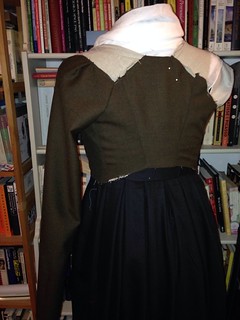
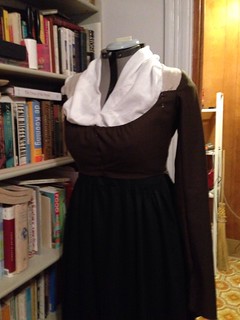
Testing the bodice and sleeve

but that’s fine, actually. I like to get dirty. The red Virginia cloth dress is now clay-splashed, and while it was made especially for the “People of 1763” event, it may no longer work. Fine for cherry-sellers, fine for hand-bill hawkers, it will not do for a lady’s maid, and I don’t especially want to clean it. Hope I can get my stays wrangled back into shape and that my cross-barred gown fits…but if not, I’ll be a recently promoted lady’s maid.

From the back.

My other upcoming role as a maid will be at the John Brown House Museum, on October 5. This has required quite a bit of thinking and stewing about appropriate clothing and realistic background. I finally settled on a black-and-brown combination of petticoat and open robe, with the style of the open robe based on Paul Sandby drawings and extant garments, but determined by the scant three and a quarter yards of brown worsted that I was able to find.

Winter, 1795. The British Museum, 2010,7081.509

Winter, 1795. The British Museum, 2010,7081.509

The bodice back is based on the 1795-97 cross-front gown from Museum of Costume in Bath shown in The Cut of Women’s Clothes. The front is meant to be transitional: a little bit of gathering at the neck, but not a great deal, with the edges still pinning closed. The sleeves are long and slim, and will button at the wrist once I’ve gotten the length worked out.

The skirt will pleat, with fullness centered on the back triangle and decreasing to the front. For the black petticoat, I used the double inverted box pleat of the 1790s open robe in Costume in Detail. As you might imagine or just plain hope, they work! I’ve also made a small pad to help lift the skirt in the back and create the right profile; I’m thinking of adding buttons and loops so that it can migrate from gown to gown.

Share this:

  • Share on Facebook (Opens in new window) Facebook
  • Share on Pinterest (Opens in new window) Pinterest
  • Email a link to a friend (Opens in new window) Email
  • Share on X (Opens in new window) X
Like Loading...

In the Pink

14 Sunday Jul 2013

Posted by kittycalash in Clothing, Making Things, Reenacting, Research

≈ Comments Off on In the Pink

Tags

18th century clothes, Clothing, common dress, Costume, dress, fashion, resources, sewing

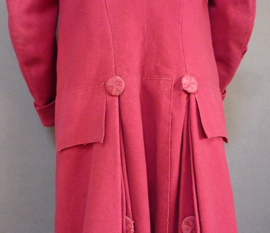
Detail, back pleats

Detail, back pleats

I swear I try to be positive about the mistakes I make. But not only did I discover this morning that I had lost my struggle with spacial processing, now I have found clear imagery to show how I should have handled the pleats on the Zombie Coat. Live, learn, unstitch and restitch: that’s all I can do. Now I have only to decide whether to do the unstitching this weekend, or next week. It will have to be done: now I know the way I’ve done it is wrong, and the master’s eye will be on that mistake and then he will know, and I will know that he knows, and it will just go on from there to tired shame.

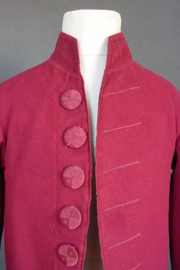
Man's wool  coat, 1770s. Meg Andrews.

Man’s wool coat, 1770s. Meg Andrews.

My favorite part of the description is this:

Either the coat was altered for another man or the wearer got fatter! … There is a half moon insertion under the arms… There’s no detail photo of that half-moon insertion, but I do so wish there was. The description notes additional changes: “If you look at one cuff you can see a lighter part of a button shape next to the seam. The cuffs have been removed and then added to the edge of the cuff to lengthen the sleeve.” At least we know garments in the past, even ones as lovely as this, were altered and changed.

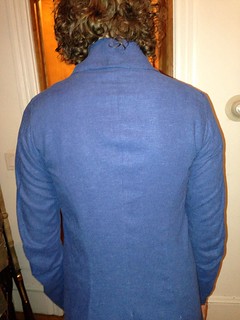
Puckering on the Zombie Coat. It’s still a nice blue, and you know what? It fits me, so maybe he’ll lose it to his refugee mother.

I will probably be inserting shapes of various kinds into the Zombie Coat, since I do now have a diagnosis for this puckering at the shoulder blades. “Viewed from the back and sides, it appears that the sleeve is binding on the front of his shoulder, causing pulling across the back shoulders – the puckers are caused by the stretching of the fabric across the rounding of the back and shoulders. If you make the top of the upper sleeve wider, or raise the shoulder cap it will create more fullness over the top of the sleeve and reduce the binding that is translating down the sleeve and across the back.”

By the time I make the changes I need to, the Zombie Coat will have acquired its own pre-history.

Share this:

  • Share on Facebook (Opens in new window) Facebook
  • Share on Pinterest (Opens in new window) Pinterest
  • Email a link to a friend (Opens in new window) Email
  • Share on X (Opens in new window) X
Like Loading...

Townspeople, 1763

24 Wednesday Apr 2013

Posted by kittycalash in Clothing, Events, History, Reenacting

≈ 5 Comments

Tags

1763, 18th century, 18th century clothes, Costume, dress, fashion, Reenacting, Research, Thomas Marshall's Boston Militia

I have this friend, DC: I can call him a friend now, but when we worked together, he was more of a nemesis, mostly because of his OCD tendencies, intense perfectionism, and complete inability to meet deadlines. It was a classic example of Mr Failure-to-Plan working poorly with Miss Contingency-Plan-Required. We literally knocked heads installing an exhibition, and I can still feel the hollow ringing pain. But it’s been six years, and with that distance, friendship is possible.

I'm only in this for the cannon.

I’m only in this for the artillery.

But he’s got this idea.  In August 1763, Boston celebrated the Treaty of Peace ending the Seven Years War (known here as the French and Indian War). There are fantastic descriptions of the celebrations and Thanksgiving Proclamations issued by the colonies, and you can read more about it in the Boston Gazette 8-15-1763.

My friend’s idea is to re-create this celebration, complete with cannons and volleys, and to that end he has enlisted local re-enactors, including a unit he didn’t realize I was part of when he asked me if I had a 1763 impression. True to form, we are asking questions he’s not yet prepared to answer… including, what sort of people do you want these townspeople to be? With the calendar as packed as it is, stitching up militia and my own clothes needs to start now, what with the regular regimental requirements due in June and again in August, and oh yes, actually maintaining life and a tolerable standard of cleanliness in the home.  (DC is moving to Europe in the Fall. After this event, when he leaves North America, I expect we’ll be better friends.)

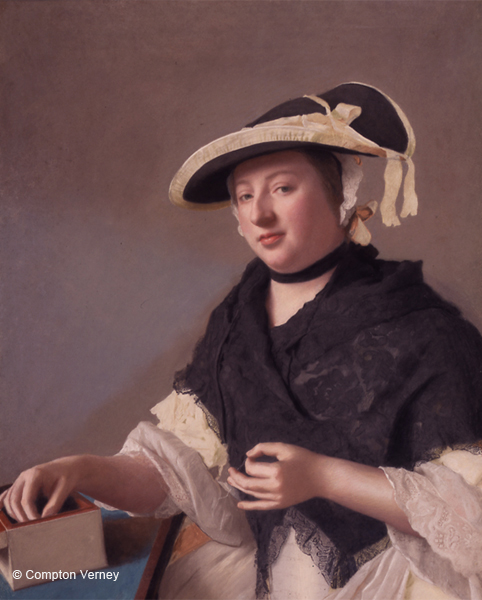
Jean-Etienne Liotard (1702-1789) Portrait of a Woman called Lady Fawkener circa 1760

Jean-Etienne Liotard (1702-1789) Portrait of a Woman called Lady Fawkener circa 1760

The reason I want an answer now is simple: I want a hat. After steaming and cramming The Hat onto Mr S’s head, I deeply desire my own Hat. I don’t covet much, really, and a hand-made piece of headwear made by someone you know and respect seems a very innocent thing to covet, even if coveting is wrong.  But to give the Favorite Hatmaker time to create a hat like the one at left, and me time to trim same, I need to know rather soon if I should be a lady or a cherry-seller.

I started a Pinterest board (when all else fails, collect images) of 1763 ideas. It’s a pretty simple thing, really, gown with robings, cap, blah blah petticoats blah blah, but: isn’t it all about the fabric? And the trims? And, lest we forget, the coveted hat!

Paul Sandby, London Cries: Black Heart cherries... ca. 1759. YCBA,  B1975.3.206

Paul Sandby, London Cries: Black Heart cherries… ca. 1759. YCBA, B1975.3.206

The Sandby cherry seller can probably be replicated with an open gown with robings made from B&T’s Virginia cloth; the question is merely of color, drape, and patience waiting for swatches. (Wish Wm Booth still had that yellow and blue striped linen, but my blue and white linsey-substitute would have to do.) This is simple enough, really; I have a cap like the cherry-seller’s cut out, somewhere, or linen to make one, anyway.

Paul Sandby, London Cries: The Fishmonger (detail), 1759. YCBA B1975.3.210

Paul Sandby, London Cries: The Fishmonger (detail), ca. 1759. YCBA B1975.3.210

Maybe the compromise is this, yellow, with a black hat. I suspect this hat is straw, but perhaps I could combine the hat above with this idea. The black hat and black cape are very appealing. The answer, of course, is all in research: find out about the men in Thomas Marshall’s Boston Militia, and from there I can find out about, or make intelligent surmises, about the women. But that’s irritating, as military/militia-based history often is–to be dependent on the men. Perhaps the less annoying route lies through JSTOR…. and following up on the memory of a Boston widow-businesswoman.

In the end, I’m realistic enough to know that I shall be lucky to get a new hat trimmed at all, given all the menswear there is to complete between now and August. Even my plans for chitzy sewing this week turned late yesterday into, “Oh, but I thought you liked the Adjutant. We’re going up Saturday for fitting.” I suppose that means they think I’ll finish something enough for fitting.

Share this:

  • Share on Facebook (Opens in new window) Facebook
  • Share on Pinterest (Opens in new window) Pinterest
  • Email a link to a friend (Opens in new window) Email
  • Share on X (Opens in new window) X
Like Loading...

Mary Adams

22 Friday Mar 2013

Posted by kittycalash in Clothing, History, Museums

≈ Comments Off on Mary Adams

Tags

18th century clothes, authenticity, details, dress, fashion, lacings, Mary Adams, paintings, Research, resources, spectacles, stomachers, Yale Center for British Art

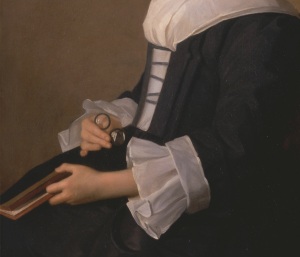
Mary Adams, 1754, YCBA

Meet Mary Adams, painted in 1754. She looks to be a certain age, does she not? But she’s still rocking some style. I like black, and wore black clothes almost exclusively for years from high school on, despite the relentless taunts of  feral sixth-grade boys. (My nickname was Boots. Costuming and living history is but another episode of dressing funny…)

But I digress.

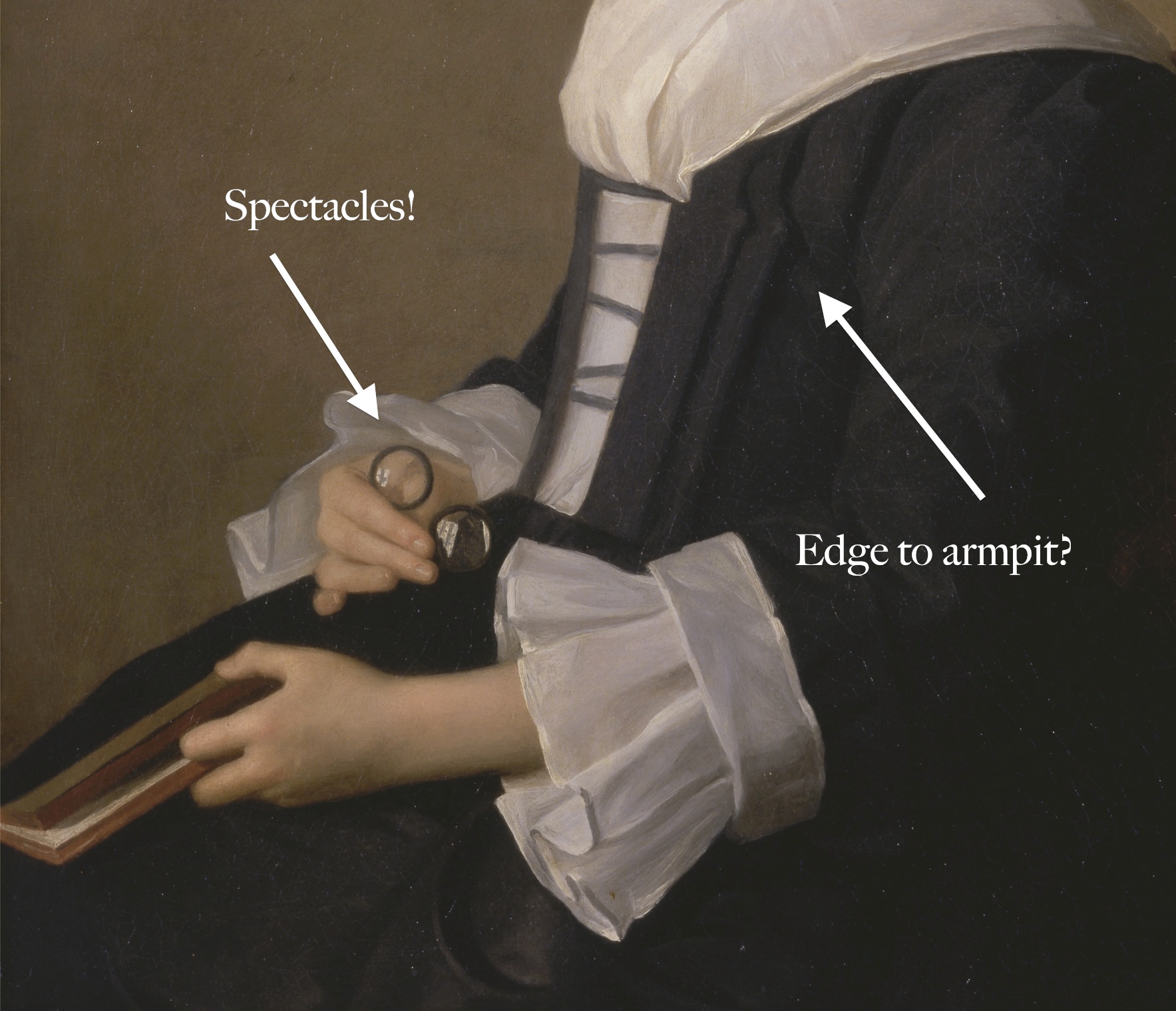
Mary was a happy find this morning, because I knew I’d seen this little detail somewhere…and here it is:

Detail, Mary Adams, 1754,B1981.25.513, YCBA

Detail, Mary Adams, 1754,B1981.25.513, YCBA

Did you catch that? It looks remarkably like Mary has laced her gown over her kerchief, and not over a stomacher. I’m doing a little dance, thankyouverymuch, because that is how I roll. Or lace, as the case may be. Look, too, at the top of the lacing: her gown is pulling. Yes. Imperfections, how I adore thee.

Snark aside, it’s a kind of relief. Looking at Copley and Feke and all their sleek silken women is like flipping through Vogue in the doctor’s office waiting room: after a while, I start to feel woefully inadequate in all ways. From the Richard III gown’s wiggly seams to my inability to pin my dresses straight, and heck, the generally asymmetrical rumpled-ness of my presentations… you can get to feeling very low, as Thompson and Thomson observe in Prisoners of the Sun.

Details!

Details!

So among the things  I note in the painting is the depth of the pull at the top of the gown.  Hmm. I feel better about how my flesh and gown relate in the armpit area now.

But if the pull line starts over beyond the robings, that helps a costumer figure out where to put the lace holes and how to arrange the gown. I also like the asymmetry of blue lace zig-zagging down the kerchief. When I work that out on Richard III, and alter my red calico gown, I’ll use Mary’s portrait as a reference.

Finally, and perhaps best, of all, Mary can read. And she need spectacles. That wonderful pair in her hand look like they are cousins of this pair. All in all, a happy find this morning.

Share this:

  • Share on Facebook (Opens in new window) Facebook
  • Share on Pinterest (Opens in new window) Pinterest
  • Email a link to a friend (Opens in new window) Email
  • Share on X (Opens in new window) X
Like Loading...

More on Pockets

18 Monday Mar 2013

Posted by kittycalash in Clothing, Museums

≈ Comments Off on More on Pockets

Tags

18th century, 18th century clothes, Clothing, Costume, dress, museum collections, Research, resources, Revolutionary War

If you think you don’t like military history, think again. A friend of mine is working on a French and Indian War 250th Anniversary project in Boston, and in the course of his research he got interested in a red velvet grenadier’s cap that I happen to be adjacent to from time to time.

UBM 2006-08-53

UBM 2006-08-53

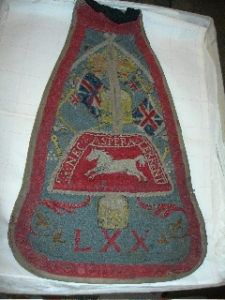
One thing led to another, fortunately for him and not me, and he ended up calling on the National Army Museum in London. There a curator after my own heart distracted him with one of the coolest things I have ever seen: A Lady’s Pocket made from the decorative panel of a mitre cap, or as they call it, Mitre Pocket.

Here’s their description:

“Front section of a mitre cap made into a ladies pocket, 1760 (c); wool and cotton; on front the emblems for the 70th Regiment of Foot, all sewn as for the period, 1760 (c); back is made of brown cloth; front is bound with red cloth binding.

Note: Hanoverian white horse and ‘Nec Aspera Terrent’ used by 8th (The King’s) Regiment of Foot, later King’s (Liverpool Regiment), which might make the L an initial not a numeral and the XX a company number rather than part of the regimental numeral.”

Grenadier’s cap, 1833.1.1, RIHS

One of the most charming things about the email is that the woman at the NAM sent my friend an image of a gown and pocket, just so he’d be clear about how it would have been worn. He knew anyway, but I thought that was a very nice thing to do.

The cap we’re looking into is this one, said to have been picked up at Bunker Hill. Not for nothin’ (as the locals say), but this cap would make a lovely pocket.

Share this:

  • Share on Facebook (Opens in new window) Facebook
  • Share on Pinterest (Opens in new window) Pinterest
  • Email a link to a friend (Opens in new window) Email
  • Share on X (Opens in new window) X
Like Loading...
← Older posts
Newer posts →

Archives

wordpress statistics

Creative Commons License
Kitty Calash blog by Kirsten Hammerstrom is licensed under a Creative Commons Attribution-NonCommercial-ShareAlike 4.0 International License.

Website Built with WordPress.com.

  • Subscribe Subscribed
    • Kitty Calash
    • Join 621 other subscribers
    • Already have a WordPress.com account? Log in now.
    • Kitty Calash
    • Subscribe Subscribed
    • Sign up
    • Log in
    • Report this content
    • View site in Reader
    • Manage subscriptions
    • Collapse this bar
 

Loading Comments...
 

    %d