• Home
  • Completed Costumes/Impressions
  • Emma and Her Dresses
  • Free Patterns and Instructions

Kitty Calash

~ Confessions of a Known Bonnet-Wearer

Kitty Calash

Tag Archives: dress

Hand-woven Linens by Subscription

06 Wednesday Aug 2014

Posted by kittycalash in Clothing, Living History, Making Things

≈ 2 Comments

Tags

18th century clothes, authenticity, Costume, dress, fashion, interpretation, Justin Squizzero, living history, Making Things, resources, sewing, style

In the few short years I have been doing costumed interpretation and living history, I have made three shifts and four shirts and am making up a fifth shirt, with a possible sixth needing to be made, as well as four aprons. I’m not crazy, I just sew that way…for three people (one still growing) who dress for the decades between 1763 and 1812.

linen sample

Hand-woven linen: the top edge is the selvedge

There are several annoying factors when sewing historic clothing with modern materials– mostly that the modern materials aren’t quite right, and can be quite wrong. As Sharon Burnston explains on her website, much of this has to do with selvedges— which are not hard, and rarely tucked, now. The other trouble is width: many fabrics now come 54 to 60 inches wide, which means that you have to cut them down when making shift.

There is a solution: hand-woven, period-correct linen, available now by subscription from Justin Squizzero [email to order: justin(dot)levi(at)ymail(dot) com].

Mr Squizzero will weave both plain and check to the width you want: 3/4 (27″), 7/8 (31.5″) and yard (36″) widths, perfectly correct for period clothing.
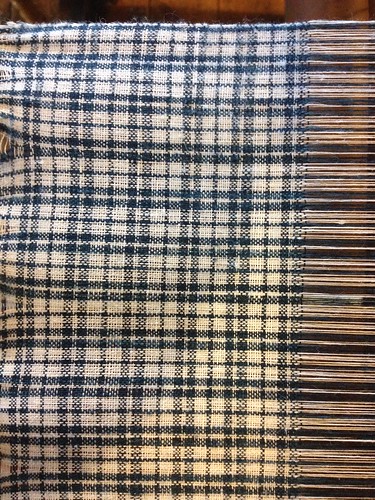
Hand-woven checked linen

Hand-woven checked linen

The prices are $130/yard for plain bleached, $160/yard for checks– and what checks! Indigo dyed blue and white check in a pattern documented to New England at the turn of the 19th century? Oh, yes, please: I must save my allowance and sew only from my stash.

Although we debated fabric weights this past weekend, here’s what I think, and have found through wearing: shirts for soldiers and artisans– but not the elite–can certainly be made of the white and the check; I would made a shift from the white, but I prefer how my heavier shift body feels and behaves under stays. The check would be ideal, too, for an apron, which would require only one yard.

If you’re wearing a coat made from $120/yard wool dyed with documented colors, shouldn’t you wear the most correct shirt possible underneath? Entirely hand-woven (and hand-dyed in the case of the checks), you’re buying art– but isn’t that what you’re making and creating when you hand-sew your clothes and step into the past?

Share this:

  • Share on Facebook (Opens in new window) Facebook
  • Share on Pinterest (Opens in new window) Pinterest
  • Email a link to a friend (Opens in new window) Email
  • Share on X (Opens in new window) X
Like Loading...

Back Bump: The Regency Silhouette

03 Tuesday Jun 2014

Posted by kittycalash in Clothing, History, Making Things, Reenacting, Research

≈ 3 Comments

Tags

18th century clothes, 18th century clothing, authenticity, Costume, dress, fashion, fashion plates, history, living history, Making Things, Research, sewing

Ah! Quelle antiquité!!! Oh! Quelle folie que la nouveauté ... Engraving, 1797. 1892,0714.755 British Museuem

Ah! Quelle antiquité!!! Oh! Quelle folie que la nouveauté … Engraving, 1797. 1892,0714.755 British Museum

Regency, Federal, Early Republic:  we use these terms to cover (roughly) the period from 1790-1820, though technically the Regency period would mean only 1811-1820, when George IV served as Prince Regent, ruling for his incapacitated father, George III. In the United States, “Regency Costuming” is a bit of misnomer if you’re copying early American gowns, but it does serve as a handy short-hand we all tend to understand.

Grossly, the principles of dress are rooted in neo-classicism and republicanism rising from the American and French Revolutions. Specifically, we see a turning away from the heavily-boned, panniered, and formal gown styles to the looser, short-stayed, flowing, simpler gowns.  The transition is summed up for me in this satirical print.

So, you’re no longer side-to-side wide, baby: you gotta have back.

How do you get back? There are a couple of perfectly authentic tricks that do not require you to stuff a cat into the back of your dress, though you can do that if you want. The combination I have found to work is two-part: a small, crescent-shaped pad, and the method of pleating. How you deploy the pad and the pleats will give you the silhouette you desire.

First, though: which silhouette? In really the 1790s, the silhouette is rounder than you might think. It really is a round gown.

Ann Frankland Lewis, 1793. LACMA
The Frail Sisters, 1794

To get that look, I use a small rump pad, bustle pad, or bum roll (call it what you like), which is stitched to the inside of my petticoat.

Pad from the inside
Pad from the inside
Pad from the outside

That’s the white IKEA curtain petticoat I made during the extended snow days of last year, and which I have worn with the red curtain-along open robe and under the petticoat and open robe for What Cheer Day. The pad is the same natural light-weight linen I use for a many gown linings, filled with bamboo stuffing. If I’d had wool on hand in the small hours of the morning I made this pad, I would have used it, but all I had was bamboo in the rush to finish up and have something to wear for a photo shoot.

The other key factors are pleating styles and fabric weight. Pleats can add lift, but in general, the lighter the fabric, the more lift a small pad will give you.

Double and triple box pleats, exterior view
Double and triple box pleats, interior view

1780_1790
I’m particularly fond of the pleats used for the gown shown on page 75 of Nancy Bradfield’s Costume in Detail. I’ve used this as a guide several times, and I am very pleased with the results. They do vary, of course, depending on fabric weight, fibre, and length. Stiffer cottons, like the Waverly Felicity of the curtain-along gown, will make a round shape; tropical weight wool does fairly well, also, but the most amazing 1790s rendition I have achieved to date is the light-weight India print cotton short gown.

On Cassandra
On Cassandra
On me
On me

Now that’s 1790s back. The bustle-like shape surprised (OK, shocked) me, but on the whole, I think I’m pleased. So there you are: pad, petticoat and pleats: that’s how you get back.

Share this:

  • Share on Facebook (Opens in new window) Facebook
  • Share on Pinterest (Opens in new window) Pinterest
  • Email a link to a friend (Opens in new window) Email
  • Share on X (Opens in new window) X
Like Loading...

Frivolous Friday: Whitaker Auction Waistcoat

11 Friday Apr 2014

Posted by kittycalash in Clothing, History, Museums, Research

≈ 2 Comments

Tags

18th century clothes, 18th century clothing, auctions, Costume, dress, exhibits, fashion, style

It’s so nice to have enabling friends. If it’s not one tipping me off to a sale on fabric at Williamsburg (over now, keep calm) it’s another tipping me off to costume auctions.

My most recent tip-off came from Mr Cooke, about the Whitaker auction coming up April 25 and 26 in New Hope, PA. There are some very nice things from the collections of the Met and LACMA coming up in that sale. It’s hard to understand deaccessions from the outside, so I won’t comment on that part of the sales.

Unmade waistcoat ca. 1790. RIHS 1990.36.15

Unmade waistcoat ca. 1790. RIHS 1990.36.15

I was particularly taken with this waistcoat.

The lapel embroidery and button details remind me very much of an uncut dimity waistcoat in the collection of the Rhode Island Historical Society.

Whitaker’s got copyright notices on their images, so I won’t post them here, but I can assure you, the visit will be worth your while. But my tip to you is this: forget those estimates– from what I’ve seen lately, they’re all too low by a factor of 10.

Share this:

  • Share on Facebook (Opens in new window) Facebook
  • Share on Pinterest (Opens in new window) Pinterest
  • Email a link to a friend (Opens in new window) Email
  • Share on X (Opens in new window) X
Like Loading...

Use it Up, Wear it Out, Make it Do

07 Monday Apr 2014

Posted by kittycalash in Clothing, History, Museums, Research

≈ 2 Comments

Tags

18th century clothes, 18th century clothing, alterations, Clothing, dress, fashion, Global Encounters, John Brown House Museum, Metropolitan Museum of Art, Research, Rhode Island, Rhode Island Historical Society, style

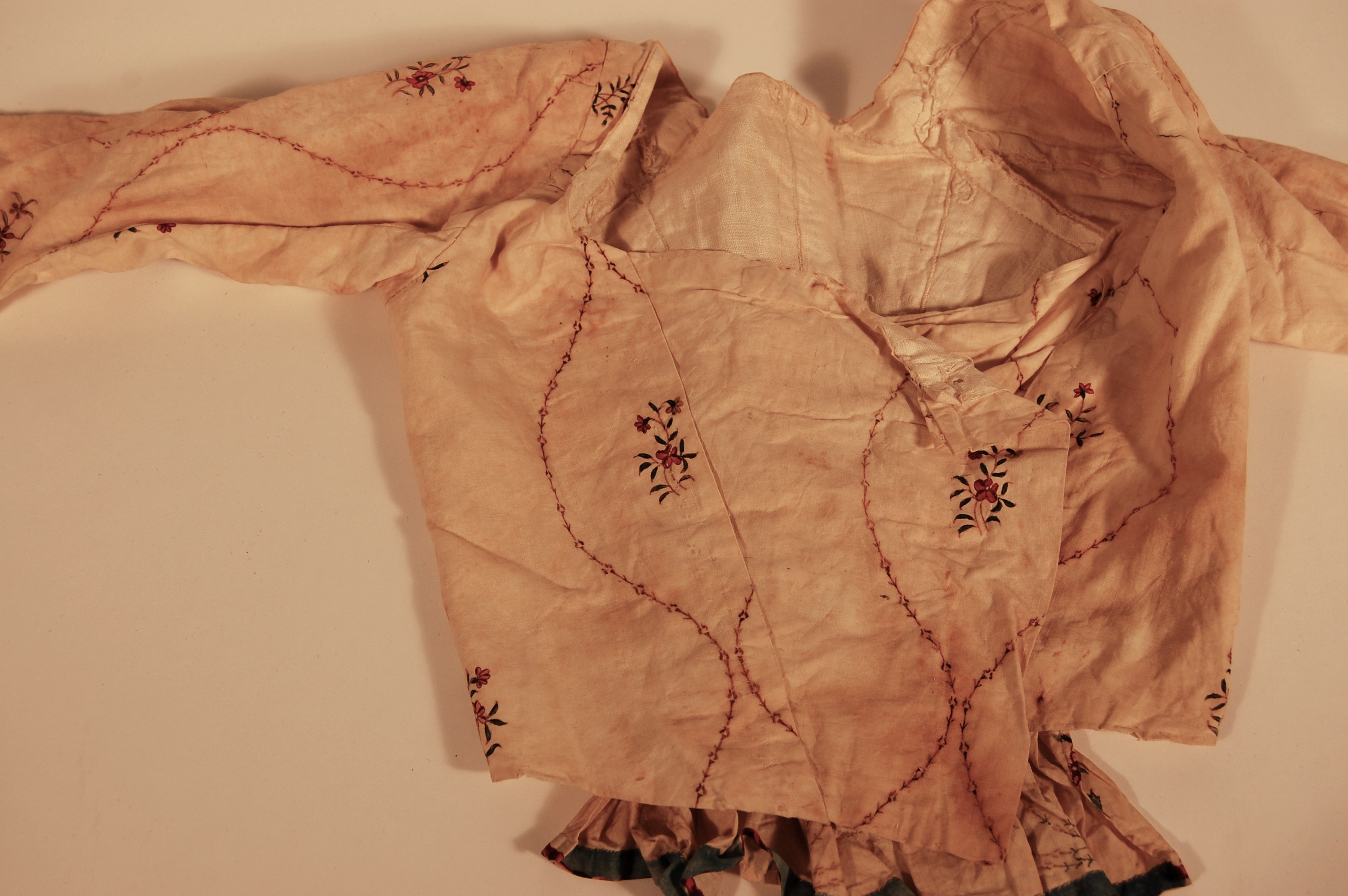
Bodice, painted Indian cotton, 1780-1795 RIHS 1990.36.27

Bodice, painted Indian cotton, 1780-1795
RIHS 1990.36.27

I’ve fallen behind again, as I spent considerable early morning time this past week working on a short presentation for a program in Worcester this past weekend. If you are among the people who do not wake at 4:00 AM panicking about the organization of your thoughts, or whom, exactly, might have worn a heavily-remade bodice, you are lucky indeed.

But I managed to present without falling all over myself, putting out someone’s eye, or causing mayhem and self-embarassment, so, phew! (I do this so much less often than I used to that my anticipatory anxiety is always high.)

Above you can see one of the items I talked about: a re-worked bodice from the collection of the Rhode Island Historical Society.

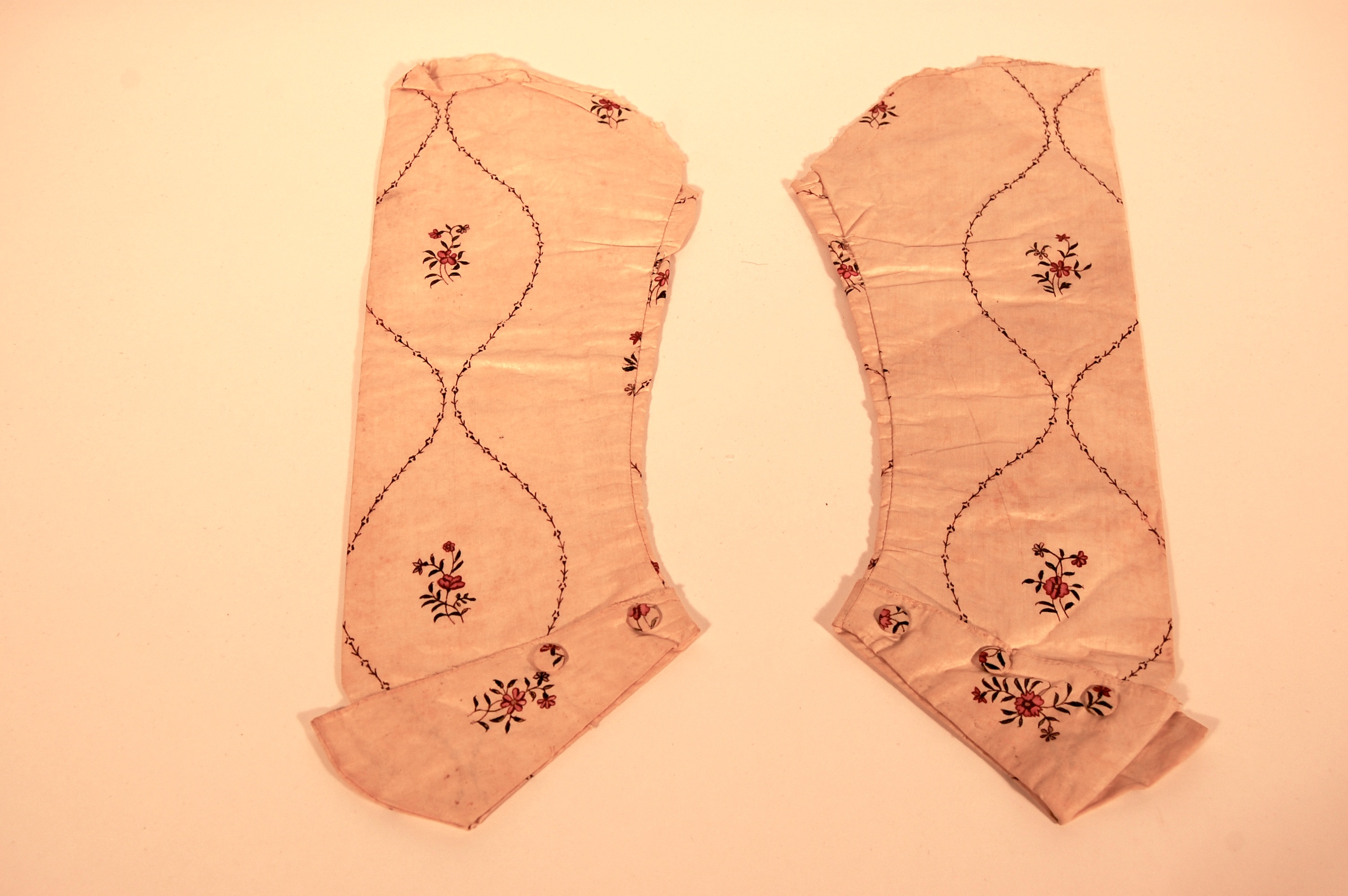
Sleeves, removed from bodice 1990.36.27. RIHS 1990.36.25A-B

Sleeves, removed from bodice 1990.36.27.
RIHS 1990.36.25A-B

I think, once upon a time, that bodice was part of a pieced-back closed-front gown with a matching petticoat.

And then I think someone decided (quite rightly) that the style was too passé for 1795, and altered the gown significantly.

Not only is there evidence of new sleeves being fitted into the gown’s armscyes, we have the sleeves-that-used-to-be. And my dear! No one is wearing sleeves like that this season!

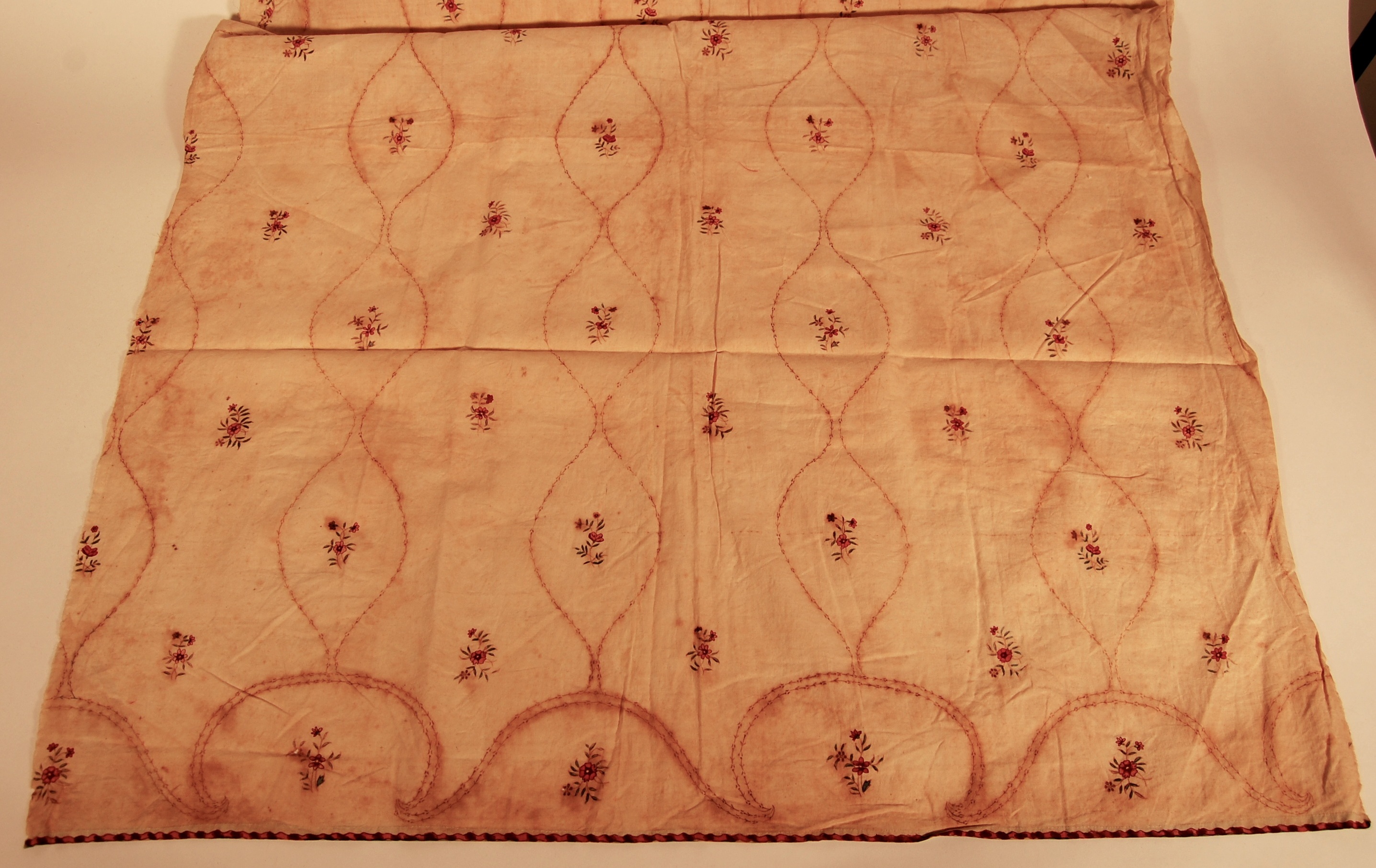
I find these garments in limbo really fascinating. Was that bodice finished and worn with a matching petticoat? (Yes, there’s a panel of that left, too; what a lovely hem!)

Skirt panel, painted Indian cotton. RIHS 1990.36.33

Skirt panel, painted Indian cotton.
RIHS 1990.36.33

Who wore the gown? Was the woman who wore it originally the same woman who wore it altered? I can only guess at this point, and may never find the smoking diary or mantua-maker’s bill. The alterations are not as finely done as the original gown, so I think there are two hands at work here– whose were those hands? There’s always more to think about and learn.

In case you’re wondering, thanks to the Met, we can see what the gown probably looked like in its first incarnation, and then what the alterations were meant to achieve. (Link to the gown on the left; link to the gown on the right.)

Robe a l'anglaise, 1785-1795 MMA 2009.300.647
Robe a l’anglaise, 1785-1795 MMA 2009.300.647
Gown and petticoat, 1790-1794 MMA C.I.45.6a,b

Share this:

  • Share on Facebook (Opens in new window) Facebook
  • Share on Pinterest (Opens in new window) Pinterest
  • Email a link to a friend (Opens in new window) Email
  • Share on X (Opens in new window) X
Like Loading...

Mischief Monday

31 Monday Mar 2014

Posted by kittycalash in Events, Living History, personal, Reenacting

≈ Comments Off on Mischief Monday

Tags

10th Massachusetts, 18th century clothes, 18th century clothing, Costume, dress, fashion, George Washington, Grand Ball, living history, Reenacting, sewing, style

The gossip begins...
The gossip begins…
I don't believe a word of it.
I don’t believe a word of it.
No, really?
No, really?
Overcome, at last, by dramatic but hilarious news.

Photos from the George Washington Birth Night Ball are finally available, and presented here for your entertainment. You can read a more comprehensive overview of the event here, on Sew 18th Century’s blog. Bonus: extra pictures!

Share this:

  • Share on Facebook (Opens in new window) Facebook
  • Share on Pinterest (Opens in new window) Pinterest
  • Email a link to a friend (Opens in new window) Email
  • Share on X (Opens in new window) X
Like Loading...
← Older posts
Newer posts →

Archives

wordpress statistics

Creative Commons License
Kitty Calash blog by Kirsten Hammerstrom is licensed under a Creative Commons Attribution-NonCommercial-ShareAlike 4.0 International License.

Website Built with WordPress.com.

  • Subscribe Subscribed
    • Kitty Calash
    • Join 621 other subscribers
    • Already have a WordPress.com account? Log in now.
    • Kitty Calash
    • Subscribe Subscribed
    • Sign up
    • Log in
    • Report this content
    • View site in Reader
    • Manage subscriptions
    • Collapse this bar
 

Loading Comments...
 

    %d