• Home
  • Completed Costumes/Impressions
  • Emma and Her Dresses
  • Free Patterns and Instructions

Kitty Calash

~ Confessions of a Known Bonnet-Wearer

Kitty Calash

Tag Archives: Events

Eating in the Field: Single-Day Events

28 Thursday Mar 2013

Posted by kittycalash in Events, Food, Living History

≈ 5 Comments

Tags

18th century, Battle Road 2013, Events, food, recipes, resources

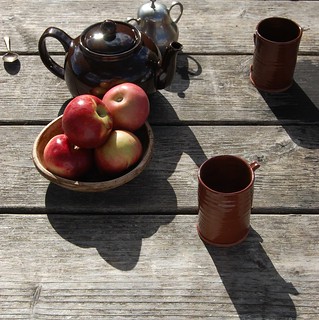
Tea Time at Nathan Hale, 2013

I’m not an expert, and your results may vary, but here’s what I’ve learned.

Single Day Events without Fires

(e.g. Battle Road, parades, Fort Lee)
For single-day, warm-weather events, ice packs covered in cloths at the bottom of a basket or slipped into a market wallet can keep food cold.

Pasties are self-contained, period appropriate, and require no “hardware” to eat. I wrap them in parchment or plain white paper and tie them with string, or wrap them individually in plain white cloths. Because the filling is cooked and then baked in the pastry, they keep and travel very well. I have a basic receipt here for pork pies; they’re good with chicken, too. Keep the filling a little on the dry side, and  you won’t need a plate. I’ve never made an all-vegetable pasty, because I live with T-Rex in a hoodie, but I imagine it would be delicious with parsnips, squash, and maybe even kale.

Another single-day-event solution is bread and cheese. John Buss of the 10th Massachusetts was all about cheese. He writes home longing for cheese, and writes, too, that he can eat cheese again because he’s recovered from the small pox. (That’s one of those historic statements that I try not to imagine too much about.) I’ve never had the time to bake bread from the Amelia Simmons’ cookbook, but I’ve had bread made from it, and it’s great. Pressed for time? Worked later than you thought you’d have to? Whole Foods Take-and-Bake baguettes have played the role of home-made bread, as have various loaves from other grocery stores.

The Hive blog has some good recommendations to fill your basket, so with some repackaging and artful packing, you can assemble an 18th century pick-a-nick basket, or stuff a market wallet with suitable foods. Just please, please: peel stickers off the fruit, and don’t pack bananas, which aren’t seen in the U.S. much before 1880.

Share this:

  • Share on Facebook (Opens in new window) Facebook
  • Share on Pinterest (Opens in new window) Pinterest
  • Email a link to a friend (Opens in new window) Email
  • Share on X (Opens in new window) X
Like Loading...

Eating in the Field

27 Wednesday Mar 2013

Posted by kittycalash in Events, Food, Living History

≈ 3 Comments

Tags

18th century, Events, food, living history, preparations, Reenacting, resources, Revolutionary War, weather

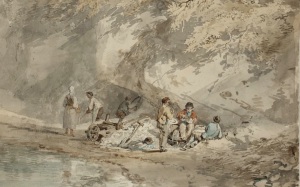
Workmen Lunching in a Gravel Pit circa 1797 Joseph Mallord William Turner 1775-1851

Workmen Lunching in a Gravel Pit, circa 1797. Joseph Mallord William Turner 1775-1851

A compatriot asked how we handle food and cooking in the field. What do we do about “yucky stuff?” by which she meant meat.

She was doing just about the same stuff we were doing, and with Battle Road around the corner, I thought I’d write about food in the field, and ways we handle it. Other people will have other ideas, but the main things I think about are:

  • Maintaining authenticity and food safety (Nobody wants flux.)
  • Historical eating is seasonal, local eating
  • Gear: less is not only more, but easier

Food safety is one of those things where you really don’t want to compromise too much, though from eating at the farm, I think there is more leeway than we admit. I will confess that when I was poor and in school, I stored dairy products on the windowsill of my studio when there was no fridge, so eating at the farm is like eating… when I was a whole lot younger.

Here are my principles. I’m not an expert, your mileage may vary, but this is where I begin.

Universal Truths

Start with who you are.
Objects you bring, and food you eat, should be true to your impression.
Authenticity goes beyond the date of accouterments: a porcelain tea set may be quite correct for a 1778 Newport or 1763 Boston parlor, but it makes very little sense if you are with a Continental private. One chipped plate is different for a woman to carry, or a piece of pewter. How long either would last you is another story, but at least you’d have a story. If you are the Colonel’s wife, it’s a different matter, even more so if it’s a British Colonel.

Food safety trumps purest authenticity.
Cloth covered, hidden ice packs will hurt no one and may save you misery later.

Stay Hydrated.

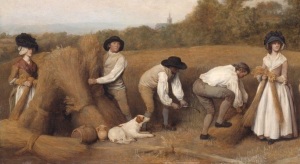
Reapers 1785 George Stubbs 1724-1806

Reapers, 1785. George Stubbs 1724-1806

Soldiers drank water.

In a hot summer camp, we keep a large pitcher full of water (see the Stubbs painting at left). Covered with a white linen or cotton cloth, it will keep coolish and free of dust & insects (or dog fur & fleas, if you’re in the Stubbs painting). We sliced limes into our enormous pitcher, and refilled it all day from the pump at OSV.

Limes are in period; justifying a source can be tricky, but at a certain level, safety trumps authenticity. 98 degrees and 90% humidity means drinking a lot of water.

Chances are you’re a caffeine addict like me, so what do you do? Boil water in a kettle, and bring tea in a screw of clean white paper is one answer. What’s your justification? I’m a personal fan of ‘stole it from my master,’ but in small quantities, perhaps you got it from home, or did a farm woman  a favor. Or stole it from her. John Smith (I kid you not), Sergeant in Colonel Lippitt’s Rhode Island State Regiment, in Continental Service, writes in his diary* of apprehending geese and chickens who failed to respond with the correct password when challenged.

*Published as “Sergeant John Smith’s Diary of 1776”, edited by Louise Rau, in Mississippi Valley Historical Review, No. 20, 1933, pages 247 – 270. NB: Kitty Calash recommends reading, not stealing.

Tomorrow: Food-related recommendations by event type.

Share this:

  • Share on Facebook (Opens in new window) Facebook
  • Share on Pinterest (Opens in new window) Pinterest
  • Email a link to a friend (Opens in new window) Email
  • Share on X (Opens in new window) X
Like Loading...

Projects A-Waiting and Awry

29 Tuesday Jan 2013

Posted by kittycalash in Historical Sew Fortnightly, Making Things

≈ Comments Off on Projects A-Waiting and Awry

Tags

18th century clothes, Clothing, Costume, dress, Events, Historical Sew Fortnightly, sewing

One of things I like about the HSF series is that it keeps me sewing. It’s good to have accountability, and the challenge provides it. Structure, and deadlines: good for the soul.

And then there’s that factor known as work. We’ll call it that, as the effects are often described in language not suitable for the New York Times, last bastion of manners. Poor William Shawn spins as each New Yorker is printed: he’d never let douchebag pass.

But I digress.

Things changed in the schedule and now I don’t have to sew delicious frock coats and corduroy breeches for February. The good news is that I will not have to wrangle the unwilling to be fitted immediately, and I will be that much more skilled by Fall, when the clothes will be wanted. It also means (sort of) that there is actually time to sew for me. This is a very good thing, as I am planning to attend Dress U and even to teach (heaven help us all) two classes, one on using museum records and collections online and in person, and another on what Reenactors and Costumers can learn from each other. So while I’m thinking about 1790s wool jackets and trousers, a Battle Road-worthy wool gown (pfft! Gowns seem easy now!), Battle Road men’s wear (a little queasy, not so easy) and at least one more pair of overalls (unprintable, really) I am also thinking about how much I don’t want to be the tiara-less, non-sparkly girl again.

What does that mean? That means silk, and the Curtain-Along Gown, which I think I have figured out. (Figuring out the silk part will come later, I’m just happy to have gotten this far…)

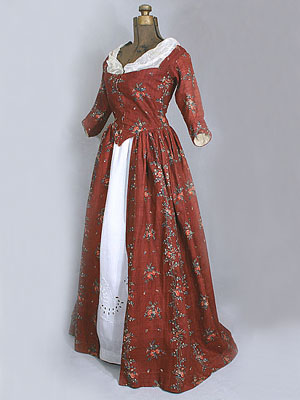
1780-1790 chintz gown

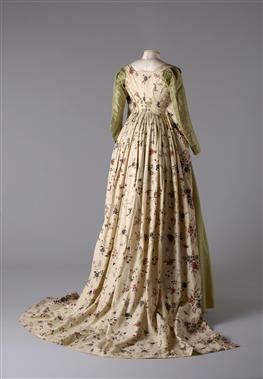
1780-1790 chintz gown

Fairfax House

Fairfax House

Historical Sew Fortnightly  #3 Under It All: I meant to do my shift, but that changed. Voila, petticoat. I have Ikea cotton curtains that will make a lovely petticoat that can be worn with a Curtain—Along gown of the dark red Waverly chintz, which I plan to make in the style of one of these gowns. An all-cotton, all-curtain ensemble makes me laugh: I am a Carol Burnett fan.

If I get the petticoat done, then I will have to make the pretty dress, at least eventually, which should be sometime between overalls (April 20) and Dress U (May 31).

10th Mass LI at Nathan Hale

10th Mass LI at Nathan Hale

That leaves time for something wicked regimental this way comes by June 15. Oh, yes, I expect Monmouth is in my future, humidity, turnpike and all. Why would I miss that?

Share this:

  • Share on Facebook (Opens in new window) Facebook
  • Share on Pinterest (Opens in new window) Pinterest
  • Email a link to a friend (Opens in new window) Email
  • Share on X (Opens in new window) X
Like Loading...

Women’s Work

22 Tuesday Jan 2013

Posted by kittycalash in Events, History, Living History, Reenacting

≈ 5 Comments

Tags

18th century, Events, interpretation, living history, women's history, work

Cooking. Gets you every time.

Cooking. Gets you every time.

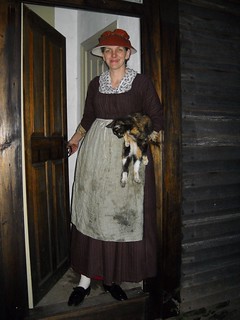
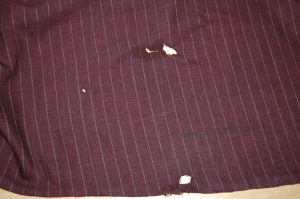
Three holes (at least; there might be four) and mending to do. The patches are cut, but I’m thinking now that a wool apron might be a good thing to have. The other thing I’ve been thinking about is what James Thurber called The War Between Men and Women, and how even in educated, enlightened North America, it plays on. [i]

At living history events or reenactments, the work and activities are divided along gender lines. Participants are supposed to follow “the rules,” which keep women on the observer side of the rope line and the men free to run around with muskets. Women sometimes seem purely decorative at the military events, and the relationships between men and women are curious. There’s the sexism between reenactors, and the sexism of the public, who can often assume women know nothing about what’s happening.  Women should, after all, know their place, just as the men know theirs.  Women can cook and clean up after the men, and the men will do all the talking, even when they’re wrong.[ii]

In a more domestic setting, this same historical dynamic can play out: women cook and serve the meals, wash the dishes, fetch the wood and water, and clean the kitchen, while men muck about outdoors until their tools break. Then they lounge about smoking, drinking, and talking.

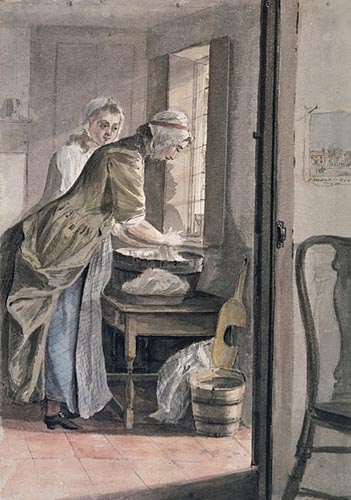
Sandby, Washing at Sandpit Gate, 1765. Royal Collection.

Sandby, Washing at Sandpit Gate, 1765. Royal Collection.

That’s all OK, to a degree.  But we’re not in the 18th century, and the women in the kitchen don’t enjoy washing other people’s dirty dishes as well as all the cooking pots and tools. We had a system on Sunday evening, but I did notice that some men just can’t be the only guy helping: once the other guys leave the room, they’re out, too, with a kind of desperation, even as the light wanes and we need all the help we can get to finish up.

So what to do? Interpreting the 18th century means facing gender roles that most American women today don’t like or embrace. What’s the best way to interpret women’s history and women’s roles in the past to people today?

On Sunday, I left the house to call the guys to the first meal, and a visitor asked if the sheep in the field were part of the site. “Yes,” I said. “ But I don’t know where the sheep are today; I don’t get to leave the house much.” And that is true: aside from fetching water when I didn’t have a man or boy to ask to do it, there was hardly need, reason, or even time, to leave the house.

I think we do a disservice to the visitors to living history sites of all kinds if we don’t find a way to talk about women’s history, and the roles—proscribed or not—that women could take on. At a RevWar encampment, we can talk about the reasons women followed the armies, the kinds of work they did for pay or rations, and what the Revolution meant for women. At the farm and at the manor, I think it’s important to talk about women’s lives in the Early Republic. How this would work at the farm, exactly, I’m not yet certain; at the manor it is easy enough, for the women who lived there were born just before the Revolution. They were well-educated and expected to choose their own husbands. We know who they were; we know less about the women at the farm, though we know about their work.

How we experience that work isn’t really the point, but the chasm between choosing to spend a day never looking beyond the scope of the hearth and having to spend days that way is enormous. It’s a point I want to make,  in a way more sophisticated than “life was hard and greasy.” It’s something to work on.


[i] This is in no way meant to equate the petty first world problems of a bunch of reenactors/living historians with the larger and more brutal problems elsewhere in the world. But relationships can change when situations change…

[ii] Fortunately, the Second Helping Regiment doesn’t work quite this way, and not just because they’re busy chewing whatever has been made for them. Cooking, and the subsequent chewing, can be used strategically.

Share this:

  • Share on Facebook (Opens in new window) Facebook
  • Share on Pinterest (Opens in new window) Pinterest
  • Email a link to a friend (Opens in new window) Email
  • Share on X (Opens in new window) X
Like Loading...

Working Weekend

03 Monday Dec 2012

Posted by kittycalash in Living History

≈ 1 Comment

Tags

Events, history, living history, Museums, work

https://i0.wp.com/farm9.staticflickr.com/8482/8239978492_81e339d5fe_n.jpgThis is the house at the farm museum where we went to work on Sunday. That bright orange under the window is squash. The part painted red is an office addition and not interpreted space.

This is the view from the site.https://i0.wp.com/farm9.staticflickr.com/8062/8238909459_f9165ff136_n.jpg It is not exactly what the tenant farmers would have seen, even discounting the power lines and road surface.   But even with the caveats of constant change in mind, I do not have access to a better lab for understanding the past. There are times when even the smart and sophisticated among us cannot come up with a better (just between us) interpretation than, “1799 sucked. And it was greasy.”

https://i0.wp.com/farm9.staticflickr.com/8210/8238912881_454a7e8b67_n.jpgThat’s not what we want the visitor to learn (everything in the past was hard) though sometimes I fear that is all they take away. Callie, seen here swearing in my hand, was trying to take away leftover chicken and so was taken away herself.

The more time I spend stooping to reach a vat of tallow, or tearing a chicken carcass apart with my hands and a dull, greasy knife, the more I think that what we fail to grasp is not that people thought differently in the past. It’s why they thought differently.

Lives could be a great deal smaller: tasks were hard and all-consuming. Even as I realized that work would be faster with greater familiarity, I also saw that repetition would not breed enlightenment, because increased speed would only make the next task come more quickly.

Share this:

  • Share on Facebook (Opens in new window) Facebook
  • Share on Pinterest (Opens in new window) Pinterest
  • Email a link to a friend (Opens in new window) Email
  • Share on X (Opens in new window) X
Like Loading...
← Older posts
Newer posts →

Archives

wordpress statistics

Creative Commons License
Kitty Calash blog by Kirsten Hammerstrom is licensed under a Creative Commons Attribution-NonCommercial-ShareAlike 4.0 International License.

Website Built with WordPress.com.

  • Subscribe Subscribed
    • Kitty Calash
    • Join 621 other subscribers
    • Already have a WordPress.com account? Log in now.
    • Kitty Calash
    • Subscribe Subscribed
    • Sign up
    • Log in
    • Report this content
    • View site in Reader
    • Manage subscriptions
    • Collapse this bar
 

Loading Comments...
 

    %d