• Home
  • Completed Costumes/Impressions
  • Emma and Her Dresses
  • Free Patterns and Instructions

Kitty Calash

~ Confessions of a Known Bonnet-Wearer

Kitty Calash

Tag Archives: historic houses

Authenticity Measur’d in Moments

30 Thursday Oct 2014

Posted by kittycalash in Events, Fail, History, Living History, Philosophy, Reenacting

≈ 10 Comments

Tags

authenticity, historic houses, history, living history, military events

Chopping wood: it takes  a lot to cook and to keep warm in 1799

Chopping wood: it takes a lot to cook and to keep warm in 1799

In the post-What Cheer Day aftermath, when I was very tired and two houses were very messed up, I started thinking about why I bothered with living history. What exactly is this thing, and why I do it? Those questions made me think about the very best moments I have had in this business of re-creating the past in cloth and smoke and time.

In no particular order:

1. Going up to the field at Coggeshall Farm to call the boys down to dinner after spending all day in the kitchen. I was desperate to get out, and finally knew first hand how limited women’s lives could be in the 18th century, especially non-elite women.

2. Running upstairs at the John Brown House with Eliza, giggling over a joke to be played on Mr Mason. I don’t know what Mr C thought of it but I felt twelve years old, silly, carefree and light. John Brown’s housekeeper surely never felt that way, but a naughty maid might have, and for an instant I knew what it was to have no responsibilities.
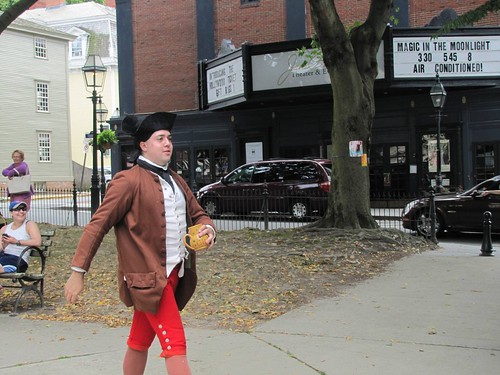
We didn’t even notice the background at the time

3. Chasing the Young Mr, a wayward apprentice, across the street; mobbing Mr Howard’s house; and arguing with the Stamp Inspector, all during the Stamp Act Protest in Newport It was not until I looked at the photos that I realized we really had been in front of a theatre, and that there were actual cars! A friend confirms that he, too, forgot about the cars, to the point of nearly being hit whilst running to Mr Howard’s house.

4. Assembling with a group of friends to take tea with Mrs Silsbee in Salem, sorting ourselves into a group on the sidewalk and venturing out, only to meet Mrs Silsbee on the street. That is the most Jane Austen/Mrs Gaskell I have ever felt. The wretched cobblestones do not count, as they were from the 20th century, but walking out on the wharf, and meeting a friend who brought an umbrella as the rain began was also very Austen-esque.

Perhaps more Gaskell than Austen, here

Perhaps more Gaskell than Austen, here

None of these are military events, and the majority of them happened this year, in past three months. I think this may be because we have been to fewer military events, and I expect the concentration is due, in part, to finally getting better at this practice. They are also site-specific, and trending toward first-person interpretation.

Coats

Those coats.

For reasons explained better by the NPS and in the excellent study of NPS-Reenactor relationships, no battle reenactment can ever capture the truth of the war it attempts to recreate, and that is true even when the battle takes place on the same site, at the same time of year, and even when soldiers are dressed in as-close-as-possible replicas of the uniforms worn at that battle, on that field, on that date, 236 years earlier, and no one has brought a spinning wheel or tent chandelier to camp.

I respect the notions of moveable monuments and performances as commemoration. I like military history, I like war memorials: there is not a competition between civilian and military reenactments. But military events have not yet had the power to transcend experience for me.

My best guess as to why military events are not transformative for me is that, to this point, the business remains too much like camping in funny clothes. As I experiment more with 18th century methods of cooking appropriate rations, and as I strip away the gear we carry into the field, the military events are better (as at Bennington). But I already know how limited women’s perspectives could be (see item 1), and while Bennington was instructive in how ridiculously different the experiences of men and women could be, the military events remain more instructive experiences for the men.

18th century camp

Domesticity in the Field

Why? Because the specificity of site plays out at those events in the battle, and not in the camp. The point at Bennington and at Saratoga and at Stony Point was to use the site as it had been used. The men experienced the landscape in ways as close as possible to what soldiers and militia had actually seen. And women stayed in camp and got smoke in their eyes, cut up vegetables, or washed clothes, which is pretty much what happens at any outdoor event where we can have a fire and, with differences in technology, is pretty much what I do when I get home from work every day.

All that leaves me wondering what to make of military events, and what I want to do in the coming year. No matter how much of this is “for the public,” it still has to be rewarding for the practitioner.
Share this:

  • Click to share on Facebook (Opens in new window) Facebook
  • Click to share on Pinterest (Opens in new window) Pinterest
  • Click to email a link to a friend (Opens in new window) Email
  • Click to share on X (Opens in new window) X
Like Loading...

What Cheer Day Review

27 Monday Oct 2014

Posted by kittycalash in Events, History, Living History, Museums, Reenacting

≈ 14 Comments

Tags

Clothing, Costume, historic houses, historic interiors, John Brown House Museum, living history, Providence, Rhode Island Historical Society, What Cheer Day

There will be more, and better, images

Let’s begin with the easy part: pretty pictures of a pretty house. (It’s too easy, right?  More on that later this week.)

There are only a few for now– while our photographer took over 800 images, before he can process and sort them, we have to put the house back together first!

October 25 was a Saturday in 1800, the last Saturday before the first public schools opened in Providence on October 27. Mr Sweet, the tailor’s apprentice, had too much current-day public school homework to join us.

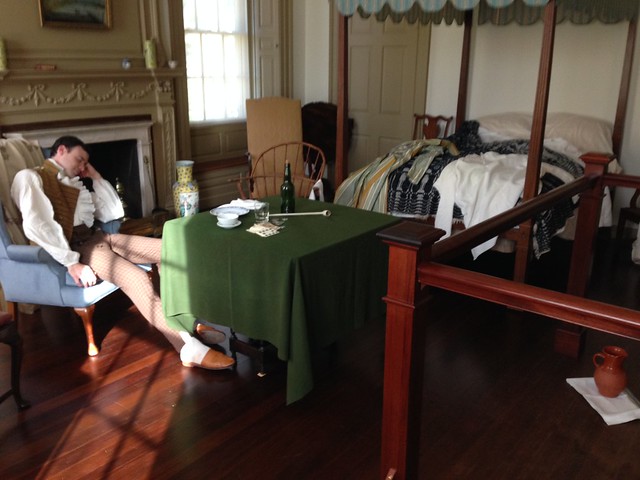
Mr Mason begins his day

It was as well, perhaps, that Mr Sweet did not see the client in his natural environment. His tailor, Mr Taber, arrived with many samples and plates for Mr Mason’s perusal, and the room was in quite a state by the day’s end. I do not know why Mr Mason could not take the short walk to Cheapside, but his custom is so good that the tailor made an exception and came to call.

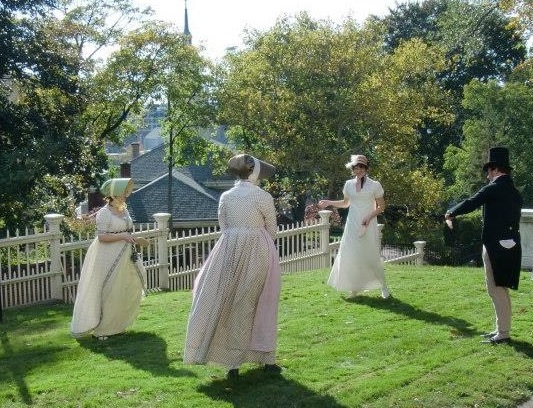
Lawn games

Late in the afternoon, we played battledore and shuttlecock; I was surprised and pleased to see the images and how much like Diana Sperling’s drawings they looked. It was a pleasure to see that we were doing something right, though a cold scoop bonnet was no help in seeing the shuttlecock.

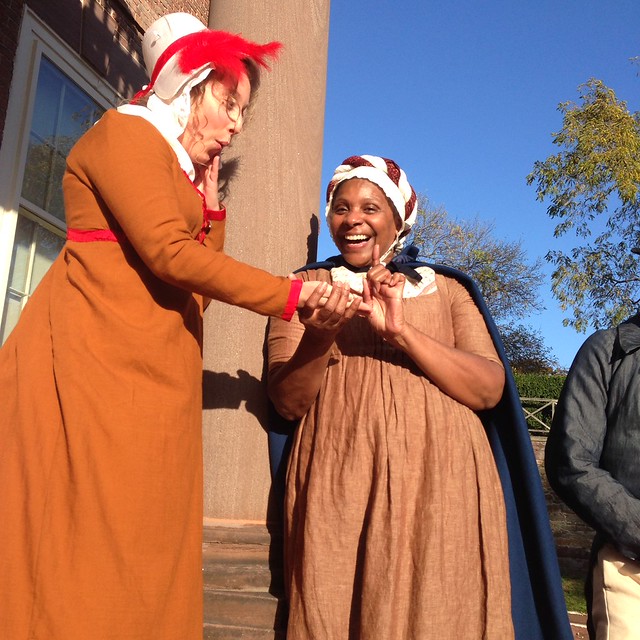
Nancy Smith hears her fortune from Goody Morris

The fortune teller came, much to the consternation of Mrs Brown and her sister. I believe it was the housekeeper who thought she could get away with inviting her friend to the house; in any case, it was foretold that Kitty should have comfort in her life, which was a great relief to someone who had been wearing straight-lasted and very flat shoes for some twelve hours.

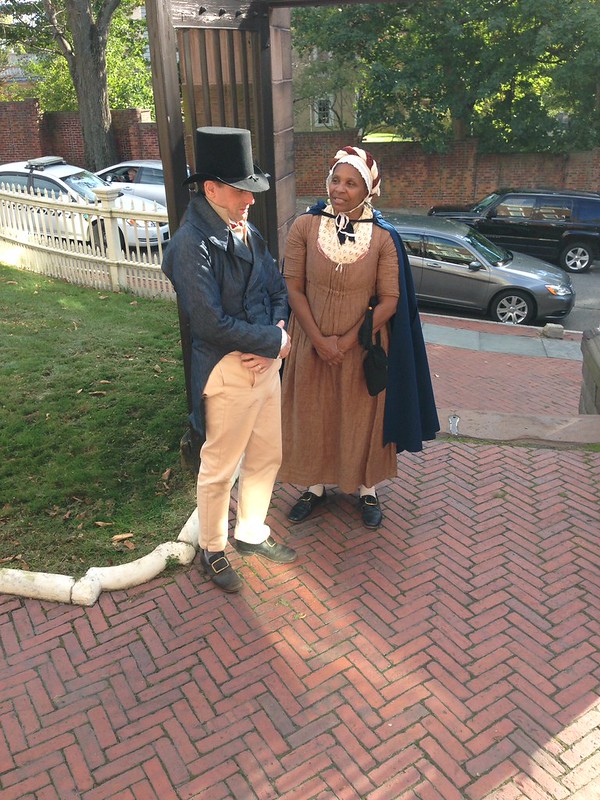
Mr Young and Goody Morris

Of late there has been a man hanging about the house; he enjoyed Goody Morris’s conversation as well, though late in the afternoon he caused quite a disturbance with a delivery of wine. We think he had been imbibing from our order, and his behaviour caused our new maid, Eliza, much distress. Mrs Brown was not well pleased at the commotion in her house.

What Cheer Day 2014

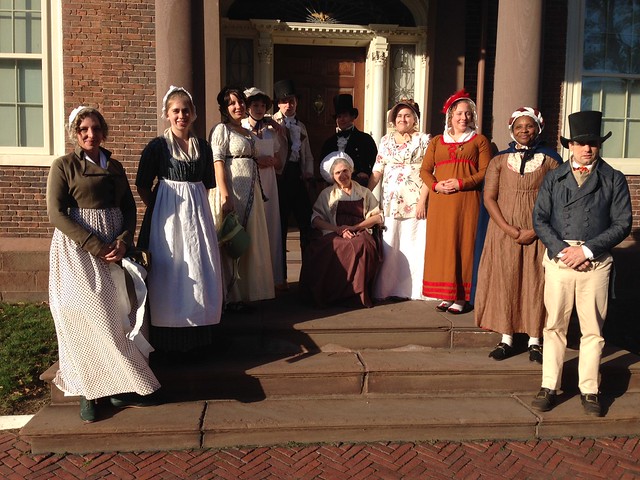
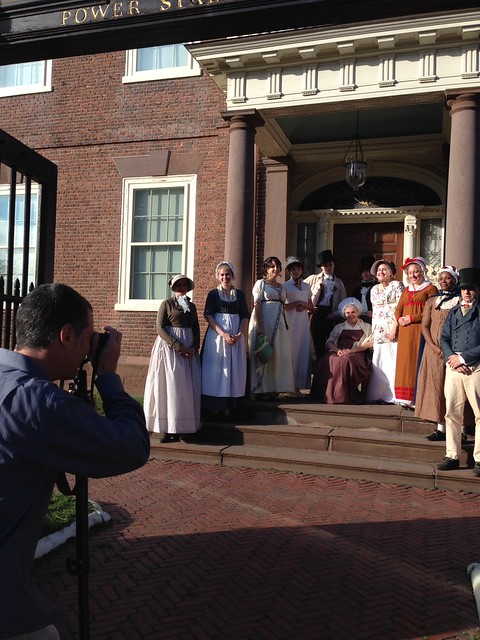
Still, by the end of the day, we were well satisfied with our work, and posed for the passing limner.

Share this:

  • Click to share on Facebook (Opens in new window) Facebook
  • Click to share on Pinterest (Opens in new window) Pinterest
  • Click to email a link to a friend (Opens in new window) Email
  • Click to share on X (Opens in new window) X
Like Loading...

History is Not a Competition

15 Sunday Jun 2014

Posted by kittycalash in Events, History, Living History, Reenacting

≈ 1 Comment

Tags

10th Massachusetts, 18th century, 18th century clothes, Amasa Soper's Company, Boston, historic houses, history, living history, Massachusetts, Paul Revere House, Reenacting, Revolutionary War

IMG_1583

Drilling by the Sergeant

Saturday was my first post-operative foray into costumed interpretation, up to Paul Revere House on Flag Day. This went much better than my first attempt at Paul Revere House, which ended in ignominy as I missed the train. In April, I managed to convince Mr S to drive in Boston, which he usually refuses to do (in fact, he nearly abandoned me once at the Old State House one Saturday after a miserable drive that had us stuck in the Downtown Crossing vortex).

I’m so glad we managed this, Despite anticipatory near-tears and epic pouting by the Young Mr, we managed to have a rather nice time.

Poise, with extra elevation by the Young Mr

Poise, with extra elevation by the Young Mr

We were in the courtyard, and Mr HC and Mr FC told the story of Amasa Soper’s company and its members several times to the streams of tourists. They solicited recruits and ran them through the 1764 drill using the nicest wooden muskets I’ve ever seen, though with mixed results. Some new volunteers held their muskets backwards, and the Young Mr’s ramrod got stuck in the barrel, though that is a known issue with that particular musket.

I sat on my ladder-back chair near the house and made the tiniest hems I could on Mr S’s next shirt, which will be for best. People asked about the sewing and my clothes, and I had a chance to talk about what women wore, typical fabrics and fibres, supplying the army, and who made what.

The day was warm, but fortunately not overwhelming, and as a museum person, I found the crowd quite interesting. This is a facet of Boston I don’t usually see: the tourist experience.

In one memorable moment, a pair of young women stood just outside the door to the house.
Young Woman Number One: “Is this really his house?”
Young Woman Number Two: “Yes, this is where Paul Revere lived.”
YWNO: “Oh, my God! I’m so excited! This is so neat!”
Kitty Calash: <eats heart out with jealousy> “Why can’t my museum do that?”

The celebrity factor of Paul Revere is undeniable. There were tourists with guide sheets in Chinese, and tourists who made me wish I still remembered my college German. Some seemed to be hitting every Boston landmark they could in one day, carrying white cardboard pastry boxes; some seemed to be going more slowly, looking, and trying to figure out what they were seeing, and what it meant.

Virtue Rewarded

Virtue Rewarded

What living history means is something I’ve been thinking about lately, or trying to. It’s tangled up with questions of authenticity and appropriateness, but what I learned on Saturday, or re-learned, was how very happy this business makes me. I like history, and historic costume. It doesn’t matter to me if we are talking Revolutionary War or New Republic or Lewis and Clark.

My favorite visitors were a mother and daughter from Steamboat Springs, Colorado, visiting Boston for the first time with a young man from New Hampshire. The mother said, “There’s so much more history here than where we’re from. Our town’s only 100 years old.”

That’s a challenge I’m always ready for, so I asked where they were from. Colorado to me means Native American settlements reaching back a thousand years, Spanish explorers and conquistadors, French, and then American, fur traders. It means hundreds of years of history, and a chance to remind people this isn’t a competition for “oldest” or “mostest.”

Knowing where our country came from is important: so yes, please visit Boston, and Paul Revere House, and Providence and Newport, too! But knowing where you are is just as important. There’s history all around you, and your local historical site, society and museum would love to tell you about it.

Share this:

  • Click to share on Facebook (Opens in new window) Facebook
  • Click to share on Pinterest (Opens in new window) Pinterest
  • Click to email a link to a friend (Opens in new window) Email
  • Click to share on X (Opens in new window) X
Like Loading...

Fog on the Hudson

21 Sunday Apr 2013

Posted by kittycalash in Museums

≈ 1 Comment

Tags

common people, historic houses, history, imperfections, Museums, tours, vacation

20130421-072045.jpg Up on the Hudson, it gets foggy. We drove through fog, which was probably a cloud, and remarked on how very different from home it is here. And once again, I demonstrated an inability to navigate through anything but a conventional New England rotary: I have over-adapted.

We went to the West Point Museum (far too warm, folks; artifacts and visitors alike will cook at 72+ F) and enjoyed the artifacts and dioramas. It’s a classical museum, chronological and linear as you would expect it to be. I don’t object to this format at all: it supports limited labeling, which I consider a blessing, really, and allows the objects to speak for themselves and leaves room for the visitor to wonder, find a label, and read more. I did take photographs, but forgot the adapter for downloading the camera.

From there we visited Fort Montgomery, which may well be the site of future shivering.
Here, I did not take photos, especially after I was warned off touching the glass by the curator or site superintendent (honest, I didn’t leave a smudge).

The last stop on Friday was at Boscobel, which I knew of from a book at work. The house is as lovely as you would expect from a place furnished by the former curator of American Decorative Arts at the Met, and funded by Lila Wallace’s fortune. It’s a guided house tour, with an audio tour for the grounds. We lasted through the guided tour (there were only the three of us) and a portion of the grounds.

I’m really glad I lifted the no photography rule at work. Boscobel has some lovely objects. I was interested in several for which there are no catalog images online, no postcards, and no images in their books. I couldn’t capture the sense of place in the house, or the room the way I saw it, and I find that archaic and frustrating.

The tour itself was everything you’d expect a tour given by retired women of means to be: genteel, focused on furniture, and docile. To their credit, they do a good job with photographs to explain how the commodes work, and by the second floor our guide had loosened up a little bit in her blue blazer. But there was little about the family and their lives, nothing about the servants, and some basic misapprehensions about how a house of that size worked. (The cast iron cylinder in a water or tea urn was never heated in the parlor fire, and never by the mistress; sparks! fire! mess on mahogany! Nope, it all happened in the kitchen.)

In the end, Boscobel was lovely and I am envious of the decor and some of the objects and details, but as the tour guide noted, I most liked the “imperfect rooms” (the pantry, the kitchen, the bathing area and the servant’s bedroom).

Huzzah for imperfections! Time to dress for the last day of the common, imperfect soldier before we tear off for home.

Share this:

  • Click to share on Facebook (Opens in new window) Facebook
  • Click to share on Pinterest (Opens in new window) Pinterest
  • Click to email a link to a friend (Opens in new window) Email
  • Click to share on X (Opens in new window) X
Like Loading...
Newer posts →

Archives

wordpress statistics

Creative Commons License
Kitty Calash blog by Kirsten Hammerstrom is licensed under a Creative Commons Attribution-NonCommercial-ShareAlike 4.0 International License.

Website Built with WordPress.com.

  • Subscribe Subscribed
    • Kitty Calash
    • Join 621 other subscribers
    • Already have a WordPress.com account? Log in now.
    • Kitty Calash
    • Subscribe Subscribed
    • Sign up
    • Log in
    • Report this content
    • View site in Reader
    • Manage subscriptions
    • Collapse this bar
 

Loading Comments...
 

    %d