• Home
  • Completed Costumes/Impressions
  • Emma and Her Dresses
  • Free Patterns and Instructions

Kitty Calash

~ Confessions of a Known Bonnet-Wearer

Kitty Calash

Tag Archives: history event

The Dirt on Ti

22 Tuesday Mar 2016

Posted by kittycalash in Events, History, Living History, Museums, Reenacting, Research

≈ 3 Comments

Tags

authenticity, common people, common soldier, domestic life, everyday, Fort Ticonderoga, history event, interpretation, living history, servants, women's history, women's work

On the road in: dirt.

Seen on the way in to Fort Ti: dirt. (Kitty Calash photo)

The dirt on Fort Ti came home on my shoes. And my petticoats. And my gown. And possibly my face, which could explain the reactions I got when I stopped for gas on the Pike Saturday evening.

It’s incredible how how dirty, dusty, and straw-filled a room can get– and that’s just the officer’s room. For all I know, a horse had been sleeping in the back corner of the barracks room we cleaned– who else would leave so much straw?

Regular readers know I have a thing about portraying women’s work in the past, as well as historical cleaning methods and what I like to call “experimental archaeology” and other people call “that crazy hobby- thing- where you get cold and dirty.” We started with mop making, of course, and when I loaded the car on Friday morning, I was pretty well pleased with my swag.

Cleaning swag. (Kitty Calash photo)
Supper time! (Kitty Calash photo)

So, what happened? How did it go? What did we do? Our Girl History provides a descriptive photo essay overview of the day. My experiences were more limited, as befits someone of my status: officer’s servant.

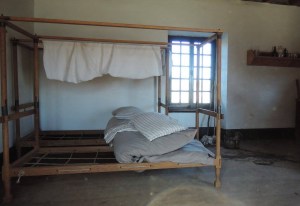
Every good experience begins with a meal. Friday night supper included bread, cheese, pork loin and apple, imported from Rhode Island. Yes, I also helped myself to bacon, to ensure none was wasted. Bedtime for officers’ servants comes early: I’m not a stranger to rope beds, but found this straw tick far more comfortable than a previous arrangement elsewhere. 

Ticks rolled back for cleaning
Start in one corner…don’t stop!

After formation, to tasks. I was ably assisted by Miss Sam, who was a better height for the brooms than I. The brooms are speculative on the one hand, and later on the other. The corn broom was markedly more effective than the broom straw, which disintegrated with use, though not for lack of care in making. We were up against some serious accumulation.

IMG_6361

Housekeeping and servants manuals from the period, like Hannah Glasse, tell you the cleaning must be done every day. It’s certainly something I heard within my own lifetime, though an ideal I continually struggle to achieve despite the advances of Mr Kenmore. The general rule is to begin at the top and work your way down: gravity is, at last, your friend. I use brushes– a large, soft round paint brush and a stiffer circular whisk– to remove dust and dirt from upper surfaces, and cobwebs from corners, and other wall-borne detritus. Gentlefolk: your cleaning ladies know much about you in any century.

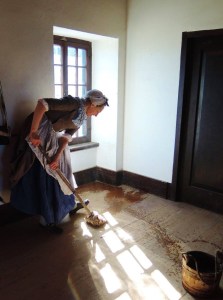
After sweeping (yes, into the fireplace or out the door, it’s that simple), scrubbing. I scrubbed the baseboards first with vinegar and water (the vinegar infused with lavender for several years). Filth, my friends. Then we mopped. Again, filth.
IMG_6363

I would have preferred to do another dust collection on the floor– the water did pool a bit on the dry dust that remained, but swabbing seemed to work and I believe we left the floor cleaner than it had been. The three mops we tested (wool, cotton, and linen strips) each had benefits and deficits.

The cotton and wool caught on the rough floor boards, but did a good job spreading water around the floor and lifting dirt. The linen strips were better at not catching and at scrubbing.

No matter what, the water got filthy and took on the look and nearly the consistency of the chocolate we drank that day. Remember the iron museum rule: don’t lick it! That rule applies everywhere.

IMG_6364

Everyone and everything got cleaned Saturday. Miss V broached the laundry with vigor, but discovered that possibly untoward things had been done in her laundry tub. Things that might involve shoes, and blacking. Marks were left on shifts and shirts, so even the wash tub got a scrub this garrison weekend.

Some of the best comments came after the fact: I’ve never heard cleaning called “one of the coolest things” seen all day, but when someone says it helps them see a space in an entirely new way, I’m incredibly happy. There’s so much about the everyday use– and maintenance– of space and objects and each other that we take for granted in our own lives. Surely the people of the past who had servants took all that work for granted.

But for me, enamored as I am of details and of the quotidian, transforming a space through the everyday work of women is a job with doing. Thanks to Fort Ti’s staff for giving me the chance to step back in time and enjoy (really, I mean it) a day of hard work bringing the mundane back to life.

Unless otherwise noted, all photos by Eliza West, courtesy of  Fort Ticonderoga.
Share this:

  • Click to share on Facebook (Opens in new window) Facebook
  • Click to share on Pinterest (Opens in new window) Pinterest
  • Click to email a link to a friend (Opens in new window) Email
  • Click to share on X (Opens in new window) X
Like Loading...

Same Place, Different Day

17 Saturday Jan 2015

Posted by kittycalash in History, Living History, Museums, Philosophy, Reenacting

≈ 7 Comments

Tags

accuracy, authenticity, history event, history events, interpretation, living history, museum practice, rant, Reenacting

We were doing some preliminary planning for an event this fall, and we were considering recreating the 1803 funeral of Important White Guy. Our event is in October; the funeral was in September. Somebody asked me, “What does it matter when we do it?” and I didn’t respond nearly as gracefully or eloquently as I could have.

Why does it matter? Does it matter to anyone but me and my cohort?

It does, and here’s one reason why: When interpreting the funeral in late October, perhaps a member of the public will ask, “When did he die?” Can an interpreter really say “September 20” and not expect a slew of questions about how long the body was kept and why the funeral was delayed and wasn’t that a health hazard? Can the event orientation start out with “We’re doing it in October because that’s when we want to do it,” without fundamentally changing the event?

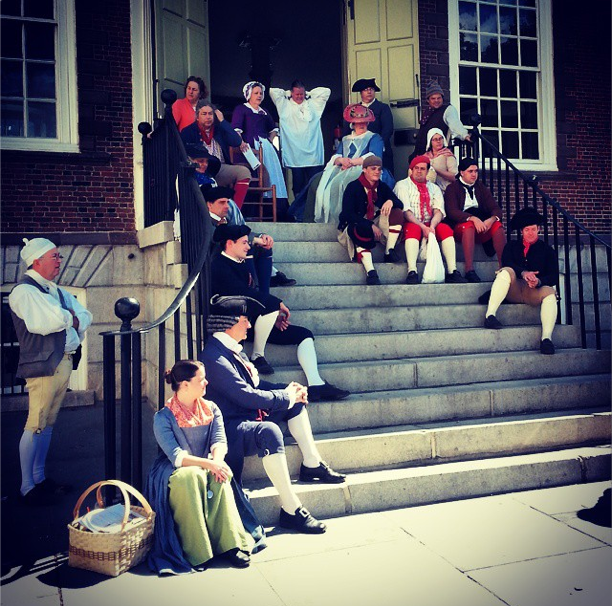
On the Colony House steps

August is hot. Can we riot in September? No!

Moving the recreation of a specific event by more than it takes to get to a weekend* seems dishonest to me: do you really want to celebrate your birthday 5 weeks after the actual date for someone else’s convenience? July 4th: Gosh, it’s not working for me this year. Let’s do that in August.

For a historical organization to suspend caring about accuracy for living history events but not for published articles, catalog records, or finding aids just contributes to the greater problem in and of living history.

When asked about the goal of a living history event, I have been told, “Well, we want families, right? So we should have some hands-on activities, you know, immersive, like candle dipping.”+

It took a bit, but at last I grasped the core of the angry-making: Kids like living history, therefore it is less sophisticated than other forms of history.

The right place for immersive string activities.

The right place for immersive string activities.

Living history is not as sophisticated, nor need it be as accurate, as traditional (written, orated, curated) historical presentations: I think that is the background assumption a lot of people make, both in the adminstration of traditional historical organizations and in the presentation on the field. It is a complete fallacy.

Living history done well and done right is as well-researched as a paper, exhibition, or article. It draws from primary sources both written and visual, it requires the absorption of countless secondary sources to help analyze the primary sources. It is as collaborative and negotiated a process as any museum exhibition, and like exhibitions, it uses material culture interpretation to deliver its messages, i.e. meet its educational and interpretive goals.

15316751814_946818c254_z

A good living history event is beautiful, but like a ballet, that beauty does not come easily. There are no shortcuts, and beauty does not equal superficial or stupid. It indicates sophistication. Part of that appeal is accuracy: the better, the more accurate and immersive the historical setting and action you create, the more visitors can learn without asking.

Lawn games

Lawn games

When I organize an event in our house at work (or even on a guided tour) one of my interpretive points is always “people saw the world differently– literally– and this event/house tour helps you see the world of 1800 the way people living then saw it.” Aesthetics were different, and were underpinned by ideas and opinions. But understanding those aesthetics and the opinions people held about race, gender, beauty, work and class takes actual research and analysis. It’s not all putting on a pretty dress and cavorting on the lawn. Facts matter. Accuracy matters.

Museums are some of the most trusted organizations. If we started juicing facts like every History channel show, we’d lose that trust, and rightly so. Our trustworthiness is grounded in our honesty and integrity.

Living history events are mobile museums, and every reenactor curates his or her own impression. To retain the trust and interest of the public, we have to be accurate.

*Events are moved to weekends because that’s when interpreters and audiences can come.

+This at a house that not only lacks a working kitchen earlier than 1960 in the staff area and was owned by a partner in a candle factory. I’m thinking “bought ’em in bulk,” here, not dipping.

Share this:

  • Click to share on Facebook (Opens in new window) Facebook
  • Click to share on Pinterest (Opens in new window) Pinterest
  • Click to email a link to a friend (Opens in new window) Email
  • Click to share on X (Opens in new window) X
Like Loading...

Archives

wordpress statistics

Creative Commons License
Kitty Calash blog by Kirsten Hammerstrom is licensed under a Creative Commons Attribution-NonCommercial-ShareAlike 4.0 International License.

Website Built with WordPress.com.

  • Subscribe Subscribed
    • Kitty Calash
    • Join 621 other subscribers
    • Already have a WordPress.com account? Log in now.
    • Kitty Calash
    • Subscribe Subscribed
    • Sign up
    • Log in
    • Report this content
    • View site in Reader
    • Manage subscriptions
    • Collapse this bar
 

Loading Comments...
 

    %d