• Home
  • Completed Costumes/Impressions
  • Emma and Her Dresses
  • Free Patterns and Instructions

Kitty Calash

~ Confessions of a Known Bonnet-Wearer

Kitty Calash

Tag Archives: John Brown House Museum

Cold Scoops

30 Tuesday Sep 2014

Posted by kittycalash in Clothing, History, Living History, Reenacting, Research

≈ 8 Comments

Tags

18th century clothing, 19th century clothing, authenticity, Clothing, common dress, common people, John Brown House Museum, Julia Bowen, Julia Bowen Martin, living history, Providence, Research, Rhode Island, What Cheer Day
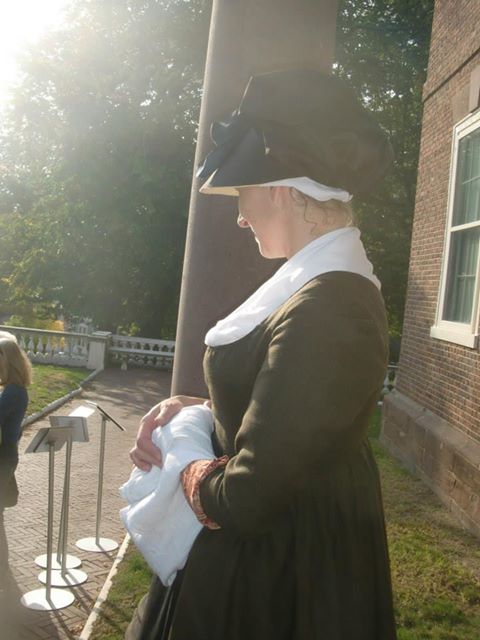
What Cheer Day preparations must begin in earnest now, no matter how distracting I might find orderly books or silk shoes (not in my size, alas: no last can be found). I already have clothes enough for a housekeeper, though I still crave a broadcloth Spencer and am working on a petticoat. I’ll hardly go outside that day, so why am I thinking bonnets– especially when I have a known bonnet problem?

One of my favorite resources for Federal era Providence is Julia Bowen’s diary. Born December 1, 1779, Julia’s diary records her life in Providence in 1799, when she was 19. She records the daily activities of the second set of Providence women– daughters not of the most elite merchants, like John Brown and John Innes Clark, but the Bowens, Powers, Howells, and Whipples. Distinguished, but not super-elite. Many of the entries are as prosaic and superficial as you’d expect from a young woman in late adolescence, and thank goodness they are, or we’d never be able to imagine life in such fine detail.

Julia got me thinking about bonnets with her entry of April 12:

found the Major & Citizen Sarah & C. Angell altering their cold scoops into Rosina hats, so busily were they employed that the Major could not go a visiting, which deprived me at once of the greatest pleasure I anticipated in my visit.

(She used code names for her friends; some we can decode, and some we cannot.)

I haven’t been able to decipher what “Rosina hats” were, but cold scoops I could handle: coal scoops.
That colloquialism fits not just fashion plates but extant coal scoops and buckets.

Denham's Auctioneers: Lot 418 A copper coal shovel and a brass coal shovel
Denham’s Auctioneers: Lot 418 A copper coal shovel and a brass coal shovel
Denham's Auctioneers: Lot 153 A copper helmet shaped coal scuttle with brass shovel and turned wooden handle £20-40
Denham’s Auctioneers: Lot 153 A copper helmet shaped coal scuttle with brass shovel and turned wooden handle £20-40

You just have to imagine them turned over.

The Gallery of Fashion, 1797, Bathing Place, Morning Dresses.

The Gallery of Fashion, 1797, Bathing Place, Morning Dresses.

15400635112_e9997f750f_z
15397772861_3ff46f286d_z

I went for cold scoop, with a pasteboard brim and olive green taffeta brim and caul. The mannequin is a 3-D sketch, if you will, of what the housekeeper plans to wear this autumn. At least until she can figure out what a Rosina hat is.
Share this:

  • Click to share on Facebook (Opens in new window) Facebook
  • Click to share on Pinterest (Opens in new window) Pinterest
  • Click to email a link to a friend (Opens in new window) Email
  • Click to share on X (Opens in new window) X
Like Loading...

Use it Up, Wear it Out, Make it Do

07 Monday Apr 2014

Posted by kittycalash in Clothing, History, Museums, Research

≈ 2 Comments

Tags

18th century clothes, 18th century clothing, alterations, Clothing, dress, fashion, Global Encounters, John Brown House Museum, Metropolitan Museum of Art, Research, Rhode Island, Rhode Island Historical Society, style

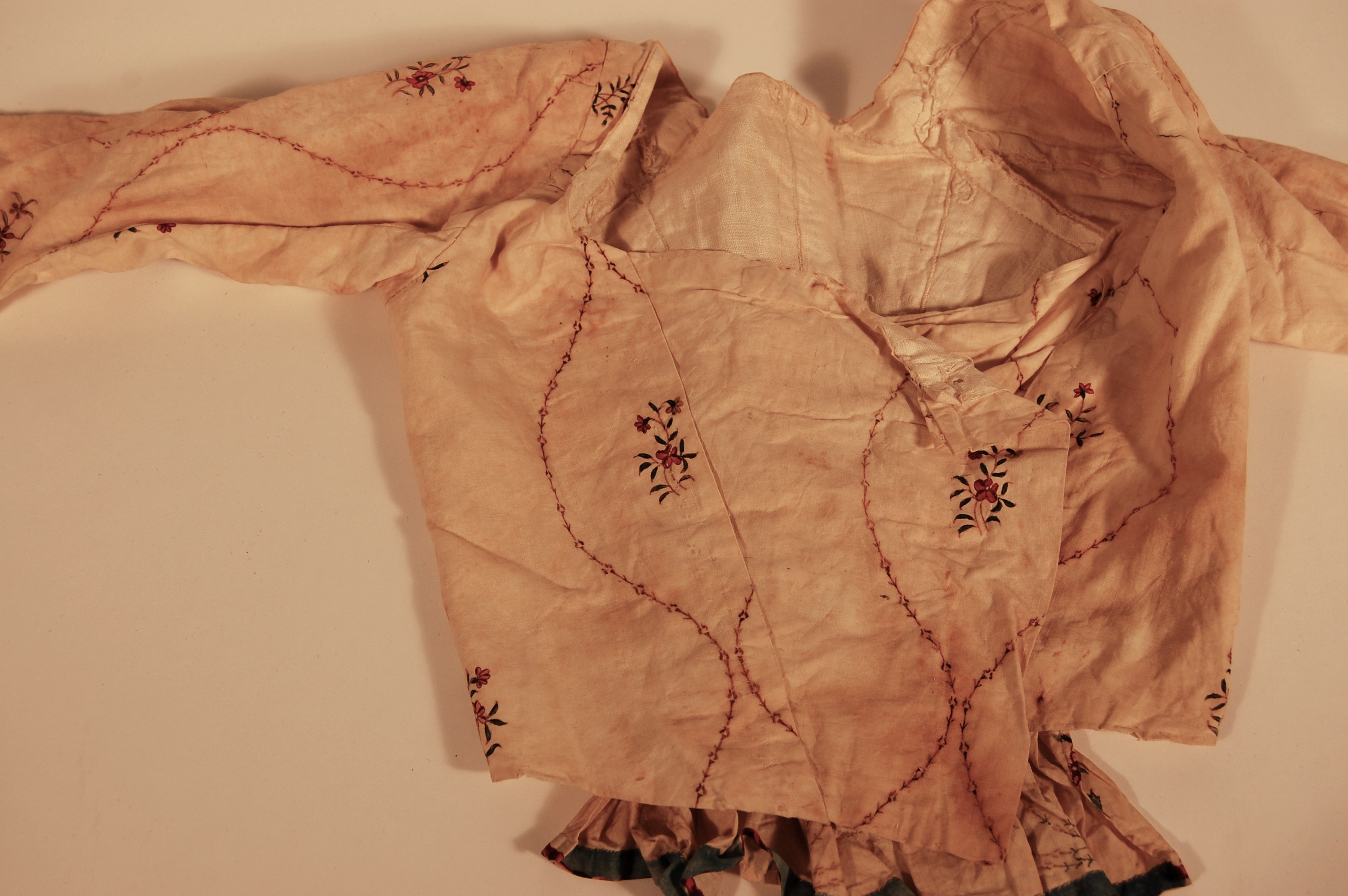
Bodice, painted Indian cotton, 1780-1795 RIHS 1990.36.27

Bodice, painted Indian cotton, 1780-1795
RIHS 1990.36.27

I’ve fallen behind again, as I spent considerable early morning time this past week working on a short presentation for a program in Worcester this past weekend. If you are among the people who do not wake at 4:00 AM panicking about the organization of your thoughts, or whom, exactly, might have worn a heavily-remade bodice, you are lucky indeed.

But I managed to present without falling all over myself, putting out someone’s eye, or causing mayhem and self-embarassment, so, phew! (I do this so much less often than I used to that my anticipatory anxiety is always high.)

Above you can see one of the items I talked about: a re-worked bodice from the collection of the Rhode Island Historical Society.

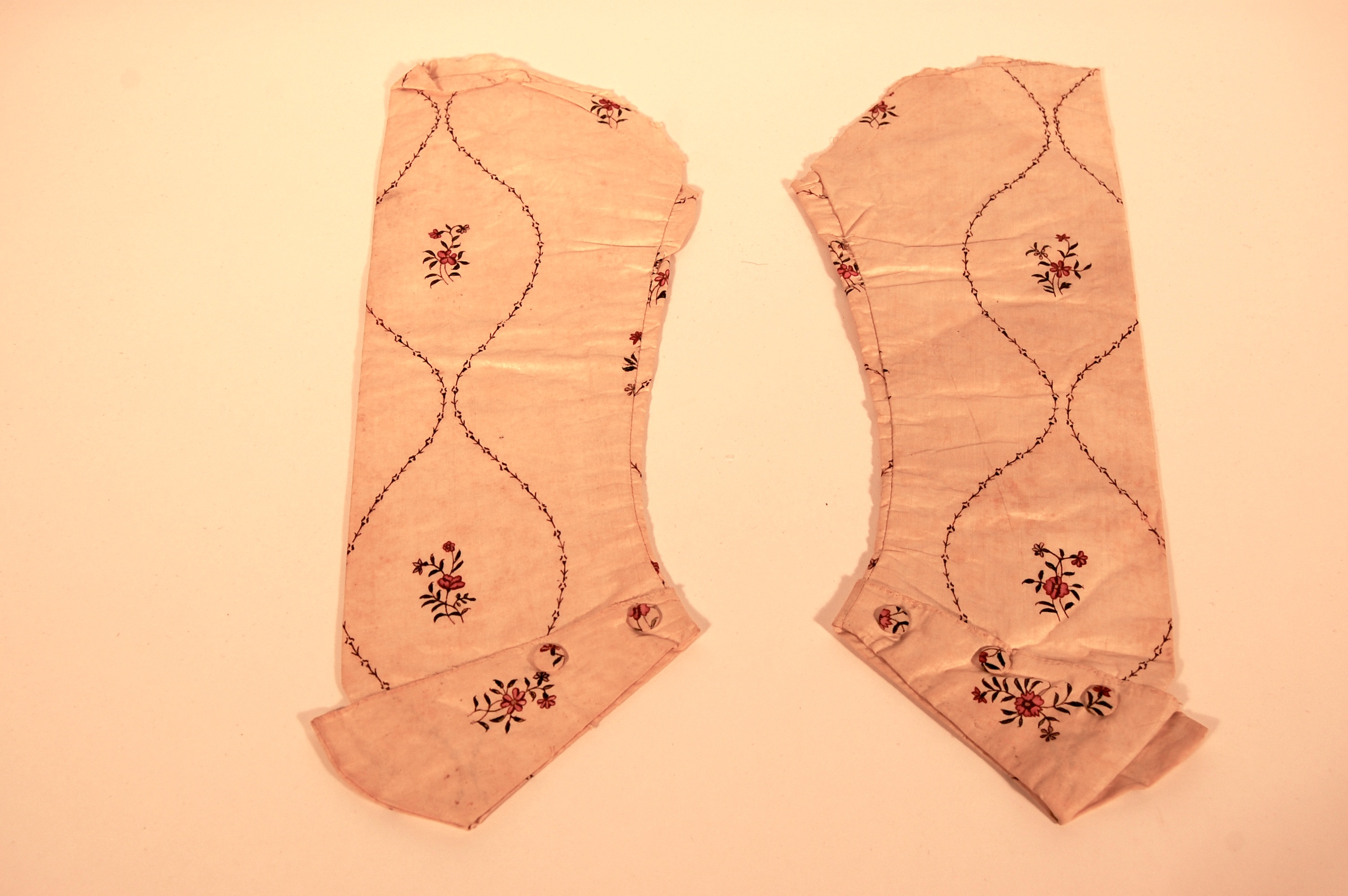
Sleeves, removed from bodice 1990.36.27. RIHS 1990.36.25A-B

Sleeves, removed from bodice 1990.36.27.
RIHS 1990.36.25A-B

I think, once upon a time, that bodice was part of a pieced-back closed-front gown with a matching petticoat.

And then I think someone decided (quite rightly) that the style was too passé for 1795, and altered the gown significantly.

Not only is there evidence of new sleeves being fitted into the gown’s armscyes, we have the sleeves-that-used-to-be. And my dear! No one is wearing sleeves like that this season!

I find these garments in limbo really fascinating. Was that bodice finished and worn with a matching petticoat? (Yes, there’s a panel of that left, too; what a lovely hem!)

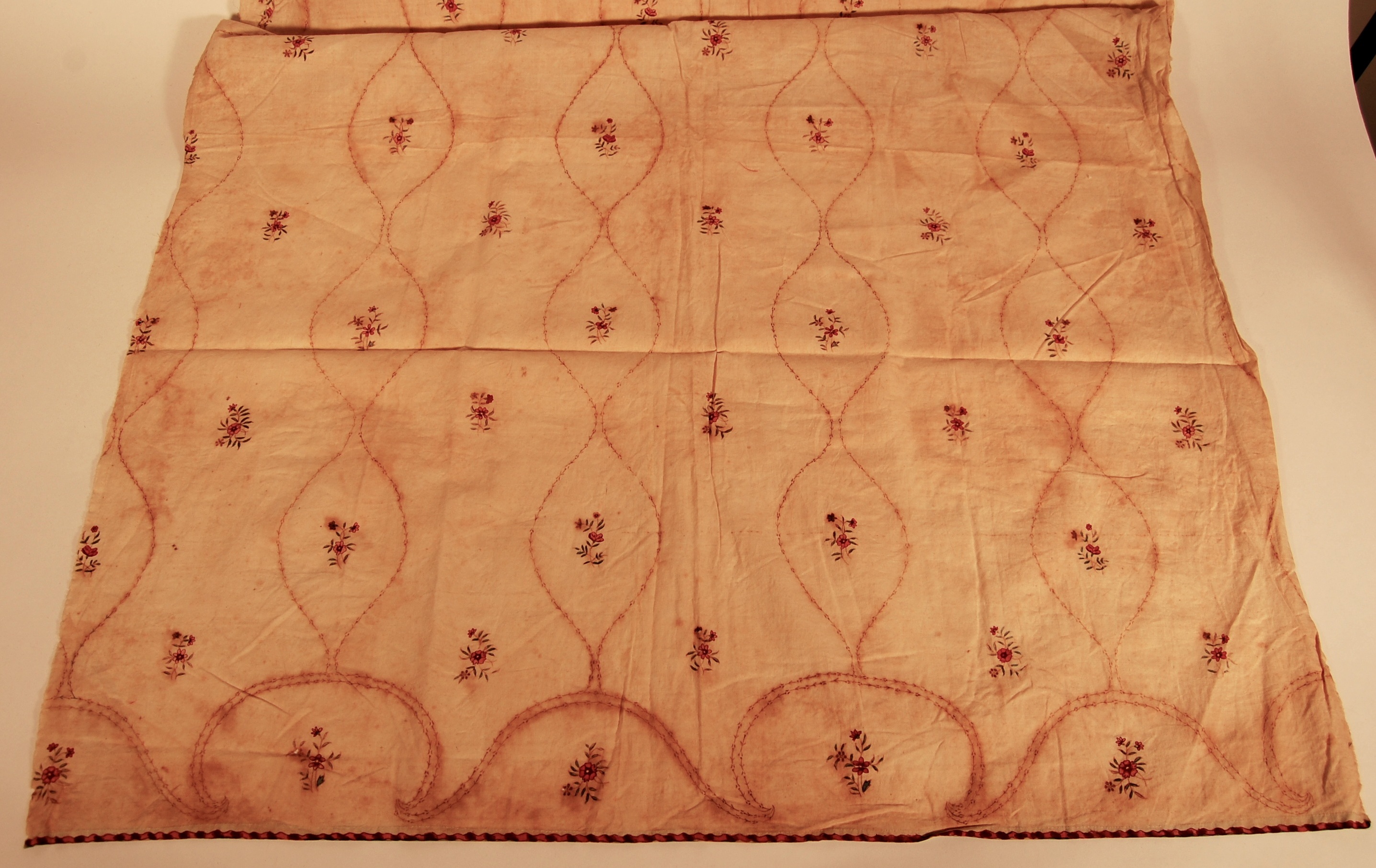
Skirt panel, painted Indian cotton. RIHS 1990.36.33

Skirt panel, painted Indian cotton.
RIHS 1990.36.33

Who wore the gown? Was the woman who wore it originally the same woman who wore it altered? I can only guess at this point, and may never find the smoking diary or mantua-maker’s bill. The alterations are not as finely done as the original gown, so I think there are two hands at work here– whose were those hands? There’s always more to think about and learn.

In case you’re wondering, thanks to the Met, we can see what the gown probably looked like in its first incarnation, and then what the alterations were meant to achieve. (Link to the gown on the left; link to the gown on the right.)

Robe a l'anglaise, 1785-1795 MMA 2009.300.647
Robe a l’anglaise, 1785-1795 MMA 2009.300.647
Gown and petticoat, 1790-1794 MMA C.I.45.6a,b

Share this:

  • Click to share on Facebook (Opens in new window) Facebook
  • Click to share on Pinterest (Opens in new window) Pinterest
  • Click to email a link to a friend (Opens in new window) Email
  • Click to share on X (Opens in new window) X
Like Loading...

Taking Tea

04 Tuesday Feb 2014

Posted by kittycalash in Events, History, Living History, Museums, Research

≈ 5 Comments

Tags

Henry Sargent, historic interiors, interpretation, John Brown House Museum, Museum of Fine Art Boston, Museums, paintings, Research, social life and customs, tea party, The Tea Party

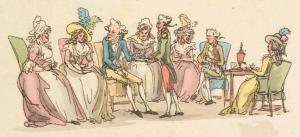
Detail, Picturesque studies and scenes of everyday life watercolor by Thomas Rowlandson, 1790. Royal Collection Trust. RCIN 810396

Detail, Picturesque studies and scenes of everyday life. Handcolored etching by Thomas Rowlandson, 1790. Royal Collection Trust. RCIN 810396

Hat tip to Jane Austen’s World for the image at left, which helped me start visualizing another program I’m involved with, this time ‘at home’ in Providence.

When we started reinterpreting the house museum, we began going back through primary sources to figure out how rooms might have been used, and furniture arranged (we don’t have inventories, so we read the house and diaries and letters– but that’s for another post).

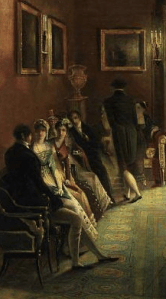
Detail, The Tea Party. Oil on canvas by Henry Sargent, 1824. MFA Boston, 19.12

Detail, The Tea Party. Oil on canvas by Henry Sargent, 1824. MFA Boston, 19.12

One of the things I remember most vividly was the description of the uncomfortable tea parties Providence women gave, where the guests sat in chairs against the walls of the rooms, balancing a tea cup in one hand and plate in another. Several hard drives later, I’m not sure where that primary source is (the hunt begins tomorrow) but it conjured images of every hostess in Providence a Hyacinth Bucket, and every guest a quivering Elizabeth Next Door.

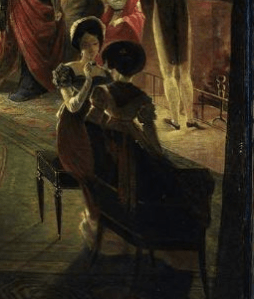
Detail, The Tea Party. Oil on Canvas by Henry Sargent, 1824. MFA Boston, 19.12

Detail, The Tea Party. Oil on Canvas by Henry Sargent, 1824. MFA Boston, 19.12

Surely that couldn’t be true? I thought I must be making it up, but then the Rowlandson turns up on the interwebs and there they are, in a row. More famously and closer to home, Henry Sargent’s painting of a Boston tea party in 1824. (The catalog description is rather nice.)

Here’s an 1824 tea party in Boston. While this is later than the tea party we’ve planned at work, it is still full of useful hints about how early, formal tea parties were conducted. We think– or I do, anyway– of ladies in frilly hats seated a tables with cakes heaped on stands and floral tea pots. I hear “tea party” and I think “doilies,” but this is not your grandmother’s tea party. It’s a different kind of social occasion, both more formal and more relaxed.

Detail, The Tea Party, oil on canvas by Henry Sargent, 1824. MFA Boston, 19.12

Detail, The Tea Party, oil on canvas by Henry Sargent, 1824. MFA Boston, 19.12

There’s not a central table to sit around, but instead chairs lined up against the wall, groups of guests, chatting. Others guests stand close to the fireplace, and a pair of ladies have taken a settee and a stool for their close conversation. We can just make out the tiny tea cup in the lady’s gloved hand.

In many ways, this depiction reminds me more of contemporary cocktail parties or open houses with the guests in small, changing groups, and no place to put your cup. Of course, most of us don’t have waiters (that’s who you see in the detail above with his back to us) or fabulous houses on the Tontine Crescent in Boston.

In so many ways, the social customs, habits and mores of the past are lost to us, and as we try to recreate them, the we excavate them from a combination of unlikely sources. Accounts, paintings, diaries, and etiquette manuals serve as sources, but it’s easier to recreate the economics of tea than the structure of a tea party. And once we do have an approximation, will it be a party anyone wants to go to?

Share this:

  • Click to share on Facebook (Opens in new window) Facebook
  • Click to share on Pinterest (Opens in new window) Pinterest
  • Click to email a link to a friend (Opens in new window) Email
  • Click to share on X (Opens in new window) X
Like Loading...

Gallery

What Cheer Day Photo Gallery

10 Thursday Oct 2013

Posted by kittycalash in Events, Living History, Museums, Thanks

≈ 2 Comments

Tags

John Brown House Museum, living history, Rhode Island, Rhode Island Historical Society, What Cheer Day

This gallery contains 19 photos.

Good Help is Hard to Find

06 Sunday Oct 2013

Posted by kittycalash in Events, Living History, Museums, Thanks

≈ 8 Comments

Tags

18th century, history, John Brown House Museum, living history, Providence, Rhode Island, Rhode Island Historical Society, What Cheer Day

Esther helps Mrs Smith with her bonnet

Esther helps Mrs Smith with her bonnet

Esther Hudson here has a terrible fascination for knittin, and an abundant fascination with sheep.I fear sometimes for her sanity, as she spends much of the evening sketchin cats on her slate and showing em to me. Cats, sheep, and knittin are much of her conversation and I wonder if she will ever be settled in a home of her own. I durst not send her away, as her father is at sea, and knowing what might befall her, given her simple ways, I think it best to keep her close. She is fond, as you can see, of dressin, but refuses utterly to quarter a fowle. She will beat a fine pound cake, but the coarser tasks of the kitchen she finds distasteful, preferrin to dress the ladies’ hair. Of her future, I do sometimes despair.

Mrs Smith and Miss Smith

Mrs Smith and Miss Smith

My cousin, Miss Eliza Smith, has donned her new dress to come up to town from her beloved Newport to see about a position. The family with whom she has found employment these many years has suffert in that city’s decline since the late war, and she seeks a new future in Providence. She writes a fine letter, and with excellent references, Miss Smith would be well suited to manage a household for Mrs Brown’s youngest daughter, the recently married Mrs Mason. Miss Smith seems also to steady Esther, whose conversation grows more sensible when she is not with me. Perhaps after speaking with Mrs Mason, Esther, Eliza and I can slip away to enjoy some of the newly pickt apples she has brought up from Rhode Island.

Mrs Smith, ready for some ale

Mrs Smith at day’s end

At the end of a long day filled with visitors– every stage has stopt at our house, some mistaking it, I think, for that questionable establishment operated by ‘Mrs’ Mary Bowen on South Main Street–I was ready to remove my soild apron (thankfully Esther has a spare) and venture down the hill to seek refreshment with my frinds. I may chanst to hear some news of the Ann & Hope, bound for Canton, and on which my son is a sailor. Or perhaps, before the light fails, I may read a bit of Mr Defoe’s most moral tale, Moll Flanders, and think in gratitude that my late husband’s family has seen fit to give me employ. I cant read at home, for if Mrs Brown catchs me readin that book agin, I will surely be trouble.

(Top photo thanks to the Providence Journal; bottom two thanks to Sharon Ann Burnston, our Mrs Brown)

Share this:

  • Click to share on Facebook (Opens in new window) Facebook
  • Click to share on Pinterest (Opens in new window) Pinterest
  • Click to email a link to a friend (Opens in new window) Email
  • Click to share on X (Opens in new window) X
Like Loading...
← Older posts
Newer posts →

Archives

wordpress statistics

Creative Commons License
Kitty Calash blog by Kirsten Hammerstrom is licensed under a Creative Commons Attribution-NonCommercial-ShareAlike 4.0 International License.

Website Built with WordPress.com.

  • Subscribe Subscribed
    • Kitty Calash
    • Join 621 other subscribers
    • Already have a WordPress.com account? Log in now.
    • Kitty Calash
    • Subscribe Subscribed
    • Sign up
    • Log in
    • Report this content
    • View site in Reader
    • Manage subscriptions
    • Collapse this bar
 

Loading Comments...
 

    %d