• Home
  • Completed Costumes/Impressions
  • Emma and Her Dresses
  • Free Patterns and Instructions

Kitty Calash

~ Confessions of a Known Bonnet-Wearer

Kitty Calash

Tag Archives: menswear

Make All the Coats

01 Wednesday Oct 2014

Posted by kittycalash in Clothing, Living History, Museums, Research

≈ 8 Comments

Tags

1818, anna maria von Phul, coatee, menswear, Missouri History Museum, watercolors

As far as I know, that’s not an internet meme yet, but it might as well be. It’s meme in my head, and that’s what counts.

While I should be thinking about the probability of Spencer-wearing in 1800 Rhode Island, I got distracted during a hunt for head wraps and found this lovely little water color.

Boy in a Beaver Hat. Watercolor by Anna Maria von Phul, 1818. MHS 1957.158.27

Boy in a Beaver Hat. Watercolor by Anna Maria von Phul, 1818. MHS 1957.158.27

How lovely is that coat? The Young Mr already has a semblance of that hat and trouser (admittedly too short) so the coat and a matelasse waistcoat would be just the ticket to recreate this image. He’ll bring his own sulky look to the party.

I’m trying to figure out what the coat would be made of, and what I’m willing to pay for a coat that will be grown out of rapidly. In the meantime, though, what a lovely image.

Back to coat dreams…and plots.

Share this:

  • Click to share on Facebook (Opens in new window) Facebook
  • Click to share on Pinterest (Opens in new window) Pinterest
  • Click to email a link to a friend (Opens in new window) Email
  • Click to share on X (Opens in new window) X
Like Loading...

Replication and Responsibility

18 Thursday Sep 2014

Posted by kittycalash in Clothing, History, Living History, Making Things, Museums, Reenacting, Research

≈ 8 Comments

Tags

1812, fashion, John Miner coat, menswear, Stonington, Stonington Historical Society, style, tailcoat

Detail, the John Miner Coat, Stonington Historical Society, 2009.120.001

Detail, the John Miner Coat, Stonington Historical Society, 2009.120.001

If I examine and exactly replicate a coat for personal use, what do I owe the museum that owns that coat– anything? I think I owe the museum any information I can share that will improve their records and help build a research file for the future.* I also think I owe them copies of the images I may take, and with digital images, that’s now incredibly easy.

But if I replicate this coat (shoulder intact) for Mr S or the Young Mr, should I give the coat to the Stonington Historical Society when we are done with it? SHS thinks I probably should, but as someone who manages collections, how many replicas do I want, and what standards do I use to judge them?

I think the best course of action is for museums to make patterns of popular or often-requested garments available for purchase, so that anyone who wants to make a replica has all the data they need. Short of that– and funds are often short for that– catalog records with as many measurements and as complete a description as possible will allow dedicated tailors and stitchers to get as close as possible to original garments.

True replicas involve recreating fabrics and using period techniques, and matching a garment measurement to measurement– and in the case of the Miner coat, there is no way to replicate its history. And the amount of work and expertise that would go into a true replica of any historic garment seems enormous– it would constitute a large donation to the museum, even if the garment had been worn.

*For those of you reading the caption on the Miner coat, yes, it needs work, and yes, SHS knows there are problems with that description. I promised to help them with their catalog record.

Share this:

  • Click to share on Facebook (Opens in new window) Facebook
  • Click to share on Pinterest (Opens in new window) Pinterest
  • Click to email a link to a friend (Opens in new window) Email
  • Click to share on X (Opens in new window) X
Like Loading...

Coats and Cooking

11 Monday Aug 2014

Posted by kittycalash in Clothing, Events, Food, History, Living History, Making Things

≈ Comments Off on Coats and Cooking

Tags

10th Massachusetts, 18th century clothes, 18th century clothing, authenticity, Bennington, Brigade of the American Revolution, Clothing, common dress, common soldier, cooking, Costume, dress, Events, food, living history, menswear, Reenacting, Revolutionary War, style

And happy not to be walking to Walloomsac, since we can’t leave till Friday.

Before we leave, there’s plenty to done, of course, and most of it in men’s wear.*
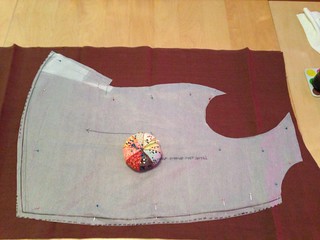
The first piece on brown linen

The Young Mr needed a new jacket, a proper one, with pockets and everything, correct for a scalawag. So that meant patterns and muslins and fittings and questions, until neither of us could really stand the other and his father called me an ambush predator of fittings. The only way to fit these wily creatures is, as they amble through the room, to leap out and toile someone.

With the pattern more-or-less fitted to the wiggly Young Mr, I cast about for fabric: there was not enough of a striped piece for both waistcoat and jacket; waistcoat won, because matching stripes on a jacket seemed too risky in this great a hurry. Instead, I sacrificed the last yardage once meant for a gown.
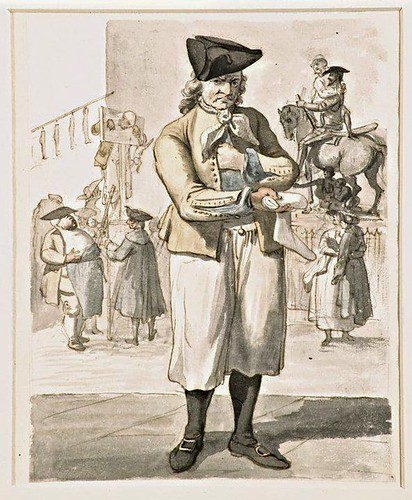
The Stocking Seller, by Paul Sandby, 1759

The Stocking Seller, by Paul Sandby, 1759

This is the inspiration for the kid’s new garment, along with Sandby’s fish monger. It seems a plausible garment to work from, and the brown linen is in keeping with the brown linen jacket at Connecticut Historical Society and the unlined linen frock coat recently sold at auction. It will also match his trousers, but this is what happens when you sew from the stash.

One pair of breeches altered, one waistcoat wanting the last seven newly-made buttons, one waistcoat in production, one jacket in production: you’d think that would be enough to get done. But I’m also working to expand my cooking repertoire, as bread and cheese gets tiresome and scrounging broken ginger cakes from the Sugar Loafe Baking Co.— while potentially good theatre–is not a solid plan for sustenance.
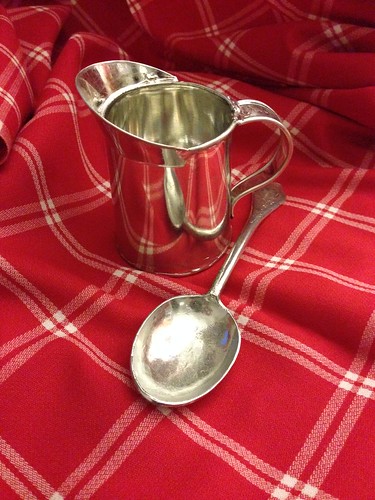
half pint and spoon measures

Half-pint and spoon

Boiling food in summer- sounds awful, right? But it’s an easy and correct way to cook,once you translate recipe measures and control the amount you’re making. I like to use Amelia Simmons’ cookbook, because it is specifically American, and my more skillful friends cooked from it at the farm.

From Enos Hitchcock’s diary, I know that he ate a boiled flour pudding with some venison stew (near the Saratoga campaign, I think) so I consider this a plausible recipe for the field, pending eggs, of course.

A boiled Flour Pudding.

One quart milk, 9 eggs, 7 spoons flour, a little salt, put into a strong cloth and boiled three quarters of an hour.

Simple enough, though Simmons later corrected the receipt to 9 spoons of flour, and boil for an hour and a half. I got out the spoon, and looked online at modern boiled pudding recipes, and will give a modified version a whirl sometime this week (always better to fail at home than in the field). Boiling the pudding in a linen cloth in a stew would make a savory bread substitute…and I really liked the one we had at the farm. Will the gentlemen at Bennington like it? Perhaps we’ll find out. If we’re not cooking with hosewater, almost anything should be edible.

*Yes, it’s a terrible and terribly dated show, but I always hear  this in Mr Humphries‘ voice from Are You Being Served?

Share this:

  • Click to share on Facebook (Opens in new window) Facebook
  • Click to share on Pinterest (Opens in new window) Pinterest
  • Click to email a link to a friend (Opens in new window) Email
  • Click to share on X (Opens in new window) X
Like Loading...

Six Toiles, a Coat and a Bonnet

07 Monday Jul 2014

Posted by kittycalash in Clothing, Events, Living History, Making Things, Reenacting

≈ 2 Comments

Tags

1812, 19th century clothing, bonnets, frock coat, living history, menswear, Salem event, sewing, tailcoat

14557116394_73c2d5ea9f_zYes, six toiles.
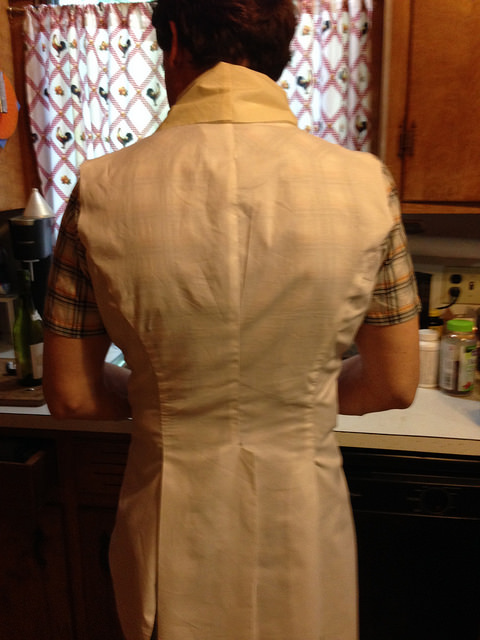
That’s how many it took to get a coat pattern to fit Mr S the way I thought it should. I finally built the pattern around a sleeve and arm scye that I knew worked and suited the period. From there, I built out the back, altering the center back seam curve to suit Mr S’s figure. Arm scyes are still hard for me to figure out, although sleeves are often my favorite part of a garment. I like how flat pieces become three dimensional in a sleeve, and I enjoy setting sleeves– go figure.

Thanks to the three-day holiday weekend and sitting out a parade to pad stitch, I have a coat body.

IMG_1725
IMG_1727

I’m not thrilled about the size of the lapels, though I have found extant examples and fashion plates showing lapels this size, and sleeves, too. While I’ve pinned up the sleeves in the back, thinking there’s too much fabric there, I can also see from the images that the subject’s posture was not the best– and that was the moment when I realized that I really did want a mannequin for menswear as the subjects are hard to catch at any age, and variable in posture and wiggliness. They also object to being pinned accidentally.

But there is at least a coat body on the way to being done, so I took a break and made a bonnet, which is really the point here <ahem> milliner’s, not tailor’s, shop, after all.

IMG_1738

Pasteboard brim, blue silk taffeta lined with white silk taffeta (they had new things at the fabric store, very exciting!), trimmed with silk ribbon from Wm Booth and paper flowers from the V&A.

Now, more bonnets, two waistcoats, a gown, an exhibition, a lecture, and Stony Point are all that stand between me and the milliners’ shop in Salem…

Share this:

  • Click to share on Facebook (Opens in new window) Facebook
  • Click to share on Pinterest (Opens in new window) Pinterest
  • Click to email a link to a friend (Opens in new window) Email
  • Click to share on X (Opens in new window) X
Like Loading...

The Taylors’ Instructor

25 Wednesday Jun 2014

Posted by kittycalash in Clothing, History, Living History, Making Things, Reenacting, Research

≈ 4 Comments

Tags

books, Federal style, menswear, Regency, Research, resources, tailcoat

Title page, The Taylors' Instructor

Title page, The Taylors’ Instructor

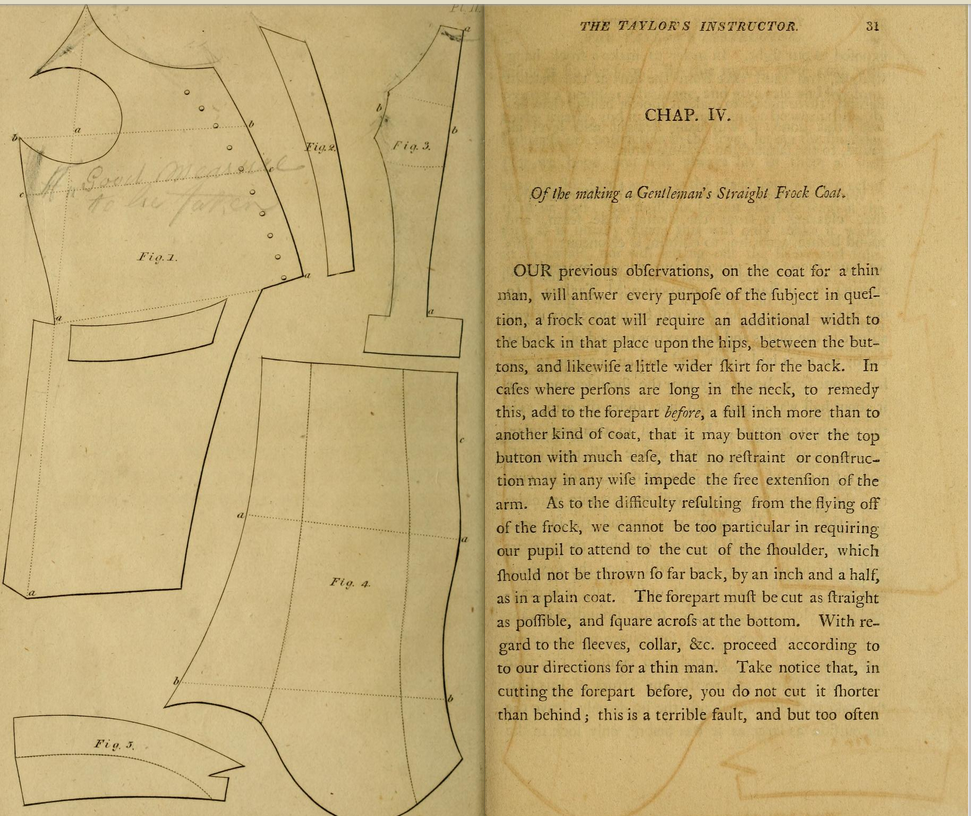
So who else was wondering what Mr Cooke meant by Lapsley and Queen? Wonder no longer, frustrated toile-makers and cuff-detail mavens, it is available on the vast interwebs of knowledge.

Go! Download the PDF and immerse yourself in an 1809 American tailors’ manual published in Philadelphia, with Eight Appropriate Engravings. We may note that there was excited squeaking when I located this, altering my nearest companions to A FIND, and letting them know that yes, I am back, and probably will continue to squeak on and off for some time to come.

From the introduction:

“…there is no situation more awkward than that of a TAYLOR who has cut and mutilated his own or his employer’s Cloth which will frequently be the case when a man has nothing to depend upon but the poor resource of chance or hope, that his clothes will fit.”

The Taylors' Instructor

The Taylors’ Instructor

I can tell from the text on Coats that my subjects will have to be further apprehended and measured, even against their will, but the results will undoubtedly be better than before.

Happy Reading, Historical Sewing Enthusiasts, and a big thank you and hat tip to Henry Cooke for the reference.

Share this:

  • Click to share on Facebook (Opens in new window) Facebook
  • Click to share on Pinterest (Opens in new window) Pinterest
  • Click to email a link to a friend (Opens in new window) Email
  • Click to share on X (Opens in new window) X
Like Loading...
← Older posts
Newer posts →

Archives

wordpress statistics

Creative Commons License
Kitty Calash blog by Kirsten Hammerstrom is licensed under a Creative Commons Attribution-NonCommercial-ShareAlike 4.0 International License.

Website Built with WordPress.com.

  • Subscribe Subscribed
    • Kitty Calash
    • Join 621 other subscribers
    • Already have a WordPress.com account? Log in now.
    • Kitty Calash
    • Subscribe Subscribed
    • Sign up
    • Log in
    • Report this content
    • View site in Reader
    • Manage subscriptions
    • Collapse this bar
 

Loading Comments...
 

    %d