• Home
  • Completed Costumes/Impressions
  • Emma and Her Dresses
  • Free Patterns and Instructions

Kitty Calash

~ Confessions of a Known Bonnet-Wearer

Kitty Calash

Tag Archives: museum collections

The Difference is…

28 Friday Feb 2014

Posted by kittycalash in Art Rant, Clothing, Museums

≈ Comments Off on The Difference is…

Tags

18th century clothes, authenticity, collections management, Costume, fashion, fashion plates, museum collections, Museums, sewing, style

I make this look good.

Robe à la Polonaise ca. 1775 British silk Length at CB: 56 in. (142.2 cm) Purchase, Judith and Gerson Leiber Fund, 1981 MMA 1981.314.1

Scrolling through Pinterest lately, I was struck by how different two presentations can make one gown look.

Above, a lovely Ikat-type silk gown with en fourreau back and trim, center front closing and probably a little closer to 1778 or 1780 than 1775.

It’s presented on a mannequin that supports the gown for photography and allows us to see it clearly, from the trim at the neck to the pleats down the back and the pleasant fullness of the skirt.

The gown is shown, we get the details.

And then, in another image, another view.

Robe à la Polonaise ca. 1775 British silk Length at CB: 56 in. Purchase, Judith and Gerson Leiber Fund, 1981 MMA 1981.314.1

In this image, the gown (and its companion) have been styled and accessorized, fichus, hats, ribbons, sashes. The skirt is more fully and completely supported, showing off the silk to even better effect. We lose the trim and pleating details, but the gown is much more attractive in this view.

This is not meant to criticize the images or the handling of the costumes, but to point out that you have to look past the plain record shots in museum databases, and see the gown as it would have been worn. Working with database images, and re-creating garments from those images, requires a leap of imagination.

The more you look (at database photos, exhibition photos, extant garments, fashion plates, other re-creations) the better you will be able to imagine the garment as it might have been, and to make it yourself.

To be fair, original garments cannot always be mounted in stylish and appropriate fashion, but they can still tell us something. The more you look, the more you’ll see.

Share this:

  • Share on Facebook (Opens in new window) Facebook
  • Share on Pinterest (Opens in new window) Pinterest
  • Email a link to a friend (Opens in new window) Email
  • Share on X (Opens in new window) X
Like Loading...

Consider the Collar

31 Friday Jan 2014

Posted by kittycalash in Clothing, Events, History, Museums, Research

≈ 5 Comments

Tags

18th century clothing, 19th century clothing, authenticity, dress, fashion, living history, museum collections, Museums, Newport, Newport Historical Society, Quakers, Research, Rhode Island, Rhode Island history, style

The Newport dresses seemed a little strange to me, in that the collar treatment was more like what I would expect to see on a pelisse than on a gown. But I am willing to be wrong, and delighted to be wrong if that’s how I will learn something.

Brown silk Quaker dress, Newport Historical Society, 20.4.1
Brown silk Quaker Dress, Newport Historical Society, D77
Morning dress, ca. 1806. American Cotton, wool. Length at CB: 54 in. (137.2 cm) Gift of George V. Masselos, in memory of Grace Ziebarth, 1976 MMA 1976.142.2
Morning dress ca. 1820. British. Cotton. Length at CB: 46 in. (116.8 cm) Purchase, Marcia Sand Bequest, in memory of her daughter, Tiger (Joan) Morse, 1979 MMA 1979.385.1

@silkdamask (that’s Kimberley Alexander’s twitter handle; she has a blog you might want to follow if you don’t already) posted a photo of the dress (above left) she imagined a young woman she’d been writing about might have worn. Housed at the Met, this embroidered American cotton and wool gown ca. 1806 has a cross-over bodice and collar.

Another day dress from the Met (above right) has a ca. 1820 date, but looks very much like the gown worn by Mrs Amelia Opie (she was a British Quaker) in this engraving after an 1803 portrait. (Other, similar gowns and portraits are pinned here.)

Amelia Opie (1769-1863). Engraving by Ridley after painting by [John] Opie, 1803. Massachusetts Historical Society, Photo. 81.490

Amelia Opie (1769-1863). Engraving by Ridley after painting by [John] Opie, 1803. Massachusetts Historical Society, Photo. 81.490

Nantucket and New Bedford  both hard large Quaker populations (remember Moby Dick?), and the Williams family in Newport had connections to New Bedford, so I looked in collections in Nantucket and New Bedford as well.

The gown below, now in the collection of the New Bedford Whaling Museum, was worn by Susan Waln Morgan Rodman (Mrs Benjamin Rodman), while pregnant; using a genealogy, we can establish pretty solid date ranges for the dresses at New Bedford Whaling Museum. It looks 1820s in style, and her first two children are born in 1821 and 1822.

Maternity gown worn by Susan Waln Morgan Rodman (Mrs Benjamin Rodman). New Bedford Whaling Museum, 1991.45.5.

Maternity gown worn by Susan Waln Morgan Rodman (Mrs Benjamin Rodman). New Bedford Whaling Museum, 1991.45.5.

A date range of 1820 to 1822 seems plausible. Susan Waln Morgan Rodman would have been about 20 with her first pregnancies. (Genealogies are on Google books.)

She seems to have kept up with style and to have liked clothes; a search for her name in the NBWM catalog returned some interesting items, though the catalog does not allow for linking to item records or searches. Mrs Rodman’s appears to have kept pace with style changes; that is, her wardrobe did not ossify in 1820-something, but evolved as fashions changed, and was appropriate for different situations.

Does that mean that all Quaker women kept pace with style changes? It’s hard to say; each of us today updates our wardrobe according to our fancy, our purse, our inclinations and our age. Are those Newport gowns going to turn out to look more like the Met gowns than I imagine? I don’t know, but it seems possible.

Share this:

  • Share on Facebook (Opens in new window) Facebook
  • Share on Pinterest (Opens in new window) Pinterest
  • Email a link to a friend (Opens in new window) Email
  • Share on X (Opens in new window) X
Like Loading...

Newport Friends

30 Thursday Jan 2014

Posted by kittycalash in Clothing, Events, History, Literature, Living History, Museums, Research

≈ 9 Comments

Tags

18th century clothing, 19th century clothing, authenticity, dress, fashion, living history, museum collections, Museums, Newport, Newport Historical Society, Quakers, Research, Rhode Island, Rhode Island history, style

Newport History, V 65, Part 1. Number 222.

Newport History, V 65, Part 1. Number 222.

I had a bit of a surprise when details emerged about the program Sew 18th Century and I will be doing in early March at her workplace. I’ve known about this since late October, but only started focusing on this last weekend, when I realized just how close March really is, and how much time I’ll be spending on well-chlorinated pool decks in February. I’m so glad I asked, because it turns out that we’re reading letters from a family of Quakers. I was not expecting Quakers, and had what is probably a completely inappropriate fabric in mind! (Off-white meandering red floral vines, to mimic a V&A gown.)

Still, there is no surprise that cannot be managed by research. There is an article about the family in Newport History, and they were kind enough to send it to me, and it arrived yesterday. Yay, mail in a small state! The article is helpful in providing context and family history, and there is even a photo, probably from a daguerreotype, of one of the women in the family.

Ruth Williams silhouette, Newport Historical Society, 91.14.4

So, what did Quaker women in Newport wear between 1800 and 1820? Lappet caps, for one thing. Lappet caps appear to have been a common cap in late 18th and early 19th century Rhode Island, and Ruth’s silhouette seems to bear that out.

These caps are also seen in many images of Quaker women, and borne out by the images in the collection where I work (sadly not appearing the catalog record, but still stable in the blog post on caps).

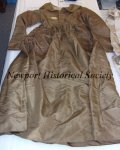
I can’t read letters in just a cap and a shift (it’s not that kind of event), so I need a dress. Newport Historical Society has two possibly Quaker gowns from the early 19th century, and they seem like plausible models.  But they raise questions quite aside from what you might find out by digging into provenance. What’s up with collars?

Brown silk Quaker dress, Newport Historical Society, 20.4.1
Brown silk Quaker Dress, Newport Historical Society, D77

The form, a brown or drab front-closing, high-waisted (but not too high) gown, with long sleeves and a pieced, shaped back, is consistent with images of Quaker women from the first quarter of the 19th century. The color and material (brown silk) is consistent with those images, and with earlier im,ages of Philadelphia Quaker women, and that all matches up with a gown that was worn by Sarah Brown of Providence. But the collar is curious, and without putting the garment on a dress form, it’s hard to tell exactly where the collar would fall, and how it would lie.

A Quaker's dress of greenish-brown taffeta American, Early 19th century. MFA Boston. 52.1769

A Quaker’s dress of greenish-brown taffeta
American, Early 19th century. MFA Boston. 52.1769

This gown at the MFA seems iconic to me, and I can imagine it underneath the white linen, cotton or silk kerchiefs and shawls of the portraits.

To learn more about Quaker aesthetics, I’ll be taking a trip down the hill to the RISD Library sometime this week, to look at books and articles. of particular interest is Quaker Aesthetics: Reflections on a Quaker Ethic in American Design and Consumption, 1720-1920. I’m also interested in an article by Deborah Kraak, Variations on ‘Plainness’: Quaker Dress in 18th Century Philadelphia. It’s not Newport, but at least it’s this continent.

I have read The Quaker: A Study in Costume, by Amelia Mott Gummere, and found it to be a pretty challenging work. It is possible that paint fumes made the writing seem more disjointed than it is, but I thought Gummere’s time-skipping references made it hard to follow the changes in Quaker dress in America, beyond what I do expect from a book published in 1901.

Share this:

  • Share on Facebook (Opens in new window) Facebook
  • Share on Pinterest (Opens in new window) Pinterest
  • Email a link to a friend (Opens in new window) Email
  • Share on X (Opens in new window) X
Like Loading...

Mischief Managed

21 Saturday Dec 2013

Posted by kittycalash in Events, Museums

≈ 1 Comment

Tags

collections management, libraries, museum collections, Museums, special collections

Providence during the Great New England Hurricane of 1938

Providence during the Great New England Hurricane of 1938

Who doesn’t wish they could wave a wand and make a collections emergency disappear? You have to be a serious masochist not to want that.

But as my architect says, Silver linings, silver linings.

Every disaster has a silver lining. We’ve had what we call a “water event” at work. That’s a terrible thing in a place full of historic and irreplaceable items. But there is good news!

1. We found it and contained it quickly.
2. We had rapid response from staff, building mitigation professionals, mechanical engineering contractors, and our architect.
3. No one was hurt.
4. Collections were moved off-site and into freezers rapidly.

We were lucky: we have an emergency preparedness plan and we’ve been through several smaller events both in the Museum and in the Library, so we know when to roll out the wet-vac, call the HVAC technicians, and call the NEDCC hotline. We know to make lists and document as we work. We know who is good at what, and how to work together, and we trust each other.

Because of our plan, our rapid response and super team, we were able to contain the problem and less than 1% of the affected items, which is phenomenally good fortune, were actually “wet.” Everything else was “damp.”

We’re also very lucky to have responsive vendors who are already familiar with our systems and our rules, and who we always pay on time. Some shared history) helps, too.

So, what will help you successfully manage your next emergency?

  • A response plan that you have updated, practiced and tested
  • Fully-stocked response kits
  • Clearly defined and understood team roles
  • Respectful relationships between team members
  • Excellent relationships with vendors you trust
  • Each of these things takes time to build. We’re re-vamping our kits now and have already seen improvements based on this experience. Why not make a New Year’s resolution to make a plan for home or for work? You’ll never regret it if you need it!

    Share this:

    • Share on Facebook (Opens in new window) Facebook
    • Share on Pinterest (Opens in new window) Pinterest
    • Email a link to a friend (Opens in new window) Email
    • Share on X (Opens in new window) X
    Like Loading...

    Breaking into Museums (for research, silly)

    14 Saturday Dec 2013

    Posted by kittycalash in Art Rant, Museums, Research

    ≈ Comments Off on Breaking into Museums (for research, silly)

    Tags

    libraries, museum collections, museum practice, Museums, Research, special collections

    Curator’s storeroom, World Rugby Museum

    So, how do you get into museums?

    Most of us come into through the front door, pay a fee or show a membership card, and enjoy whatever spectacle we’re after. Some of us like jelly fish, some of us like taxidermy, some of us like clothes.

    A universal constant for going behind the scenes is a specific, and not a general, request. You can say, “Show me all your spoons,” but not even please is going to help when there are thousands of spoons.

    I like researchers: they’re always interesting, they see the collections in ways I don’t, and they have insights that are valuable and useful. But someone who wants to see all the spoons, or all the chairs, or shoes, or fire buckets is really hard to help: There are too many of each of those things. Specific shoes, chairs, fire buckets or coats are manageable and realistic. “May I make an appointment to see spoon 1492.1.12, please?” is a question a curator, registrar, or collections manager can work with. One spoon, two spoons, five spoons, a few pairs of shoes: Studying these few things can take a great deal longer than you might expect.

    STEAM Museum of the Great Western Railway storeroom

    Think about it this way: in a Special Collections Library, you generally don’t begin with, “I’d like to see all your material on the Civil War.” For one thing, that will be a lot of stuff. Chances are good you won’t be interested in all (or even much) of it. What you’re really after is usually more specific. “All your home front diaries written by women over the age of 44,” or perhaps it’s “Battle accounts written by chaplains in the field.” Those requests archivists and librarians can and will gladly handle, and through a reference interview, can help you identify not just specific items on your topic, but help you think about your topic. But asking to see all the diaries (or anythings!) at once, is usually a non-starter. They’re all in separate collections, in separate boxes, on separate floors. Heck, I work in a place with hundreds of diaries, and I am pretty sure they’d call my therapist and the cops if I asked to see all the diaries at once. (Tempting thought that it is.)

    Once in my life have I seen “all the somethings” pulled out from storage in a museum.  The Curator of  Photographs and Prints and a visiting (contracted) scholar were selecting daguerreotypes for an exhibition, and in my very junior role as the Curatorial Assistant, I got to pull out all the daguerreotypes by Thomas M. Easterly and help spread them out on an enormous mahogany table. I’ll never forget how beautiful that was, and how special, to see so same silvered plates and brass mats spread out on a dark surface. If this link is stable, you can get a sense of what it was like. Once, in a quarter century of working in museums. Sad, isn’t it? more people should get this chance, but it’s rare. However, this rule is in place for the preservation and security of the objects.

    Yes, I want this wall of chairs. The Röhsska Museum, GÖTEBORG, Sweden

    These kinds of restrictions are part of why museums have open storage, and it’s why I wish we could have open storage. But most museums don’t, so the key to getting into the storerooms (or the research rooms) is to ask the right way. I did a presentation on the process, and there’s more good advice over at the Still Room Blog.

    Always, in museums or in libraries, if there’s a catalog, start there! You can narrow down your choices with database searches and questions in advance so that you can make the absolute most of the time you have. Your time is precious. Focusing in on what you really want to see will help the museum’s staff help you better. And if you really enjoy a collection, please consider supporting it financially, with a donation to a collections care fund, annual fund, or a membership. Your dollars count, they’re noticed, and they’re truly appreciated.
    Share this:

    • Share on Facebook (Opens in new window) Facebook
    • Share on Pinterest (Opens in new window) Pinterest
    • Email a link to a friend (Opens in new window) Email
    • Share on X (Opens in new window) X
    Like Loading...
    ← Older posts
    Newer posts →

    Archives

    wordpress statistics

    Creative Commons License
    Kitty Calash blog by Kirsten Hammerstrom is licensed under a Creative Commons Attribution-NonCommercial-ShareAlike 4.0 International License.

    Website Built with WordPress.com.

    • Subscribe Subscribed
      • Kitty Calash
      • Join 621 other subscribers
      • Already have a WordPress.com account? Log in now.
      • Kitty Calash
      • Subscribe Subscribed
      • Sign up
      • Log in
      • Report this content
      • View site in Reader
      • Manage subscriptions
      • Collapse this bar
     

    Loading Comments...
     

      %d