
• Home
  • Completed Costumes/Impressions
  • Emma and Her Dresses
  • Free Patterns and Instructions

Kitty Calash

~ Confessions of a Known Bonnet-Wearer

Kitty Calash

Tag Archives: Museums

Death by a Dull Board

10 Wednesday Oct 2012

Posted by kittycalash in Museums

≈ 3 Comments

Tags

boards, management, Museums, non-profits

The New Parliament Pudding, Met Museum

On Monday, The Still Room Blog had a fun post about murder mysteries set in museums, and the dearth of deaths of collections managers and registrars because of their low profile. If no one knows you exist, how can you get killed off in fiction?

Well, folks, here’s how: turn a non-profit board loose in a room with the general figures that appear in an annual report, and ask them a ‘fictional’ question about cutting money from an NPO’s budget. Ask, “What program would you cut?” Be sure not to give them a list of programs or detailed financial information, but only the kind of broad-stroke, simplified information that is publicly available.

Guess what they’ll cut? They’ll cut the non-public functions of the museum program because it’s non-public. (I feel nauseated as I type those words, just as ill as I felt last night.) And after all, it’s reversible! They can always hire other curators, collections managers, photographers, registrars. Cataloging gets put on hold, so what? There are still all the displays up in the house museum–and that’s all it is, a house museum, not a real museum–so we can have those positions again if things improve. We just stop collecting objects, but that’s OK, because after all, we’re not a museum!

It’s enough to make a cat laugh, and a curator, collections manager, registrar, or photographer vomit.

It was an interesting choice, made primarily because the objects were perceived as having no constituents, and those who existed didn’t matter–what do we care about the experts at Yale or Winterthur, or the Met? What do we care about the curators at the regional museums? They’re the elite, and we’re not pandering to them.

Seriously.

I’m no Wendy Cooper or Morrie Heckscher (though I have met Mr. H and moved furniture with him in my museum, and my mother knew his father) but I suspect that the group I was with last night would let them go, too, in an “academic” exercise. After all, they could consult when needed–for a fee, of course, take it or leave it–and that would be a savings. See? Win-win.

Just to be clear, it was only an exercise last night, and nothing more. But it was highly instructive in the ways that boards function when they do not fully understand how museums work (they think the Director of Education does all the exhibits) and how important is it for collections managers, registrars, and digital imaging specialists/photographers and yes, even curators, to make clear and public what they do. Without those people, museums will not know what they have, where it is, who gave it to them, or what it looks like. They also will not know where, in other museums, there are related objects and make the connections between local, regional, and national collections.

Who else will tell you the stories of the objects, and how they relate to one another?
Who else will assemble the material, physical evidence of the past?
Who else will connect you to a real object, provide you with an authentic, meaningful experience?

I hope I don’t get to find out, because I think one of the board members once suggested Boy Scouts could catalog the collection.

Remember, it was only a exercise. Instructive, though, and urgent: behind the scenes workers need to raise their profile and explain what they do, and why it’s important. Cataloging librarians, this means you, too.
Share this:

  • Share on Facebook (Opens in new window) Facebook
  • Share on Pinterest (Opens in new window) Pinterest
  • Email a link to a friend (Opens in new window) Email
  • Share on X (Opens in new window) X
Like Loading...

History Dress-Tease

06 Saturday Oct 2012

Posted by kittycalash in Clothing, Events, Making Things, Museums

≈ 2 Comments

Tags

Clothing, Costumes, Events, Museums, Reenacting, Revolutionary War, Rhode Island, Rhode Island Historical Society

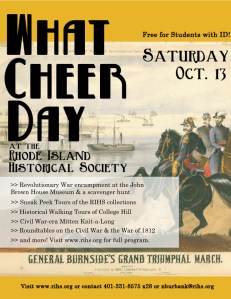
What Cheer! Day is a week away, and exactly a week from now, at 6:30 AM, I will get into my B&G guy’s truck and head into the site. We’ll measure and tape out camp sites, fire pit sites, and safety lines, bring wood and gear out from the woodshed and basement. We’ll put out the handicapped parking only sign in the parking lot, drop the orange cones (I love the thick flexible plastic of a traffic cone), and drink some coffee. I haven’t decided at what point I’ll start to fret in earnest that day, but the trick to not fretting will probably be to get dressed in 18th century clothes as soon as we are done carrying items upstairs, because then I will have to take off my watch. Watches lead to fretting: there’s administrator time, and re-enactor time, which is more like artists’ time. Better to take off the watch and get closer to the past.

Half-pleated skirt, sleeves in progress

At the School of Instruction, I thought the “People of the Brigade” program worked well; at OSV, I really appreciated  the Military Fashion Show (I did not make it to Runaway Runway). Using these models, and knowing about the School of Instruction’s Women’s Dress program, I thought we’d combine these ideas. I don’t have a good name for the program yet, but the reason I’m going so nuts about the dress from 1774 is that I plan a “History Dress-Tease:” starting in shift, stays, stockings and shoes, I’ll demonstrate all the layers my runaway wore: 2 petticoats, pockets, dress, stomacher, apron, cap, bonnet.

Any soldiers I can convince to get down to small clothes and layer up with waistcoat, coat or frock, canteen, cartridge box, bayonet scabbard, haversack, knapsack, hat and musket, will demonstrate the gear they carried. I thought about a weigh-in, to record how much it all weighs, but my scale is a pathological liar, and varies by 4 pounds from one side of the room to another.

All this work has an educational, and not merely sartorial, purpose. Now, if only the public will come…

Share this:

  • Share on Facebook (Opens in new window) Facebook
  • Share on Pinterest (Opens in new window) Pinterest
  • Email a link to a friend (Opens in new window) Email
  • Share on X (Opens in new window) X
Like Loading...

Remembrance of Transit Past

02 Tuesday Oct 2012

Posted by kittycalash in History, Museums

≈ 1 Comment

Tags

history, Museums, trains

Yesterday was staff day at work.  We went, by donated careening bus ride, to the Essex Steam Train & Riverboat. We did not get a ride in a steam-powered seaplane, but the combination of bus, train and boat was pretty entertaining. More sitting than most of us care for; one member of our party said, “This is an old person’s tour–it’s all sitting.” She’s practically a professional shopper, so she’s good on her feet in fairly high heels.

But what struck me, standing by the platform at the station is Essex, was that we were in a museum of transport past, and that it was somehow very strange to be in a place that historicized a means of getting around that many people still use every day. Except for the 6 tons of coal part, my husband takes the train to Boston every day, and has for more than 10 years. And when we first moved back East, I rode the train, too. In the dark ages of grad school, I commuted by rail. The last year at RISD, I had a job in Natick, MA, teaching at a boarding school as a visiting artist, and the question was, how to get there?

The answer was easy, the MBTA of course. I took the commuter rail to Back Bay or South Station, caught the Framingham line out to Natick and walked up the hill from the station to school. Sometimes I’d get there early enough for lunch, and pack extra grilled cheese sandwiches into my tool bag.

I liked the train commute and some of my favorite memories of pulling into Providence are from that year. The conductors were more lax, then, and would let me ride in the vestibule with them while the car door was open, watching the sunset over the west side of town. This was pre-Home Depot and Providence Place Mall and the 6-10 connector, pre-development along Royal Little Drive, pre-development in Pawtucket, so the view was a lot better. The Citizens Bank building was still under construction, it was just a steel frame that the sun would shine through at the end of the day.

All through school, I took the train to New York and then to Philly, enjoying the view of the CT coastline, its loneliness and isolation, the kind of romantic juxtaposition of the marshes and wetlands with the harsh rocks and cold grey skies of the coast. There was a little house the train passed, and every time I saw it I would think, “Someday I’d like to live in that house.”

That never happened, but when I got the job in RI, and we moved east from St. Louis, my father was working in Boston and New York, but living in Noank, CT,  just down the road from the little house. Providence was 45 minutes away by car, but Mr S and the Young Mr (then known as the Monkey) needed the car to get anywhere outside of Noank. The grocery wasn’t very big there and they needed to be able to get into Groton and Mystic, so how was I to get to work? On the train.

I took Amtrak from New London to Providence, and the train would get in around 9:10 (supposedly) and end up back in New London around 6. There were schedule changes, and the bridge at Old Saybrook tended to freeze, and there were coworkers who  didn’t get me to the station on time, and evenings spent at the RISD Library on the laptop waiting for the next train. It worked out, though, since I was writing a book at the time.

The monthly pass that was definitely cheaper than driving, and I walked around Providence when I needed anything. The conductors all knew me, and were very kind. Here’s a tip: be nice to the conductors, and you can ride free if you forget your pass. I’ve even gotten free trips to Boston when they were on duty. The view from the window was pretty much the same, though now there were McMansions and condos in Stonington. The wetlands were still there, and the coves, the nesting raptors and the shore birds. One morning I even saw a harbor seal swimming in a cove, whiskers poking up above the surface. That is definitely the coolest thing I’ve ever seen on a commute.

And then there was a museum to set all that in the past, as if to say that way of life is over. The train we were on was truly steam-powered, and that is a thing of the past. The car was from 1914, with seats that switched direction, though I remember riding on seats like that either on the MBTA back in the dawn of time, or else in Chicago.

What will I do next? Why, make a 1914-1919 traveling costume and go back to Essex to ride the train again, of course. Might as well be a museum exhibit if you’re going to travel temporally.

Share this:

  • Share on Facebook (Opens in new window) Facebook
  • Share on Pinterest (Opens in new window) Pinterest
  • Email a link to a friend (Opens in new window) Email
  • Share on X (Opens in new window) X
Like Loading...

Support Your Local Museum

26 Wednesday Sep 2012

Posted by kittycalash in Museums

≈ Comments Off on Support Your Local Museum

Tags

Museums, resources

I have the sense of two groundswells about to converge: one about museums, libraries and archives limiting access by closing or charging fees, and one about museums spending money on things they shouldn’t. There has been a lively conversation among fellow former-employees about a midwestern museum’s purchase of a piece of real estate. It is a tawdry tale, and seems a grand waste of money and goodwill.

Then there are the libraries that have closed, and the state archive that is closing to the public. And the small historical organization that charges per hour for research visits. And the place that charges a daily research fee for non-member, out-of-state residents.

ETA: New York Times coverage today of the upcoming closing in Georgia.

Folks, when you hear the word culture, you need to take out your checkbooks.

If you can “do a google,”  you can figure out who I am. But what do you think I do all day? Do you think I pattern dresses, or catalog muskets, or research painters, or study the stylistic changes in mahogany tea tables over a 30-year span?

I wish.

Do you think I wet-vac basements, change HOBO or PEM batteries, monitor and adjust air handling unit fan speeds, read boiler specs and warranty info, or keep on eye on carpenters?

Each day, I do some of those things, and some of the content-related things.

But mostly I think about money. If I don’t think about money at work, it wakes me up at night. What if I don’t get that green buildings grant? Where will I get that $78,000 for well drilling? How much does it actually cost to page each item requested in the Library? Will we ever be able to microfilm newspapers again? What do we do when the money for boxes runs out–there isn’t any more grant money after we spend this. Is there another grant I can write? How much of that $100,000 budget cut has to come out of my budgets? What will we have to stop doing?

I wake up every day at about 4:00AM, and get up by 5:00; vertical is less panicky than horizontal.

The answer to most of this is money. There’s another groundswell out there to kill the NEH, and what the heck, if places can’t make it on what they can raise, let ’em die.

Really? This is what our history has come to?

Do you know how you can help? The single most important thing you can do to make sure your history is accessible, your favorite museum stays open, your favorite objects are up online?

Join. JOIN your favorite museum. It’s probably pretty cheap. You can join mine for $40. This is such a deal. You get free admission, a magazine, a newsletter, email updates, and the knowledge that you’re helping us, we know, and we appreciate it. Want better catalog records? Become a member, and donate to an annual campaign. Write a check for a museum to buy a better camera. To buy an external hard drive for image back up. Write a check to support archival supplies. Or insurance. Or a new carpet for a gallery. Or to replace a battered book.

Every dollar counts. So does every member.

If you want to know how your museum spends its money ETA: and where it gets its money, in the US you can look them up on Guidestar. There you’ll find the 990s for most 501(c)3’s in the states. This is how I know which place in my state has a budget ten times as large as my museum’s, and which place has one 10% the size of mine. Guess which one I joined.

Share this:

  • Share on Facebook (Opens in new window) Facebook
  • Share on Pinterest (Opens in new window) Pinterest
  • Email a link to a friend (Opens in new window) Email
  • Share on X (Opens in new window) X
Like Loading...

What time is that dress in the museum?

21 Friday Sep 2012

Posted by kittycalash in Clothing, History, Museums

≈ 2 Comments

Tags

Clothing, Museums, Research, resources

Guess what: they might not know for sure. Many garments donated to museums are given without clear dates, especially older garments donated in the 20th and 21st century. That means that dating the garments is, well, tricky.

You can find many dated to 1776 by donors. Everybody wanted to be associated with such an important event…especially around 1876, and 1976. Where I work, a dress like the one to the left was given to us with the firm statement that the fabric had been brought from England to RI (how did that work with Newport blockaded?), and that the dress was from 1776. Clearly, it is not.

To the right is Deborah Sampson’s dress, possibly her wedding dress: Don’t know who she was? Read here.

Deborah Sampson’s is a closed-front round gown. Look at the catalog record, and you’ll also note the date: 1760-1790, a thirty-year spread. Why is this? Fabric gets remade, for one thing. Deborah Sampson Gannett’s dates are 1760-1827, so if this is her dress, we know she didn’t wear it in this size or style in 1760. But fabric can easily pre-date a garment. The V&A sometimes had three dates for their Spitalfields silk gowns: the date of the fabric, the date it was first made into a garment, and the date it was altered into a new style.

Sampson marries in 1785. That seems like a plausible date for this dress, given its style. That’s where the 1790 comes in; yes, it could be that late, it’s conservative in New England and makes a nice ending to a “circa” date. So how else might this dress be dated? 1785-1790? 1780-1790, fabric possibly earlier? Given the database I know HNE uses, the date field is a little tricky (we use the same one). If I were to catalog the dress, I think I’d use 1783-1788. Why 1783? Because we know Deborah Sampson was probably not wearing dresses in 1783: she was in the Army roughly 1778-1783. I’d add 5 years to that because it encompasses the date of her marriage, 1785, and indicates that I’m not convinced or have no firm documentation that this was in fact her wedding dress. That’s just how I would approach this if the dress was in my museum and is not intended as a criticism of HNE’s cataloging. And it’s not to suggest that my own catalog records don’t need work, because they do.

What does this mean for researchers and costumers? When I do research, because I know how the process can work, it means I’m often skeptical, or wish that the reasoning behind the date was explained—especially behind a 20 or 30 year range. It also means you have to fact check yourself, with independent verification. For that, I use period images, which I’ll explore in another post.

Share this:

  • Share on Facebook (Opens in new window) Facebook
  • Share on Pinterest (Opens in new window) Pinterest
  • Email a link to a friend (Opens in new window) Email
  • Share on X (Opens in new window) X
Like Loading...
← Older posts
Newer posts →

Archives

wordpress statistics

Creative Commons License
Kitty Calash blog by Kirsten Hammerstrom is licensed under a Creative Commons Attribution-NonCommercial-ShareAlike 4.0 International License.

Website Built with WordPress.com.

  • Subscribe Subscribed
    • Kitty Calash
    • Join 621 other subscribers
    • Already have a WordPress.com account? Log in now.
    • Kitty Calash
    • Subscribe Subscribed
    • Sign up
    • Log in
    • Report this content
    • View site in Reader
    • Manage subscriptions
    • Collapse this bar
 

Loading Comments...
 

    %d