• Home
  • Completed Costumes/Impressions
  • Emma and Her Dresses
  • Free Patterns and Instructions

Kitty Calash

~ Confessions of a Known Bonnet-Wearer

Kitty Calash

Tag Archives: newspapers

Aspirational Shopping

11 Saturday May 2013

Posted by kittycalash in History

≈ Comments Off on Aspirational Shopping

Tags

18th century, 18th century clothes, advertising, common dress, consumer culture, historical myths, history, newspapers, Providence, Research, resources, Rhode

So, I always thought that window shopping was a product of the late 19th or early 20th century, the plate glass windows of the Bon Ton, and The Lady’s Paradise.

Providence Gazette and Country Journal, 4-18-1772

Providence Gazette and Country Journal, 4-18-1772

I was wrong.  Check out the last line in this ad from the Providence Gazette and Country Journal of April, 1772:

“Any Person not wanting to purchase, but having a Mind to see the greatest Pennyworths, shall be waited on with great Chearfulness, by their very humble Servant, PAUL ALLEN.”

In case we forget, the past is there to remind us that the consumer culture started much, much earlier than we think it did. Stop blaming Don Draper: I give you Paul Allen.

Share this:

  • Click to share on Facebook (Opens in new window) Facebook
  • Click to share on Pinterest (Opens in new window) Pinterest
  • Click to email a link to a friend (Opens in new window) Email
  • Click to share on X (Opens in new window) X
Like Loading...

Chintz? Check!

10 Friday May 2013

Posted by kittycalash in 1763 Project, Clothing, History, Research

≈ 4 Comments

Tags

18th century, 18th century clothes, advertising, fabric, newspapers, Providence, Rhode Island

Les Fleur d' Inde

Les Fleur d’ Inde: delicious!

Because I am prey to a pretty print as much as the next princess costume blogger tenant farmer’s wife, I thought I should go  looking for evidence before I launch into any cotton sacques, and to justify the use of the print remnant I’m stitching up into a jacket. (Apologies in advance to my friend who bought enough for a gown, because you know we’ll wear them to the same event…)

Providence Gazette and Country Journal, March 16, 1765

Providence Gazette and Country Journal, March 16, 1765

American Historical Newspapers to the rescue, once again. Here’s an ad for Alexander Black and Archibald Stewart, from the Providence Gazette and Country Journal of March 16, 1765.  Chintz and calico: it’s here in Providence in 1765. I knew there were merchants selling calicoes and chintzes in Providence in 1768 (including Samuel Young, who printed his broadside in red).

Chintz and chip hatsThree years later, Joseph and Wm. Russell at the sign of the Golden Eagle are selling (lately imported from London and Bristol) “A neat and genteel assortment of dark ground calicoes and chintz.” This ad runs to four columns in the Providence Gazette and Country Journal, 1768, April 9. It’s a tantalizing list, and no, I did not miss those chip hats and bonnets!

forks!

Digression: I was attracted to this bit about forks as I recall being told by a historic house tour guide once that “forks were not in common use until the Civil War.” It’s an early house, maybe he meant the English Civil War, but I think forks were here to stay and be bought for a variety of prices long before the American Civil War. How else to explain those archaeological finds that show forks of some kind at Rev War forts and camp sites? /Digression. New digression: OMG, knitting needles! /New digression.
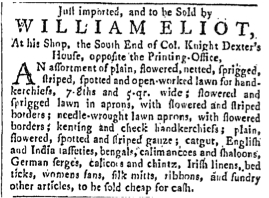
William Eliot

Back to chintz: Here, in 1771, is William Eliot, selling chintzes in Providence, and advertising in the Providence Gazette and Country Journal of June 1, 1771. He also has “flowered and sprigged lawn in aprons,” and Kenting and check handkerchiefs.  (Kenting was a fine linen fabric)

In the limited search I ran (1754-1783 newspapers), plenty of references to chintz appear in Providence alone (there were 166 hits, but the ads repeat). This completely unscientific approach in which I stopped looking in 1771*, has turned up 5 merchants, if you count the RIHS Library’s broadside for Samuel Young. Chintzes and calicoes were everywhere. Dark grounds were “genteel,” checks and spots and stripes are popular and common.

Paul Sandby, London Cries: Black Heart cherries... ca. 1759. YCBA,  B1975.3.206

Paul Sandby, London Cries: Black Heart cherries… ca. 1759. YCBA, B1975.3.206

I begin to see 18th century Providence, if not all of the Colonies, as a variegated, kaleidoscopic place of pattern and color. I think there was more than we realize, even if only in small amounts.

Look again at the cherry seller: her petticoat is yellow and blue, if not yellow, blue, and white striped,  her apron is blue, her stockings brown or faded reddish, her cap is affixed with a pink or red ribbon, and she wears a checked kerchief. She’s poor and sort of faded, but she’s colorful–more colorful, perhaps, than we have credited.

*I do have to head out to work, but I can search again.

Share this:

  • Click to share on Facebook (Opens in new window) Facebook
  • Click to share on Pinterest (Opens in new window) Pinterest
  • Click to email a link to a friend (Opens in new window) Email
  • Click to share on X (Opens in new window) X
Like Loading...

In the Grip of La Grippe

07 Tuesday May 2013

Posted by kittycalash in History

≈ 2 Comments

Tags

18th century, catarrh, contagion, illness, la grippe, newspapers, Research, resources

lwlpr13377

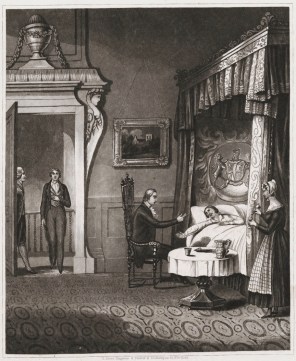
The Life of a Nobleman: the sick room, LWL call no.
830.00.00.73+

I had a cold this week past, and quite miserable it made me, too. It got me thinking about illness, and historical perceptions of illness.

I love words, and old words are best, and one of my favorites has long been catarrh. It sounds just like what it is. The Times (another one of my loves) has a hilarious column on the subject, originally published in 1865. It makes me want to write a chapbook, “Letters on Cattarh.” The first known use of the word is in the 15th century, so chances are good it turns up in 18th century usage. In fact, it turns up in the Boston Post Boy of Jan 1 1736 not as a cause of death, but as the reason for the state of George Bethune’s lungs.

Scanning America’s Historical Newspapers (yes, I do this for fun) turns up more than 1,400 hits before 1783 alone for “illness,” most resulting in death, though some are described as past, and disfiguring. My money’s on smallpox for those.

Providence Gazette and Country Journal, 1768.

Providence Gazette and Country Journal, 1768.

Catarrh turns up 27 times. Here it is in the Providence Gazette and Country Journal of 1768. It’s from an extract of the minutes of the American Society, held at Philadelphia, for Promoting Useful Knowledge. I can imagine the gentlemen sitting with pipes and punch bowl, grumbling to each other, “We can send a ship to Suriname, but we can’t cure the common catarrh.” Or perhaps it is the ladies who say it, as the gentlemen come stumbling home from the meeting to Promote Useful Knowledge.

La Grippe

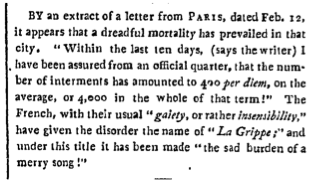
La Grippe, as experienced by poor Adelaide, is influenza. The etymology suggests a 1770-80 French origin, from gripper, to seize suddenly. That’s pretty descriptive, if you’ve ever had flu. La Grippe turns up in the index of the Philadelphia Repository and Weekly Register, January 1, 1803, as “prevalent at Paris,” and on April 9, 1803, we can read the little article about it.

On April 11, 1803, in the Alexandria Advertiser and Commercial Intelligencer there appears an “Extract of a private letter” describing interments of 400 per day, and 4000 in a ten-day period. This was serious, serious stuff. Facing illness today, we’re so much better off than people were in 1803, or even 1903. Germ theory is only 150 years old at the most, and really, thank goodness for it.

For more on the various diseases and epidemics of the past, I give you the Contagion database from Harvard. It’s an excellent collection of articles and links to additional reading, from smallpox to influenza. I feel better already.

Share this:

  • Click to share on Facebook (Opens in new window) Facebook
  • Click to share on Pinterest (Opens in new window) Pinterest
  • Click to email a link to a friend (Opens in new window) Email
  • Click to share on X (Opens in new window) X
Like Loading...

Runaway Styles

21 Saturday Jul 2012

Posted by kittycalash in Clothing, History

≈ 1 Comment

Tags

Clothing, Costume, newspapers, Research, resources

Many thanks to Becky Fifield (The Still Room Blog) for revisiting the article she published last year on her amazing Runaway Clothing Database (RCD). It is available now as a downloadable PDF from the publisher’s website. I devoured it for its systematic look at classifying–cataloguing, really–not just the runaways themselves, but their articles of clothing.

What Becky did with nearly 900 ads was to create catalog records for each woman who ran away, as well as her clothing. It’s a phenomenal project, and one that works well now, in an age of computer databases and improved cataloguing nomenclature. It is also a testament to dedication and love: the amount of time to construct the database and enter all the records is significant. That’s hours, tens of hours, of work before the fun part of analyzing the data can begin.

Kudos to Becky, for hard work and inspiration!

Share this:

  • Click to share on Facebook (Opens in new window) Facebook
  • Click to share on Pinterest (Opens in new window) Pinterest
  • Click to email a link to a friend (Opens in new window) Email
  • Click to share on X (Opens in new window) X
Like Loading...

Vogue for the Lower Sorts

01 Friday Jun 2012

Posted by kittycalash in Clothing, Reenacting

≈ Comments Off on Vogue for the Lower Sorts

Tags

ads, Clothing, common dress, newspapers, Research, Rhode Island

How does a reenactor know what to wear? There’s a wide range of choices for any decade, so how do you know what’s right?

Well, you don’t, not without documentation. This is where it can be nice to be a soldier. There’s griping in my house about “plain old white linen grumble frocks grumble waistcoat grumble” but really, the man and boy know who they are and what to put on. (Doesn’t stop them wanting regimentals, and I know they’re casting sidelong covetous glances at British coats.)

What about the women? The range is vast, from Mr. and Mrs. Ralph Izard

to the  Oyster Seller.

Both are ca. 1775, though the original Oyster Seller was probably earlier, but here’s the thing: how differently would she have dressed in 1775 than she would have in 1765?

It’s a point taken up, to a degree, in The Dress of the People, which I devoured in the orthopedist’s waiting room yesterday.

So if you know you’re not Alice Delancey Izard, but you’re not really an oyster seller, either, what do you do?

You check the ads.

I search runaway ads for Rhode Island to check my choices. That’s how I came to make a blue wool cloak, because I found Lucy, who ran away in December 1776 in a “blue Baize cloak.” There was Polly Young, who ran away in June, 1777, in a “black skirt petticoat and a short calico gown with long sleeves.” What did that short gown look like? I wish I knew. But it does place short gowns in Rhode Island (Lucy wore a short striped Dark Flannel gown when she ran away). Now, if only we knew what “short gown” meant in New England.

Share this:

  • Click to share on Facebook (Opens in new window) Facebook
  • Click to share on Pinterest (Opens in new window) Pinterest
  • Click to email a link to a friend (Opens in new window) Email
  • Click to share on X (Opens in new window) X
Like Loading...
Newer posts →

Archives

wordpress statistics

Creative Commons License
Kitty Calash blog by Kirsten Hammerstrom is licensed under a Creative Commons Attribution-NonCommercial-ShareAlike 4.0 International License.

Website Built with WordPress.com.

  • Subscribe Subscribed
    • Kitty Calash
    • Join 621 other subscribers
    • Already have a WordPress.com account? Log in now.
    • Kitty Calash
    • Subscribe Subscribed
    • Sign up
    • Log in
    • Report this content
    • View site in Reader
    • Manage subscriptions
    • Collapse this bar
 

Loading Comments...
 

    %d