• Home
  • Completed Costumes/Impressions
  • Emma and Her Dresses
  • Free Patterns and Instructions

Kitty Calash

~ Confessions of a Known Bonnet-Wearer

Kitty Calash

Tag Archives: personal

A Six Word Story

14 Monday May 2018

Posted by kittycalash in personal

≈ 17 Comments

Tags

cats, personal

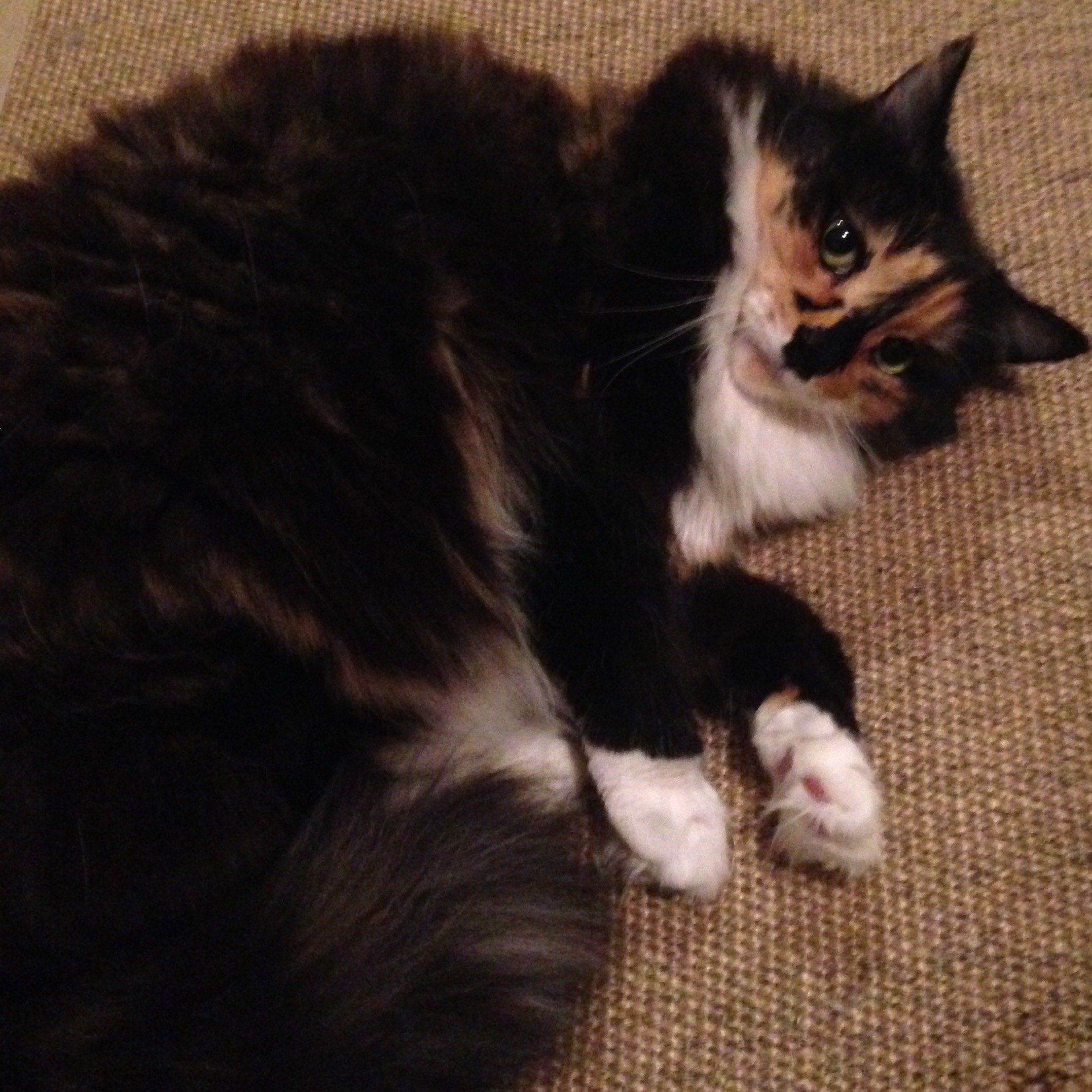
Lady Cat, AKA Lucky Edie, in her floofy prime

Six word stories. They’re foundation exercises in many writing classes, especially flash fiction classes. The most famous is probably Hemingway’s: “For sale: baby shoes, never worn.” So much packed into those six words, eight syllables. You can imagine a family, a room, clothes, a place of worship, a coffin, emotions. (Or a family, a room, an angry child, bare feet, and a pair of rejected multi-coloured sneakers if you’re me, who had a child who channeled his great-grandmother and thus was incredibly picky about his shoes at 16 months and refused to wear anything except solid red Keds.)

But I digress.

I have a six word story for you: My cat is dying of cancer.
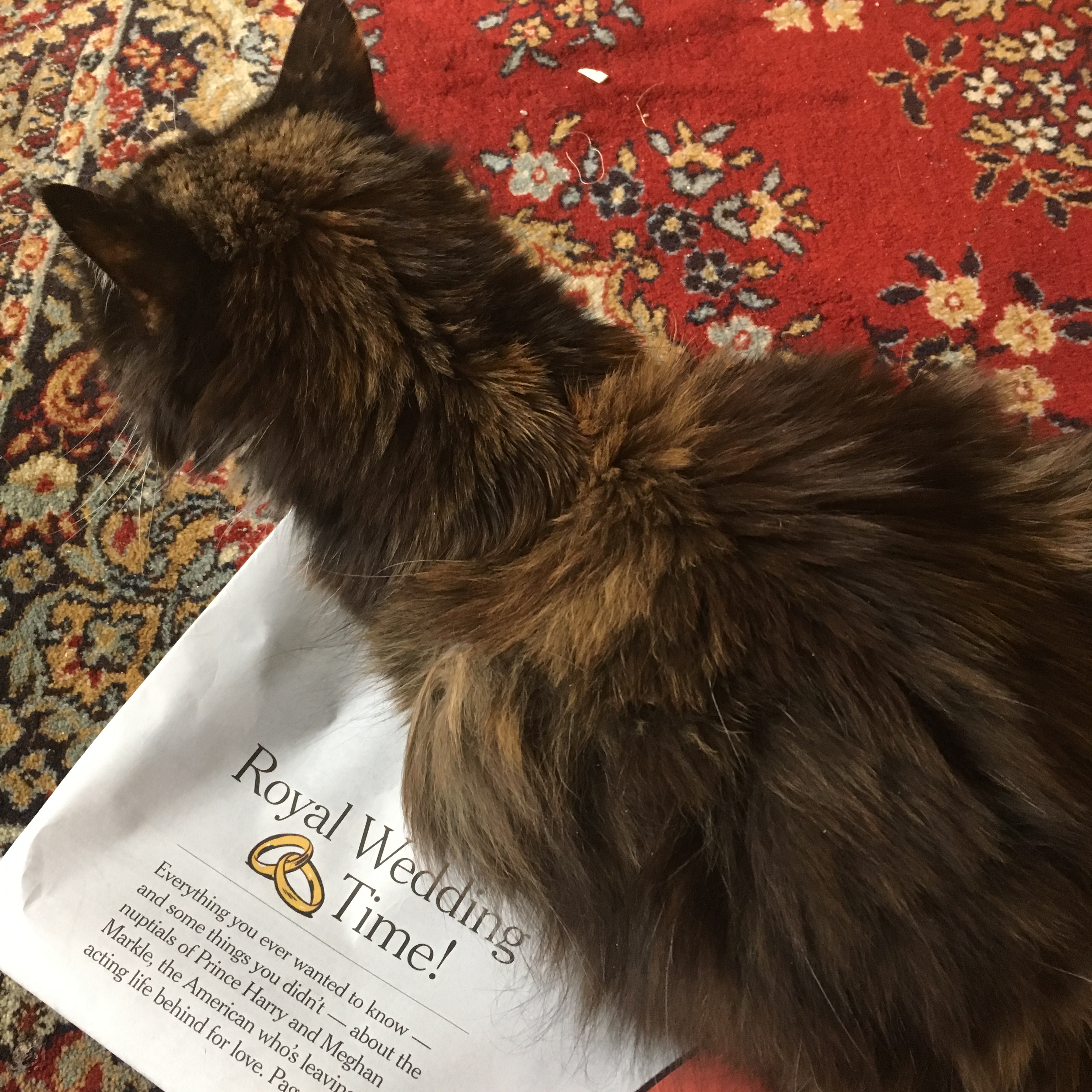
Lady Cat on Sunday

Lady Cat, Lady Bird, Flirty Birdie, Lady Fat, Lucky Lady, Lucky Eatie: She has had many names since we scooped her up from the back yard of our Smith Street 3-decker in 2005 and brought her on up to the East Side (it is possible to literally re-enact The Jeffersons’ theme song in Providence). She was born under a sheet of plywood against a garage behind our house, one of three fluffy kittens born to a short-haired calico mother. She and her litter mates were like a dessert tray: one fluffy and biscuit coloured, warm, light brown; one, vanilla-cream coloured, soft ecru; and Lady, rocky road ice cream, pastry, caramel, cream, and chocolate, with a stripe down her nose like a monkey.

Lady and Socks: prelude to peace

She wasn’t easy to catch, but I managed, on the very last day we would ever be in that apartment, caught her and wrangled her into a cat crate where she spun around like the Tasmanian Devil in the Bugs Bunny cartoons. Eventually she settled down to watching me and the movers hustle the last pieces out of basement on onto a truck, and made the trip over the river and up the hill to a new, larger house.

As my son struggled with spelling homework, Lucky Lady and her arch-nemesis Whiskers (the cat who lived in the house behind us) became the stuff of legend– Whiskers more than Lady, but every week, as Whiskers stole doughnuts from dinosaurs, was stopped by the police, or generally misbehaved, Lucky Lady would often save the day, once by socking Whiskers with her powerful paw. Whiskers and Lucky saved us from second grade.

Dignity. Like Gene Kelly– and just as acrobatic.

Found feral, she was never fully tame, though she made decisions about not venturing outside in the snow again (after a night out in the cold) and she learned not to jump against the screens trying to get at Whiskers (she fell out of the first floor window once). We brushed her, and she adapted after the first few times, when she hissed and bit at the brush. She loved catnip, and eating feathers (I learned to keep my millinery supplies in a cupboard), and chewing wool (I learned to keep my wool in a cupboard). She learned, and we learned, and she is ours and we are hers.
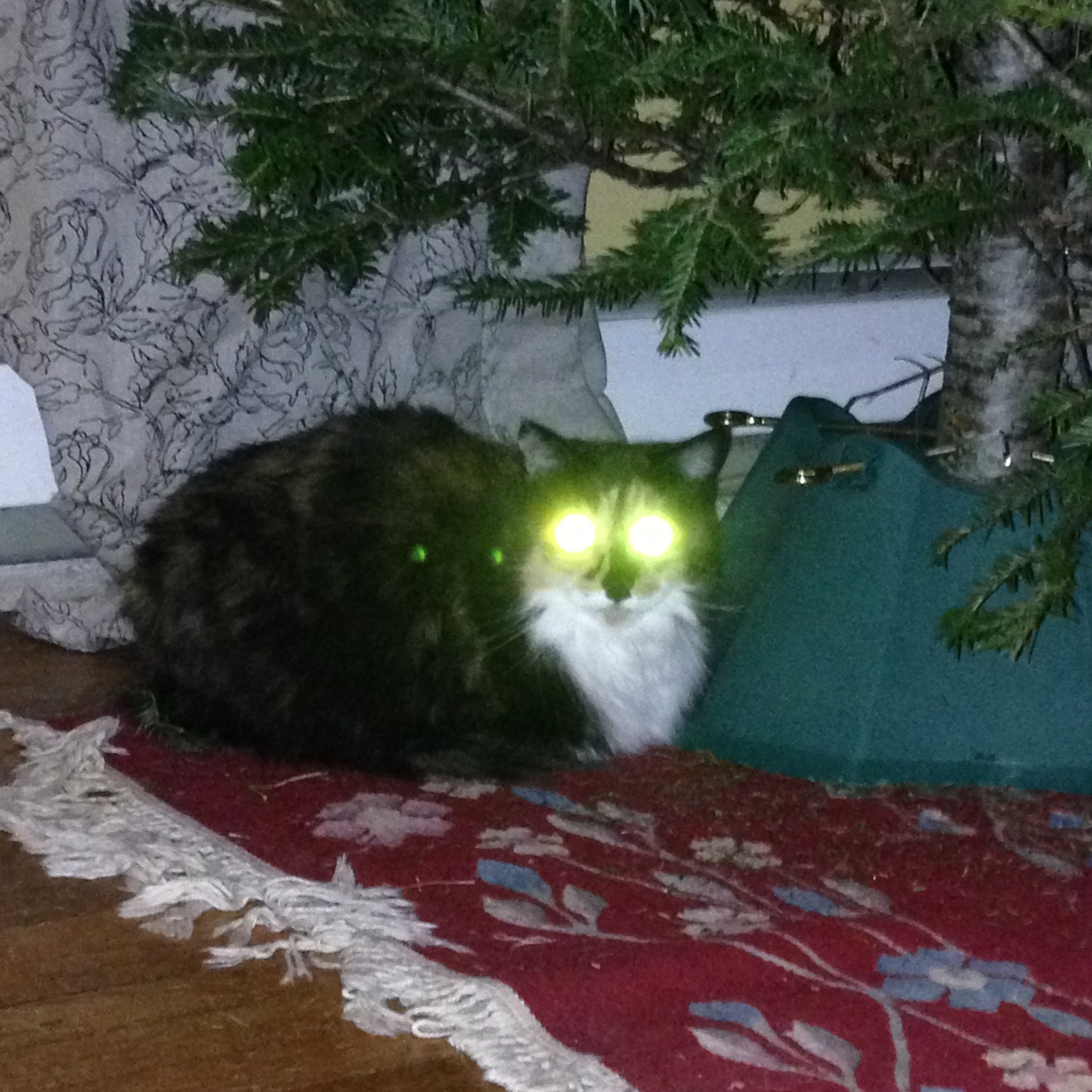
One year, she got lasers for Christmas.

Now that she is terminally ill, we do what we can for her. She eats Trader Joe’s tuna for cats because she can keep it down; she drinks CatSure (she prefers premixed to powder mixed); we give her catnip. Sunday night she did not know what to do with the catnip, and ultimately fell asleep in the catnip without enjoying it.

Socks, checking on the Time Machine

Her adopted sister Socks (the one-eyed, wobbly, film noir-loving, Nazi-hating tabby cat known as the Howling Assistant) died last summer. Lucky Lady will die soon, too, though we will keep her as comfortable as we can as long as we can. It’s hard to say how long it will be, and I feel wrenched and torn as I contemplate what Lady must endure and how much I will miss her, the last living connection to Providence I have with me in Alexandria. She’s more than a symbol, of course; she’s an independent being. But when Lady dies, a little part of me will go, too, and the past, and New England, will seem even farther away.
Share this:

  • Click to share on Facebook (Opens in new window) Facebook
  • Click to share on Pinterest (Opens in new window) Pinterest
  • Click to email a link to a friend (Opens in new window) Email
  • Click to share on X (Opens in new window) X
Like Loading...

Living Deliberately

08 Tuesday May 2018

Posted by kittycalash in Living History, personal, Philosophy, Reenacting

≈ 7 Comments

Tags

domestic life, historic houses, interpretation, living history, personal, philosophy

WCD: The Original

A friend of mine recently wrote about replicating the domestic life of the past (specifically the 18th century) and how much meaning that had for her.

Being so deeply embedded in the rhythms of life there, it became my home in a very real sense that has never left me.

I read that quickly, and what I read was that the place she had spent so much time was home to her because the place never left her– she carried its rhythms and seasons within her. Perhaps that isn’t quite what she meant, but that’s the risk of writing: the reader reads what they need to.

It made me think of home, and of living deliberately, and of a very bad year I had a long time ago, before I even imagined doing living history, when I thought I would spend my life making new things, like cities and buildings. (This makes me think of an album I listened to at the time, More Songs About Buildings and Food, which seemed all the more important because I’d gone to RISD, too.

Food, in a Building, in Rhode Island

The year I turned 25 was particularly bad not because a man broke my heart, though that didn’t help, and not because I had a miscarriage, though that was the catalyst that led to the man breaking my heart, but because the miscarriage shattered my sense of purpose and self. Somehow, everything that I had ever wanted to be — a sculptor, an architect, a writer– was gone, and I didn’t know what to do or how to be. (Read The Year of Magical Thinking if you want a well-written take on this kind of loss.) I didn’t know what to do next, but the man who eventually broke my heart gave me a book to help me figure it out: Chop Wood, Carry Water

Chopping wood.

Two years ago, I wrote a piece called Zen and the Art of Living History, in which I extolled the virtue of the everyday: Embrace the everyday, bring everyone back into history. Since then, I’ve thought more about how history and historic house museums can be a catalyst for change, how domestic sites can create “homes for history,” where we can have the difficult conversations that must be had to make the change I think we need as a nation, and as humans. These changes are happening, slowly, in museums and at historic sites, but even at the personal level, there’s meaning and change to be had through the business of “doing history.”

I suspect that among the reasons people really enjoy immersive, civilian (non-musket) events is because the work brings them into the rhythms of the natural world in a way that industrial life precludes or even prohibits. Consciously or not, interpreting the domestic life of the past forces us into mindfulness, into being as much as or more than doing. That’s the point of “chop wood, carry water:” to live deliberately. To cook without a clock, with only the color of the coals and the smell of the food to guide you; to notice the changing light because, as it fades, you must act to create light; to find the flaws and shifts in a floor as you scrub it, because there’s no machine between you, just your hands and a brush or a mop: all these tasks force you to be in the moment, noticing your environment, noticing yourself. You. A corporeal presence in a material world. How does that feel, moment to moment? Physically, emotionally: the challenge of living in the past is to live an unmediated life.

To go back to basics the way we do with civilian or domestic-site based living history brings us back to our base: we face our physical needs and the challenge of meeting them. We face emotional tests that help us imagine how people in the past endured– I often wonder how everyday people coped with “melancholia,” grief, and disappointment– and help us endure. It brings us home to ourselves, to our individual histories and our shared histories, and that’s what really matters. The connection to the everyday that we experience in a place in time puts us in a continuum with the people of the past, and gives us a place to be, a thing to do, a meaning. And that is what every one of us needs.

Share this:

  • Click to share on Facebook (Opens in new window) Facebook
  • Click to share on Pinterest (Opens in new window) Pinterest
  • Click to email a link to a friend (Opens in new window) Email
  • Click to share on X (Opens in new window) X
Like Loading...

Didion, Despair, and Not Looking Back

31 Saturday Mar 2018

Posted by kittycalash in personal

≈ Comments Off on Didion, Despair, and Not Looking Back

Tags

don't look back, living history, personal, philosophy, why I left

Not everyone develops a relationship with a place that feels romantic, a relationship so intense, even when tortured, that when you leave, at last, as leave you must, you are torn apart by knowing the place abused you– and knowing you must go. Still: you love the place and cannot quite bear to not be there. It’s a complicated thing, and as with most tempestuous relationships, this tug of a place on one’s heart must be analyzed, objectified, studied, and understood. I thought I was making progress that way until I was given a chance to look back– don’t ever look back– and even though I did not look the basilisk full in the face, I was nauseated: waves of sadness and anger broke over me at reading a head line and image caption.

I stepped back to consider just what it was about the place and the situation that affected me so. Reading almost always helps. This time, I pursued literary criticism as a means to understanding. Van Wyck Brooks absent from the shelf at my local public library, I took hold of Joan Didion, and found myself rewarded.

“The Seacoast of Despair” described my place perfectly.

‘Happiness’ is, after all, a consumption ethic, and Newport if the monument of a society in which production was seen as the moral point, the reward if not exactly the end, of the economic process. The place is devoid of the pleasure principle.

Devoid of the pleasure principle? In Freudian psychology, the pleasure principle is the instinctive seeking of pleasure and avoiding of pain in order to satisfy biological and psychological needs. Specifically, the pleasure principle is the driving force guiding the id. Didion states, “To have had the money to build “The Breakers” or “Marble House” or “Ochre Court” and to choose to build at Newport is in itself a denial of possibilities; the island is physically ugly, mean without the saving grace of extreme severity, a landscape less to be enjoyed than dominated.”

Indeed. Mean with the extreme severity, a landscape to be dominated. Those phrases define the principles that shaped my relationships with a few denizens of Newport, who, in truth worked and did not live there, but who seemed fully to embody, embrace, and imbue their personages with non-pleasure principled forces drove them to dominate others, and to consume, for their own use, much of what they encountered. Didion described my experiences and observations of Newport in language better than I could ever hope to conjure.

Three years ago this week, I came to a realization, first on a drive to Newport, and then on a train to Boston. I saved the tweets from that train trip.

Screen Shot 2018-03-31 at 4.25.26 PM
Screen Shot 2018-03-31 at 4.19.39 PM

I went to Boston that Saturday–it snowed; the train was an early one–to make a presentation at History Camp on work that related to Rhode Island and to Newport history. Earlier in the week, I’d had a vision in Newport that unsettled and delighted me, and informed those tweets.

“There was a for sale sign on one property (Sotheby’s Realty, of course), and for an instant, I imagined walking into the house and owning it, starting a life completely different from the one I live, with different people and places.”

Between that vision on Bellevue and Saturday’s train trip, I had enough exchanges with the object of my desire to form a fuller notion of what that vision meant. That understanding led to the tweets, which I posted as #fiction to protect the vision, and the desire, from the reality of my seemingly-unalterable situation.

The miracle here is that I had a vision, and have very nearly carried it out, despite not fully understanding how much of my standing life I would have to burn down to achieve that kind of freedom. It had not occurred to me that moving and changing  to achieve what I wanted–to no longer have a secret, to grasp those lapels nearly every night when I arrive home from work, and taste that accent on every kiss– it had not occurred to me how much I would have to destroy, or leave behind, and that in doing so, I would leave bones of my former soul to be picked over by opportunists ready to exploit an opening.

The consumption ethic: they have grabbed what they could not get while I was still there, and they run their paws over the work without fully understanding it. And that is where I can take my sole pleasure: the schadenfreude of watching them strive and fail, or perhaps the pleasure of watching them reach and grasp. Either way, I know I cannot look back. Something might be gaining on you, and it’s best to outrun those monsters.

Didion, Joan. “The Seacoast of Despair,” p. 157-158.  Reprinted in We Tell Ourselves Stories in Order to Live, New York: Everyman’s Library, 2006.

Share this:

  • Click to share on Facebook (Opens in new window) Facebook
  • Click to share on Pinterest (Opens in new window) Pinterest
  • Click to email a link to a friend (Opens in new window) Email
  • Click to share on X (Opens in new window) X
Like Loading...

The Work of Women

08 Thursday Mar 2018

Posted by kittycalash in History, Research

≈ 6 Comments

Tags

collections management, friend, international womens day, personal, philosophy, women's history, women's work

International Women’s Day: I may have missed it online but I have spent this day– this entire week, in fact– working with a woman I greatly admire and like. I’ve written about her before, my 96-year-old friend who was in the OSS and married a man who had fought for Chiang Kai-shek in World War II and against the Communists after the war.

It has been a week of learning about my friend, her mother, her aunts and great aunts and grandmothers; of learning about her daughters (and son), and her friends and the work she did.

Tuesday night, we had dinner with one of her friends who lives in a little red house not far from where I lived before I left Rhode Island. The Little Red House, as we always call it, was cozy and warm, built in 1793 when the East Side of Providene was rural, and the north end of it occupied by the Dexters, Morrises, Sessions and Coles on their farms.

The parlor was small, and the five of us filled it (along with a silver standard poodle who shook hands with us all). We ate in what had been the kitchen of the house, with a fire in the fireplace that had been used for cooking (and was still set up for cooking, though that was not where our meal was cooked). We ate from antique transferware, drank wine poured from antique decanters, and sat on antique chairs at an antique table in a room lit by candles. I would be lying if I tried to deny the warm magic of the setting, the scene, and the storytelling.

But the point is not that I had a wonderful time: the point is that I learned that night, and this week, about the ways that women look out for each other (when they’re not competing with each other), and the ways that women shepherd the history of families and places as they maintain collections of furniture, textiles, paintings, and prints.

As I held my friend’s hand and lit her way with my phone flashlight down a stone path to a waiting Subaru, I might as well have been holding a lantern and guiding her down a path to a waiting carriage, where wooden and tin footwarmers would replace a heater and blower motor. Some things are timeless and placeless: friendship, love, and caring. The need (the aspiration) to always care for the people around you, to be gentle and giving when you can, and to take and ask for help when you must: Those “feminine” values are what makes the world go ‘round, and keeps it steady.

Share this:

  • Click to share on Facebook (Opens in new window) Facebook
  • Click to share on Pinterest (Opens in new window) Pinterest
  • Click to email a link to a friend (Opens in new window) Email
  • Click to share on X (Opens in new window) X
Like Loading...

Where You Come From

24 Sunday Dec 2017

Posted by kittycalash in History, personal

≈ 1 Comment

Tags

blurry photos, family, family portrait, personal, photography, Research

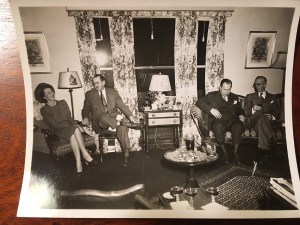
A selection from the box, mostly documenting the first two decades of my mother’s life

Mumblety-odd years ago, my first museum job was in a photograph and print collection, working as a photo researcher both finding and processing collections. There was a voyeuristic quality to the work, sometimes when going through a photographer’s more personal images, but especially when working on a family collection.

As I continued to work in the field, I started meeting with donors, and learned to talk them into giving their collections to the museum. It was easy enough to talk to them about making their memories tangible, creating and preserving a legacy of their lives so that others could understand the past and the contribution they, in particular, had made. How they typified an important part of a state or region’s history.

Susie the Cat makes many appearances

Sporadically, I organized my own photos and ask my mother for images of our family. I certainly took plenty of photos of my own son, but as time went on– and whether this is due to smartphones or trying to live in the moment, or not wanting to break the magical spell of an experience– I stopped taking pictures. I could still talk people into donations, and still enjoyed going through their family albums, but recording my own life didn’t make much sense to me, and I began to consider pitching images and letters and postcards, especially as I packed to move south. Keeping photographs for myself didn’t make sense.

Federal furniture: always central in my family

Sitting in bed on Friday night, Drunk Tailor and I looked through a box of snapshots my mother keeps in a fabric-covered box. He said, “Photographs are what you use to show people what you used to look like,” and to a degree that’s true. They are also proof that you had a life before this moment (think Blade Runner) and proof– perhaps– that you are who you think you are (think Blade Runner 2049). But even more like the Blade Runner movies, photographs of your past, or your family’s past, tell you where you come from, and where you might belong. Love them or leave them, you fit in somewhere in a larger story of people, and that shapes your identity, what you do, who you love, and how you live.

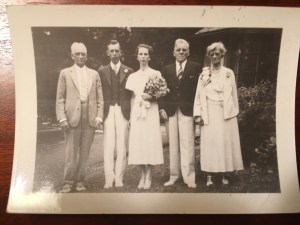
1936: My grandmother’s wedding.

As every year ends, I look back with some sadness at things I wish I had done differently, people I wish I had not hurt, people I wish I’d hugged more. The box of snapshots reminds me that I’m all too common, all too normal. Everyone has those pangs of nostalgia, the words they wish they’d said, the loss they feel as they lose the people they love.

Saint Lucia Day ca 1947

And that’s the point, I suppose: love one another. Be excellent to each other. Take the photos, label them (in pencil, on the back, listen to your archivist), and look at them when you can’t remember who you are, where you came from, or why you matter.

Share this:

  • Click to share on Facebook (Opens in new window) Facebook
  • Click to share on Pinterest (Opens in new window) Pinterest
  • Click to email a link to a friend (Opens in new window) Email
  • Click to share on X (Opens in new window) X
Like Loading...
← Older posts
Newer posts →

Archives

wordpress statistics

Creative Commons License
Kitty Calash blog by Kirsten Hammerstrom is licensed under a Creative Commons Attribution-NonCommercial-ShareAlike 4.0 International License.

Website Built with WordPress.com.

  • Subscribe Subscribed
    • Kitty Calash
    • Join 621 other subscribers
    • Already have a WordPress.com account? Log in now.
    • Kitty Calash
    • Subscribe Subscribed
    • Sign up
    • Log in
    • Report this content
    • View site in Reader
    • Manage subscriptions
    • Collapse this bar
 

Loading Comments...
 

    %d