• Home
  • Completed Costumes/Impressions
  • Emma and Her Dresses
  • Free Patterns and Instructions

Kitty Calash

~ Confessions of a Known Bonnet-Wearer

Kitty Calash

Tag Archives: Research

Three sticks, two kettles, no matches

20 Wednesday Feb 2013

Posted by kittycalash in History, Living History, Reenacting

≈ 2 Comments

Tags

18th century, authenticity, living history, Reenacting, Research, resources, Revolutionary War

Soldiers Cooking, 1798 National Army Museum (UK), 1983-11-63-1

Here’s some visual evidence for why we travel with three sticks, two kettles, and no matches. (We bring the sticks as we suspect the sites where we camp & cook don’t want amateur logging on their grounds.)  I stumbled upon this at the National Army Museum in the UK. Here’s what they say about the image:

Soldiers from an unknown unit attend to their cooking pot on a break from their duties during the Wars of the French Revolution (1793-1802). They are accompanied by their womenfolk. Although only a few men from each unit were officially allowed to marry and have their wives and families accompany them, women would have been found in almost every British military camp. Some worked as cooks, laundry women and sutlers (camp followers who sold provisions), while others were prostitutes.

One of the things one learns when reading about women who followed the armies of the Revolutionary War is that prostitution–at least for those following the American army– was not high on the list of occupations for women.

Why not? Lack of ready cash, folks.

Working for the Army would get you rations, and that literal meal ticket was desirable in a time of shortages and want. If you’d been burned out of your home or farm (I’m looking at you, 54th Reg’t of Foot, Aquidneck Island torchers) what would you eat? What would you do? It depended, of course, but one thing to do would be to follow your husband if he had enlisted.

I know less about the women who followed the British Army, but for a Continental Army start, I recommend the following books:

Belonging to the Army. Mayer, Holly A. USC Press, 1996.

Liberty’s Daughters. Norton, Mary Beth. Cornell, 1980. (My edition, 1996)

Revolutionary Mothers. Berkin, Carol. Vintage Books, 2005.

In Pursuit of Liberty. Werner, Emmy. Potomac Books, 2009.

The last title is about children in the time of the Revolution, not women, but considering who was left home with the children, and in trying to understand what the time might have been like for the Young Mr, I’ve given it a read as well.

As for the camp gear? We keep it at a minimum based on period images. We don’t all sleep in one tent, but we pack as light as we can. It’s nice when authenticity and ease are the same.

Share this:

  • Share on Facebook (Opens in new window) Facebook
  • Share on Pinterest (Opens in new window) Pinterest
  • Email a link to a friend (Opens in new window) Email
  • Share on X (Opens in new window) X
Like Loading...

Sandby’s Women

11 Friday Jan 2013

Posted by kittycalash in Clothing, History, Museums

≈ 3 Comments

Tags

18th century, 18th century clothes, common dress, Costume, dress, fashion, fashion plates, museum collections, Museums, Paul Sandby, Research, resources, watercolors, Yale Center for British Art

20130109-061710.jpgSara Hough’s date of ca. 1805 piqued my curiosity and Cassidy was suspicious, too. So I went looking into Paul Sandby a little bit more.

Many of us know him for the sketches and watercolors of working people in mid-18th century England. They’re oft-used references for people doing Rev War reenacting as they’re full of the kinds of details seen in the watercolor of Sara Hough. I hadn’t thought of Sandby for later 18th century references, which shows how little I was thinking.

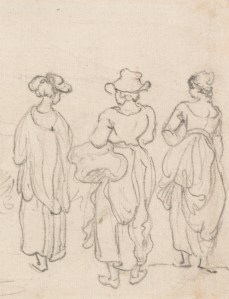
Sandby: Figure with Lute & Tamourine, YCBA

Sandby: Figure with Lute & Tamourine, YCBA

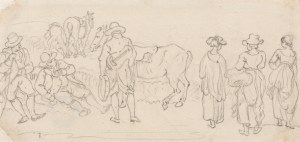
Thanks to the 18th Century Material Culture Resource Center, I found the Sandby “People and Places” presentation, which led me back to the Yale Center for British Art, and this image of musicians, horses and women. There’s no date in the record, though the presentation calls it ca. 1785. There seems to be a series or portfolio of Sandby sketches similar in size and type from about 1785, so it’s a reasonable assumption…with the usual caveat about assumptions, but no aspersions on the compiler of the presentation.

Sandby, detail, YCBA

Sandby, detail, YCBA

Sandby: Two Women and a Basket, YCBA

Sandby: Two Women and a Basket, ca. 1759 YCBA

Let’s look at a detail of the women in the drawing. Their waists are higher than we see in earlier Sandby drawings, and their profile slimmer, more classical, particularly the figure on the far right. Her bodice looks to me like a late 18th-century bodices.

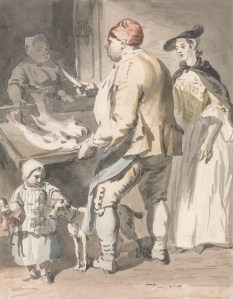
Sandby: A Fishmonger, YCBA

Sandby: A Fishmonger, ca. 1759 YCBA

Sandby had the skill to depict clothing with minimal gestures, as he does below in A Fishmonger, part of the London Cries series.

It’s that circa that gets you. I believe it for the ca. 1759, all the way. The figures fit into the visual continuum of Sandby’s mid-century work as I know it. (You’ll just have to trust me that I have a visual memory, and that, for once, the years of art school matter.)

And I kept wondering if he really had worked late into the 18th century, and then I found this:

Sandby: Family in Hyde Park, YCBA

Sandby: Family in Hyde Park, YCBA

Again, no date, but there are distinctive markers to tell us this is post-1780, even inching to the early 1790s. The waistcoats on the adolescent boys are shorter and double-breasted. The shape of the boy’s hats has changed: these aren’t cocked hats, and they’re not soft round hats. But look even closer and you’ll see the ties at the knees of their breeches, very typical and fashionable for the 1790s. All this before we’ve even gotten to the woman! Look at what she’s wearing: that’s certainly a plausible ensemble for 1794, isn’t it? The waist has moved up, the skirts are lighter, likely mull or muslin, and the skirt of what I interpret as an open robe, much like Sara Hough‘s, is trained on the ground. If this is a Sandby drawing, which I don’t doubt, then I think we definitely see him working into the mid-1790s.

And just for one final kick, I checked the Met again, where they have a Paul Sandby drawing dated 1798-1799. I wonder…but the coat collar and waistcoat might have it.

Sandby, Group of 4 Children and a Dog, MMA

I’m still not sold on ca. 1805 for Sara Hough (why no ‘h’ on Sara when the drawing is inscribed by Sandby, “Sarah Hough…”?) but I’d endorse 1795. The tricky part, as always, is the circa: so much depends on how a museum interprets ‘circa.’ For some, it’s 5 years either side of the date; for others, it’s 10. When I see a circa date, I get skeptical, and start doing math.

Share this:

  • Share on Facebook (Opens in new window) Facebook
  • Share on Pinterest (Opens in new window) Pinterest
  • Email a link to a friend (Opens in new window) Email
  • Share on X (Opens in new window) X
Like Loading...

What Pinterest Can Do, or, Asher Durand

22 Saturday Dec 2012

Posted by kittycalash in History, Museums

≈ 2 Comments

Tags

19th century, american art history, Asher B Durand, Asher Brown Durand, asher durand, museum collections, Museums, painting, pinterest, portraits, Research, resources

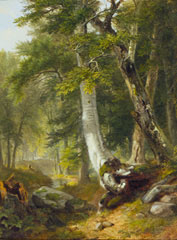
BRM-Landscape, Wood Scene

BRM-Landscape, Wood Scene

At the Brandywine River Museum, I saw an Asher B. Durand landscape and said, “I haven’t thought about Asher Durand in a long time.” My mother, ever the realist, muttered just-loud-enough, “Well, why would you?!” She studied art history for real, me, I only went to art school. It’s a wonder I can even feed myself.

Getting my stimulating-image fix last night on Pinterest: lo and behold, Asher B. Durand! Buddy! Good to see you! Even better, the side of Asher Durand you never get in those American Art History classes taught by a disheartened adjunct on a three-year contract trying to beat Manifest Destiny into you.

If you’re like me, Asher Durand’s the original Jersey Boy member of the Hudson River School, all Thanatopsis and metaphors, machine-in-the-garden, acolyte of Thomas Cole. But it’s better than that–he’s also Mr. Awesome Portrait.

MMA-Mrs Winfield Scott

Thanks to Cassidy, Mrs. Winfield Scott gazed calmly from the screen last night, lovely in her golden silk gown with fine silk over sleeves not even as heavy as butterfly wings. Lovely Mrs. Scott, against a backdrop of a…finely painted river scene, highly detailed and with a looming cloud… That painter guy seems to know what he’s doing, why, Asher B. Durand, you scamp! You worked landscape magic into the background of that money-making, pay-the-bills portrait.

Grey Collection-Summer Afternoon

Cows won’t pay for portraits of themselves, so the history and landscape painters of the past generally had to shill the portraits (G.C. Bingham did it, but without Asher B’s grace). Lucky for us, they were good at people, too, though I think you can tell their first love is landscape.

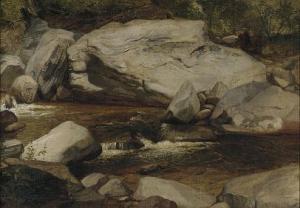
PAFA-Creek & Rocks

PAFA-Creek & Rocks

Art History Secrets Revealed: I have a friend who paints rocks in streams (and other things), but Ken’s paintings of rocks are incredibly beautiful. He studied at the Pennsylvania Academy of the Fine Arts, which is home to…did you guess? Asher B. Durand’s painting of rocks in a stream.

So while Pinterest can be home to horrors (go see for yourself, I’m not looking), it can lead you to places you didn’t expect to go, or back to things you’d forgotten about, like Asher B. Durand. He was useful to know about when I worked in the Midwest, photo editing a history journal.  I’m glad I’ve met him again.

Share this:

  • Share on Facebook (Opens in new window) Facebook
  • Share on Pinterest (Opens in new window) Pinterest
  • Email a link to a friend (Opens in new window) Email
  • Share on X (Opens in new window) X
Like Loading...

Caps and Randomness

20 Thursday Dec 2012

Posted by kittycalash in Clothing, History, Museums

≈ Comments Off on Caps and Randomness

Tags

cataloging, museum collections, Museums, National Gallery of Art, Research, resources, zen cataloging

NGA- Lady Wearing a Large White Cap

NGA- Lady Wearing a Large White Cap

Sweet cap, right? It all started because it’s cold this morning here in RI and I thought about skating when I went out to get the Times, and that led to Gilbert Stuart, which led to the National Gallery.

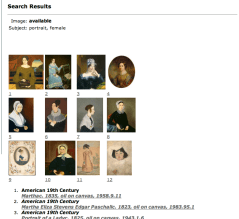
They have a fun search option, similar to the Tate Britain’s subject-search, but not quite as elegant.
You can start with a subject search, and then add a sub category. Results (stability not guaranteed) show you things you would not have otherwise expected, and that’s one more reason to love online catalogs & databases.

NGA Screenshot

NGA Screenshot

The results give you little unexpected galleries, and the juxtaposition or similarities of the thumbnails help you see the work differently. Black dresses and white collars are prevalent on this page: why? Is this fashion alone, or are these mourning garments? they’re earlier than the Civil War, but maybe it’s time to re-read This Republic of Suffering.

NGA- Sarah Cook Arnold knitting

NGA- Sarah Cook Arnold knitting

But wait–who is this? It’s Probably Sarah Cook Arnold, Knitting. (Probably is not her name, smartypants, it’s an adverb.)

She’s knitting in the round, by the way, on three incredibly tiny pins from an invisible ball of yarn, possibly swallowed by the cat hidden in her skirts. (I know a woman who can knit with these skinny quadruple-ought pins, but they are a hazard in my hands.)

I would not have found Sarah Cook Arnold knitting without using the random subject search, nor would I have found Fabulous Cap at the top. Sometimes you need to enjoy the journey as much as the destination.

Share this:

  • Share on Facebook (Opens in new window) Facebook
  • Share on Pinterest (Opens in new window) Pinterest
  • Email a link to a friend (Opens in new window) Email
  • Share on X (Opens in new window) X
Like Loading...

Smibert Smitten

19 Wednesday Dec 2012

Posted by kittycalash in History, Museums

≈ 5 Comments

Tags

18th century clothes, Clothing, Costume, dress, fashion, john smibert, Museums, Research, resources

John Smibert made me laugh. He’s been dead since 1751, so it wasn’t easy.

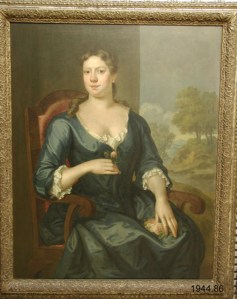
The day I went to the MFA and walked into the gallery with Mrs Tyng on wall, I laughed, and said, “I know her!” while my son died a small interior death. Then I pulled up the record and image for Mrs Browne, and showed him how I knew Mrs Tyng.

Follow Smibert’s pictorial advice if you’re reenacting an American woman of means between 1729 and 1732, and you’re wearing blue silk. You may have a red silk wrapper/shawl. Your shift will show at the center front and sleeves to show off your fine linen. You look like you might be a little cold, but perhaps that explains the “I store oranges in my bodice” look.

See for yourself:

MMA, Mrs Brinley & her son

MFA, Mrs MacSparran

RIHS, Mrs Browne

MFA, Mrs Tyng

MFA, Mrs Dudley

Smith College- Mrs Erving

Smith College- Mrs Erving


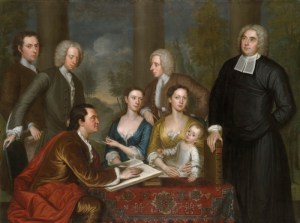
Yale- The Bermuda Group

Yale- The Bermuda Group

After a while, you start to wonder if there was only one woman in the colonies in 1730… And then you wonder how she got into every painting…

I know, style and conventions helped create these portraits as much as Smibert’s skill. And the portraits only get weird when you do the thing that was never supposed to happen. We were never meant to see all of these portraits all together, all at once, anywhere.

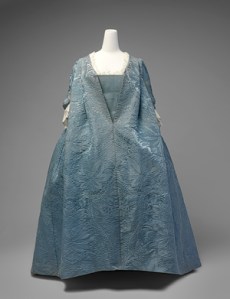
h2_2010.148-1 So, what’s she wearing? Probably this dress. No, not this exact dress, though if it was same woman in all those paintings, maybe the Met does have her actual dress. (Sometimes I have these weird museum-y ideas, and that’s generally when I need a vacation or come up with a new program idea.)

The robe volante shows up in paintings of women dressing, and in informal scenes, as below. She’s clearly wearing stays, which is helpful to know, because while I knew the women in the Smibert paintings ought to be wearing stays, and they had conical torsos, the orange-smuggling look was confusing.

Galerie Dreyfus- Scène galante dans un parc, ca 1725

Galerie Dreyfus- Scène galante dans un parc, ca 1725

In fact, it confuses me still.

Seriously, the 18th century was a pretty sexy place, if you like oranges and silk.

Yale- Mrs Tyng

Yale- Mrs Tyng

Look, there’s Mrs Tyng again! She’s left the MFA and taken a chair at Yale.

Share this:

  • Share on Facebook (Opens in new window) Facebook
  • Share on Pinterest (Opens in new window) Pinterest
  • Email a link to a friend (Opens in new window) Email
  • Share on X (Opens in new window) X
Like Loading...
← Older posts
Newer posts →

Archives

wordpress statistics

Creative Commons License
Kitty Calash blog by Kirsten Hammerstrom is licensed under a Creative Commons Attribution-NonCommercial-ShareAlike 4.0 International License.

Website Built with WordPress.com.

  • Subscribe Subscribed
    • Kitty Calash
    • Join 621 other subscribers
    • Already have a WordPress.com account? Log in now.
    • Kitty Calash
    • Subscribe Subscribed
    • Sign up
    • Log in
    • Report this content
    • View site in Reader
    • Manage subscriptions
    • Collapse this bar
 

Loading Comments...
 

    %d