• Home
  • Completed Costumes/Impressions
  • Emma and Her Dresses
  • Free Patterns and Instructions

Kitty Calash

~ Confessions of a Known Bonnet-Wearer

Kitty Calash

Tag Archives: Research

To Name a Thing is to Know theThing: Vocabulary Exercises

08 Tuesday Aug 2017

Posted by kittycalash in Clothing, History, Living History, Research

≈ Comments Off on To Name a Thing is to Know theThing: Vocabulary Exercises

Tags

CoBloWriMo, definitions, fabric, fashion plates, future projects, Research, resources, vocabulary

Today’s CoBloWriMo prompt is vocabulary, which in my case usually means blue, NSFW, or unprintable in the New York Times according to their Style Guide, (but now OK in the New Yorker, thank you Tina Brown).

Captain Haddock proclivities aside, I find myself trying to remember to use period-correct terms as I work, which means trying to figure out what the terms mean. It isn’t always easy, but there are number of printed and online sources.

Here, for example, is the Robe de Marcelline fashion plate I’ve been obsessed with since at least 2011, when Sabine made hers. I finally tracked down some dark green gingham fabric in Framingham, but, d’oh! It’s cotton and not marcel(l)ine.

Google Books provides many useful lookups, through dictionaries and, best of all at the moment, The Dictionary of Fashion History, which helpfully illuminates marceline as “a brilliant but slight kind of sarcenet.” That helps narrow down “lining fabric for women’s clothes,” and confirms that this is a lightweight, probably plain weave, silk.

That doesn’t solve my fabric issue, but given that I am still lack full-time work outside the house, Imma stick with my remnant table cotton. But at least I know what I *should* be using, and have expanded my vocabulary along the way.

Share this:

  • Click to share on Facebook (Opens in new window) Facebook
  • Click to share on Pinterest (Opens in new window) Pinterest
  • Click to email a link to a friend (Opens in new window) Email
  • Click to share on X (Opens in new window) X
Like Loading...

Styles Style: Book Recommendation

06 Sunday Aug 2017

Posted by kittycalash in Book Review, material culture, Research

≈ 1 Comment

Tags

book review, CoBloWriMo, Research, resources

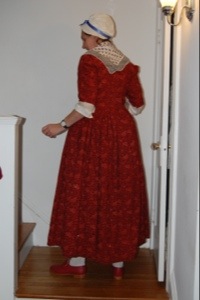
Please forgive the watch– a test shot of a gown from a runaway ad.

This is a quick one, because I’m writing in advance of a trip to New England, but for me, the best secondary source I’ve read that helped me understand the people I was clothing is John Styles’ The Dress of the People. That’s not to say that I haven’t read more, and found period resources and collections of resources equally useful. If you’re doing a poor woman in America, Don Hagist is your man, with Wenches, Wives and Serving Girls (now Wives, Slaves, and Servant Girls. Read Good Wives, Nasty Wenches, and Uneasy Patriarchs for more on period terminology).

I like Styles because he helps us understand the why of people’s clothing, and their wants. For me, context is key (I harp on this a lot) so insight into how many shifts are usual, the fashion for pocket watches, and the activity of the second hand clothes market is really helpful. So despite my love of shiny satin gowns and fashion of all eras, among the few books I didn’t send to storage when I moved was The Dress of the People. I think that’s a strong recommendation.

(researc

Share this:

  • Click to share on Facebook (Opens in new window) Facebook
  • Click to share on Pinterest (Opens in new window) Pinterest
  • Click to email a link to a friend (Opens in new window) Email
  • Click to share on X (Opens in new window) X
Like Loading...

Fave Friday: Full-On Federal

04 Friday Aug 2017

Posted by kittycalash in Clothing, History, Research

≈ 1 Comment

Tags

19th century clothing, CoBloWriMo, fashion, Federal style, personal, Research, resources


Favorite Era? Easy-peasy! Federal, of course. Whether furniture or fashion, the early Republic is my thing. I spend a fair amount of time in the 18th century, since there are so many events in that time period, and while I loved the story of the American Revolution as a child, the early Federal* period intrigues me more. Furniture, porcelain, wallpaper, and clothing from 1790-1820 all appeal to me, as well as the notion that women’s roles were in flux in the earliest decades of the United States.

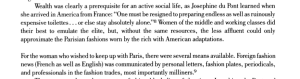
“American Women and French Fashion,” from The Age of Napoleon

I love the idea of women in mercantile businesses and trade, and the way that milliners provided access to fashion (and you can read more about that in The Age of Napoleon).

Merrymaking at a Wayside Inn, watercolor on paper by John Lewis Krimmel. 1811-1813. Metropolitan Museum of Art, 42.95.12

I also love the way that American women (and men) translated European high style into a vernacular, as seen in John Lewis Krimmel’s watercolors of Philadelphia and surrounding areas.

This is a time period I’m comfortable in (yes, the stays are part of that comfort) but aside from comfort and aesthetics, I think it’s also because for a brief time, women had slightly more freedom than they had previously.

It was short-lived, and Republican motherhood was confining in its own way before the “cult of womanhood” blossomed fully. But ideals of freedom and fashion very briefly aligned, and for that, I love the Federal– and vain creature that I am, I think it suits me.

*pre-Andy Jackson, amirite?

Share this:

  • Click to share on Facebook (Opens in new window) Facebook
  • Click to share on Pinterest (Opens in new window) Pinterest
  • Click to email a link to a friend (Opens in new window) Email
  • Click to share on X (Opens in new window) X
Like Loading...

“Exteriorizing,” or, Showing the Past: Part II

16 Thursday Feb 2017

Posted by kittycalash in History, Living History, Reenacting

≈ 2 Comments

Tags

authenticity, first person interpretation, living history, Reenacting, Research

Part II of the two-part guest posts by Sharon Burnston. Part I is here. ( Just below, if you are scrolling)

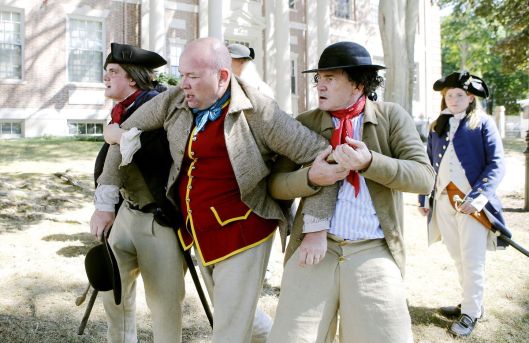
In the previous blog post, I explained the concept of “Yes, and”. But in the case of the naval press gang reenactment last summer in Newport, the “Yes, and” dialogue that I expected didn’t happen. When the press gang invaded the tavern I was mistress of, and started grabbing sailors, I attempted to intervene. This would have allowed me to put into words, for the benefit of the public watching, what this intrusion into our community would do to the town, in terms of the loss of the local men both collectively and individually.

Melee in the Square, Newport RI, August 2016

Melee in the Square, Newport RI, August 2016

In attempting to defend my customers, I as tavern mistress could have functioned as a token representative of all the other women of Newport, all of whom had economic, social, and maybe personal ties to the impressed men. The public would have had a better chance to grasp what the impressment actually meant to the people of Newport. But this failed to happen. Nobody in the press gang picked up on my gambit, they went about their business with a very convincing and no doubt authentic silent ruthlessness. One brandished his club and snarled, “Silence, woman!” which effectively shut down my efforts entirely. However one of my “customers” picked up on my gambit and began pleading to be released on account of his wife and children, but he got essentially the same response that I did, and he was also shut down.

Alex Cain impressed in Newport, August 2016. Photo by Philip Sherman, Newport Daily News

Alex Cain impressed in Newport, August 2016. Photo by Philip Sherman, Newport Daily News

I didn’t put all that effort into my tavern and tavern mistress impression just to be a scenic backdrop for the press gang. It was my expectation that there would be interaction between the tavern owner and the naval crew, which would serve to better educate the public by exteriorizing what we roleplayers were thinking and feeling about what was happening. My mistake was in taking for granted that this would be obvious to the other role players, and that the naval crew would give me a “Yes, and” response for the benefit of the audience.

In short, I think we could have done a better job of *interpreting* what was happening if we hadn’t all been quite so focused on doing it as *authentically* as possible. I do not in any way fault the guys who were portraying the naval crew. To their credit, they played their roles with superb accuracy. If anything the fault was mine for assuming we’d be all on the same page, and ready to interact with one another. It is my opinion that as an interpretive exercise, this living history scenario would have benefited from being just a teensy bit less “authentic” and a little bit more theatrical.

A Cribbage Party in St. Giles. Thomas Rowlandson, 1787. Royal Collection Trust.

A Cribbage Party in St. Giles Disturbed by a Press Gang. Thomas Rowlandson, 1787. Royal Collection Trust.

In talking afterward with members of the public, I found too many of them confused, they saw the action but didn’t really understand what was going on, nor what was at stake for the various individual characters involved. It would have been so easy to get the essential points across while the scene was unfolding, and it doesn’t take long, a few sentences exchange is enough. But all participants have to understand in advance the merits of this, and be prepared for it when it happens.

DSCN4459

In my opinion it’s great, but not enough, to know the best possible historical information on the event we are presenting, and to replicate the clothing and equipment so meticulously. We also should be prepared to join together to learn how to portray it in the most informative and articulate way possible. This can only make our first-person historical reenactments even better than they already are.

Share this:

  • Click to share on Facebook (Opens in new window) Facebook
  • Click to share on Pinterest (Opens in new window) Pinterest
  • Click to email a link to a friend (Opens in new window) Email
  • Click to share on X (Opens in new window) X
Like Loading...

“Exteriorizing,” or, Showing the Past: Part I

15 Wednesday Feb 2017

Posted by kittycalash in History, Living History, Reenacting

≈ 2 Comments

Tags

authenticity, first person interpretation, interpretation, living history, Reenacting, Research

This guest post was written by Sharon Burnston. Sharon and I will be co-teaching an interactive workshop on first person impressions this June. “Exteriorizing” is an important part of developing an impression that works not just to represent a character, but to tell a story. Part II will appear tomorrow.
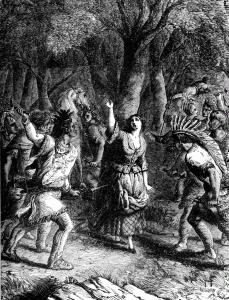
John Gilmary Shea, The Story of a Great Nation (New York: Gay Brothers & Company, 1886)after 444, says "page 475" University of South Florida clip art collection.

John Gilmary Shea, The Story of a Great Nation (New York: Gay Brothers & Company, 1886)after 444, says “page 475” University of South Florida clip art collection.

The first time I was ever “abducted” at a living history event was during an F&I scenario 35 years ago. I was dragged off into the bushes by scary looking strangers, and it was all very well researched and convincing.

But one thing I realized, upon reflection afterward, is that a really accurately portrayed scenario isn’t always in all ways the “best” scenario, for the participants or the public. In real situations that are terrifying, the usual physiological/behavioral responses are those described as Flight, Fight or Freeze. That’s what real people do when that sort of thing really happens. At the time I was abducted by “the French and the Indians”, I put myself into the moment, imagined how I would really feel if it were actually happening, and I froze. I portrayed terror so well, my abductors looked at me oddly, wondering if I was okay. But y’know what? The spectators, standing 30 feet or more away, couldn’t see my face, couldn’t hear my shallow breathing, and they got nothing out of it.

The Abduction of Daniel Boone's Daughter by the Indians. oil on canvas by Carl Wimar, 1853. Washington University Kemper Art Museum. Gift of John T. Davis, Jr., 1954 WU 4335

The Abduction of Daniel Boone’s Daughter by the Indians. oil on canvas by Carl Wimar, 1853. Washington University Kemper Art Museum. Gift of John T. Davis, Jr., 1954
WU 4335

I realized that I had actually failed to do justice to the interpretive moment, I should have done something less lifelike and more communicative. I should have screamed for help, in detail, loudly, and at length. In real life, this would have been a risky thing for a captive to do, but in a reenactment interpretive setting, it would have been useful. I mean, I knew precisely why my character was terrified, but did the public? If I had screamed and carried on, it would have given me an opportunity to put into words what the 18c abducted woman knew about what was going to happen to her. It would have been a better scenario in terms of educating the public if I had, in a word, exteriorized what my character was feeling into words, for everyone present to hear.

The problem with my having learned this sort of thing experientially and so long ago, is that I tend to blithely assume that other folks whom I regard as skilled 18c role players also know it, because to me it is by now so obvious.
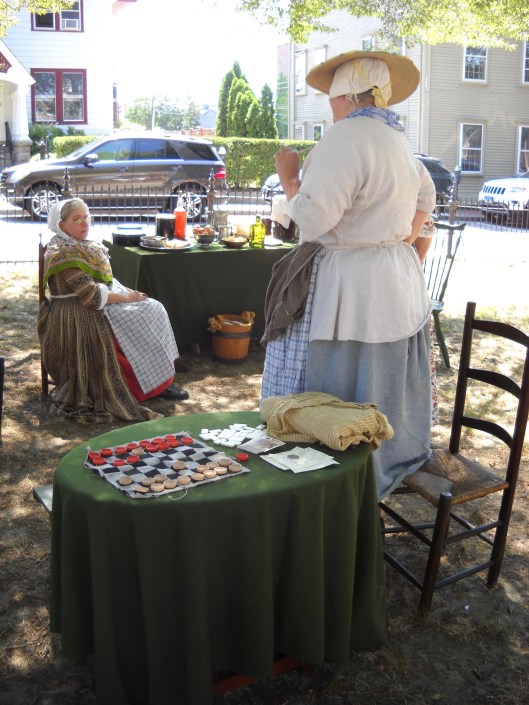
DSCN4448

Last summer I participated in a brilliant re-creation of a different kind of abduction, a reenactment of the British naval press gang that abducted American sailors out of Newport RI harbor in 1765. Over 60 of us from all across New England worked hard for months to research and develop our impressions in order to make this event as convincing and accurate as we could. For the most part, we succeeded magnificently. But I came away dissatisfied and I think some of the public I talked to did also. That was a helluva scenario, meticulously planned and carried out, and we did it so well! But I think we could have done it one or two notches better, and here is why I think so.

First person role playing has far more of theater about it than perhaps we living historians care to admit. Drawing upon theatrical strategies can allow us to better communicate our knowledge to the audience, by exteriorizing our characters’ thoughts or feelings into dialogue the public can hear, even if doing so might slightly violate the strictest historical purity of our role playing. After all, don’t we claim to be doing this in order to educate the public?

The strategy I have in mind is the collaborative trick referred to in improvisational theater as “Yes, and”.

“Yes, and…” refers to a basic concept in improv theater. If a participant throws a gambit at you, don’t shut it down. Accept it, whatever it is (“Yes”) and then add something of your own (“and…”) to expand on the idea and keep it going. “Yes” means being receptive to the contributions of others. “And” means offering something back, to further the collaborative process.

How would this notion apply to a living history role playing scenario? Stay tuned to find out!

Share this:

  • Click to share on Facebook (Opens in new window) Facebook
  • Click to share on Pinterest (Opens in new window) Pinterest
  • Click to email a link to a friend (Opens in new window) Email
  • Click to share on X (Opens in new window) X
Like Loading...
← Older posts
Newer posts →

Archives

wordpress statistics

Creative Commons License
Kitty Calash blog by Kirsten Hammerstrom is licensed under a Creative Commons Attribution-NonCommercial-ShareAlike 4.0 International License.

Website Built with WordPress.com.

  • Subscribe Subscribed
    • Kitty Calash
    • Join 621 other subscribers
    • Already have a WordPress.com account? Log in now.
    • Kitty Calash
    • Subscribe Subscribed
    • Sign up
    • Log in
    • Report this content
    • View site in Reader
    • Manage subscriptions
    • Collapse this bar
 

Loading Comments...
 

    %d