• Home
  • Completed Costumes/Impressions
  • Emma and Her Dresses
  • Free Patterns and Instructions

Kitty Calash

~ Confessions of a Known Bonnet-Wearer

Kitty Calash

Tag Archives: resources

More on Pockets

18 Monday Mar 2013

Posted by kittycalash in Clothing, Museums

≈ Comments Off on More on Pockets

Tags

18th century, 18th century clothes, Clothing, Costume, dress, museum collections, Research, resources, Revolutionary War

If you think you don’t like military history, think again. A friend of mine is working on a French and Indian War 250th Anniversary project in Boston, and in the course of his research he got interested in a red velvet grenadier’s cap that I happen to be adjacent to from time to time.
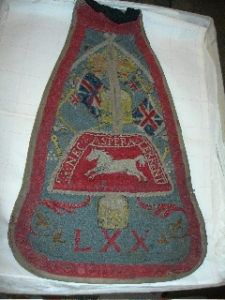
UBM 2006-08-53

UBM 2006-08-53

One thing led to another, fortunately for him and not me, and he ended up calling on the National Army Museum in London. There a curator after my own heart distracted him with one of the coolest things I have ever seen: A Lady’s Pocket made from the decorative panel of a mitre cap, or as they call it, Mitre Pocket.

Here’s their description:

“Front section of a mitre cap made into a ladies pocket, 1760 (c); wool and cotton; on front the emblems for the 70th Regiment of Foot, all sewn as for the period, 1760 (c); back is made of brown cloth; front is bound with red cloth binding.

Note: Hanoverian white horse and ‘Nec Aspera Terrent’ used by 8th (The King’s) Regiment of Foot, later King’s (Liverpool Regiment), which might make the L an initial not a numeral and the XX a company number rather than part of the regimental numeral.”

Grenadier’s cap, 1833.1.1, RIHS

One of the most charming things about the email is that the woman at the NAM sent my friend an image of a gown and pocket, just so he’d be clear about how it would have been worn. He knew anyway, but I thought that was a very nice thing to do.

The cap we’re looking into is this one, said to have been picked up at Bunker Hill. Not for nothin’ (as the locals say), but this cap would make a lovely pocket.

Share this:

  • Share on Facebook (Opens in new window) Facebook
  • Share on Pinterest (Opens in new window) Pinterest
  • Email a link to a friend (Opens in new window) Email
  • Share on X (Opens in new window) X
Like Loading...

Short Gown Alert! Griselle en négligé du matin

13 Wednesday Mar 2013

Posted by kittycalash in Clothing, History, Living History

≈ 10 Comments

Tags

18th century clothes, Clothing, common dress, fashion plates, Historical Sew Fortnightly, resources

2a54bb721a01bb282ea52a2f916c53b8

Griselle en négligé du matin, faisant sa provision au Marché des Quinze-vingts

Griselle en négligé du matin, faisant sa provision au Marché des Quinze-vingts

Very roughly, Griselle, in morning undress, goes to the “Three Hundred” market for provisions.

Said to be on Paris maps of 1760 and 1771, the Quinze-vingts Market was probably razed for the Rue de Rivoli. Interestingly, the major ophthalmic hospital in Paris is the Three Hundred, and there has been a Three Hundred hospital since 1260. (Sorry, Mr S: even in history, there is no escaping hospitals or eyeballs.) The neighborhood takes its name from the hospital, so Griselle is headed to her neighborhood market. You wouldn’t go far from home in négligé du matin.

Let’s look at what she’s wearing: It’s the reenactor’s frenemy, the short gown. Griselle here is post-1789, check the raised waist line and the non-cone bosom shape. Is it 1790, 1792ish? Probably in that range. If you don’t want to wing a version of this based on illustrations and Costume Close Up, you can get a pattern for a similar garment. It was workshop tested; my version is here.

What I like are the basic details: turban scarf, kerchief, simple short gown, striped petticoat, clocked stockings, slippers, just a bundle for the market.

The simplicity is key here, also tiny details. Look at the end of her sleeve: buttons. This is fantastic news for those of us who need to get our enormous hands through slender 18th-century sleeves. It’s taking a lot of will power not to head down to the stash and start on a mock up of this short gown right this minute…

The silhouette matches the pouter-pigeon, full-bust look of more formal wear of ca. 1792, so I don’t think she’s gone stay-less. The striped petticoat could be cotton or linen; Wm Booth had some variegated stripe linen that could work for a version of this. Are we seeing her shift, or another petticoat under the stripes? It’s so similar in length, and her shape so full, that I think it is second petticoat and not shift.

The stockings and what I will call their clocks, but look like decorative gussets, that coordinate with the slippers, are a nice touch. Visible beneath this shorter hem, they provide another bit of color and decorative accent to this plain look.

If I didn’t have those guys to sew for, this is what I would have chosen for Peasants and Pioneers. Not that I don’t love my boys…but menswear is time consuming.

Share this:

  • Share on Facebook (Opens in new window) Facebook
  • Share on Pinterest (Opens in new window) Pinterest
  • Email a link to a friend (Opens in new window) Email
  • Share on X (Opens in new window) X
Like Loading...

Sweet Danish!

28 Thursday Feb 2013

Posted by kittycalash in Clothing, Museums

≈ 1 Comment

Tags

dress, Museums, National Museum of Denmark, patterns, Research, resources, Tidens Toj

That dress!

You know the fabulous 1797 wedding gown from the Danish Museum? It turns up on blogs as the Tidens Toj gown. Many of the links to the pattern and the gown are broken now, but fear not, it only moved. Wouldn’t know anything about museum website links changing…

You may know this already, but it’s here now. The National Museum of Denmark has a nice set of Pinterest boards,  which is how I found the dress. The PDF is still available from the catalog record, and has a link here.

English Dress, 1780

The Fashion History- Future Clothing exhibit is still up, and many of the garments have PDF patterns. There is a pretty post-RevWar era “English Dress,” which also has a pattern. The translation that Google provides is a trifle (no, actually, quite) hilarious. Don’t trust it…you’ll end up with sweaters and wrinkles instead of Brunswicks and pleats.

Share this:

  • Share on Facebook (Opens in new window) Facebook
  • Share on Pinterest (Opens in new window) Pinterest
  • Email a link to a friend (Opens in new window) Email
  • Share on X (Opens in new window) X
Like Loading...

Three sticks, two kettles, no matches

20 Wednesday Feb 2013

Posted by kittycalash in History, Living History, Reenacting

≈ 2 Comments

Tags

18th century, authenticity, living history, Reenacting, Research, resources, Revolutionary War

Soldiers Cooking, 1798 National Army Museum (UK), 1983-11-63-1

Here’s some visual evidence for why we travel with three sticks, two kettles, and no matches. (We bring the sticks as we suspect the sites where we camp & cook don’t want amateur logging on their grounds.)  I stumbled upon this at the National Army Museum in the UK. Here’s what they say about the image:

Soldiers from an unknown unit attend to their cooking pot on a break from their duties during the Wars of the French Revolution (1793-1802). They are accompanied by their womenfolk. Although only a few men from each unit were officially allowed to marry and have their wives and families accompany them, women would have been found in almost every British military camp. Some worked as cooks, laundry women and sutlers (camp followers who sold provisions), while others were prostitutes.

One of the things one learns when reading about women who followed the armies of the Revolutionary War is that prostitution–at least for those following the American army– was not high on the list of occupations for women.

Why not? Lack of ready cash, folks.

Working for the Army would get you rations, and that literal meal ticket was desirable in a time of shortages and want. If you’d been burned out of your home or farm (I’m looking at you, 54th Reg’t of Foot, Aquidneck Island torchers) what would you eat? What would you do? It depended, of course, but one thing to do would be to follow your husband if he had enlisted.

I know less about the women who followed the British Army, but for a Continental Army start, I recommend the following books:

Belonging to the Army. Mayer, Holly A. USC Press, 1996.

Liberty’s Daughters. Norton, Mary Beth. Cornell, 1980. (My edition, 1996)

Revolutionary Mothers. Berkin, Carol. Vintage Books, 2005.

In Pursuit of Liberty. Werner, Emmy. Potomac Books, 2009.

The last title is about children in the time of the Revolution, not women, but considering who was left home with the children, and in trying to understand what the time might have been like for the Young Mr, I’ve given it a read as well.

As for the camp gear? We keep it at a minimum based on period images. We don’t all sleep in one tent, but we pack as light as we can. It’s nice when authenticity and ease are the same.

Share this:

  • Share on Facebook (Opens in new window) Facebook
  • Share on Pinterest (Opens in new window) Pinterest
  • Email a link to a friend (Opens in new window) Email
  • Share on X (Opens in new window) X
Like Loading...

Sandby’s Women

11 Friday Jan 2013

Posted by kittycalash in Clothing, History, Museums

≈ 3 Comments

Tags

18th century, 18th century clothes, common dress, Costume, dress, fashion, fashion plates, museum collections, Museums, Paul Sandby, Research, resources, watercolors, Yale Center for British Art

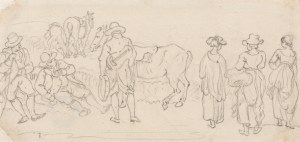
20130109-061710.jpgSara Hough’s date of ca. 1805 piqued my curiosity and Cassidy was suspicious, too. So I went looking into Paul Sandby a little bit more.

Many of us know him for the sketches and watercolors of working people in mid-18th century England. They’re oft-used references for people doing Rev War reenacting as they’re full of the kinds of details seen in the watercolor of Sara Hough. I hadn’t thought of Sandby for later 18th century references, which shows how little I was thinking.

Sandby: Figure with Lute & Tamourine, YCBA

Sandby: Figure with Lute & Tamourine, YCBA

Thanks to the 18th Century Material Culture Resource Center, I found the Sandby “People and Places” presentation, which led me back to the Yale Center for British Art, and this image of musicians, horses and women. There’s no date in the record, though the presentation calls it ca. 1785. There seems to be a series or portfolio of Sandby sketches similar in size and type from about 1785, so it’s a reasonable assumption…with the usual caveat about assumptions, but no aspersions on the compiler of the presentation.

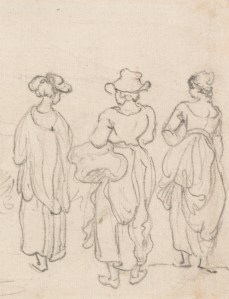
Sandby, detail, YCBA

Sandby, detail, YCBA

Sandby: Two Women and a Basket, YCBA

Sandby: Two Women and a Basket, ca. 1759 YCBA

Let’s look at a detail of the women in the drawing. Their waists are higher than we see in earlier Sandby drawings, and their profile slimmer, more classical, particularly the figure on the far right. Her bodice looks to me like a late 18th-century bodices.

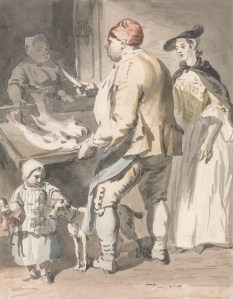
Sandby: A Fishmonger, YCBA

Sandby: A Fishmonger, ca. 1759 YCBA

Sandby had the skill to depict clothing with minimal gestures, as he does below in A Fishmonger, part of the London Cries series.

It’s that circa that gets you. I believe it for the ca. 1759, all the way. The figures fit into the visual continuum of Sandby’s mid-century work as I know it. (You’ll just have to trust me that I have a visual memory, and that, for once, the years of art school matter.)

And I kept wondering if he really had worked late into the 18th century, and then I found this:

Sandby: Family in Hyde Park, YCBA

Sandby: Family in Hyde Park, YCBA

Again, no date, but there are distinctive markers to tell us this is post-1780, even inching to the early 1790s. The waistcoats on the adolescent boys are shorter and double-breasted. The shape of the boy’s hats has changed: these aren’t cocked hats, and they’re not soft round hats. But look even closer and you’ll see the ties at the knees of their breeches, very typical and fashionable for the 1790s. All this before we’ve even gotten to the woman! Look at what she’s wearing: that’s certainly a plausible ensemble for 1794, isn’t it? The waist has moved up, the skirts are lighter, likely mull or muslin, and the skirt of what I interpret as an open robe, much like Sara Hough‘s, is trained on the ground. If this is a Sandby drawing, which I don’t doubt, then I think we definitely see him working into the mid-1790s.

And just for one final kick, I checked the Met again, where they have a Paul Sandby drawing dated 1798-1799. I wonder…but the coat collar and waistcoat might have it.

Sandby, Group of 4 Children and a Dog, MMA

I’m still not sold on ca. 1805 for Sara Hough (why no ‘h’ on Sara when the drawing is inscribed by Sandby, “Sarah Hough…”?) but I’d endorse 1795. The tricky part, as always, is the circa: so much depends on how a museum interprets ‘circa.’ For some, it’s 5 years either side of the date; for others, it’s 10. When I see a circa date, I get skeptical, and start doing math.

Share this:

  • Share on Facebook (Opens in new window) Facebook
  • Share on Pinterest (Opens in new window) Pinterest
  • Email a link to a friend (Opens in new window) Email
  • Share on X (Opens in new window) X
Like Loading...
← Older posts
Newer posts →

Archives

wordpress statistics

Creative Commons License
Kitty Calash blog by Kirsten Hammerstrom is licensed under a Creative Commons Attribution-NonCommercial-ShareAlike 4.0 International License.

Website Built with WordPress.com.

  • Subscribe Subscribed
    • Kitty Calash
    • Join 621 other subscribers
    • Already have a WordPress.com account? Log in now.
    • Kitty Calash
    • Subscribe Subscribed
    • Sign up
    • Log in
    • Report this content
    • View site in Reader
    • Manage subscriptions
    • Collapse this bar
 

Loading Comments...
 

    %d