• Home
  • Completed Costumes/Impressions
  • Emma and Her Dresses
  • Free Patterns and Instructions

Kitty Calash

~ Confessions of a Known Bonnet-Wearer

Kitty Calash

Tag Archives: Revolutionary War

I came, I saw, I sewed

23 Tuesday Apr 2013

Posted by kittycalash in Events, Living History, Reenacting

≈ Comments Off on I came, I saw, I sewed

Tags

18th century clothes, Clothing, common dress, Costume, Events, history, living history, Reenacting, Revolutionary War

The usual view: the backs of the bellowers.

My usual view: the backs of the bellowers.

Last weekend was the BAR School of Instruction at the New Windsor Cantonment in Vails Gate, NY. April is an interesting month for travel: changeable weather can land you in a serious fog/cloud, some places aren’t open yet, but the crowds are, mercifully, small.

The meetings and discussions were interesting, and I think its useful for reenactors to continue to ask themselves questions about what they do, and how they do it–questions beyond authenticity. I still think there are great unspoken truths in the Temple Building: in the 21st century, a male dominated, volunteer-run organization will not thrive in its current form.

Chase with sticks.

Chase with sticks. He needs drum instruction.

Movement towards demonstrations that make effective use of the actual numbers of soldier who turn out makes sense. as do roles for men retired from the field. More formal interpretive roles for women might strengthen the organization … but for now, I’ll try to learn as much as I can. Laundry: that’s something to work on.

Patina, not dirt.

Patina, not dirt.

Of course, they don’t want their clothes washed. That’s not dirt, that’s patina. I have this for a time to help me figure out how to put together one for the Young Mr, and eventually, for Mr S. It’s less crunchy now that it has hung up for a while, and I do understand the desire for patina. Mr S likes to get his overalls filthy, and his hunting frock. But where would that leave the washer woman?

Mending, I suppose, though I know women were employed by RI state troops to make shirts (there are receipts). We don’t need shirts right now, we need hunting shirts, which it turns out were probably actually hunting frocks, tied at the front with tapes.

Alterations ahead?

Alterations will be ahead for this, though can you call them alterations before the thing is even finished? I started on Wednesday with just the cut pieces, and got this far, plus a completed but not attached sleeve, by mid-day Sunday. (Photos here.) As one of the women at the SOI said, “Without us, they’d be naked and hungry. You think they’d learn to appreciate it.” Probably not until they are actually naked and hungry…

Les Fleur d' Inde

Les Fleur d’ Inde

For relief from the plain linen, I cut out a chintz jacket; the remnant was just enough to get a front-closing short jacket cut. It shouldn’t take too long to make, and will be a nice thing to have in warmer months. And it’s just enough pretty fabric that I might have been able to afford it.

Share this:

  • Share on Facebook (Opens in new window) Facebook
  • Share on Pinterest (Opens in new window) Pinterest
  • Email a link to a friend (Opens in new window) Email
  • Share on X (Opens in new window) X
Like Loading...

Requiems and Reenactments

17 Wednesday Apr 2013

Posted by kittycalash in Events, Living History, Reenacting

≈ 15 Comments

Tags

battles, commemoration, discussion, living history, Patriots Day 2013, Reenacting, Revolutionary War

Warning: Long reenactor-heavy content ahead.

Evan McGlinn for the NY Times. Click for slide show.

Evan McGlinn for the NY Times. Click for slide show.

My friend wrote on Tuesday about battle reenactments, and whether or not they’re appropriate or even, well, decent, in a way; she has been thinking about the Battle Road event, Patriots Day, and the Battle at Lexington Green in light of the explosions at the Boston Marathon.

She helped me remember the reading and thinking I had done this past fall when people at work asked if reenactments (and even museum exhibitions) glorified war, and when I started to wonder why, exactly, I was in this hobby. I read Vanessa Agnew on “History’s Affective Turn: Historical Reenactment and its Work in the Present” in Rethinking History 11:3, 299-312 (2007) and “Mobile Monuments: A view of historical reenactment from inside the costume cupboard of history” by Stephen Gapps, also in Rethinking History 13:3, 395-409 (2009). I’m still working my way through “Mimic Toil: Eighteenth-Century Preconditions for the Modern Historical Reenactment” by Simon During, again from Rethinking History, 11:3, 313-333 (2007). There’s a good bibliography at the University of York, but getting at these takes JSTOR or ProjectMUSE access; check with your local public or university library. For list of books about commemoration, History, Memory, and Monuments: An Overview of the Scholarly Literature on Commemoration by Kirk Savage is an excellent starting place. To find out more about why reenactments differ on different sites, and to discover more about the sometimes-fraught relationship between the NPS and reenactors, you can read this on the role of reenactors at National Parks.

The article that resonated most was Gapps. He wrote about a variety of reenactment types, but what made sense to me as a member of two military reenactment groups, both part of the Brigade of the American Revolution, was his writing about the military reenactments. Gapps focuses on Civil War reenacting, and that is an area in which I’m not interested, but his central tenet rang true to me:

…the performance of history has been largely dismissed by cultural critics as a form of nostalgia, but … it actually has a significant role to offer – particularly as a form of public commemoration of shared remembrance of historical events.

Mr S between the Adjutant and the Dollmaker. Thanks to JacobMar1ey on flickr.

Public commemoration is a large part of the reenactments I’m involved with, but they work differently for participants and spectators, and for different kinds of participants. For a recent example, Mr S and I spent Monday morning in Concord at the North Bridge ceremony, and had two very different experiences.

He came back from the bridge and said, “I was really scared. For a moment there, crossing the bridge and seeing all the British forces, I had a sense of what it must have been like.”

On the North Bridge. Thanks to JacobMar1ley at flickr.

While he had been on the bridge, I was in the gardens with the public thinking, Those poor British soldiers, while I listened to the crackle of candy wrappers and people giggling about their dogs. The crowd spread out on the hill that leads to the Concord River, festival-style, and I was appalled that they came for entertainment to what I thought of as a truly ceremonial and commemorative event. The NPS rules about engagements and casualties suddenly made a lot of sense.

My friend wrote specifically about how reenactments can never portray the reality of fear and horror that is war. She is right. NPS agrees: Even the best-researched and most well-intentioned representations of combat cannot replicate the tragic complexity of real warfare. The activity and logistical support for modern battle reenactments is inconsistent with providing a memorial atmosphere. There is something about reenactments that I cannot fully embrace even as I love them. I have a difficult relationship with “patriotism,” as I have a difficult relationship with America, and much as I have a difficult relationship with my family and friends, whom I also love dearly, though rarely demonstratively.

Naked Raygun, Chicago.

I have been grappling with the concept of America and history and the meaning of American symbols—semiotics—since I started making art. I came of age in the punk years in Chicago, stapling photocopied collages to telephone poles. Reagan was president, nuclear war seemed imminent. I made sculpture and installations about American architecture and literature, as a way to explore American history. I remain skeptical about the political process, even as I engage in it.

So why am I a reenactor? It isn’t always easy. Sometimes it’s uncomfortable, personally—intellectually—it can be difficult to fully embrace sometimes. Recently, with online discussions of gun control and the relationship between rifle/black powder clubs, the NRA, and reenactors, it has been difficult to grapple with all of the different points of view and to be true to one’s beliefs. Most of the time people don’t air their opposing views. Some of us do, as one writer noted, hold our noses and pay our dues. I knew this going in.

But reenacting, in a way, is an art form for me, a very personal one, one that this blog is part of.

Another friend avoids the military reenactments and sticks to living history through museum work. Mr S enjoys the farm work as much as the battles, because he likes working hard. He likes the physical experience of both; he likes the people, too, and whether he’s chopping wood with the hat maker or crossing the bridge with the adjutant, the shared experiences mean a lot to him. For me, the most profound experiences of women’s history have come at the farm, probably because that is the truest means of reaching the past for a woman I have yet to discover. Can I find that moment in military reenacting? Perhaps, by working hard at recreating the army follower experience.

Unlike monuments, reenactments have the potential to create more open ended and contextual historical commemorations. (Gapps, abstract)

One thing I do not like about the battles is the public. I stand on the public side of the rope line, and think, “Those are my people out there, on the field.” The public—the predatory photographers, the hooting guys, the texting teens, the snacking people—seem so out of place to me. I know it’s entertaining, but it’s somewhere between real and not real, and I can’t forget that it is often about something that was real.

Photo by Evan McGlinn for NY Times. Click for slide show.

Photo by Evan McGlinn for NY Times. Click for slide show.

Mr S hears spectators yell, Get those British bastards! but that doesn’t mean he likes to hear it. It’s not just because we have friends among those enemies, but because they represent men who, just like the Americans, were scared and wounded, hungry and dying. They were here doing their jobs in a place claimed by the British Crown. Does that yell miss the point of the reenactment as commemoration? Is it simple boorishness? Does the comment show the relationship between reenactment and spectator to be too close to blood sport?

Or is the problem that some of the military reenactments fail to adequately contextualize the ‘battle’ as a commemoration or demonstration? Does narration help? We discussed this in the car on the way home from Battle Road: amplified narration and role-playing can deepen the experience for visitors and reenactors alike. What are the better ways to present history for the public? (We’re not suggesting narration for Battle Road: we were comparing notes on different events, and the different perspectives we have from two sides of the rope line.)

I think it’s encouraging when reenactors, even some who might be stereotyped from a distance as old guys who’ll never change, ask themselves questions about what they do, and how, and why. Questions are where we start, and conversations. I’m glad my friend started a conversation. We won’t all like or agree with every statement, but we have to keep talking.

Share this:

  • Share on Facebook (Opens in new window) Facebook
  • Share on Pinterest (Opens in new window) Pinterest
  • Email a link to a friend (Opens in new window) Email
  • Share on X (Opens in new window) X
Like Loading...

Hat, Rescued

10 Wednesday Apr 2013

Posted by kittycalash in Clothing, Events, Living History, Reenacting, Thanks

≈ 1 Comment

Tags

18th century clothes, Battle Road 2013, common dress, Costume, fashion, hats, living history, Revolutionary War

Really, the power of the interwebs. Not that I shouldn’t have contacted the hat maker, but the hat is soft and lovely and looks just like one in a painting at work. And I so readily saw it ornamented with ostrich plumes that would have made it twice as pettable.

20130410-054451.jpg
But the hat maker emailed and recommended a technique I will call “steam and cram” but which involves the judicious application of steam followed by placing the hat on the head. So I pulsed steam into the crown of the hat, avoiding a) the neat label pasted on the top and b) the sides, which have such a lovely feel and verticality. And then hat was then placed firmly on Mr S’s head.

Felt is such amazing stuff: I love the way the wool changes as you felt knitting. There is a moment when the fibers change– it’s hard to describe, exactly, but there’s a feeling of release, and then the knitting as a whole becomes more plastic and malleable.

The same thing happened with this hat: while atop Mr S’s head, he felt it relax, and voila! Hat! Fitting!

He looks pretty happy about it, doesn’t he?

I did find an article comparing Concord and Lexington in the pre-Revolutionary period which included a statistical analysis of the Lexington Militia with a small number of non-tax payers and men with small holdings, justifying the appearance of the two this household will provide. Apparently they do not have my same need for fully-researched, found-it-on-JSTOR fantasies.

Share this:

  • Share on Facebook (Opens in new window) Facebook
  • Share on Pinterest (Opens in new window) Pinterest
  • Email a link to a friend (Opens in new window) Email
  • Share on X (Opens in new window) X
Like Loading...

Eating in the Field: Playing with Fire

03 Wednesday Apr 2013

Posted by kittycalash in Events, Food, Living History

≈ 2 Comments

Tags

common soldier, Events, food, haversacks, living history, Reenacting, Revolutionary War

Multi-Day, or Events with Fires

(e.g. Redcoats & Rebels at OSV, “encampments”)

Less will be more next time, I swear.

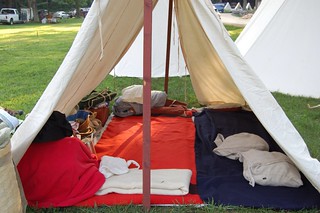
We use as small a cooler as we can, and save it for things that get dangerous, like meat. We skip dairy. If your impression is that of soldiers in the field, forget cream in your coffee or milk in your tea, unless you can point to the farm you stole it from! (See John Smith’s diary.) We hide the cooler under a blanket in our tent. Yes, the blanket is a red bed cover from Ikea and needs to be replaced.

Carrots, onions, potatoes, parsnips, beets, apples, can all travel in bags, baskets or bowls. Think basics if your impression is common soldier or common person.

Rations were generally a pound of beef for a soldier, half a pound for women on the ration, and a quarter pound for children. You can use these proportions to figure out what to make, and John Buss had a lot to say about the quality and frequency of the beef and other rations. Jeremiah Greenman of the 2nd Rhode Island ate dog on the way to Quebec, and that was one time they weren’t the 2nd Helping Regiment. We draw the line well on this side of that kind of authenticity.

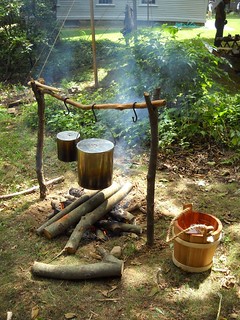
Three sticks, two kettles, one bucket. I love that bucket.

Men carried their rations in haversacks, so yes, a little eeww if you’re thinking a pound of salted beef in a linen sack along with a pound of bread or flour.  That’s where the cooler comes in, and a metal bowl or plate. We use split firewood to cut the meat on, and then burn the wood instead of washing a wooden cutting board in the field.

I have brought home-baked tea bread to events, and taken cookies (little cakes) to the farm. But you have to think about the context of the event, and your specific impression. I’d like to strip everything down to the “three sticks, two kettles, no matches” principle, but we’re stuck with cooler because we cook.

What we did at OSV, which was two dinners (Friday and Saturday) and two breakfasts  and lunches (Saturday and Sunday) was this:

Friday Dinner: pasties

Saturday Breakfast: apples, bread and ham and cheese. Guess who forgot the eggs and oatmeal? Yes, me! The one in charge of stores. Thankyouverymuch.

Saturday Lunch: Apples, bread and ham and cheese.

Saturday Supper: Beef stew with carrots, onions and potatoes. Authenticity would have made this plain boiled beef but fortunately for us, OSV is a farm, and we could pretend John Smith had helped us enhance our rations. We scraped the kettle clean.

Sunday Breakfast: Apples, bread and cheese. The soldier in the tent next to us appeared with a cup of coffee. We eyed him with real envy; sensing peril, he quickly told us we could get our mugs filled at the OSV store, at a discount. Off we quick-marched, and Bob finished his coffee in safety. It wasn’t very good coffee, but it was the best coffee I had that week.

Sunday Lunch: By this point, the child had eaten anything that remained, and we had to buy lunch.

What did I learn from that experience?

  • Bring more fruit
  • Bring more bread
  • Bring the coffee & the coffee pot

When we consider packing for Monmouth this summer, these are the factors we’ll take into account, and one of the largest factors will be the amount the kid is accustomed to eating.

Share this:

  • Share on Facebook (Opens in new window) Facebook
  • Share on Pinterest (Opens in new window) Pinterest
  • Email a link to a friend (Opens in new window) Email
  • Share on X (Opens in new window) X
Like Loading...

Eating in the Field

27 Wednesday Mar 2013

Posted by kittycalash in Events, Food, Living History

≈ 3 Comments

Tags

18th century, Events, food, living history, preparations, Reenacting, resources, Revolutionary War, weather

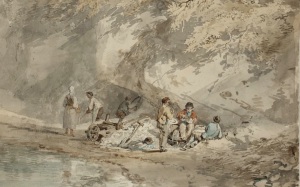
Workmen Lunching in a Gravel Pit circa 1797 Joseph Mallord William Turner 1775-1851

Workmen Lunching in a Gravel Pit, circa 1797. Joseph Mallord William Turner 1775-1851

A compatriot asked how we handle food and cooking in the field. What do we do about “yucky stuff?” by which she meant meat.

She was doing just about the same stuff we were doing, and with Battle Road around the corner, I thought I’d write about food in the field, and ways we handle it. Other people will have other ideas, but the main things I think about are:

  • Maintaining authenticity and food safety (Nobody wants flux.)
  • Historical eating is seasonal, local eating
  • Gear: less is not only more, but easier

Food safety is one of those things where you really don’t want to compromise too much, though from eating at the farm, I think there is more leeway than we admit. I will confess that when I was poor and in school, I stored dairy products on the windowsill of my studio when there was no fridge, so eating at the farm is like eating… when I was a whole lot younger.

Here are my principles. I’m not an expert, your mileage may vary, but this is where I begin.

Universal Truths

Start with who you are.
Objects you bring, and food you eat, should be true to your impression.
Authenticity goes beyond the date of accouterments: a porcelain tea set may be quite correct for a 1778 Newport or 1763 Boston parlor, but it makes very little sense if you are with a Continental private. One chipped plate is different for a woman to carry, or a piece of pewter. How long either would last you is another story, but at least you’d have a story. If you are the Colonel’s wife, it’s a different matter, even more so if it’s a British Colonel.

Food safety trumps purest authenticity.
Cloth covered, hidden ice packs will hurt no one and may save you misery later.

Stay Hydrated.

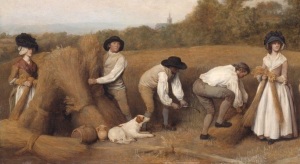
Reapers 1785 George Stubbs 1724-1806

Reapers, 1785. George Stubbs 1724-1806

Soldiers drank water.

In a hot summer camp, we keep a large pitcher full of water (see the Stubbs painting at left). Covered with a white linen or cotton cloth, it will keep coolish and free of dust & insects (or dog fur & fleas, if you’re in the Stubbs painting). We sliced limes into our enormous pitcher, and refilled it all day from the pump at OSV.

Limes are in period; justifying a source can be tricky, but at a certain level, safety trumps authenticity. 98 degrees and 90% humidity means drinking a lot of water.

Chances are you’re a caffeine addict like me, so what do you do? Boil water in a kettle, and bring tea in a screw of clean white paper is one answer. What’s your justification? I’m a personal fan of ‘stole it from my master,’ but in small quantities, perhaps you got it from home, or did a farm woman  a favor. Or stole it from her. John Smith (I kid you not), Sergeant in Colonel Lippitt’s Rhode Island State Regiment, in Continental Service, writes in his diary* of apprehending geese and chickens who failed to respond with the correct password when challenged.

*Published as “Sergeant John Smith’s Diary of 1776”, edited by Louise Rau, in Mississippi Valley Historical Review, No. 20, 1933, pages 247 – 270. NB: Kitty Calash recommends reading, not stealing.

Tomorrow: Food-related recommendations by event type.

Share this:

  • Share on Facebook (Opens in new window) Facebook
  • Share on Pinterest (Opens in new window) Pinterest
  • Email a link to a friend (Opens in new window) Email
  • Share on X (Opens in new window) X
Like Loading...
← Older posts
Newer posts →

Archives

wordpress statistics

Creative Commons License
Kitty Calash blog by Kirsten Hammerstrom is licensed under a Creative Commons Attribution-NonCommercial-ShareAlike 4.0 International License.

Website Built with WordPress.com.

  • Subscribe Subscribed
    • Kitty Calash
    • Join 621 other subscribers
    • Already have a WordPress.com account? Log in now.
    • Kitty Calash
    • Subscribe Subscribed
    • Sign up
    • Log in
    • Report this content
    • View site in Reader
    • Manage subscriptions
    • Collapse this bar
 

Loading Comments...
 

    %d