• Home
  • Completed Costumes/Impressions
  • Emma and Her Dresses
  • Free Patterns and Instructions

Kitty Calash

~ Confessions of a Known Bonnet-Wearer

Kitty Calash

Tag Archives: Revolutionary War

Over(h)alls, Trousers, & Breeches, oh, my!

26 Tuesday Mar 2013

Posted by kittycalash in Clothing, History, Museums

≈ 3 Comments

Tags

10th Massachusetts, 18th century clothes, common dress, menswear, Research, resources, Revolutionary War, soldiers

Trousers, ca 1793. MMA,1988.342.3

Gentleman can agree to disagree on the attributed date of this garment, just as gentlemen might agree to differ on whether to call these trousers or overalls. It’s all in the crotch length, friends, and we’ll just back away.

But before I return a book of letters to the lender, I wanted to record some of the details that struck me.

Right from the start, the John Buss Letters, edited by Ed Nash, are filled with details. I got excited because, in a slightly random and not at all fabric-hoarding way, I purchased a remnant of grey striped woolen goods from Wm Booth, with the intention of making a jacket or trousers from the fabric.

This notion was rejected by my resident tenant farmer, who has particular ideas about his appearance and the quality of goods which should encase his limbs. Rebuffed from my historic fashion fantasy, I turned for solace to the John Buss letters, determined to make it all up by learning the history of the tenant farmer’s new regiment.

And lo, on page 9, in the very second letter, John writes home to his parents in Leominster, MA on October 1, 1776, saying that “my trowis has got very thin, I should be very glad if mother would make me a pare of striped wooling trowis as son as you can…” My tenant farmer was not impressed by my excitement.

Yes, all my fantasies are documented. But look: John Buss’s trousers are thin, not his breeches. And he’s clear about the difference between trousers, overhalls and breeches. In a February 22, 1778 letter from Valley Forge, Buss tells how he drawd from stores in Bennington “one frock, one Jacket, one Pare overhalls, one of stockings, one Pare of shoes and one shirt. Albany, October 25th., 1777, I drawd a  Red Jacket Quemans Pattern. November 5th., I drawd a pare of Braches and a pare of fresh shoes that was not worth tow shillings.”

Later, Buss requests lining (linen) to make breeches, as he is hot. So he draws clear distinctions between these garment forms. This is a costumer’s dream, really, and for me–oh, those striped wooling trowis! Now I have to make them. Look out, Young Mr…they’re headed your way. And lucky me, I have documentation for that red broadcloth remnant I bought in a random and utterly non-fabric-hoarding way.
Share this:

  • Share on Facebook (Opens in new window) Facebook
  • Share on Pinterest (Opens in new window) Pinterest
  • Email a link to a friend (Opens in new window) Email
  • Share on X (Opens in new window) X
Like Loading...

Can’t talk, sewing.

21 Thursday Mar 2013

Posted by kittycalash in Clothing, Events, Living History, Reenacting

≈ Comments Off on Can’t talk, sewing.

Tags

18th century clothes, Battle Road 2013, Clothing, common dress, Reenacting, Revolutionary War, sewing, weekend

Raspal,_Antoine_-_The_Couturiers_workshop_-_1760

I wish I had this workshop to help me! Instead, I have the “assistant” who tends to howl and a room full of garments to finish and alter. The skirts of the brown gown are done and want only tape at the hems, so I can, in theory, move onward to sleeves. I’ll have to scrap plans for an HSF petticoat this weekend, as I have really fallen behind.

Menswear, to finish and to alter

Battle Road inspection/walk through is Saturday, and second hand reports of the reactions to letters received have me thinking about authenticity, standards, and communication. Last Saturday, I went to see Sew18thCentury and had a lovely time. Not only did we have a delicious late lunch and tea, an interesting chat about ideas and sewing and all sorts of things, I also got to get outta town on my own. (For growing up in a city, I am very happy to spend time in open spaces with grass, trees, and cows.)

I mentioned to Sew18thCentury that we’d wrestled with Fort Ti and chosen not to go because we did not, in our estimation, meet standards, and she was surprised that we didn’t. In truth, we did not. The guys clothes weren’t right, and I know our blankets aren’t right…heck, our tent’s not right.

What makes it all worse is that I know these things aren’t right. So I’ve tracked down blankets and just need to order them, and the tent–well, not this year, but maybe next, I can get around to sewing a linen bell-back tent. Mr S has learned back-stitching and whip stitching this week, so in a year we could tackle a tent together. It’s a process, and this year, unless there was a miracle of increased speed in sewing, I still wouldn’t go to Fort Ti in September.

But what about Battle Road? This inspection is not just for safety, it’s also for dress and appearance. This has thrown me into a tizzy: the jacket’s not done and the coat’s not altered. If the guys don’t pass inspection, they can’t be part of Battle Road, and I’ll feel bad that I didn’t put alterations first. But realistically, I can’t imagine getting their things done by Saturday morning. At least the coat will have the alteration marks made by the master… the road to hell may be paved with good intentions, but the road to Battle Road is paved with pins and linen thread.

Share this:

  • Share on Facebook (Opens in new window) Facebook
  • Share on Pinterest (Opens in new window) Pinterest
  • Email a link to a friend (Opens in new window) Email
  • Share on X (Opens in new window) X
Like Loading...

Choosing a Gown

19 Tuesday Mar 2013

Posted by kittycalash in Clothing, Events, History, Living History, Making Things

≈ 1 Comment

Tags

18th century, 18th century clothes, authenticity, Battle Road 2013, Clothing, common dress, Costume, fashion, history, living history, Research, Revolutionary War

Here’s a good question (I love questions): how do you choose which [historic example] to make?

The answer, as almost always: Research.

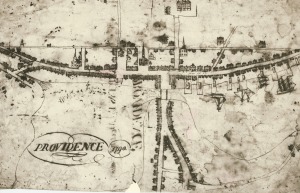
I start with a date. For Battle Road, the dress must be typical of New England in April, 1775 and appropriate for my impression or persona.  As I imagine my character from the past, she’s in her 40s, from the upstart town of Providence, married to a tradesman or craftsman. She has one child, and I haven’t thought about whether or not it’s one only or one surviving—too busy chasing the One Child Who Eats Like Ten.

Providence, 1790. John Fitch, RIHS Map #30

Providence, 1790. John Fitch, RIHS Map #30

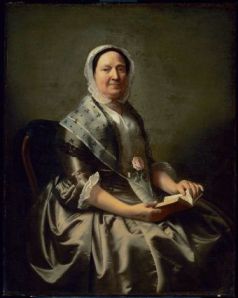
Mrs Nathaniel Ellery, J S Copley, 1765, MFA Boston

Mrs Nathaniel Ellery, 1765, MFA Boston

Living in a port city means my character—we’ll call her Kitty—has access to new goods and ideas, a town where you can buy almost anything, but where staymakers are less common than in Newport.  It’s less refined than Newport, brassier, but competitive and striving and with plenty of money in some hands. Providence is where the Gaspee affair was plotted; in 1790, residents from around the world are recorded here—men from Java, living in Providence—it’s polyglot, mercantile, striving.

Given that Kitty is of the middling sort in a town, she can wear linen and wool and camblet and even some silk. Her clothes will be fashionable but not high style, “a thought behind the current moment,” as Lord Peter says of someone’s hat. What’s the purpose of this brown gown? Everyday wear, that, with accessories, can be dressed up, or dressed down. Eventually, who knows, I might manage a crewel work stomacher and nice linen cuff-ruffles for my shift, though a filthy apron, burned skirt, and a striped rough linen petticoat are more likely…

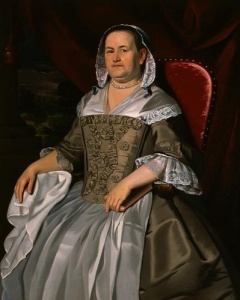
Mrs. James Otis (Mary Allyne Otis). JS Copley, ca. 1760. Wichita Art Museum

Mrs. James Otis ca. 1760. Wichita Art Museum

Making an everyday dress means not copying the silk dress from Williamsburg, and honestly, I couldn’t wear that wedding cake frosting on my chest, nor what Mrs. Otis has on her stomacher. How about that lovely Norwich wool gown? Well…almost. But I can’t sew that well, and haven’t got fabric that lovely, couldn’t afford it now, wouldn’t have had it then. I have brown wool. Have I seen Mrs. John Brown dressed like one of Copley’s women? Perhaps (if you take Copley as evidence, which you must do carefully.) Have I looked at the lovely brown silk satin and thought, I could do that. Possibly.

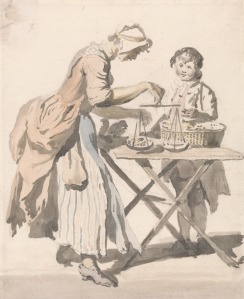
Black Heart Cherries, Paul Sandby, ca. 1759. YCBA B1975.3.206

Black Heart Cherries, Paul Sandby, ca. 1759. YCBA B1975.3.206

What we do know is that in New England, gowns are found more often than any other kind of garment (i.e. short gowns or jackets or riding habits). We know that wool is common, but that linen is found in towns and cities, wool more often in the country, and that the pretty, but expensive, cotton prints are popular. Open robes are more common earlier, and “hatchet” cuffs (pleated tubes) predominate. The style is worn by Copley’s women and Sandby’s girls, and it’s seen in images from 1760 on. That means it’s a good choice for a base style for any class level.

Here’s my process, more or less:

Determine the date, that sets the style.
1775 means stomacher front gown.

Determine the character, that sets the fabric and trims.
Kitty’s New England middling, so she’ll have a wool gown with robings but not trims, a plain stomacher, cuffs and not ruffles, and a matching petticoat.

Determine the event, that sets the accessories.
Battle Road is a hard one for me: as a woman, I shouldn’t be there, and as a Rhode Islander, I really shouldn’t be there. (RI militia were stopped at the border by the governor to prevent them joining Massachusetts men after news of the events at Lexington and Concord reached Rhode Island. They did get there eventually and participated in the siege of Boston, but you see what I mean…) So I have to construct a story for how to dress, and the best I can manage is going out, either to a shop or to pay a casual call on family. So what I plan is a matching petticoat, white neck handkerchief, clean check apron, and bonnet over a clean white cap. (This emphasis on clean should remind me to wash and iron a thing or two.)

That’s my story, and I’m stickin’ to it. For now, anyway, till I get a better idea.

Share this:

  • Share on Facebook (Opens in new window) Facebook
  • Share on Pinterest (Opens in new window) Pinterest
  • Email a link to a friend (Opens in new window) Email
  • Share on X (Opens in new window) X
Like Loading...

More on Pockets

18 Monday Mar 2013

Posted by kittycalash in Clothing, Museums

≈ Comments Off on More on Pockets

Tags

18th century, 18th century clothes, Clothing, Costume, dress, museum collections, Research, resources, Revolutionary War

If you think you don’t like military history, think again. A friend of mine is working on a French and Indian War 250th Anniversary project in Boston, and in the course of his research he got interested in a red velvet grenadier’s cap that I happen to be adjacent to from time to time.

UBM 2006-08-53

UBM 2006-08-53

One thing led to another, fortunately for him and not me, and he ended up calling on the National Army Museum in London. There a curator after my own heart distracted him with one of the coolest things I have ever seen: A Lady’s Pocket made from the decorative panel of a mitre cap, or as they call it, Mitre Pocket.

Here’s their description:

“Front section of a mitre cap made into a ladies pocket, 1760 (c); wool and cotton; on front the emblems for the 70th Regiment of Foot, all sewn as for the period, 1760 (c); back is made of brown cloth; front is bound with red cloth binding.

Note: Hanoverian white horse and ‘Nec Aspera Terrent’ used by 8th (The King’s) Regiment of Foot, later King’s (Liverpool Regiment), which might make the L an initial not a numeral and the XX a company number rather than part of the regimental numeral.”

Grenadier’s cap, 1833.1.1, RIHS

One of the most charming things about the email is that the woman at the NAM sent my friend an image of a gown and pocket, just so he’d be clear about how it would have been worn. He knew anyway, but I thought that was a very nice thing to do.

The cap we’re looking into is this one, said to have been picked up at Bunker Hill. Not for nothin’ (as the locals say), but this cap would make a lovely pocket.

Share this:

  • Share on Facebook (Opens in new window) Facebook
  • Share on Pinterest (Opens in new window) Pinterest
  • Email a link to a friend (Opens in new window) Email
  • Share on X (Opens in new window) X
Like Loading...

Work, work, workman’s jacket

04 Monday Mar 2013

Posted by kittycalash in Clothing, Historical Sew Fortnightly, Making Things, Reenacting

≈ 4 Comments

Tags

18th century clothes, Battle Road 2013, common dress, Historical Sew Fortnightly, living history, Making Things, Revolutionary War

It fits! It might be painful, though.

Ah, yes. Work. It continues on the workman’s jacket for the Young Mr to wear at Battle Road, and for next week’s HSF deadline. There are some additional views of him in the same pose here. I tacked the lapels down because I have seen that detail on an original garment, and because if I don’t, they’re likely to bother the kid.

The nice thing about a workman’s jacket is that a waistcoat is optional underneath it. This short, only post-RevWar waistcoats look alright. So for Battle Road, long underwear may be in order. It wasn’t last year, but who knows?

Paul Sandby, A Sandpit. YCBA B1975.3.930

Paul Sandby, A Sandpit. YCBA B1975.3.930

Sandby, Roslin Castle detail, YCBA, B1975.4.1877

Paul Sandby, Roslin Castle detail, YCBA, B1975.4.1877

The form is authentic, thank goodness, for working men’s clothes; on the left, in a detail from Sandby’s A Sandpit, is a jacket in blue. On the right, in a detail from Roslin Castle, Midlothian, is another jacket that looks short, worn without a waistcoat. It may not be as short, but I am encouraged by the lack of waistcoat, though I will insist on shoes…

The form persists for a long time, and is seen in military wear as well, in light infantry and dragoon troops, as well as in sailor’s clothing.


Share this:

  • Share on Facebook (Opens in new window) Facebook
  • Share on Pinterest (Opens in new window) Pinterest
  • Email a link to a friend (Opens in new window) Email
  • Share on X (Opens in new window) X
Like Loading...
← Older posts
Newer posts →

Archives

wordpress statistics

Creative Commons License
Kitty Calash blog by Kirsten Hammerstrom is licensed under a Creative Commons Attribution-NonCommercial-ShareAlike 4.0 International License.

Website Built with WordPress.com.

  • Subscribe Subscribed
    • Kitty Calash
    • Join 621 other subscribers
    • Already have a WordPress.com account? Log in now.
    • Kitty Calash
    • Subscribe Subscribed
    • Sign up
    • Log in
    • Report this content
    • View site in Reader
    • Manage subscriptions
    • Collapse this bar
 

Loading Comments...
 

    %d