• Home
  • Completed Costumes/Impressions
  • Emma and Her Dresses
  • Free Patterns and Instructions

Kitty Calash

~ Confessions of a Known Bonnet-Wearer

Kitty Calash

Tag Archives: Rhode Island

How deep were my pockets?

15 Friday Nov 2013

Posted by kittycalash in Art Rant, Museums

≈ 4 Comments

Tags

auctions, common dress, common people, fashion, history, museum collections, Museums, Rhode Island

Warning: Museum-related Digression

Not deep enough, not by half.

Lot 194, hammer price: $22,500. Estimate:$4,000-$5,000

Lot 194, hammer price: $22,500. Estimate:$4,000-$5,000

On November 13, Augusta Auctions held a sale in New York that included some really wonderful things, and chances are good that if you read this blog, you know about some of the items, like the British consul’s coat, some very lovely leather trousers, and my personal favorite, the Rhode Island man’s day suit.

That suit! I’ve heard about that suit from a couple of people, but I’ve never seen it in person. I’ve made a jacket from a pattern taken from the coat, but until the photos turned up on the auction site, I didn’t know what the original looked like. It’s not flashy. You think, it’s a plain brown linen suit, no big deal, until you start to look at the simple, direct construction methods (which I have seen in other Rhode Island garments), and the rather elegant lines. This seems, from the distance at which I have to observe it, very like the boy’s jacket at Connecticut Historical Society. They share similar lines, are similar in color, and probably represent the most common everyday wear of the middling sorts of southeastern New England.

Historians and curators increasingly recognize the importance of the “common everyday” people and their material world, whether it’s Jill Lepore on Jane Franklin Mecom or whoever bought this suit. There are and were more of the 99% than the 1%, and to really understand the past, we have to collect what we can to document the daily lives of the majority of the people.

So of course I wanted this suit very badly. I looked up previous auction results, I poked around in other museum’s catalogs, and looked at our own collections. I prepared a case statement and took it to the Board committee that oversees Collections– when we spend large sums, we have to get approval. The Board committee authorized me to bid, but set a limit based on our acquisitions budget, which is funded from prior sales of duplicate or unrelated material in our collection. (Things like 20th century oriental rugs and mid-Atlantic corner cupboards– we can’t use them, they weren’t made or used in Rhode Island, but were acquired to furnish our house museum, until it was over-furnished. Then we went through a lengthy and formal deaccession process.)

Watching the online bidding, I could tell the sale was hot: there were folks with deep, deep pockets bidding, and I knew early on I would not get the suit. By the time it was all over, the hammer price was $22,500 (it’ll be $27,000 with the buyer’s premium) for a suit with a $4,000 – $5,000 estimate. I should say that it did rawther well, considering, but even in a different budget year, I would not in my wildest dreams have gone as high as the winning bidder did. Every result in this sale felt new, and dangerous, the way the Betty Ring sampler sale prices felt new and dangerous.

These prices feel dangerous because they skew the market and the past in a curious way: when the objects of the everyday become this valuable, this expensive, how can a museum with a mission to interpret the past of a specific people ever hope to compete? I can’t, not even with a concerted effort to develop a donor base that would support an acquisition at more than four times an estimate. What does that do to the market? It puts it squarely in the realm of the 1%.

That 1% is not just oil barons, it’s museums with enormous endowments and revenue streams, like the Met. I’ve posted before about the difference in museum revenue streams and endowments, and how a place like the Met can gross over a billion dollars in revenue in a fiscal year. With money like that, $22,500 is nothing. Museums like the Met and the MFA and the PEM and LACMA can out-bid smaller museums, vacuum up collections, and amass great hoards of material. What the little people have to do is to build relationships, and hope that they can get some of the material before it ever gets to auction. I didn’t have that chance, but it’s the only one I’ll ever have in what seems to be a new market for old things.

This sale also made me think that the museum world is increasingly a winner-take-all world much like politics or business, or even education. There are the haves, with large endowments and major gifts, attracting more gifts and endowments, and then there are the have-nots, with very limited funds and volunteer staffs. Those of us in the middle are feeling the same squeeze that the ever-smaller middle class is feeling, with similar income erosion as what our endowments earn buys us less, and as grant funds are ever harder to get. Programs are more competitive, and there’s less money for the big national endowments (NEA, NEH, IMLS) to give away.

Capitalism and market forces are at work, changing collections and changing how museums can and will operate. We have to radically and rapidly rethink how museums function both in acquiring collections (if we can continue to acquire them at all– there’s a cost not only to acquiring but to keeping) and in making them accessible. The smaller museums have to make better cases for mattering more to their audiences, or culture will be increasingly sequestered in larger, richer places.

Share this:

  • Share on Facebook (Opens in new window) Facebook
  • Share on Pinterest (Opens in new window) Pinterest
  • Email a link to a friend (Opens in new window) Email
  • Share on X (Opens in new window) X
Like Loading...

Gallery

What Cheer Day Photo Gallery

10 Thursday Oct 2013

Posted by kittycalash in Events, Living History, Museums, Thanks

≈ 2 Comments

Tags

John Brown House Museum, living history, Rhode Island, Rhode Island Historical Society, What Cheer Day

This gallery contains 19 photos.

Good Help is Hard to Find

06 Sunday Oct 2013

Posted by kittycalash in Events, Living History, Museums, Thanks

≈ 8 Comments

Tags

18th century, history, John Brown House Museum, living history, Providence, Rhode Island, Rhode Island Historical Society, What Cheer Day

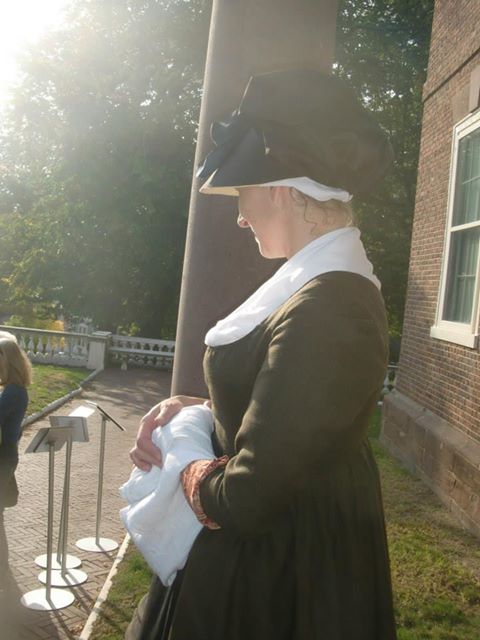
Esther helps Mrs Smith with her bonnet

Esther helps Mrs Smith with her bonnet

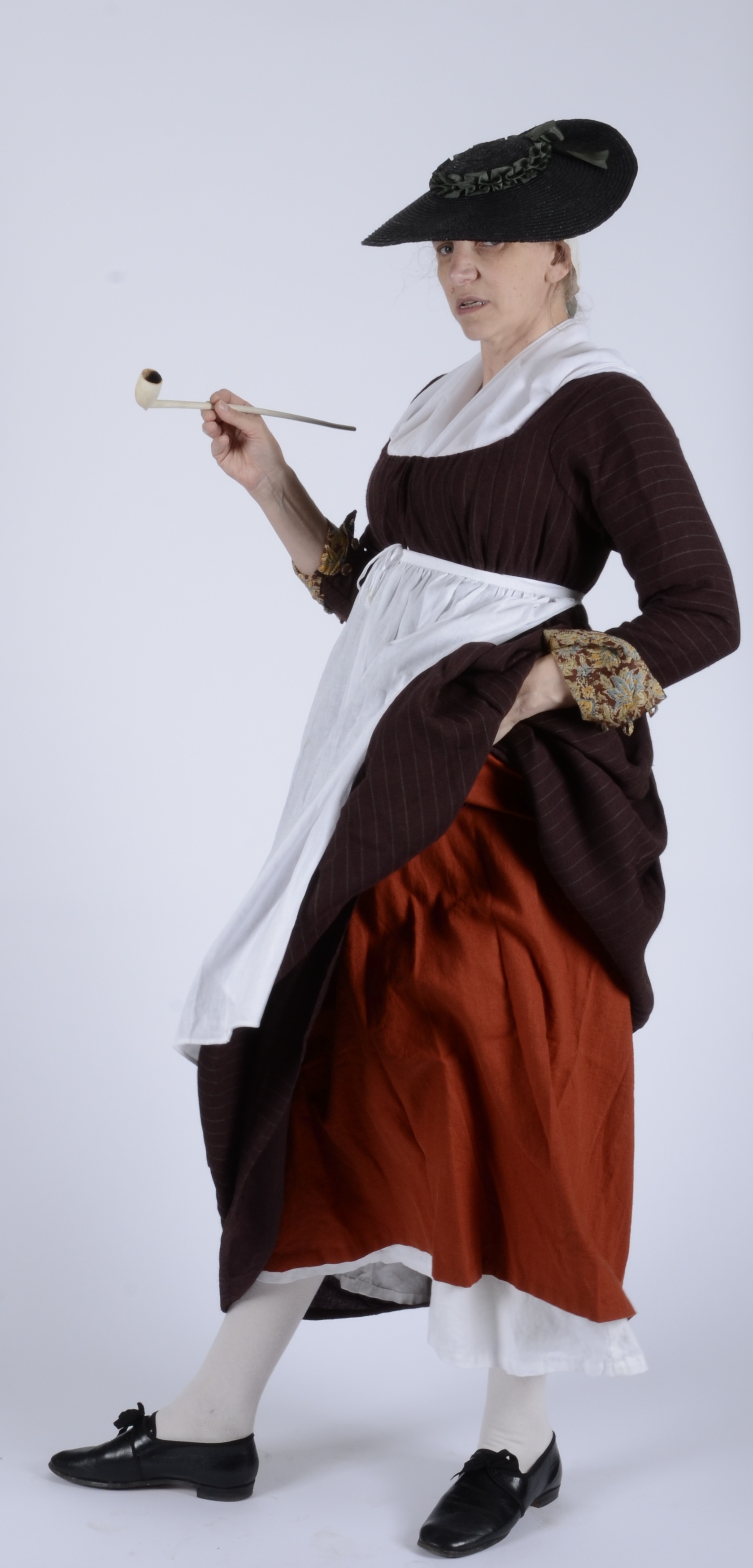
Esther Hudson here has a terrible fascination for knittin, and an abundant fascination with sheep.I fear sometimes for her sanity, as she spends much of the evening sketchin cats on her slate and showing em to me. Cats, sheep, and knittin are much of her conversation and I wonder if she will ever be settled in a home of her own. I durst not send her away, as her father is at sea, and knowing what might befall her, given her simple ways, I think it best to keep her close. She is fond, as you can see, of dressin, but refuses utterly to quarter a fowle. She will beat a fine pound cake, but the coarser tasks of the kitchen she finds distasteful, preferrin to dress the ladies’ hair. Of her future, I do sometimes despair.

Mrs Smith and Miss Smith

Mrs Smith and Miss Smith

My cousin, Miss Eliza Smith, has donned her new dress to come up to town from her beloved Newport to see about a position. The family with whom she has found employment these many years has suffert in that city’s decline since the late war, and she seeks a new future in Providence. She writes a fine letter, and with excellent references, Miss Smith would be well suited to manage a household for Mrs Brown’s youngest daughter, the recently married Mrs Mason. Miss Smith seems also to steady Esther, whose conversation grows more sensible when she is not with me. Perhaps after speaking with Mrs Mason, Esther, Eliza and I can slip away to enjoy some of the newly pickt apples she has brought up from Rhode Island.

Mrs Smith, ready for some ale

Mrs Smith at day’s end

At the end of a long day filled with visitors– every stage has stopt at our house, some mistaking it, I think, for that questionable establishment operated by ‘Mrs’ Mary Bowen on South Main Street–I was ready to remove my soild apron (thankfully Esther has a spare) and venture down the hill to seek refreshment with my frinds. I may chanst to hear some news of the Ann & Hope, bound for Canton, and on which my son is a sailor. Or perhaps, before the light fails, I may read a bit of Mr Defoe’s most moral tale, Moll Flanders, and think in gratitude that my late husband’s family has seen fit to give me employ. I cant read at home, for if Mrs Brown catchs me readin that book agin, I will surely be trouble.

(Top photo thanks to the Providence Journal; bottom two thanks to Sharon Ann Burnston, our Mrs Brown)

Share this:

  • Share on Facebook (Opens in new window) Facebook
  • Share on Pinterest (Opens in new window) Pinterest
  • Email a link to a friend (Opens in new window) Email
  • Share on X (Opens in new window) X
Like Loading...

Missus Smith and Mistuh Mason Stay Up All Night…

03 Thursday Oct 2013

Posted by kittycalash in Clothing, Events, Living History, Museums

≈ 7 Comments

Tags

18th century clothing, John Brown House Museum, Rhode Island, sewing, What Cheer Day

petticoat

… sewin’. Or so they say.

Missus Smith gave up at 12:30 to go to sleep, and got up again just as Mistuh Mason was going to bed.

I find the whole thing suspicious, don’t you?

Share this:

  • Share on Facebook (Opens in new window) Facebook
  • Share on Pinterest (Opens in new window) Pinterest
  • Email a link to a friend (Opens in new window) Email
  • Share on X (Opens in new window) X
Like Loading...

“I know a guy”

27 Friday Sep 2013

Posted by kittycalash in Uncategorized

≈ Comments Off on “I know a guy”

Tags

John Brown House Museum, JohnBrownHouse, Rhode Island, What Cheer Day

The Banishment of Roger Williams, RIHS 1943.3.1

It’s an oft-used phrase in my state of residence: I know a guy. Even I use it, because I do. Know a guy. A bunch of guys. They are mostly contractors, but they get stuff done and if they can’t, well, then they know a guy.

My favorite guy, Billy, union carpenter and accidental poet, is a descendant of Roger Williams, and has shown me his genealogy to prove it. He’s a multiple-great-grandson of Roger’s youngest son, Joseph, and Lydia Olney. As it happens, not too long after my encounters with Billy, I visited a donor in the rural but wealthy Quiet Corner of Connecticut. The widow of a man descended from a Rhode Island governor, Natalie showed me her late husband’s genealogy.

Yes, the children of the very wealthy scion of lawyers and governors and bankers are some kind of cousin of a construction superintendent who lives in area known as “Rhode Island’s Alaska.” I was immensely gratified and smug all the way home from that donor visit.

As we try to calculate how many domestics are involved in making John Brown’s house run (perhaps nine), though we think the domestics aren’t family members, it might be worth considering that in Rhode Island, you can be relatives and still not be family. You might just “know a guy.”

Share this:

  • Share on Facebook (Opens in new window) Facebook
  • Share on Pinterest (Opens in new window) Pinterest
  • Email a link to a friend (Opens in new window) Email
  • Share on X (Opens in new window) X
Like Loading...
← Older posts
Newer posts →

Archives

wordpress statistics

Creative Commons License
Kitty Calash blog by Kirsten Hammerstrom is licensed under a Creative Commons Attribution-NonCommercial-ShareAlike 4.0 International License.

Website Built with WordPress.com.

  • Subscribe Subscribed
    • Kitty Calash
    • Join 621 other subscribers
    • Already have a WordPress.com account? Log in now.
    • Kitty Calash
    • Subscribe Subscribed
    • Sign up
    • Log in
    • Report this content
    • View site in Reader
    • Manage subscriptions
    • Collapse this bar
 

Loading Comments...
 

    %d