• Home
  • Completed Costumes/Impressions
  • Emma and Her Dresses
  • Free Patterns and Instructions

Kitty Calash

~ Confessions of a Known Bonnet-Wearer

Kitty Calash

Tag Archives: work

Shameful and Shifty: HSF #2,UFO

06 Wednesday Feb 2013

Posted by kittycalash in Historical Sew Fortnightly, Making Things

≈ 2 Comments

Tags

Clothing, Costume, Historical Sew Fortnightly, sewing, work

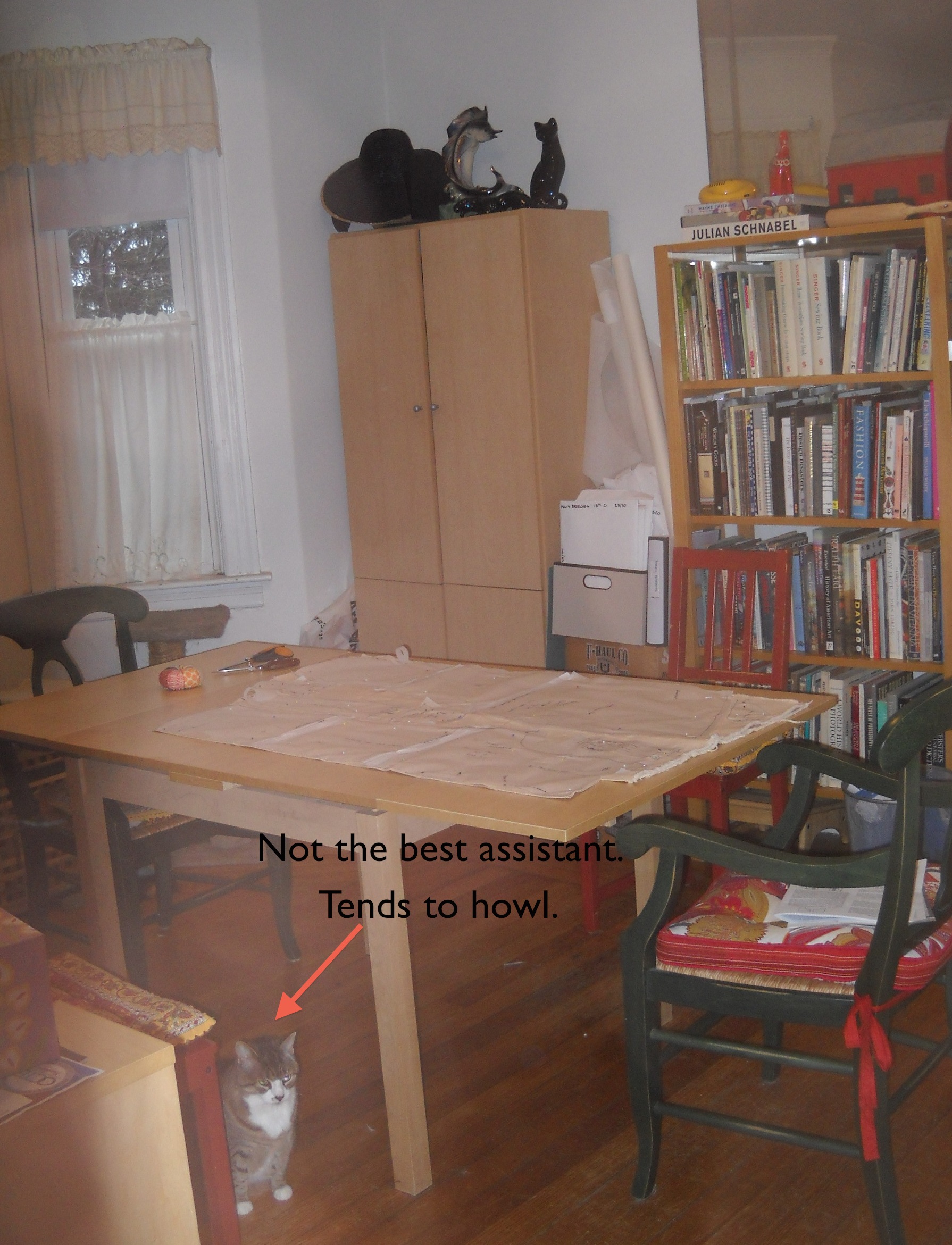
Chaos on deck, assistant elsewhere

Chaos on deck, assistant elsewhere

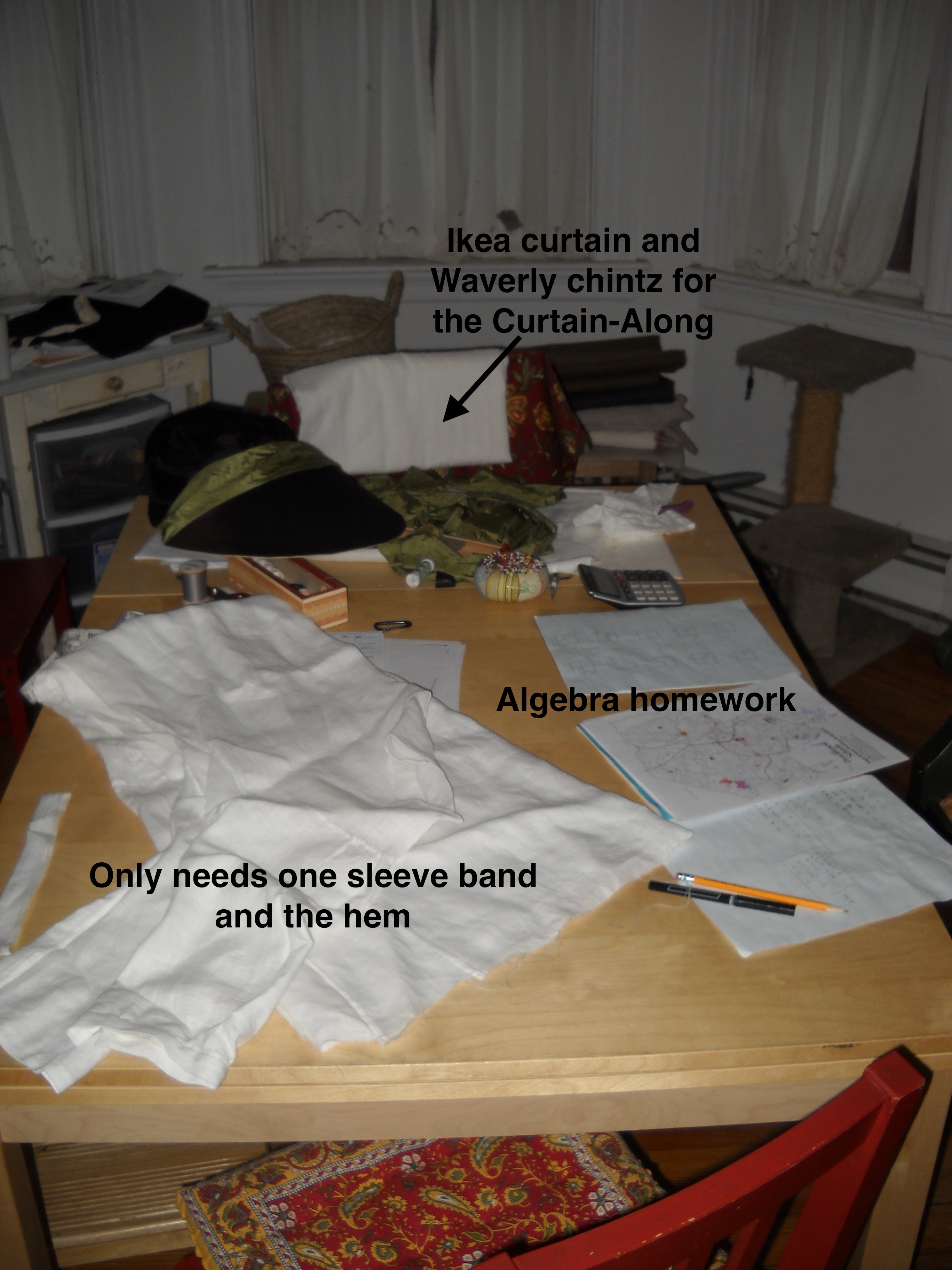
It’s not done, it’s as simple as that. I had a shift in hand for HSF #2: UFO. Along the way, I made significant progress: side seams sewn up, sleeve seams sewn up, and all of them flat-felled, until, at last: One sleeve band and a hem stood between me and completion. Whatever week that was, on that Sunday evening, reader, I slept. Work does that to me.

Dining/sewing/library room with "assistant"

Assistant has been howling more of late

Luckily, I can kick it forward to HSF#3, Under it All, because that petticoat isn’t cutting itself out. It’s not its fault: there’s homework piled on top of the table, a bill from the dentist, and other assorted bonnet-related chaos. All day long the linen and cotton listen to my howling assistant, then the Young Mr comes home and coughs, and what’s yardage to do? Drape over a chair, flat-out, folded, and exhausted.

It’s not history until it hurts, and I can assure you that from how my colleagues and I feel, our Library is chock-full of history goodness (along with 18,240 moved books and a great deal of newly assembled Ikea furniture).

Share this:

  • Click to share on Facebook (Opens in new window) Facebook
  • Click to share on Pinterest (Opens in new window) Pinterest
  • Click to email a link to a friend (Opens in new window) Email
  • Click to share on X (Opens in new window) X
Like Loading...

Women’s Work

22 Tuesday Jan 2013

Posted by kittycalash in Events, History, Living History, Reenacting

≈ 5 Comments

Tags

18th century, Events, interpretation, living history, women's history, work

Cooking. Gets you every time.

Cooking. Gets you every time.

Three holes (at least; there might be four) and mending to do. The patches are cut, but I’m thinking now that a wool apron might be a good thing to have. The other thing I’ve been thinking about is what James Thurber called The War Between Men and Women, and how even in educated, enlightened North America, it plays on. [i]

At living history events or reenactments, the work and activities are divided along gender lines. Participants are supposed to follow “the rules,” which keep women on the observer side of the rope line and the men free to run around with muskets. Women sometimes seem purely decorative at the military events, and the relationships between men and women are curious. There’s the sexism between reenactors, and the sexism of the public, who can often assume women know nothing about what’s happening.  Women should, after all, know their place, just as the men know theirs.  Women can cook and clean up after the men, and the men will do all the talking, even when they’re wrong.[ii]

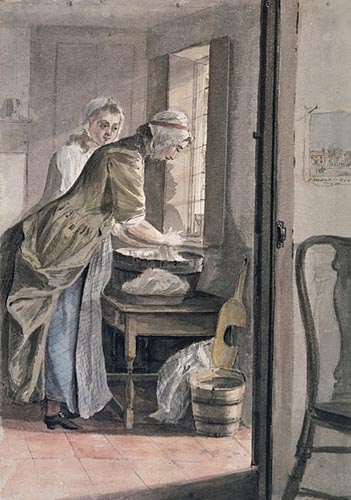
In a more domestic setting, this same historical dynamic can play out: women cook and serve the meals, wash the dishes, fetch the wood and water, and clean the kitchen, while men muck about outdoors until their tools break. Then they lounge about smoking, drinking, and talking.

Sandby, Washing at Sandpit Gate, 1765. Royal Collection.

Sandby, Washing at Sandpit Gate, 1765. Royal Collection.

That’s all OK, to a degree.  But we’re not in the 18th century, and the women in the kitchen don’t enjoy washing other people’s dirty dishes as well as all the cooking pots and tools. We had a system on Sunday evening, but I did notice that some men just can’t be the only guy helping: once the other guys leave the room, they’re out, too, with a kind of desperation, even as the light wanes and we need all the help we can get to finish up.

So what to do? Interpreting the 18th century means facing gender roles that most American women today don’t like or embrace. What’s the best way to interpret women’s history and women’s roles in the past to people today?

On Sunday, I left the house to call the guys to the first meal, and a visitor asked if the sheep in the field were part of the site. “Yes,” I said. “ But I don’t know where the sheep are today; I don’t get to leave the house much.” And that is true: aside from fetching water when I didn’t have a man or boy to ask to do it, there was hardly need, reason, or even time, to leave the house.

I think we do a disservice to the visitors to living history sites of all kinds if we don’t find a way to talk about women’s history, and the roles—proscribed or not—that women could take on. At a RevWar encampment, we can talk about the reasons women followed the armies, the kinds of work they did for pay or rations, and what the Revolution meant for women. At the farm and at the manor, I think it’s important to talk about women’s lives in the Early Republic. How this would work at the farm, exactly, I’m not yet certain; at the manor it is easy enough, for the women who lived there were born just before the Revolution. They were well-educated and expected to choose their own husbands. We know who they were; we know less about the women at the farm, though we know about their work.

How we experience that work isn’t really the point, but the chasm between choosing to spend a day never looking beyond the scope of the hearth and having to spend days that way is enormous. It’s a point I want to make,  in a way more sophisticated than “life was hard and greasy.” It’s something to work on.


[i] This is in no way meant to equate the petty first world problems of a bunch of reenactors/living historians with the larger and more brutal problems elsewhere in the world. But relationships can change when situations change…

[ii] Fortunately, the Second Helping Regiment doesn’t work quite this way, and not just because they’re busy chewing whatever has been made for them. Cooking, and the subsequent chewing, can be used strategically.

Share this:

  • Click to share on Facebook (Opens in new window) Facebook
  • Click to share on Pinterest (Opens in new window) Pinterest
  • Click to email a link to a friend (Opens in new window) Email
  • Click to share on X (Opens in new window) X
Like Loading...

Night Lights and a Book

14 Friday Dec 2012

Posted by kittycalash in Clothing, History

≈ Comments Off on Night Lights and a Book

Tags

blurry photos, books, bookstores, Clothing, Costume, dress, fashion, Providence, Rhode Island, work

DSCN3605Last night, I went to a meeting downtown for my boss, and chose to walk instead of drive. I took some blurry photos along the way as evening became night and the city became more and more like Busy Town. The skill level of local drivers is not too different from Richard Scarry’s drivers…and the hills and the way the houses stack up, and the way we recognize or know each other here reminds me of Scarry’s books.

Walking back to the museum, I stopped at one of my favorite bookstores, where the selection runs from the perverse to the erudite.  I picked up many books and limited myself to three, including Very Vintage. (Did I mention Symposium’s remainder table pricing? Ah, yes: that’s why three books were possible.)
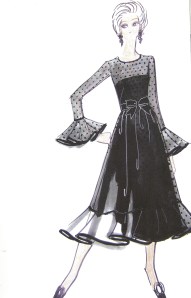
The text could have been edited a little more carefully and I am a fan of the endnote (not present here). But there are excellent photos I have not seen before and diagrams patterning garments. Now you see why I bought this: where else will I find diagrams of aTeddy Boy Jacket and a 1960s Bellville Sassoon-inspired evening dress?
dress2dress

Share this:

  • Click to share on Facebook (Opens in new window) Facebook
  • Click to share on Pinterest (Opens in new window) Pinterest
  • Click to email a link to a friend (Opens in new window) Email
  • Click to share on X (Opens in new window) X
Like Loading...

Surprise!

06 Thursday Dec 2012

Posted by kittycalash in History, Museums

≈ Comments Off on Surprise!

Tags

arts, exhibits, galleries, John Brown House Museum, Museums, work

Warning: Museum content ahead.

I found this link in the AASLH.org twitter feed yesterday: a post at The Uncataloged Museum about the Museum of Hunting and Nature in Paris.

CW Peale: The Artist in His Museum

What a great find, a wunderkammer in the 21st century. After this weekend, I was thinking even more about the ways in which museums engage (or fail to engage) their viewers. Working where I do, I can’t light a fire in a fireplace and hearth cook: for one thing, it wasn’t done in that house (and chimneys are all capped now, anyway).

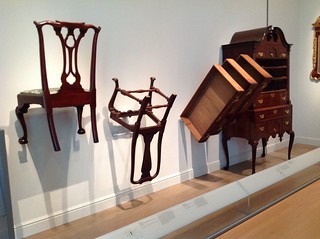
But wait: isn’t there some place other than a living history museum where people have immersive and transformative experiences? Perhaps art museums? The last time I went to the MFA I did have to keep convincing my companion to stay a little longer–but even the 13-year-old was convinced when each gallery led us to a new surprise.

MFA: American Wing, with replicas

Take away lesson: surprise. wonderment. unusual presentations.

My colleague at work said one of the best things we ever did was to install a post-party room with a broken plate on the floor. You don’t see broken things in a museum! You don’t see messes. But that’s normal for a house, so why not for a house museum?

In preparing a room for a display change, we removed the manservant mannequin, and stashed him temporarily outside a storeroom (former bedroom) door. There’s a niche, and he was partially hidden, and looked guilty, as he reached for the door knob. That’s another kind of surprise, the hidden history of of a house–not just the servants, but also the gossip– that could be brought to life.

Share this:

  • Click to share on Facebook (Opens in new window) Facebook
  • Click to share on Pinterest (Opens in new window) Pinterest
  • Click to email a link to a friend (Opens in new window) Email
  • Click to share on X (Opens in new window) X
Like Loading...

Consider the Chicken

04 Tuesday Dec 2012

Posted by kittycalash in Food, Living History

≈ 6 Comments

Tags

cooking, david foster wallace, food, history, living history, Museums, recipe, weekend, work

https://i0.wp.com/farm9.staticflickr.com/8311/7995409969_f925f8a7eb_n.jpg

Nobody puts Dumber in a pot

With apologies to the late David Foster Wallace

The majority of us do not consider the chicken. We may consider whether the package of chicken we purchase is free range, organic, cage-free, grain fed, cruelty free. But we are unlikely to think about the implications for the physical being, the essence of chicken-ness, that the chicken’s conditions create for it.

And I am here to tell you that the cage-free, organic, free-range chickens and chicken parts that you purchase at Whole Foods or your other large vendors bear little to no relationship to the actual free-range, catch-as-catch can, ne’er-do-well chicken of the historic barn yard. For one thing, living history chicken is ripped.

https://i0.wp.com/farm9.staticflickr.com/8205/8243387583_072e352ff9_n.jpgIt’s well-developed physically, with strong, sturdy bones and robust ligaments. Its musculature is tight: this is not a bird in need of a personal trainer. Its meat, when cooked, is not white. It is dark meat, not so dark meat, and sort-of white meat. Its taste was described to me as gamey, but I disagree. It was chicken, but earthy, sweet and fresh and rich.

But all that came after the meeting of human, knife, and chicken.

Disassembling the chicken fell to me; I declined rubbing butter into flour having prevented a fall down cellar stairs by putting my hand in fresh goose guano, so I after I washed my hands, I addressed the chicken in its bowl, and took up a knife.

Dumber & Friend

By this time, post-carrots, -parsnips, -squash, -string, -tallow and -suet, the knife lacked the purest essence of knife, that is, sharpness. But it functioned well enough for the task, with some persuasion. The skin was much thicker and more resilient than a store-bought chicken, and greasier, though not in an unpleasant way at first. The muscles were well-developed, and pink. Rosy pink, deep pink, dark like wine. There were no large slabs of the shiny, flaccid, pale meat you find on the chickens in the store. Those aren’t chickens any more: those are products.

The process of quartering the chicken took strength and pressure on the knife, and the strength of my hands. I did have to rip joints apart, and break the carcass’s back. All of this had a sound, and a mild smell of chicken, mixed with the melting tallow. But it was the sound that, with the greasy, slick knife, and the grease that soon covered my hands and wrists, that kept bringing me back to what I was doing, and that, when the bird was broken apart and in the pot and my hands washed, again (they itched), send me outside and up the hill for air and sky.

We boiled the chicken in a kettle we’d already boiled crook neck squash in; later, we added sage, thyme, parsnips and carrots. It was delicious. The broth was incredible, and the whole meal very simple. That’s the whole of the recipe: boil a chicken, add herbs and root or fall vegetables, boil until done, serve. Use any uneaten broth and bones/meat for  stew, pie or other dishes. That’s it.

The product chickens from the market are bred to fall apart. They haven’t got what a running, pecking, eating everything chicken’s got in muscle, ligament, and tendon.

On Sunday, after we came home, I looked at the food in our cupboards. There were boxes, cardboard, plastic, layers of packaging. The cheese was square. These things came from the good market, but were they food, or were they products? I felt like a passenger on the ship in Wall*E, and I was appalled.

Share this:

  • Click to share on Facebook (Opens in new window) Facebook
  • Click to share on Pinterest (Opens in new window) Pinterest
  • Click to email a link to a friend (Opens in new window) Email
  • Click to share on X (Opens in new window) X
Like Loading...
← Older posts
Newer posts →

Archives

wordpress statistics

Creative Commons License
Kitty Calash blog by Kirsten Hammerstrom is licensed under a Creative Commons Attribution-NonCommercial-ShareAlike 4.0 International License.

Website Built with WordPress.com.

  • Subscribe Subscribed
    • Kitty Calash
    • Join 621 other subscribers
    • Already have a WordPress.com account? Log in now.
    • Kitty Calash
    • Subscribe Subscribed
    • Sign up
    • Log in
    • Report this content
    • View site in Reader
    • Manage subscriptions
    • Collapse this bar
 

Loading Comments...
 

    %d