Tags
18th century, John Brown House Museum, JohnBrownHouse, Rhode Island, Rhode Island Historical Society, What Cheer Day

The event poster, designed by my colleague in the deerskin breeches! You’ll be joining us, right?

10 Tuesday Sep 2013
Posted in Events, Living History, Museums
≈ Comments Off on What Cheer Day 2013
Tags
18th century, John Brown House Museum, JohnBrownHouse, Rhode Island, Rhode Island Historical Society, What Cheer Day
The event poster, designed by my colleague in the deerskin breeches! You’ll be joining us, right?
08 Sunday Sep 2013
Tags
 The neighborhood where we live is part of the old rural past of our college town: it’s up the hill from the oldest settlement area, and slopes downhill to a plateau that runs out towards the other river, where the land drops precipitously. The house we live in was built in the 1920s, about the time of the junior high school and the stadium below us. The streets are named for the people who settled and farmed here, and two of the early houses remain, one frame and one stone.
Even into the 1940s, there was a dairy farm in this area, and a milk wagon; paintings from the first quarter of the twentieth century show an orchard named for one of the settlers, and there’s possible physical evidence of an earlier existence: apple trees in the verge around the corner from us.
I don’t know if these are new trees or old, though apple trees can live a long time. Well established and productive, the apples look like Paula Reds, but then again, so do Devonshire Quarrendens. (Paulas are a 1968 apple introduction, based on McIntosh apples.) What I do know is that they’re early season and good for eating, though we don’t like to pick too many: it feels like stealing, though no one ever seems to picks them. Mr S finally heard why: they’re Animal Apples.

A man and his son were on bikes at the corner under the tree; the man told his son the apples were not for eating: “Those aren’t for people. Those are animal apples.”
Those apples are delicious, and if it didn’t feel like stealing, I’d go up there with a basket. So many go to waste, and I suppose it’s because people have this “animal apple” idea.
There’s good foraging in the city, if you look, blackberries and raspberries in scrub ground, the apple trees, and the lettuce I let go to seed that flourished in the cracks of the walk down the side of our house. The idea that apples on a city tree aren’t for people is sad. I ate mulberries off the tree in our yard in Chicago, where we grew rhubarb in the yard that fronted a busy street.
I don’t know what I find most disturbing about Animal Apples: the possibility that we’re so far removed from food that people can’t tell the difference between eating apples and ornamental apples, or that we’re so far from where our food originates that we fear anything that’s not assembled, processed, or obviously tamed and presented for our consumption.
07 Saturday Sep 2013
Posted in Clothing, History, Living History, Reenacting, Research
≈ Comments Off on What (Cheer) to Wear?
Tags
18th century, 18th century clothes, authenticity, John Brown House Museum, living history, resources, Revolutionary War, What Cheer Day, work
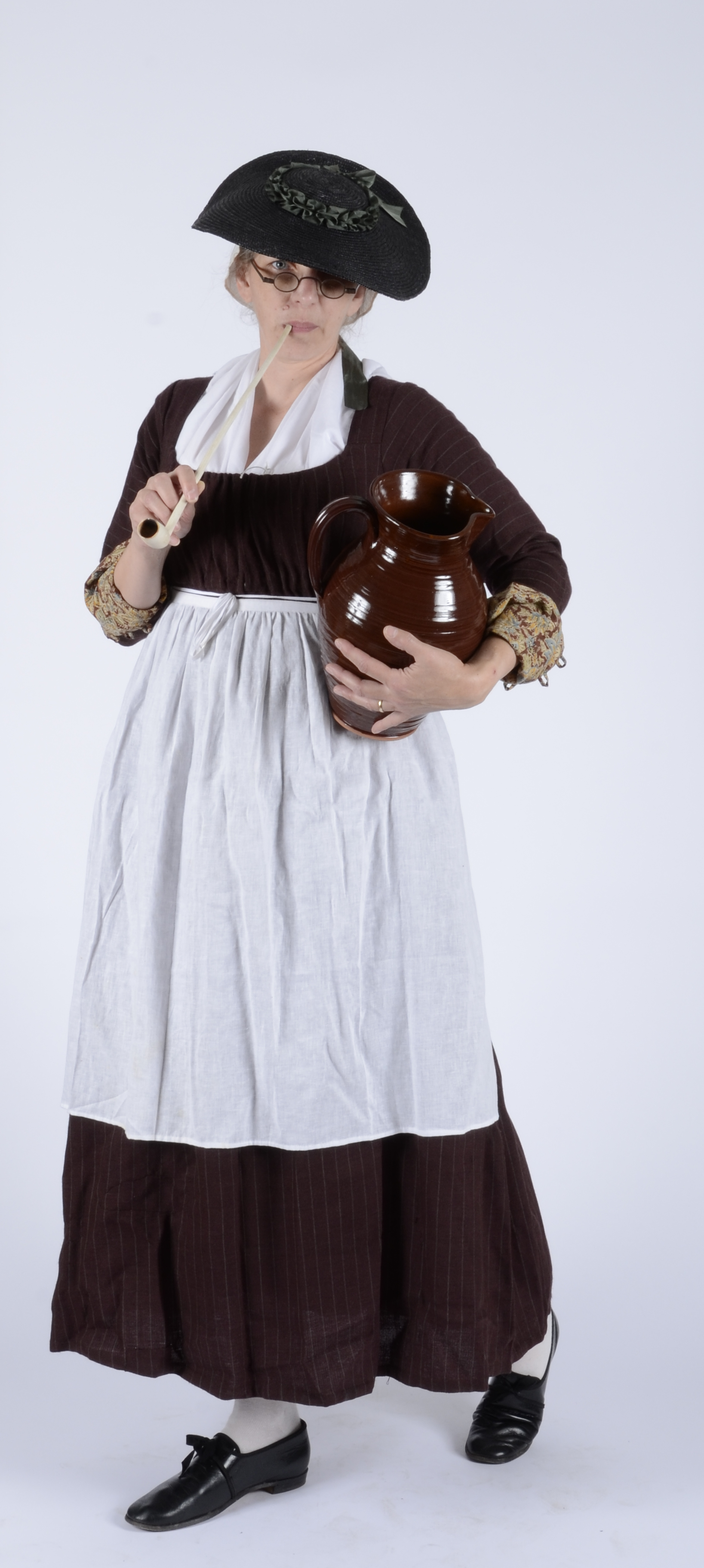 It’s 1800. Do you know what your housekeeper is doing? I don’t. Or, more accurately, I can’t decide.
I’m hung up on stays, and not wanting to make another pair. I’m indecisive about style, and though Mrs Garnett has her charms, it’s her bonnet I love more than anything.
Here’s what I’ve found, in servant-land:
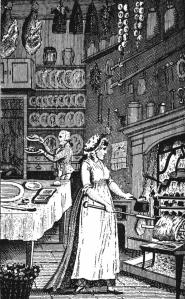
Note that this woman is, in the kitchen, wearing an open robe and quilted petticoat.The style of her bodice–which looks like a cross-over bodice–and the train of the robe suggest the 1790s. Score one for style.
That open robe, where have I seen that before? Why, yes, Mr Sandby showed us that style for a nurserymaid. (It’s interesting, too, that both images show women with their hair quite visible under their caps, and not pulled up and out of sight.)

Why does “robe stye” matter? Because I only found 3 and a quarter yards of a brown fabric I like, and even with the most careful cutting, that’s unlikely to make a full gown. However, I have some lightweight black wool that will make a decent petticoat. The bodice style is a bit of a stumper, though: the wool has good drape, so it might work for something other than the usual bodice I make. I did consider whether a very smooth, edge-to-edge, front-closing style of the 1780s would be more appropriate, but I think that I can move the bodice style forward, style-wise, and be correct.
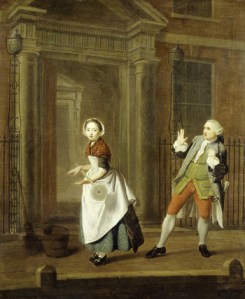
Brown gowns are a fine tradition in the sartorial habits of questionable servants. This young housemaid twirls her mop dry while wearing a brown gown over what could be a dark blue or a black quilted petticoat. The red “bandannoe” is a nice touch, though I don’t think I’ll wear one myself for this event.
In all this there is a compromise: using fabric I like, in a style I know I can make and document, perhaps even without having to make new stays. That would be ideal, because although it’s four weeks to the event, I’ll lose a week of sewing time to other commitments. Three weeks to pattern and hand sew a petticoat, gown, apron and cap seems just manageable.
06 Friday Sep 2013
Posted in Clothing, Events, Living History, Reenacting
Tags
10th Massachusetts, 18th century clothes, authenticity, Brigade of the American Revolution, common soldier, Costume, living history, Reenacting, Revolutionary War, sewing
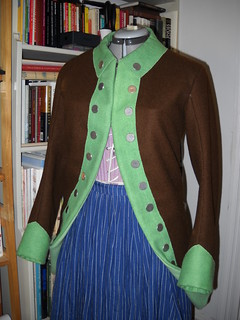
Front view on Cassandra.
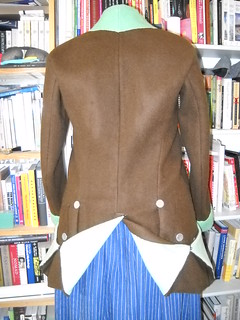
Back view, over petticoats
That’s right, it’s done, in all its brown and green glory, with not one buttonhole in sight.
I imagine Henry Cooke will tug on it, the same way my grandmother used to tug on my clothes, and find the things I need to fix that I can’t even see until he points them out. But that’s OK– what better way to learn?
You can see the progression on the project here, but there’s no tutorial or instruction manual, just visual notes as I went along. It’s Mr Cooke’s pattern and kit.
I think they’ll be glad of wool coats up at Saratoga, and if I didn’t have a new gown and petticoat, and possibly even stays, to make by October 5, I would think hard about making John Buss’s “red Queman’s pattern jacket” and “striped woolen trowsis” for the Young Mr to wear. With luck, he’ll have a borrowed coat to wear; I doubt a hunting frock will be as warm as he’d like by late September. No one, not even Mr Cooke (and I did ask), knows with certainty what a “Queman’s pattern jacket” is, but it might be a short coat or jacket. What I do know is that visions of a short red coat and grey striped trousers dance in my head, and the list of things I want to make just gets longer.
For now, though, this 1777 10th Massachusetts coatee is done, or nearly done, though on Mr S, I predict center back pleat tweaking.
03 Tuesday Sep 2013
Posted in Clothing, Events, Living History, Making Things, Reenacting, Research
Tags
10th Massachusetts, 18th century clothes, authenticity, Brigade of the American Revolution, common soldier, living history, Reenacting, Revolutionary War, Saratoga, uniforms, Wasmus diary
 In 1777, the uniforms of the Continental Army remained largely uncodified and, well, non-uniform. At Ticonderoga, German accounts from the spring of 1777 state that “Few of the officers in General Gates’ army wore uniforms, and those that were worn were evidently of home manufacture and of all colors. For example, brown coats with sea-green facings, white linings, and silver dragons(epaulettes or shoulder knots), and gray coats with yellow buttons and straw facings, where to be seen in plenty.”
Brown coats with sea green facings. There’s one in our regiment, and it is a lovely thing. The Adjutant thought it would be interesting for the troops to turn out in these coats at Saratoga, an event to which the coat can be documented (being soon after Fort Ticonderoga) and an event that will take place on the historic site. So we’re making them, in a project that started Saturday, and here we are: ready to have the lapel width adjusted, because my eye tells me it is too big, and yes, I’m told that it was cut a but wide. So this morning, a lapel trim is in order.
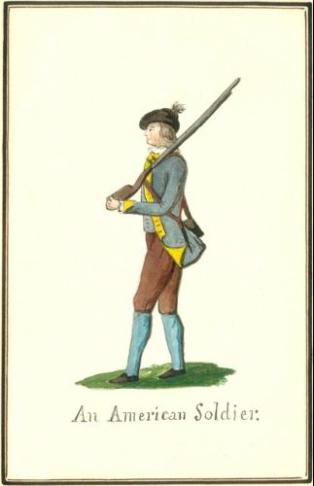
An American Soldier. ca.1852 copy of a ca.1777 watercolor by Hessen-Hanau Captain Friedrich von Germann. Niedersächsisches Staatsarchiv, Wolfenbüttel, Braunschweig
But really, these coats.
Here you can see the style that we’re making, with applied lapels and shanked buttons, simple turn backs on the front skirts, and flat collars. The cuffs are also applied, non-functioning cuffs that come to a point in front. (Also, documented blue stockings!)
These coats will be worn with overalls, waistcoats and shoes, because we know from John Buss’s letters that the regiment was issued overalls and shoes in the summer of 1777. No visible stockings, sadly.
This is the kind of project I can get pretty stoked about, with its combination of aesthetics and documentation. A coat described in a German diary, made in pettable wool broadcloth that will be unlike anything else on the field? Of course I want to help make that vision real.
Imagine a moment on the field, with these documented coats, so unusual (the sea green may have been a faded blue, but sea green is what was seen), worn in a place where they were worn. I don’t need to remind you about the authenticity/commemoration thing, do I? Because it’s pretty clear that’s what’ll happen three weeks from now in New York.
 Kitty Calash