• Home
  • Completed Costumes/Impressions
  • Emma and Her Dresses
  • Free Patterns and Instructions

Kitty Calash

~ Confessions of a Known Bonnet-Wearer

Kitty Calash

Author Archives: kittycalash

Miss Juniper Fox

23 Thursday Oct 2014

Posted by kittycalash in Research

≈ 5 Comments

Tags

18th century, engravings, fashion, hairstyles, lewis walpole library, satire, squirrels, style

Miss Juniper Fox. [London] : Pub. by MDarly 39 Strand, Mar. 2, 1777. Lewis Walpole Library , 777.03.02.01.

Miss Juniper Fox. [London] : Pub. by MDarly 39 Strand, Mar. 2, 1777.
Lewis Walpole Library , 777.03.02.01.

If you’re not wearing an inverted rooster held down by two foxes on your head, you’re not living 1777.

I have no idea what, beyond extreme hairstyles, this print is satirizing. It’s not the Wedding of Mrs Fox (as interesting a read as that is), and it’s really 100 years too late to be about Quakers.

The thing about those foxes is that at first glance on my phone, I thought they were the muscular lycanthropic squirrels of historic house wallpaper, but what two squirrels would be doing with a rooster– supporting him in illness? holding him hostage for an acorn ransom?– was beyond me.

At least as roosters, this headdress makes a bit more (morbid) sense, but it’s still a satirical engraving that makes less sense to us in 2014 than it did in 1777.

Share this:

  • Share on Facebook (Opens in new window) Facebook
  • Share on Pinterest (Opens in new window) Pinterest
  • Email a link to a friend (Opens in new window) Email
  • Share on X (Opens in new window) X
Like Loading...

What Cheer! Wednesday

22 Wednesday Oct 2014

Posted by kittycalash in Living History, Museums, Uncategorized

≈ Comments Off on What Cheer! Wednesday

Tags

18th century clothes, 18th century clothing, 19th century clothing, interpretation, John Brown House Museum, living history, Museums, Reenacting, Rhode Island, Rhode Island Historical Society, weekend, What Cheer Day, work

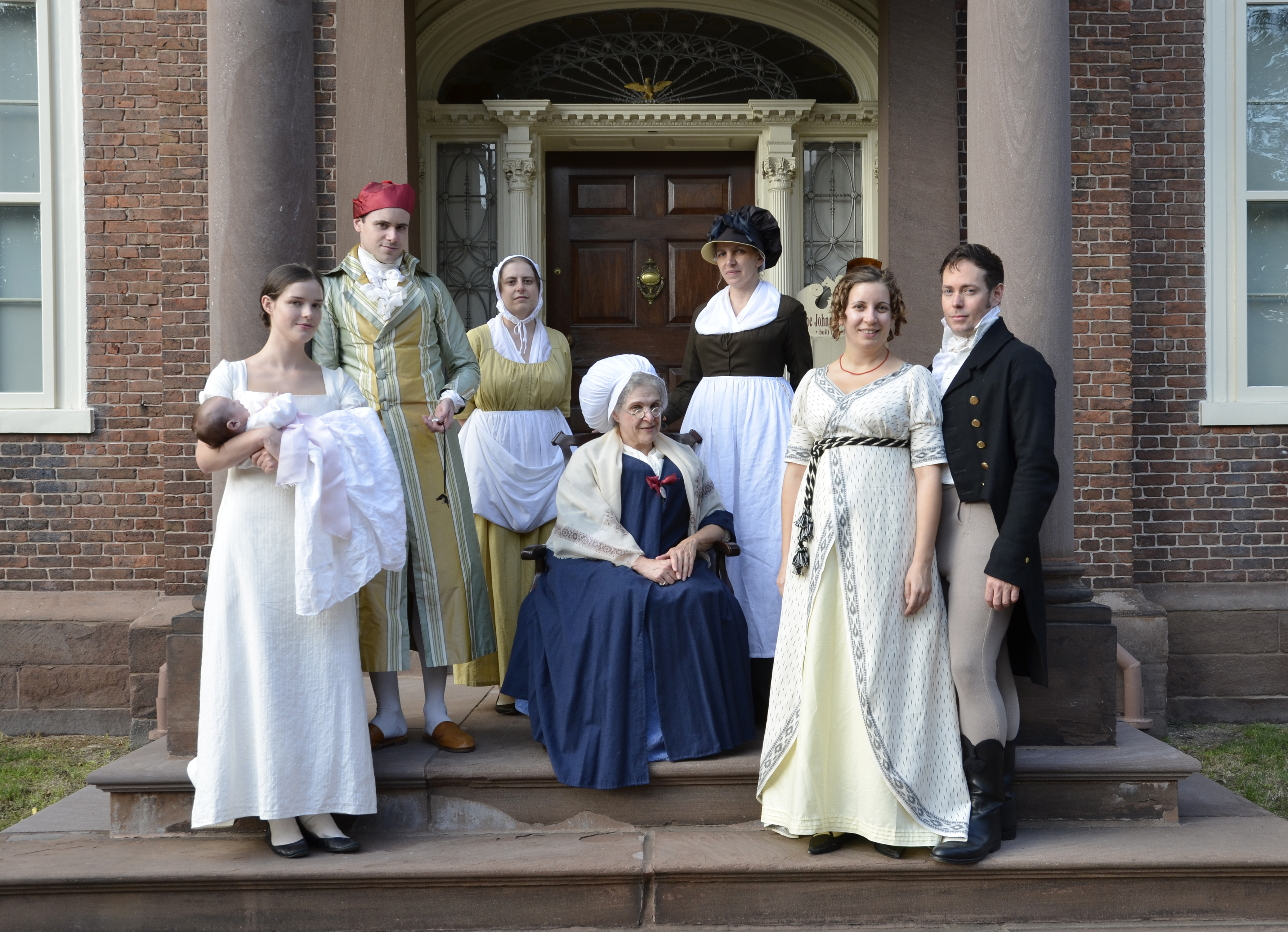
The cast at the end of the day

The cast at the end of the day

Where are you going this weekend? I’m going to Providence in 1800, along with my family and friends.

The mantua maker is coming, and writes a very pretty letter about the new fashions she has found for the young ladies.

Mr Herreshoff and Miss Brown hope soon to be married

Mr Herreshoff and Miss Brown hope soon to be married

Mrs Brown will be in, and receiving guests, and we hear that Mr Herreshoff will come to call as well. While he may decry the state of the roads, we expect him to have news of business conditions in New York, and his prospects for the future.

Miss Alice– Mrs Mason, now– will be at home with her sister, Miss Brown, and Mr Mason is living here now as well. I do not know how I shall keep their room in order, since he is hardly outside of it!

There are other visitors I expect as well; there is a man (I cannot call him a gentleman) who has been doing jobs for us, though he does not live here at the house. He seems extraordinarily interested in the house, and will not stay away. Whatever can be his interest? There may also be a tailor and his apprentice– though the apprentice tends to daydreaming, and looks above his station, studying Latin at all hours. I think he will not be long in his apprenticeship if he will not pay attention.

If you have not visited us before, you can find directions here.


Share this:

  • Share on Facebook (Opens in new window) Facebook
  • Share on Pinterest (Opens in new window) Pinterest
  • Email a link to a friend (Opens in new window) Email
  • Share on X (Opens in new window) X
Like Loading...

Mad for Plaid and Patches

21 Tuesday Oct 2014

Posted by kittycalash in Clothing, Museums

≈ 8 Comments

Tags

19th century, 19th century clothing, checks, Clothing, common dress, Costume, fashion, Federal style, linen, museum collections, Rhode Island history, style

Yesterday, I went to visit another collection, this time at the University of Rhode Island. I don’t have thoughts about replicating coats- they didn’t ask me any hard questions about making coats, they just let me work– but I did see a lot of amazing garments.

I’m focused primarily on men’s clothing at the moment, largely because I’m stumbling towards an exhibit or a paper or maybe a better blog post, and because thus far I have not found any examples of women’s garments made from locallly-woven checks or stripes in local collections.*

What I concentrated on at URI were two very lovely examples of the kinds of clothing worn by everyday people in Rhode Island and Southeastern Connecticut, both collected by a woman who lived in the village of Lafayette on the Victory Highway. Mrs Muriel Buckley was born in Exeter, RI in 1884, and started collecting clothing of all kinds in 1900, when she married; by the mid-1950s, she was known as a “one woman historical society,” according to a Providence Journal article, and hosted parties where she and her guests dressed up in the clothes and cooked colonial recipes in early ironware. **

As my late landlady’s husband used to say, “Cut the cackle, let’s eat some grub.”***

Blue and white striped linen fall-front trousers ca. 1830, URI 1967.13.16

11967.13.16, trousers ca 1830. Gift of Mrs Muriel Buckley, URI Textile Collection.

1967.13.16, trousers ca 1830. Gift of Mrs Muriel Buckley, URI Textile Collection.

These are pretty interesting, with about a dozen patches of various sizes and fabrics. The main fabric is a blue and white stripe linen of 42 threads per inch. The fall-fronts have pockets built into the bearers, with a welt cut on the grain but set on the bias for a snazzy little graphic moment. The button holes appear to be slightly rounded at the ends in a way that siuggests intent and helps confirm the date. The buttons are not all the same design, but are all four-holed bone buttons. The trousers have a 31″ waistband, a 19.5″ rise, and a 26″ inseam.

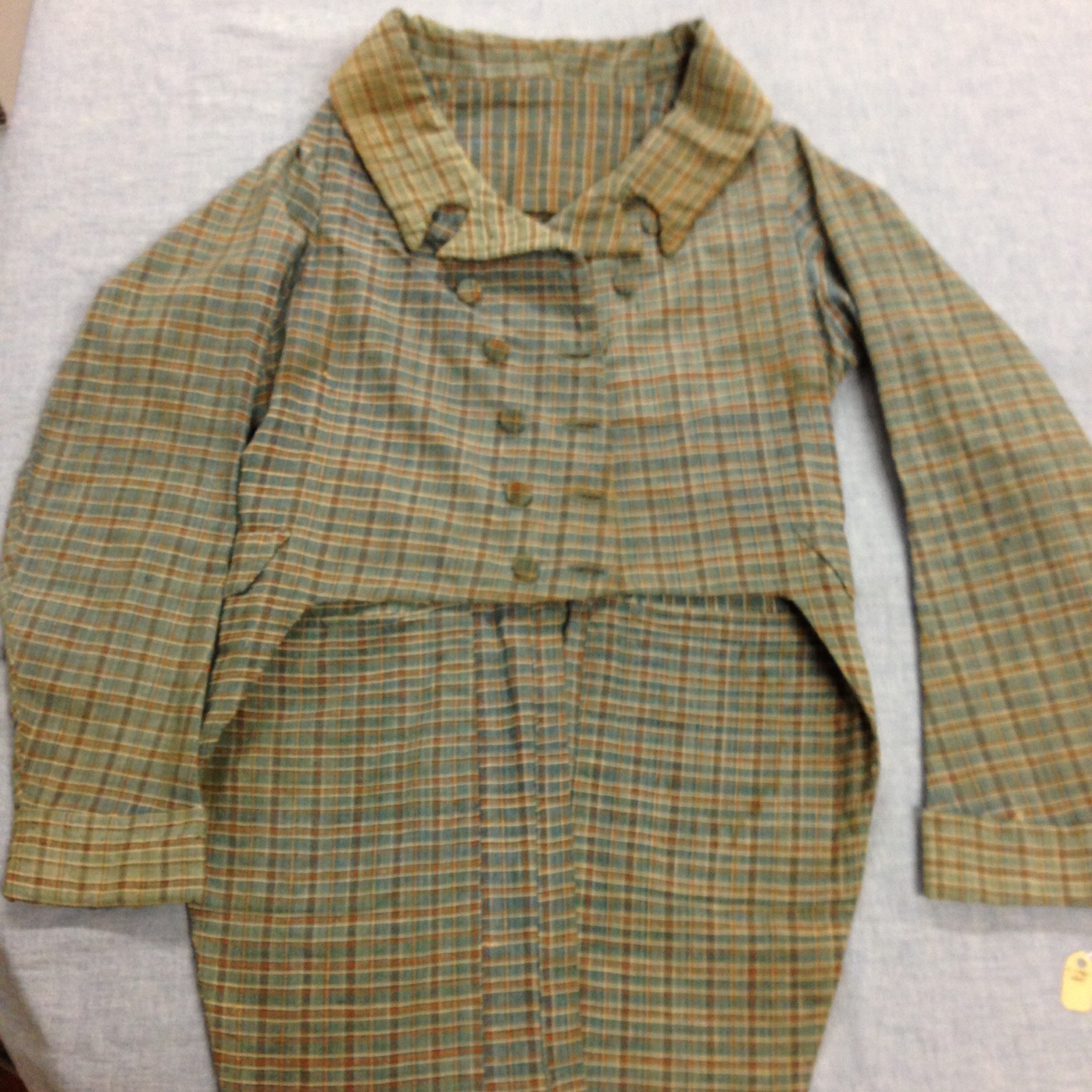
The other truly fabulous piece I saw was a coat in a blue, white and orange check “Stonington Plaid” ca. 1800, URI 1967.13.17.

This is a double-breasted, self-faced tail coat with self-covered buttons and notch collar lapels, false pocket flaps on coat body and pockets in the tails and left breast. The unlined, folded-back cuffs are tacked to the sleeve and may have been shortened. The overall length at CB is 36″, sleeve length is 25.5″ and the chest is about 34″.

1967.13.17, "Stonington Plaid" linen check coat, 1800-1810. Gift of Mrs Muriel Buckley, URI Textiles Collection.

1967.13.17, “Stonington Plaid” linen check coat, 1800-1810. Gift of Mrs Muriel Buckley, URI Textiles Collection.

When I opened this coat and looked at the seams, I was struck by the construction method, not because it was different, but because it was so typical. (I also peeked inside two wool broadcloth coats in the cupboard: same construction as the woolen coats I’d seen before.) It;’s nice to see conventions in action, and recognize what you’re seeing.

The collar on this coat has some little anomalies suggesting a less-experienced hand, or perhaps a foray into a new type of collar; judging by the pad stitching, I’m more inclined to guess less experienced hand, though not home manufacture. Someday I’ll track down the South County and eastern CT tailor’s books…
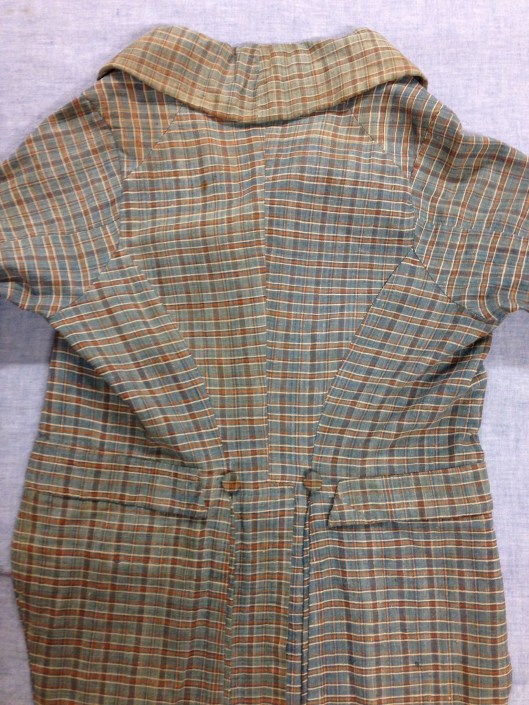
1967.13.17, back view of "Stonington Plaid" checked linen coat. Gift of Mrs Muriel Buckley, URI Textiles Collection.

1967.13.17, back view of “Stonington Plaid” checked linen coat. Gift of Mrs Muriel Buckley, URI Textiles Collection.

In the meantime, what amazing clothes and fabulous fabrics! The past looks nothing like what we imagine unless we can look past fashion plate elegance to the riot of stripes and checks and prints that must have existed in almost every village and town in Rhode Island.

*With the exception of a pocket at Mystic Seaport and a gown at the Smithsonian: accessory in the first case and very not local in the second case, making in hard to study in a day trip.

**Having palpitations yet? Your heart will really race if I can track down the photos to prove all this. In other news, I know a couple of gentlemen who are currently “one person historical societies.” The collecting instinct in wired into some folks.

***Jack and Harriet: she survived the 1938 Hurricane, and their overweight black-and-white polydactyl cat, Bonnie, followed them around the corner to church every Sunday.

Share this:

  • Share on Facebook (Opens in new window) Facebook
  • Share on Pinterest (Opens in new window) Pinterest
  • Email a link to a friend (Opens in new window) Email
  • Share on X (Opens in new window) X
Like Loading...

Whimsical Wednesday

15 Wednesday Oct 2014

Posted by kittycalash in personal, Thanks

≈ Comments Off on Whimsical Wednesday

Tags

bedroom, birthday, decorating, home decor, Ikea, personal, thanks, Young Mr

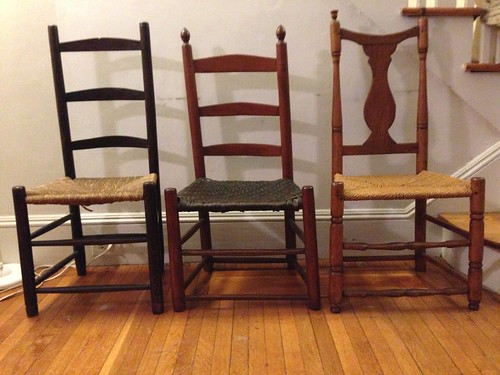
Hades (center), flanked by Pain and Panic

As elevating and inspiring as #dmmh was, reality is always around the corner, as predictable as a cast-iron frying pan in a Katzenjammer Kids cartoon. So on Tuesday, Mr S and I went to IKEA to re-vamp the Young Mr’s bedroom.

I know: this isn’t Martha Stewart, so what gives?

The Young Mr turns 16 on Saturday, and we wanted to mark the day in a memorable way. We had originally planned to go to Liberty Hall in NJ, where we would present the kid with his own Charleville and a Wegman’s white cake. Reality intervened in the form of AP European History, which led to dropping the swim team, which has their first  meet on Sunday. We dropped Liberty Hall, expecting to be swimming, but we’ve had to drop swimming to manage AP Euro.

So this has been a Very Tough Week chez Calash, and last Tuesday, the Young Mr slipped into the kind of Serious Funk that only teenagers can have. Reader, it was so bad, I asked him if he wanted to see his therapist and he said, “Yeah, OK. I guess.”

So, appointment on the horizon, we cast about the house looking for places in which one could do homework. Reader, there were few, and mostly they were places where I already sew or write. Something had to be done!

The Young Mr Surveys his Territory

IKEA catalog at the ready, my friend and I developed a plan: we would transform the Young Mr’s room for his birthday: He would get a desk, and place to lounge whilst reading, and I would get my table back.

We still have some tweaking to do, but he has a desk, a bench, and a watercolor of the Morgan that he loves (that once was mine) and loft bed that he seems to like.

Since the photo was taken, all free space has been claimed by textbooks and Magic cards, and I suppose the underneath spaces will soon be colonized by feral socks. Still, in the interim between this moment and Sometime Thursday Afternoon, the Young Mr has a nice room that makes him, and us, and his grandmother, feel that Things Might Be OK. I hope you have a cozy corner in your home where Things Are OK for you– and if you don’t, I hope you will  make one, soon.

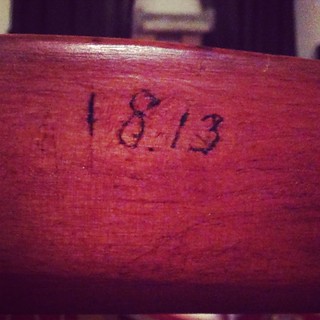
The back of the top rail of Hades.

Oh, and Hades? That’s an 1813 chair we found in James Woods’s booth at the local antique mall. He’s from here, so no big. We figure the other two are his henchmen from Hercules. The names seemed appropriate to their relative comfort levels for long-term seating.


Share this:

  • Share on Facebook (Opens in new window) Facebook
  • Share on Pinterest (Opens in new window) Pinterest
  • Email a link to a friend (Opens in new window) Email
  • Share on X (Opens in new window) X
Like Loading...

Military (History) Monday

13 Monday Oct 2014

Posted by kittycalash in History, Research

≈ 2 Comments

Tags

10th Massachusetts, digital humanities, history, John Buss, letters, maps, NEH, Northeastern University, projects

Map of the town of Providence by Daniel Anthony, 1803

Map of the town of Providence by Daniel Anthony, 1803

This past weekend, I went to an NEH workshop at the Northeastern that was really exciting: Digital Methods for Military History. If you’ve been following along here, you’ll know that I don’t just love clothes, I also love history, and military history. There’s an amazing amount of work being done that looks at the past in new ways, and that can hardly ever be bad.

I took notes both digital and analog, and tried to learn as much as I could. It’s all very exciting– I tried not to leap immediately to Map All the Data, but it’s hard not to. So much potential.

On Saturday, there were papers projects on Geographies of the Holocaust, and another on Viewshed Analyses of Iberian Fortifications— I’m mangling the title, for which I do apologize–but that last was so exciting. I began to see where the Young Mr’s love of gaming, history and warfare might come together to good effect in a scholarly way. I also saw how high school student projects mapping neighborhoods could build on work kids had already done collecting oral history narratives in grade school, and that really, high school students need digital toolboxes just as much as college students do.

Georectified map of Providence, using Mapwarper.

Georectified map of Providence, using Mapwarper.

Friday’s papers on networking were also fascinating: both the Muninn Project and Quantifying Kissinger. Digging into social and temporal connections illuminates new angles on history, or even helps find and locate men lost in battle. (Easier to do at Vimy Ridge than Stony point, of course, but applicable nonetheless.) Kissinger and the word collocation analysis was funny as well as insightful, and I think the two are often found together. Word analysis gave a sense of Kissinger and his personality that you would develop more slowly reading every document, which is why you want a historian to do the work for you.

Where does this leave me? (Map all the data!) With the firm knowledge that I need to focus very directly on one small project. John Buss seems ideal: one guy with known connections and origin, one set of letters, limited movement and short duration. (At least when compared to Arnold’s March to Quebec or all of Jeremiah Greenman’s diary.)

A discrete project seems likeliest to work on something like Neatline, once I figure out how to deal with the Omeka issue. Neatline was like a mash-up of database fields and Illustrator, so I felt pretty at home.

We also learned about Mapwarper, and georectification. That’s pretty cool stuff, too.

Georectified Providence without the underlay

Georectified Providence without the underlay

The process will require distilling the letters into data (places, dates, names); collecting maps; collecting data associated with the names– and that’s the easy part. I can imagine a map with clickable areas that link to letters, other images, stories– links building on links– but I haven’t sketched it all out yet, or even imagined a final product. First, I have to find a map.

Share this:

  • Share on Facebook (Opens in new window) Facebook
  • Share on Pinterest (Opens in new window) Pinterest
  • Email a link to a friend (Opens in new window) Email
  • Share on X (Opens in new window) X
Like Loading...
← Older posts
Newer posts →

Archives

wordpress statistics

Creative Commons License
Kitty Calash blog by Kirsten Hammerstrom is licensed under a Creative Commons Attribution-NonCommercial-ShareAlike 4.0 International License.

Website Built with WordPress.com.

  • Subscribe Subscribed
    • Kitty Calash
    • Join 621 other subscribers
    • Already have a WordPress.com account? Log in now.
    • Kitty Calash
    • Subscribe Subscribed
    • Sign up
    • Log in
    • Report this content
    • View site in Reader
    • Manage subscriptions
    • Collapse this bar

Loading Comments...

    %d