• Home
  • Completed Costumes/Impressions
  • Emma and Her Dresses
  • Free Patterns and Instructions

Kitty Calash

~ Confessions of a Known Bonnet-Wearer

Kitty Calash

Author Archives: kittycalash

Frivolous Friday: Comforts of a Rumpford

10 Friday Oct 2014

Posted by kittycalash in Frivolous Friday, History, Research

≈ Comments Off on Frivolous Friday: Comforts of a Rumpford

Tags

cats, engravings, furniture, half robes, historic interiors, interpretation, satire, silly cat photos, slipcovers, sofas

A companion pl. to BMSat 9813. A pretty young woman wearing a décolleté négligé, stands with her back to the fire, her gown raised to leave her posterior naked. She holds a book: 'The Monk - a Novel by M' ['G. Lewis', cf. BMSat 9932]; another is open on the floor: 'Œconomy of Love by Dr Arm[strong', 1736]. A cat rolls on its back. On a table are a decanter of 'Creme de Noyau', and an open book: 'The Kisses'. On the mantelpiece are flowers and an ornate clock with embracing cupids. A picture partly covered by a curtain represents Danaë receiving the golden shower. The room, apparently that of a courtesan, is luxuriously furnished. 26 February 1801 Hand-coloured etching, British Museum, 1935,0522.7.12

A companion pl. to BMSat 9813. A pretty young woman wearing a décolleté négligé, stands with her back to the fire, her gown raised to leave her posterior naked. She holds a book: ‘The Monk – a Novel by M’ [‘G. Lewis’, cf. BMSat 9932]; another is open on the floor: ‘Œconomy of Love by Dr Arm[strong’, 1736]. A cat rolls on its back. On a table are a decanter of ‘Creme de Noyau’, and an open book: ‘The Kisses’. On the mantelpiece are flowers and an ornate clock with embracing cupids. A picture partly covered by a curtain represents Danaë receiving the golden shower. The room, apparently that of a courtesan, is luxuriously furnished. 26 February 1801
Hand-coloured etching, British Museum, 1935,0522.7.12

I’ve left that caption intact, though it seems quite long enough for a blog post itself. This image turned up on Twitter (you can follow me there @kittycalash, expect randomness) and delighted me at the end of a long, tough week. I’m particularly taken with the cat, which resonates with an lolcat that floated about the interwebs last winter. The interwebs can be a strange place…

But aside from that silly cat, there are a wealth of details in this image, some of which are explicated in the caption.

What struck me- after the cat– was the slipcover on the sofa. How lame is that– but it’s true. Floral print, I suspect, but possibly woven, it’s loosely draped and long. I’m more familiar with the checked linen slipcovers seen in representation of New England interiors, so the floral really struck me. I suppose those linen checks symbolize all the puritanical uprightness and restraint of early Federal New England dons (if you believe in that kind of thing), while the loose floral print drapery tells you everything you need to know about our Rumpford friend.

We all see what we want to see…cats, slip covers, or courtesans.

Share this:

  • Share on Facebook (Opens in new window) Facebook
  • Share on Pinterest (Opens in new window) Pinterest
  • Email a link to a friend (Opens in new window) Email
  • Share on X (Opens in new window) X
Like Loading...

Woolen Woes

08 Wednesday Oct 2014

Posted by kittycalash in Clothing, Fail, Living History, Making Things, Research

≈ 7 Comments

Tags

19th century clothing, Costume, dress, failure, fashion, fashion plate, Federal style, Joseph Taber, living history, Making Things, Providence Journal, Regency, Research, sewing, Spencer, Spencers, style

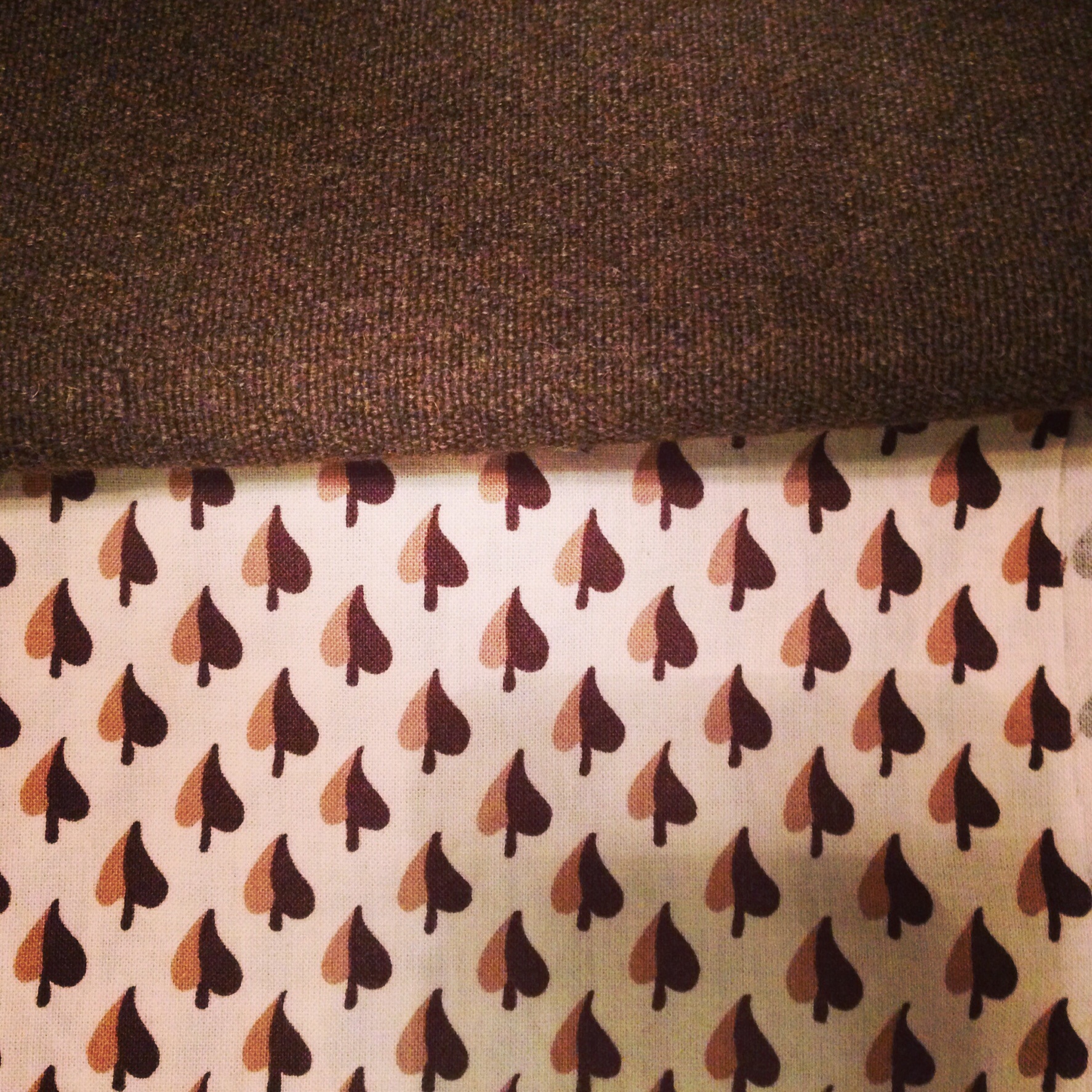
imageOn Saturday, I got a very nice piece of wool from Mr C’s Strategic Fabric Reserve, just the color and weight I’d been looking for to make a Very Specific Spencer. The VSS is not a replica, but rather specific to a gown: I want it to go with a 1797 V&A print.

Did women wear Spencers in 1797-1800 Providence? At least one tailor, Joseph Taber, advertised that he made Habits and Spencers, but as far as I know, there are no extant Rhode Island Spencers. Given how few collections are fully online here, and how few Spencers survive anywhere, I’m not too surprised. Julia Bowen’s diary covers Spring and Summer, when she’s quilting (mighty lazy work, she says), but she doesn’t say much about outerwear.
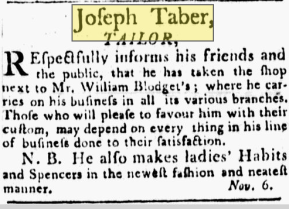
Providence Journal, 11-13-1799

Providence Journal, 11-13-1799

I’ve been on the fence about how common Spencers were– after all, the drawings in Mrs Hurst Dancing show women clearly wearing red cloaks– but might a Spencer and cloak combination have been just the thing to keep warm on a raw October day? With a wool petticoat and long wool stockings, you could be fashionable and warm.

There’s no firm documentation of any of that– which does not mean, as I once muttered in the general direction of some recalcitrant docents, that rich people in Providence hunkered naked in cold corners of curtain-less rooms gnawing on raw meat.** What it does mean is that much of what we make and wear is conjecture, based on examples from the same time period in other geographic areas.

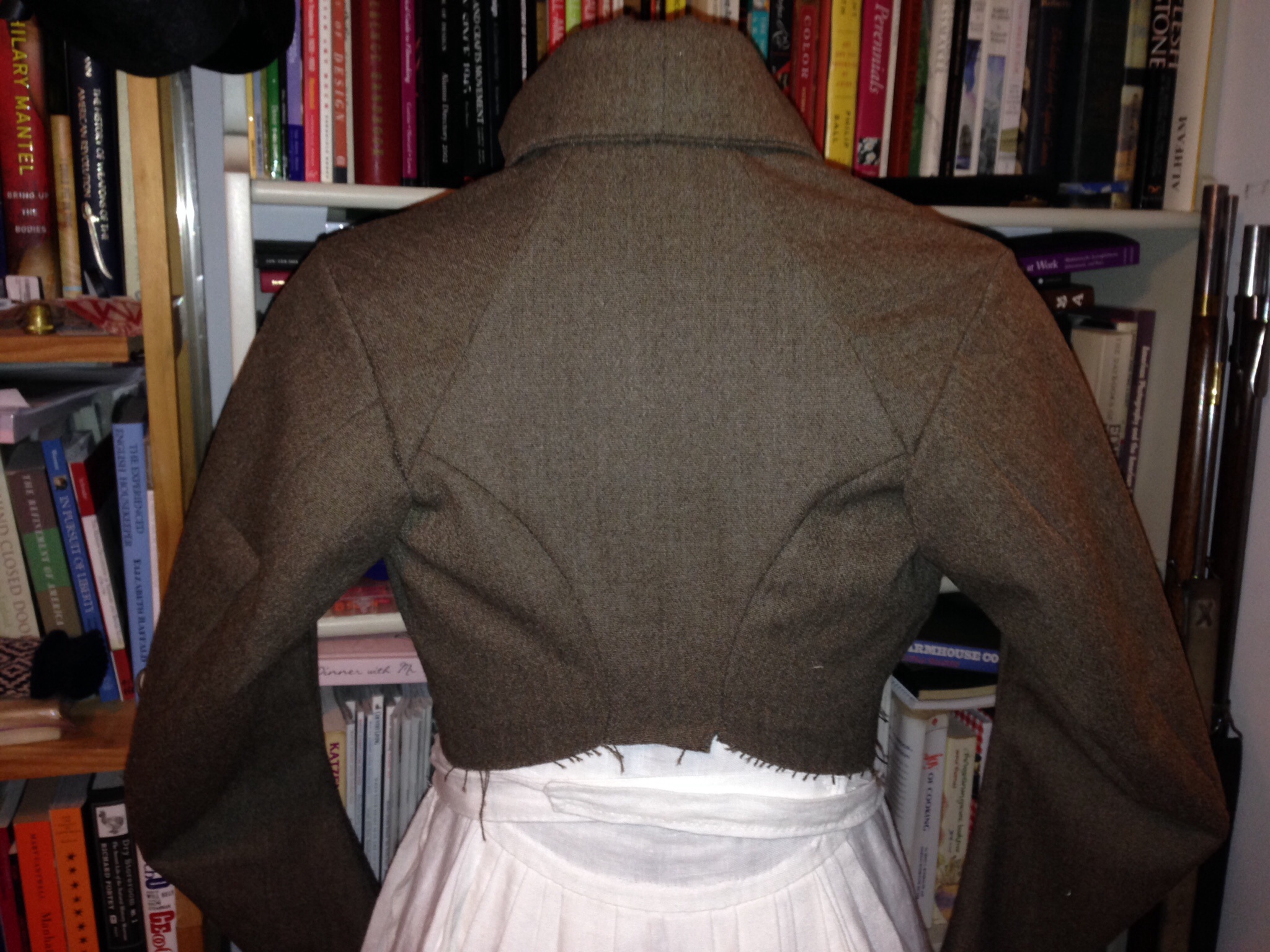
Can I have a Spencer in New England? I’m not sure, but I’ve made another one anyway, and here it is, still underway. (The thing about Cassandra is that while she is a very patient model, she has terrible posture. I can verify the back fits me a great deal better than it fits her.)
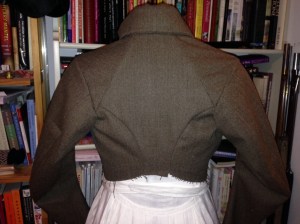
Cassandra's posture is very different from mine. She will not pull her shoulders back!

Cassandra’s posture is very different from mine. She will not pull her shoulders back!

This wool is buttery and soft, and takes the needle well. Waxed thread glides through it and grips. It does have a tendency to fray a bit at the cut edges, but has a good pinked edge, and there are examples of pinked-edge facings in extant men’s wear. Sweet, right?

I’m not showing you this to boast about my skills, but to show off an dandy mistake. In working the folded edge of the collar, I trimmed a bit too much at the neck edge, and found the collar a bit small when I basted it in. Of course I removed it, and started again, easing a bit more as I went: Huzzay! It fit!

Really, I'm not sure how this happened. But there it is: upside down.

Really, I’m not sure how this happened. But there it is: upside down.

Oh, reader: rejoice not. I backstitched that bad boy on upside down. Expletive deleted! Mad Skillz: I even managed that bit of genius before my pre-work panic attack.

I took the garment in to work to seek council from my tailoring-class-educated friend who possesses native common sense and Yankee practicality. It came down to this: is it worse to have the collar upside down, or to have it not fit as well right side up? Decide with the knowledge that working the fabric more will affect the cut edge badly. My friend suggested stitching in the ditch with contrasting thread to make this flaw an Intentional Design Element.

Black trim on a Spencer?

That is a good idea, but I thought the flaw will still be too noticeable. Then it came to me: trim. Just as the construction guys are spreading drywall mud in the chinks around the window frames, I can spread some wool braid love around this collar. There’s certainly evidence for trim use on Spencers in fashion plates, and trim would push the men’s wear aspect of this garment even farther. As soon as I got home, I double-checked extant garments and fashion plates, Roy Najecki’s lace page, and measured my edges.

Four yards of quarter-inch black mohair braid should do the job, stitched around the edge of the collar and lapels, the cuffs and possibly the hem edge.

Do I run the chance of looking like a black-outlined cartoon drawing? Yes.

Did I just buy endless hours of tiny stitching? Yes.

This is a crazy, work-making solution that may leave me with a garment not suited to my class in early Federal Providence. But I think it’s going to look amazing when it’s finished.

**(The docents argued that textiles were SO RARE and SO PRICY in late 18th century RI that NO ONE in Providence had curtains. NO ONE. The lack of fire was my own bitterness coming out at this Great Curtain Kerfluffle which took place at a public lecture I gave explaining what we knew about the use of textiles to furnish Providence homes of people who would be as rich as Bill Gates today.)

Share this:

  • Share on Facebook (Opens in new window) Facebook
  • Share on Pinterest (Opens in new window) Pinterest
  • Email a link to a friend (Opens in new window) Email
  • Share on X (Opens in new window) X
Like Loading...

Material Girl

05 Sunday Oct 2014

Posted by kittycalash in Making Things, Museums, Philosophy

≈ 3 Comments

Tags

advice, fabric, scissors, sewing, sewing project, strategic fabric reserve, tools

Yes, I am a material girl. The Strategic Fabric Reserve has grown beyond the allotted cupboards into plastic containers hidden under living room furniture and my desk. Reader, it’s true: I have a fabric problem.

But here’s the thing: you want to work with the best materials you can afford, and that means fabric, scissors, needles, thread, even measuring tapes. As a carpenter I know once said, “Life’s short; buy a good hammer.”

Just enough!

Just enough!

I’m currently working with a remnant of wool camblet from a friend’s stash, left over from making someone else’s coat. There’s just enough to make me a Spencer (with a little perfectly-accurate cuff piecing), and I’m finding that running the needle through the wool is like a knife through butter. Baby, it’s smooth.

And that’s the thing: working with better materials is actually easier than working with lesser goods. Maybe you’re buying from the remnant table (I know I do): just buy the best stuff you can afford, and as much of it as you afford.*

It’s taken me a while to learn this, and I’ll confess: I still have IKEA furniture, because I still have a teenager living at home, and three insufferable cats. But we swap out as we find affordable better things, because they are more beautiful and more pleasing.

Shears: former fabric and current fabric.

Shears: former fabric and current fabric.

You can do the same with your sewing (or cooking or carpentry or cat husbandry) tools. My former fabric shears finally gave up after 15 years; I replaced them with better Ginghers (thank goodness for coupons) and downgraded the formerly “best” scissors to pattern-cutting duty. I have small thread scissors for home, and scissors for events that I’ll shed fewer tears over if I lose, because event sewing is often mending and not garment construction.

Second best for events; best for home.

Second best for events; best for home.

Buy it once: that’s an ideal that can be hard to achieve in reenacting. Research moves on, everybody makes mistakes**, but you can never go wrong buying the best you can afford. Ease of use and finished beauty will make it worthwhile.

*They laughed when I bought that striped velvet from Wm Booth at Bennington– until they saw the originals I had in mind.Quirky can be right and even amazing, but cheap requires caution.

**I hear this in my head as the refrain from a New Order song at least once a day. And then I sigh. But it’s true, and worth taking to heart without beating yourself up over it. You will survive whatever unfortunate yardage or pink-handled, blistered-inducing scissors you now regret. There’s always the office Yankee Swap or Goodwill.

Share this:

  • Share on Facebook (Opens in new window) Facebook
  • Share on Pinterest (Opens in new window) Pinterest
  • Email a link to a friend (Opens in new window) Email
  • Share on X (Opens in new window) X
Like Loading...

Make All the Coats

01 Wednesday Oct 2014

Posted by kittycalash in Clothing, Living History, Museums, Research

≈ 8 Comments

Tags

1818, anna maria von Phul, coatee, menswear, Missouri History Museum, watercolors

As far as I know, that’s not an internet meme yet, but it might as well be. It’s meme in my head, and that’s what counts.

While I should be thinking about the probability of Spencer-wearing in 1800 Rhode Island, I got distracted during a hunt for head wraps and found this lovely little water color.

Boy in a Beaver Hat. Watercolor by Anna Maria von Phul, 1818. MHS 1957.158.27

Boy in a Beaver Hat. Watercolor by Anna Maria von Phul, 1818. MHS 1957.158.27

How lovely is that coat? The Young Mr already has a semblance of that hat and trouser (admittedly too short) so the coat and a matelasse waistcoat would be just the ticket to recreate this image. He’ll bring his own sulky look to the party.

I’m trying to figure out what the coat would be made of, and what I’m willing to pay for a coat that will be grown out of rapidly. In the meantime, though, what a lovely image.

Back to coat dreams…and plots.

Share this:

  • Share on Facebook (Opens in new window) Facebook
  • Share on Pinterest (Opens in new window) Pinterest
  • Email a link to a friend (Opens in new window) Email
  • Share on X (Opens in new window) X
Like Loading...

Cold Scoops

30 Tuesday Sep 2014

Posted by kittycalash in Clothing, History, Living History, Reenacting, Research

≈ 8 Comments

Tags

18th century clothing, 19th century clothing, authenticity, Clothing, common dress, common people, John Brown House Museum, Julia Bowen, Julia Bowen Martin, living history, Providence, Research, Rhode Island, What Cheer Day

What Cheer Day preparations must begin in earnest now, no matter how distracting I might find orderly books or silk shoes (not in my size, alas: no last can be found). I already have clothes enough for a housekeeper, though I still crave a broadcloth Spencer and am working on a petticoat. I’ll hardly go outside that day, so why am I thinking bonnets– especially when I have a known bonnet problem?

One of my favorite resources for Federal era Providence is Julia Bowen’s diary. Born December 1, 1779, Julia’s diary records her life in Providence in 1799, when she was 19. She records the daily activities of the second set of Providence women– daughters not of the most elite merchants, like John Brown and John Innes Clark, but the Bowens, Powers, Howells, and Whipples. Distinguished, but not super-elite. Many of the entries are as prosaic and superficial as you’d expect from a young woman in late adolescence, and thank goodness they are, or we’d never be able to imagine life in such fine detail.

Julia got me thinking about bonnets with her entry of April 12:

found the Major & Citizen Sarah & C. Angell altering their cold scoops into Rosina hats, so busily were they employed that the Major could not go a visiting, which deprived me at once of the greatest pleasure I anticipated in my visit.

(She used code names for her friends; some we can decode, and some we cannot.)

I haven’t been able to decipher what “Rosina hats” were, but cold scoops I could handle: coal scoops.
That colloquialism fits not just fashion plates but extant coal scoops and buckets.

Denham's Auctioneers: Lot 418 A copper coal shovel and a brass coal shovel
Denham’s Auctioneers: Lot 418 A copper coal shovel and a brass coal shovel
Denham's Auctioneers: Lot 153 A copper helmet shaped coal scuttle with brass shovel and turned wooden handle £20-40
Denham’s Auctioneers: Lot 153 A copper helmet shaped coal scuttle with brass shovel and turned wooden handle £20-40

You just have to imagine them turned over.

The Gallery of Fashion, 1797, Bathing Place, Morning Dresses.

The Gallery of Fashion, 1797, Bathing Place, Morning Dresses.

15400635112_e9997f750f_z
15397772861_3ff46f286d_z

I went for cold scoop, with a pasteboard brim and olive green taffeta brim and caul. The mannequin is a 3-D sketch, if you will, of what the housekeeper plans to wear this autumn. At least until she can figure out what a Rosina hat is.

Share this:

  • Share on Facebook (Opens in new window) Facebook
  • Share on Pinterest (Opens in new window) Pinterest
  • Email a link to a friend (Opens in new window) Email
  • Share on X (Opens in new window) X
Like Loading...
← Older posts
Newer posts →

Archives

wordpress statistics

Creative Commons License
Kitty Calash blog by Kirsten Hammerstrom is licensed under a Creative Commons Attribution-NonCommercial-ShareAlike 4.0 International License.

Website Built with WordPress.com.

  • Subscribe Subscribed
    • Kitty Calash
    • Join 621 other subscribers
    • Already have a WordPress.com account? Log in now.
    • Kitty Calash
    • Subscribe Subscribed
    • Sign up
    • Log in
    • Report this content
    • View site in Reader
    • Manage subscriptions
    • Collapse this bar

Loading Comments...

    %d