• Home
  • Completed Costumes/Impressions
  • Emma and Her Dresses
  • Free Patterns and Instructions

Kitty Calash

~ Confessions of a Known Bonnet-Wearer

Kitty Calash

Category Archives: Clothing

Winter Workshops

05 Friday Dec 2014

Posted by kittycalash in Clothing, Events, Living History, Museums

≈ Comments Off on Winter Workshops

Tags

18th century clothes, 18th century clothing, 19th century clothing, common dress, Costume, Events, Henry Cooke, interpretation, living history, Newport Historical Society, resources, Rhode Island Historical Society, Stamp Act Protest, What Cheer Day

Interior of a Tailor's Shop, Museum of London

Interior of a Tailor’s Shop, Museum of London

Come sew with me! Well, you’ll be sewing with Henry Cooke, but I’ll be there, too.

Check the Newport Historical Society’s website for more information about workshops and conversations this winter designed to for anyone with an interest in early American history who wants to expand their understanding of material culture interpretation.


Share this:

  • Share on Facebook (Opens in new window) Facebook
  • Share on Pinterest (Opens in new window) Pinterest
  • Email a link to a friend (Opens in new window) Email
  • Share on X (Opens in new window) X
Like Loading...

One Coat Two Coat Red Coat Green Coat

15 Saturday Nov 2014

Posted by kittycalash in Clothing, Making Things, personal

≈ 5 Comments

Tags

19th century clothing, broadcloth, Costume, dress, fashion, fashion plates, greatcoat, plans, Redingcote, style, winter, winter coat

1813 Bonnet of untrimmed velvet, Redingote of Merino
1817 Velvet bonnet and broadcloth coat

I cannot manage to find the button I need to sew onto my real-world everyday winter coat, but I’m pondering and plotting how much broadcloth a Redingote (Redingcoat or Redingcote) would require, and internally debating the merits of red versus green.

Greatcoats have their attractions, and while Mr S would undoubtedly enjoy the warmth of a greatcoat, with a February 14 program in the offing, I am pondering a greatcoat of my own.

I can rationalize [almost] anything, but a Redingcote is a stretch even for me, despite that February program (indoors). I suppose the real appeal of one of these coats, aside from the pleasure of handling delicious green or red wool, is the challenge of making one. I have even found a front view to aid in the patterning.

1813 Hat of velvet and broadcloth coat

What stops me? Some unfinished projects, and a certain feeling of unease about buying quantities of expensive wool. I have two yards of dark green broadcloth, but I’m pretty certain that I will need three to make even the shorter red coat. Without making a firm resolution, I had determined that I wanted to sew down my stash–and I suppose the answer is to sew it down, or put it on Etsy. Or to buy the wool, make the coat, and wear it in the winter. It would be a spur to winter program ideas, after all.

Now, if only I could find the missing button from my winter coat…

Share this:

  • Share on Facebook (Opens in new window) Facebook
  • Share on Pinterest (Opens in new window) Pinterest
  • Email a link to a friend (Opens in new window) Email
  • Share on X (Opens in new window) X
Like Loading...

The Very Specific Spencer, Finished!

11 Tuesday Nov 2014

Posted by kittycalash in Clothing, Fail, Living History, Making Things, Reenacting

≈ 2 Comments

Tags

1790s, 1797, 18th century clothes, 18th century clothing, fashion, Federal style, sewing, sewing project, Spencer, Spencers, style, What Cheer Day, wool

Ta da!
JDK_8197_1

Yes, finished! And just in time, too! The braid arrived in the mail three days before the Spencer was wanted, and fortunately I had finished the garment by then, and the baking could take care of itself after a while, and I managed not to get eggs beaten with sugar on any lovely wool or mohair.

JDK_8210_1

I think it looks well enough with the gown and bonnet, though I am fairly certain the darts are too far to the sides in this iteration. How that happens when you use the same pattern twice I do not know.

You may recall that this is the Spencer where I demonstrated an uncanny ability to sew a collar on upside down. The braid went on pretty quickly, again proving that good materials make good sewing.

As mentioned previously, the cuffs are pieced, but this is a perfectly accurate way to deal with a shortage of material and/or cuffs.

I’m fairly pleased with how it turned out, and very pleased with how warm it is.  Over the cotton gown, the Spencer was plenty warm– and I certainly wished I had it after we left the house and went down to the river!

On the whole, I suppose I’m pleased…as pleased as I ever am …which means you can expect pattern revisions in the future!


Share this:

  • Share on Facebook (Opens in new window) Facebook
  • Share on Pinterest (Opens in new window) Pinterest
  • Email a link to a friend (Opens in new window) Email
  • Share on X (Opens in new window) X
Like Loading...

Mad for Plaid and Patches

21 Tuesday Oct 2014

Posted by kittycalash in Clothing, Museums

≈ 8 Comments

Tags

19th century, 19th century clothing, checks, Clothing, common dress, Costume, fashion, Federal style, linen, museum collections, Rhode Island history, style

Yesterday, I went to visit another collection, this time at the University of Rhode Island. I don’t have thoughts about replicating coats- they didn’t ask me any hard questions about making coats, they just let me work– but I did see a lot of amazing garments.

I’m focused primarily on men’s clothing at the moment, largely because I’m stumbling towards an exhibit or a paper or maybe a better blog post, and because thus far I have not found any examples of women’s garments made from locallly-woven checks or stripes in local collections.*

What I concentrated on at URI were two very lovely examples of the kinds of clothing worn by everyday people in Rhode Island and Southeastern Connecticut, both collected by a woman who lived in the village of Lafayette on the Victory Highway. Mrs Muriel Buckley was born in Exeter, RI in 1884, and started collecting clothing of all kinds in 1900, when she married; by the mid-1950s, she was known as a “one woman historical society,” according to a Providence Journal article, and hosted parties where she and her guests dressed up in the clothes and cooked colonial recipes in early ironware. **

As my late landlady’s husband used to say, “Cut the cackle, let’s eat some grub.”***

Blue and white striped linen fall-front trousers ca. 1830, URI 1967.13.16

11967.13.16, trousers ca 1830. Gift of Mrs Muriel Buckley, URI Textile Collection.

1967.13.16, trousers ca 1830. Gift of Mrs Muriel Buckley, URI Textile Collection.

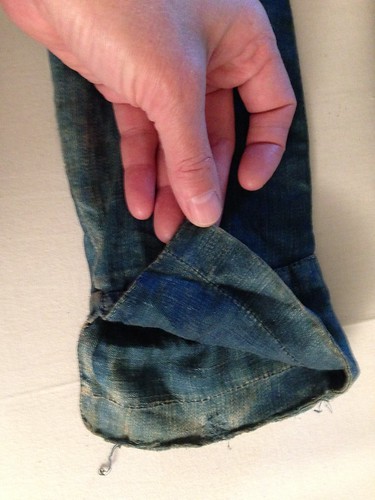
These are pretty interesting, with about a dozen patches of various sizes and fabrics. The main fabric is a blue and white stripe linen of 42 threads per inch. The fall-fronts have pockets built into the bearers, with a welt cut on the grain but set on the bias for a snazzy little graphic moment. The button holes appear to be slightly rounded at the ends in a way that siuggests intent and helps confirm the date. The buttons are not all the same design, but are all four-holed bone buttons. The trousers have a 31″ waistband, a 19.5″ rise, and a 26″ inseam.

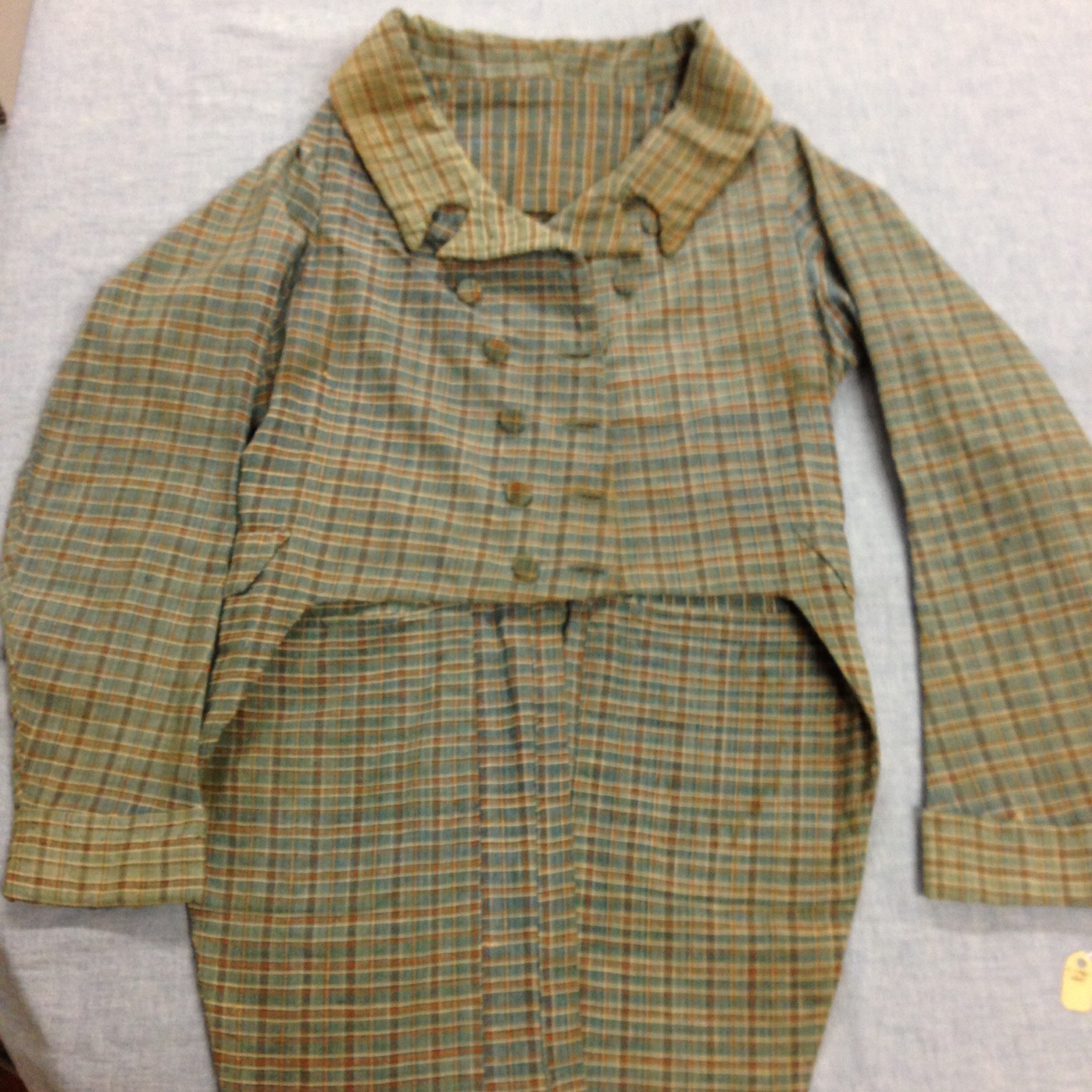
The other truly fabulous piece I saw was a coat in a blue, white and orange check “Stonington Plaid” ca. 1800, URI 1967.13.17.

This is a double-breasted, self-faced tail coat with self-covered buttons and notch collar lapels, false pocket flaps on coat body and pockets in the tails and left breast. The unlined, folded-back cuffs are tacked to the sleeve and may have been shortened. The overall length at CB is 36″, sleeve length is 25.5″ and the chest is about 34″.

1967.13.17, "Stonington Plaid" linen check coat, 1800-1810. Gift of Mrs Muriel Buckley, URI Textiles Collection.

1967.13.17, “Stonington Plaid” linen check coat, 1800-1810. Gift of Mrs Muriel Buckley, URI Textiles Collection.

When I opened this coat and looked at the seams, I was struck by the construction method, not because it was different, but because it was so typical. (I also peeked inside two wool broadcloth coats in the cupboard: same construction as the woolen coats I’d seen before.) It;’s nice to see conventions in action, and recognize what you’re seeing.

The collar on this coat has some little anomalies suggesting a less-experienced hand, or perhaps a foray into a new type of collar; judging by the pad stitching, I’m more inclined to guess less experienced hand, though not home manufacture. Someday I’ll track down the South County and eastern CT tailor’s books…

1967.13.17, back view of "Stonington Plaid" checked linen coat. Gift of Mrs Muriel Buckley, URI Textiles Collection.

1967.13.17, back view of “Stonington Plaid” checked linen coat. Gift of Mrs Muriel Buckley, URI Textiles Collection.

In the meantime, what amazing clothes and fabulous fabrics! The past looks nothing like what we imagine unless we can look past fashion plate elegance to the riot of stripes and checks and prints that must have existed in almost every village and town in Rhode Island.

*With the exception of a pocket at Mystic Seaport and a gown at the Smithsonian: accessory in the first case and very not local in the second case, making in hard to study in a day trip.

**Having palpitations yet? Your heart will really race if I can track down the photos to prove all this. In other news, I know a couple of gentlemen who are currently “one person historical societies.” The collecting instinct in wired into some folks.

***Jack and Harriet: she survived the 1938 Hurricane, and their overweight black-and-white polydactyl cat, Bonnie, followed them around the corner to church every Sunday.

Share this:

  • Share on Facebook (Opens in new window) Facebook
  • Share on Pinterest (Opens in new window) Pinterest
  • Email a link to a friend (Opens in new window) Email
  • Share on X (Opens in new window) X
Like Loading...

Woolen Woes

08 Wednesday Oct 2014

Posted by kittycalash in Clothing, Fail, Living History, Making Things, Research

≈ 7 Comments

Tags

19th century clothing, Costume, dress, failure, fashion, fashion plate, Federal style, Joseph Taber, living history, Making Things, Providence Journal, Regency, Research, sewing, Spencer, Spencers, style

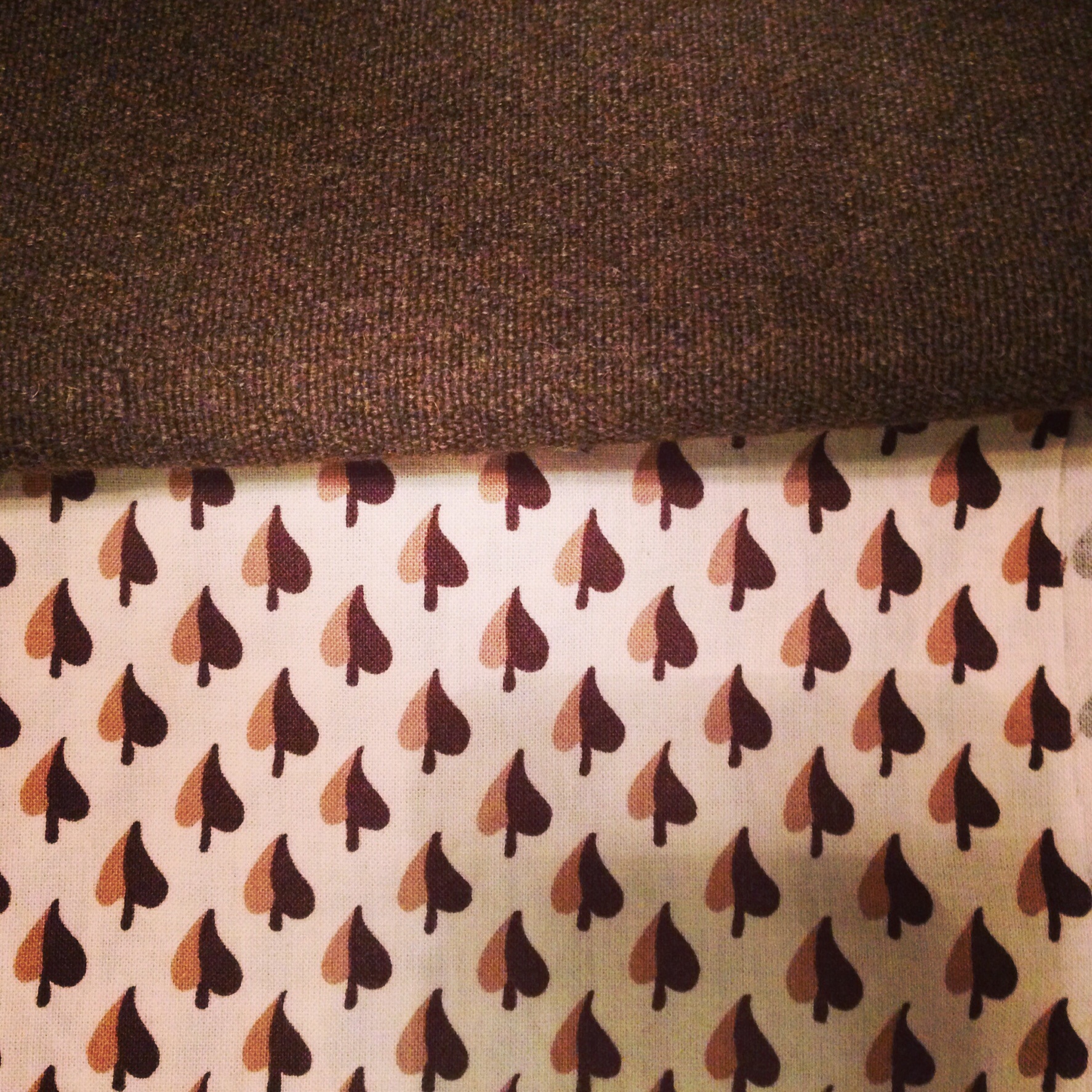
imageOn Saturday, I got a very nice piece of wool from Mr C’s Strategic Fabric Reserve, just the color and weight I’d been looking for to make a Very Specific Spencer. The VSS is not a replica, but rather specific to a gown: I want it to go with a 1797 V&A print.

Did women wear Spencers in 1797-1800 Providence? At least one tailor, Joseph Taber, advertised that he made Habits and Spencers, but as far as I know, there are no extant Rhode Island Spencers. Given how few collections are fully online here, and how few Spencers survive anywhere, I’m not too surprised. Julia Bowen’s diary covers Spring and Summer, when she’s quilting (mighty lazy work, she says), but she doesn’t say much about outerwear.
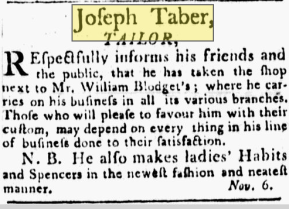
Providence Journal, 11-13-1799

Providence Journal, 11-13-1799

I’ve been on the fence about how common Spencers were– after all, the drawings in Mrs Hurst Dancing show women clearly wearing red cloaks– but might a Spencer and cloak combination have been just the thing to keep warm on a raw October day? With a wool petticoat and long wool stockings, you could be fashionable and warm.

There’s no firm documentation of any of that– which does not mean, as I once muttered in the general direction of some recalcitrant docents, that rich people in Providence hunkered naked in cold corners of curtain-less rooms gnawing on raw meat.** What it does mean is that much of what we make and wear is conjecture, based on examples from the same time period in other geographic areas.

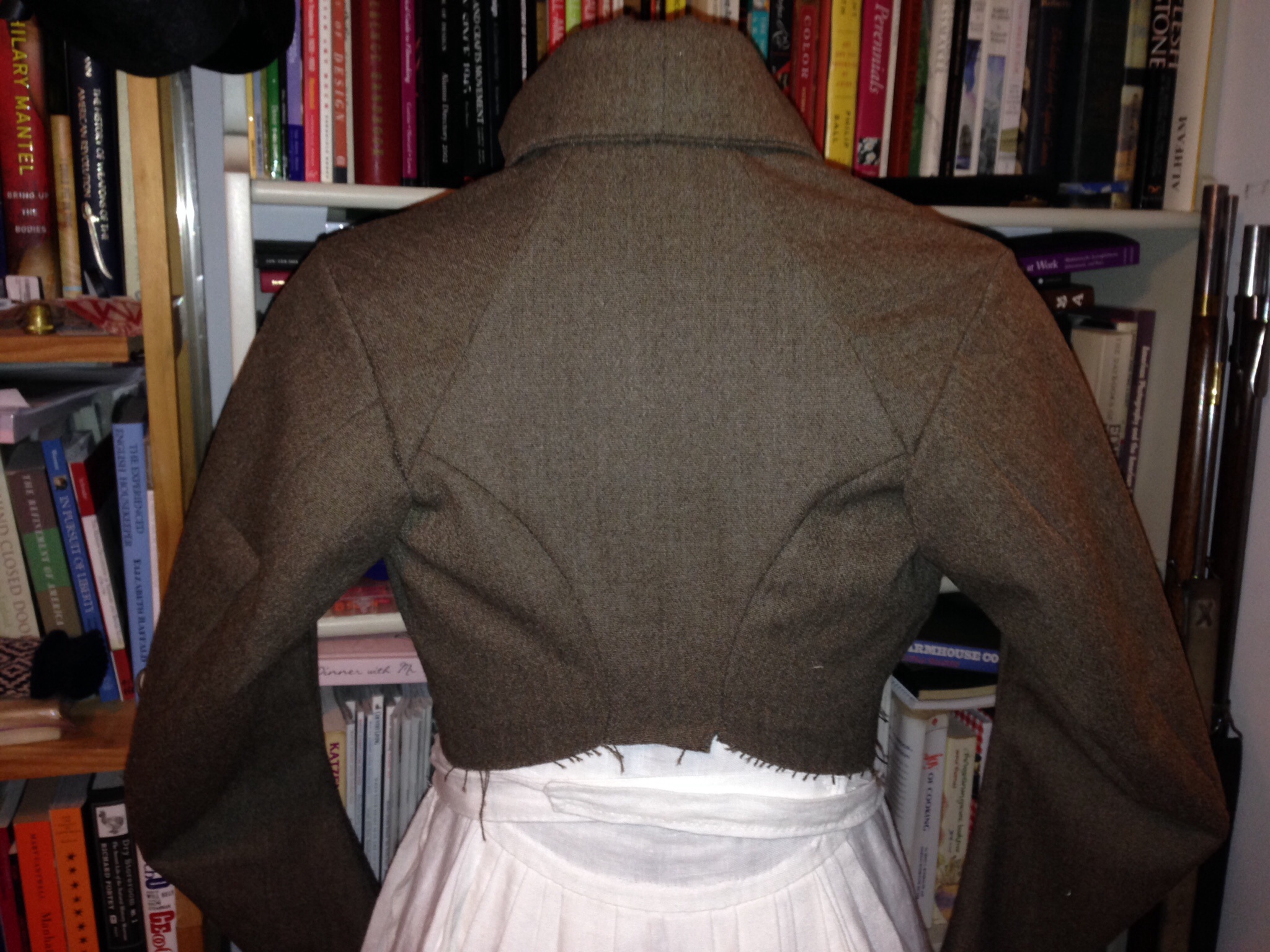
Can I have a Spencer in New England? I’m not sure, but I’ve made another one anyway, and here it is, still underway. (The thing about Cassandra is that while she is a very patient model, she has terrible posture. I can verify the back fits me a great deal better than it fits her.)
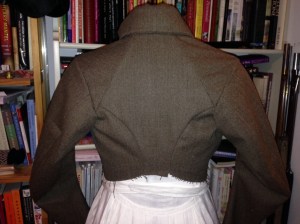
Cassandra's posture is very different from mine. She will not pull her shoulders back!

Cassandra’s posture is very different from mine. She will not pull her shoulders back!

This wool is buttery and soft, and takes the needle well. Waxed thread glides through it and grips. It does have a tendency to fray a bit at the cut edges, but has a good pinked edge, and there are examples of pinked-edge facings in extant men’s wear. Sweet, right?

I’m not showing you this to boast about my skills, but to show off an dandy mistake. In working the folded edge of the collar, I trimmed a bit too much at the neck edge, and found the collar a bit small when I basted it in. Of course I removed it, and started again, easing a bit more as I went: Huzzay! It fit!

Really, I'm not sure how this happened. But there it is: upside down.

Really, I’m not sure how this happened. But there it is: upside down.

Oh, reader: rejoice not. I backstitched that bad boy on upside down. Expletive deleted! Mad Skillz: I even managed that bit of genius before my pre-work panic attack.

I took the garment in to work to seek council from my tailoring-class-educated friend who possesses native common sense and Yankee practicality. It came down to this: is it worse to have the collar upside down, or to have it not fit as well right side up? Decide with the knowledge that working the fabric more will affect the cut edge badly. My friend suggested stitching in the ditch with contrasting thread to make this flaw an Intentional Design Element.

Black trim on a Spencer?

That is a good idea, but I thought the flaw will still be too noticeable. Then it came to me: trim. Just as the construction guys are spreading drywall mud in the chinks around the window frames, I can spread some wool braid love around this collar. There’s certainly evidence for trim use on Spencers in fashion plates, and trim would push the men’s wear aspect of this garment even farther. As soon as I got home, I double-checked extant garments and fashion plates, Roy Najecki’s lace page, and measured my edges.

Four yards of quarter-inch black mohair braid should do the job, stitched around the edge of the collar and lapels, the cuffs and possibly the hem edge.

Do I run the chance of looking like a black-outlined cartoon drawing? Yes.

Did I just buy endless hours of tiny stitching? Yes.

This is a crazy, work-making solution that may leave me with a garment not suited to my class in early Federal Providence. But I think it’s going to look amazing when it’s finished.

**(The docents argued that textiles were SO RARE and SO PRICY in late 18th century RI that NO ONE in Providence had curtains. NO ONE. The lack of fire was my own bitterness coming out at this Great Curtain Kerfluffle which took place at a public lecture I gave explaining what we knew about the use of textiles to furnish Providence homes of people who would be as rich as Bill Gates today.)

Share this:

  • Share on Facebook (Opens in new window) Facebook
  • Share on Pinterest (Opens in new window) Pinterest
  • Email a link to a friend (Opens in new window) Email
  • Share on X (Opens in new window) X
Like Loading...
← Older posts
Newer posts →

Archives

wordpress statistics

Creative Commons License
Kitty Calash blog by Kirsten Hammerstrom is licensed under a Creative Commons Attribution-NonCommercial-ShareAlike 4.0 International License.

Website Built with WordPress.com.

  • Subscribe Subscribed
    • Kitty Calash
    • Join 621 other subscribers
    • Already have a WordPress.com account? Log in now.
    • Kitty Calash
    • Subscribe Subscribed
    • Sign up
    • Log in
    • Report this content
    • View site in Reader
    • Manage subscriptions
    • Collapse this bar
 

Loading Comments...
 

    %d