• Home
  • Completed Costumes/Impressions
  • Emma and Her Dresses
  • Free Patterns and Instructions

Kitty Calash

~ Confessions of a Known Bonnet-Wearer

Kitty Calash

Category Archives: Food

Fun and Feasting in Cambridge

16 Tuesday Jul 2013

Posted by kittycalash in Events, Food, Living History, Reenacting

≈ 2 Comments

Tags

10th Massachusetts, 18th century, common soldier, cooking, Events, food, living history, Reenacting, Revolutionary War

Well, we didn’t feast, it was too hot. But I helped make a feast. I didn’t document it with  photos because I didn’t think my companion would appreciate it. But here’s what we did.

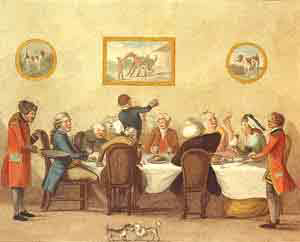
General Washington was set to dine with the gentry, so a repast needed to be made. The captain’s wife volunteered to provide the meal and I served as scullery maid, a role I do find comfortable. (Anyone else identify with Daisy on Downton Abby? She’s the character I feel most like.)

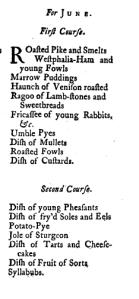
The menu:

Salmagundi
Onion Pie
Bread & Cheese
Pickles
Fruit
Ratafia Cakes
Claret

We worked in the NPS staff kitchen in the carriage house behind Longfellow House: air conditioned, but the kitchen is in a former bathroom. Still, there was a sink and some counter space, so we were set.

A salmagundi is a kind of mixed salad, by which I do not mean tossed. It is perhaps most similar to a chopped, layered salad today. Colonial Williamsburg has an adaptation here, and that formed the basis of our creation.

We used one bag of pre-washed leaf lettuce, one roasted chicken (I did not have to rip it up! I got to chop eggs instead), two tins of anchovies, a medium ham, a lemon, etc. Although we had wooden bowls for prep work, we ran out of places to put the chopped ingredients, so ended up using the NPS staff containers from the dish drainer. With a glass full of egg yolk, a bulk food container of egg white, a black plastic dish of ham and a plastic water cup of anchovies arranged on the crowded sink, we achieved a workable if slightly bizarre mise en place.

What’s astonishing is how much space all that food takes up. You think it’s not enough when it’s contained, but get it on a platter and wow! That’s a shockingly large amount of food. The captain and his wife will be enjoying that salmagundi all week, I fear.

The onion pie was pre-baked from the CW recipe as well. I favor Chesire Pie, and know it is a unit favorite (since four of us devoured one for breakfast at Monmouth…mmmm, pie….)

The pickles were amazing! Made from a 1747 Hannah Glasse recipe, pickled cucumber slices are pretty simple. You may, of course, wish to reduce the quantities:

“To pickle large cucumbers in ſlices. TAKE the large cucumbers before they are too ripe, ſlice them the thickneſs of crown pieces in a pewter-diſh ; to every dozen of cucumbers ſlice two large onions thin, and ſo on till you have filled your diſh, with a handful of ſalt between every row : then cover them with another pewter-diſh, and let them ſtand twenty-flour hours, then put them in a cullender, and let them drain very well ; put them in a jar, cover them over with white wine vinegar, and let them ſtand flour hours ; pour the vinegar from them into a copper ſauce-pan, and boil it with a little ſalt ; put to the cucumbers a little mace, a little whole pepper, a large race of ginger ſliced, and then pour the boiling vinegar on. Cover them cloſe, and when they are cold, tie them down. They will be fit to eat in two or three days.”

Read more at Celtnet: http://www.celtnet.org.uk/recipes/glasse-of-pickling-14.php
Copyright © celtnet

Ratafia cakes are funny little things. I only had one, when they came back from the table (I did mention Daisy, right?) but I might try them. They are not ideal for camp eating–in fact, they would be downright inappropriate–mostly because they are rather fragile and travel poorly.

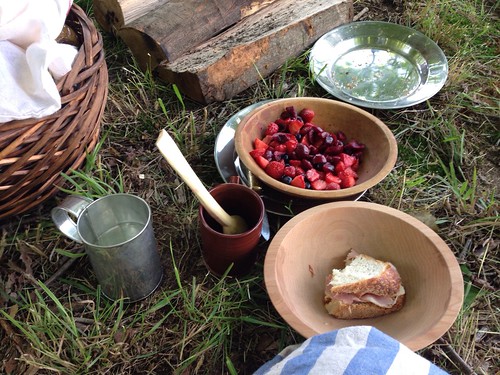
The rest of us–the privates and sergeant and the Young Mr, who was playing Washington’s aide de camp as a young scamp–ate bread and cheese and fruit in the shade of a tree. It was too hot to eat much.

Share this:

  • Click to share on Facebook (Opens in new window) Facebook
  • Click to share on Pinterest (Opens in new window) Pinterest
  • Click to email a link to a friend (Opens in new window) Email
  • Click to share on X (Opens in new window) X
Like Loading...

Apprehending Chicken

27 Thursday Jun 2013

Posted by kittycalash in Events, Food, Living History, Reenacting, Research

≈ 4 Comments

Tags

10th Massachusetts, 18th century, 2nd Rhode Island, common people, common soldier, cooking, food, living history, Reenacting, Revolutionary War

Living History Chickens. Don’t mess with them.

I have written in the past about the Living History Chicken, ripped and delicious, and the joys of making such a creature fit into a cast-iron pot. While “chicken ripper” might be the appellation you desire, it’s not what I want to be known for.

Last time, I dissed the modern ham as an item ill-suited to camp cooking (tasty, but it doesn’t look right). I have also seen hams on a spit cooked slowly (too high above) a fire, and heard a rumour about a very authentic ham-dining experience with a very authentic digestive result. That’s taking things farther than I care to take any regiment, so what to do?

Continental Army rations included, among other things, a pound of flour and a pound of beef a day per man. In Rhode Island at least, that beef might also have been fish, and I have seen chicken listed, too, as it is, technically, meat. Not wanting to inflict our fishy Ocean State customs on all comers, I think I’ll spare the regiments a pound of fish a day. But chicken? What to do? Hope to cook it?

Or maybe we should eat more fruit.The Afternoon Meal by Luis Meléndez, ca. 1772. MMA, 1982.60.39

One option is to rip the carcass apart (see above) and boil it. That would get the job done, for a bone-in chicken stew. However, I am thinking of string roasting chicken (or cornish game hens, since modern grocery store chickens are awfully large).

To be quite technically correct, I could only cook chicken for the Second Helping Regiment. They had a documented poultry thief among their number, one John Smith, who apprehended poultry if it failed to give the correct countersign when challenged. However a chicken is prepared, it will be a messy business, as we have no forks. It’s fingers, knives and spoons for us, as we have no forks. That does increase the appeal of boiling, since the meat would come off the bone more easily.

Share this:

  • Click to share on Facebook (Opens in new window) Facebook
  • Click to share on Pinterest (Opens in new window) Pinterest
  • Click to email a link to a friend (Opens in new window) Email
  • Click to share on X (Opens in new window) X
Like Loading...

Drawing Beef and Flour

26 Wednesday Jun 2013

Posted by kittycalash in Food, Living History, Reenacting, Research

≈ Comments Off on Drawing Beef and Flour

Tags

10th Massachusetts, 18th century, cooking, Events, food, Research, Revolutionary War

The Durham Ox: yet to come in 1778

Drawn meat: The Durham Ox.

Or beeve and flower, depending on how you’re spelling in 1778.
John Buss of the 10th Massachusetts complained mightily of the rations he drew, and the quality of the beef, pining in his letters home for cheese and cider. His affection for cheese has become part of the unit’s lore and an in-joke, so I did make certain to have plenty of cheese for Monmouth. Bread, cheese, ham, fruit in season, beef stew: yawn, after a while.

Trying to cook authentically in the field could result in dull, repetitive menus, recreating the soldiers’ experience, but unless everyone you’re feeding has signed up for that, you may have an unhappy crowd on your hands. Mostly they just want food, but people will grumble if you are cooking the same thing every week (and that opportunity exists). When I was a kid, my mother cooked chicken and broccoli every Sunday night, and to this day, I won’t eat chicken and broccoli unless it is in satay sauce.

Sorry, Private: not in this man's Army.

Sorry, Private: not in this man’s Army.

The 10th can count themselves lucky that they weren’t on the expedition to Quebec, when Newfoundland was on the 2nd Rhode Island’s menu, as well as squirrel-head-and-candle-wick soup. (Try explaining this Newfoundland business to your creative writing group. I tried historical fiction and got a reputation for being “dangerous,” and you can, too.)

At Monmouth, we served as another regiment’s….disposers…on Sunday morning, and were treated to the extra steaks they cut from a ham. Grilled and stacked on bread with hard cheddar cheese, this was delicious. Our conversation turned quickly to the question of grilling. After all, we only have kettles and sticks. I said I’d buy and carry a grate if they wanted ham so much, but the Adjutant proposed weaving a grid of green sticks and holding that over coals, and just brushing off the ashes when the meat fell into the coals. The minor detail left out is what we would use to retrieve the meat, though it must be a stick by any other name.

One cannot fry in or on tinware: the tinning will melt. We know soldiers carried as little as they could even in the regular infantry, so light infantry units were packing nothing but what they had to carry. No frying pan; no grate. Upon reaching this conclusion, we turned our sad-eyed stares on the other regiment with their table and stools and grill and ham, and were rewarded with another grilled ham piece each. Dogs have got a good thing going.

Begging and sharing aside, what about ham? The joke we make at home about ham being the natural prey of cats who butcher, brine, and cook the ham they beg for applies just as much to light infantry troops and their hangers-on. (They shouldn’t really have me along, but they are stuck and I’m pretty handy for getting the meals out, the canteens filled, and the wounds bandaged.) But a ham? Harder still to justify. Salt pork, yes; salt beef, yes. But the attractive and portable boneless hams at the supermarket are, sadly, more delicious than authentic.

One can take on the task of preparing meat properly oneself, in one’s copious spare time, but that won’t fix July and August’s meals. Staring sad-eyed at other regiments seems a parasitic and reputation-destroying plan. What to do?

Tune in next time for more adventures in historic meats!

Share this:

  • Click to share on Facebook (Opens in new window) Facebook
  • Click to share on Pinterest (Opens in new window) Pinterest
  • Click to email a link to a friend (Opens in new window) Email
  • Click to share on X (Opens in new window) X
Like Loading...

18th Century Sno-Cones

18 Tuesday Jun 2013

Posted by kittycalash in Food, Living History, Reenacting

≈ 1 Comment

Tags

10th Massachusetts, Battle of Monmouth 2013, Brigade of the American Revolution, Events, food, Monmouth 235th, Reenacting

Nooning Saturday. Sandwiches and fruit

You may not have seen the Mad Men episode about the Sno Ball campaign, but chances are good you remember Sno Cones in paper cups from street vendors or Woolworth’s. On a hot August afternoon in Chicago, they were a treat waiting for the insufferably delayed Number 11 bus. On a warm New Jersey night, one can be inspired.

When the Wemrock Orchards truck came through camp Saturday evening, we bought another bag of ice—20 pounds!—and added ice to our pitchers. The Young Mr started crunching ice cubes, and The Adjutant observed, “You’re following the label’s advice: ‘Ice is Food’.” Mr S and I looked at each other and said, “I wonder if you could make a shrub slushy?” But what to beat the ice with? Musket butts were considered and rejected. And suddenly the Young Mr said, “We have a mallet!”

Indeed we do: Mr S made us a whacking great mallet with an enormous head. We ran to the tent to fetch the mallet and the flask of shrub, wrapped two handfuls of ice in the cleanest white cloth we had, laid it on Table (a clean, flat piece of firewood) and wielded the mallet. Just a small amount of shrub (recipe here) will do; it’s pretty potent stuff, even when non-alcoholic. I did not whack long enough, but shrub over crushed ice is a delicious, if highly unlikely for a common soldier, treat. The Adjutant is correct: the ice needed more whacking. But when he said, “I guess someone will have to make a mallet for the unit that’s flat on one side and serrated on another,” I figured we’d been accepted, crazy snow-cones and all.

Share this:

  • Click to share on Facebook (Opens in new window) Facebook
  • Click to share on Pinterest (Opens in new window) Pinterest
  • Click to email a link to a friend (Opens in new window) Email
  • Click to share on X (Opens in new window) X
Like Loading...

Monmouth Menus

12 Wednesday Jun 2013

Posted by kittycalash in Events, Food, Living History, Reenacting

≈ 6 Comments

Tags

10th Massachusetts, Brigade of the American Revolution, common soldier, food, Monmouth NJ, Revolutionary War, seasonal menus

Food: It is always on my mind, even cataloging. When the tan and brown and black colors of a sampler make me think of Tiramisu,  I know it’s time to wrap up work for the day. But food is particularly on my mind this week, as I plan and calculate for Monmouth, hoping to use the lessons I’ve learned in the past instead of just being anxious. I know it’s not a test, but it feels like one, somehow.

The Young Mr has aged suddenly, in Don Draper’s kitchen.

Continental rations were supposed to be a pound of beef and a pound of flour a day for man, half that for a woman employed by the army and a quarter of that for a child. The Young Mr (who isn’t really a child and is sort of a soldier) would get more if he was really a drummer… but in any case, we’re looking at 2 + ½ + ¼ or 2 ¾ pounds of beef and the equivalent of flour at a minimum to feed two soldiers, a woman, and a child per day (at a minimum, I expect to feed the adjutant as well as ourselves).

I float out ideas like fire cake or pudding to take account of the flour, but Mr S reels me in and suggests that we should stick to what we know until we can test other ideas on the landlord’s fire pit. We shall substitute bread, therefore, and I probably will not make a nuisance of myself at the bakery or the grocery and ask them to weigh the loaves, as I have my own kitchen scale and can obsess about this in the comfort of our home.

Too fancy! From the Complete Housewife.

Too fancy! From the Complete Housewife.

My plan is about the same as every camp dining plan: that’s suitable, given the repetitive nature of Army rations (and the repetitive complaints of the soldiers, echoed in every war).

Friday
Pasties. They keep and travel well.

Saturday Morning
Bread, cheese, strawberries, eggs
Ideally, I’ll find a farm stand where I can buy local strawberries, but we will only get into a discussion of what exactly would have been in season on New Jersey in June 1778, which leads to a discussion of global heating.

Saturday Lunch
Bread, cheese, ham, cookies from home

Saturday Dinner
Beef stew and bread, strawberries, cookies from home

Sunday Morning
Bread, cheese, fruit, eggs

Sunday Lunch
Bread cheese, ham, and anything that’s left

This is essentially the same plan that I had for OSV last year, with the biggest sticking points being: will I remember the eggs? Will I manage coffee? I’m not very good at anything until I have coffee, or some kind of caffeine, which could be a challenge this time around. There’s an ice truck scheduled to go through the camps, but what I want to know is, when’s the coffee truck coming?

Share this:

  • Click to share on Facebook (Opens in new window) Facebook
  • Click to share on Pinterest (Opens in new window) Pinterest
  • Click to email a link to a friend (Opens in new window) Email
  • Click to share on X (Opens in new window) X
Like Loading...
← Older posts
Newer posts →

Archives

wordpress statistics

Creative Commons License
Kitty Calash blog by Kirsten Hammerstrom is licensed under a Creative Commons Attribution-NonCommercial-ShareAlike 4.0 International License.

Website Built with WordPress.com.

  • Subscribe Subscribed
    • Kitty Calash
    • Join 621 other subscribers
    • Already have a WordPress.com account? Log in now.
    • Kitty Calash
    • Subscribe Subscribed
    • Sign up
    • Log in
    • Report this content
    • View site in Reader
    • Manage subscriptions
    • Collapse this bar
 

Loading Comments...
 

    %d