• Home
  • Completed Costumes/Impressions
  • Emma and Her Dresses
  • Free Patterns and Instructions

Kitty Calash

~ Confessions of a Known Bonnet-Wearer

Kitty Calash

Category Archives: Living History

Squirrel!

28 Tuesday Nov 2017

Posted by kittycalash in Clothing, Living History, Making Things, Reenacting

≈ Comments Off on Squirrel!

Tags

18th century clothes, 18th century clothing, authenticity, common dress, sewing, squirrels, waistcoat, winter

It’s astonishing to me, in a way, that I haven’t posted about this before, but shockingly, I have not. Remember the need to keep warm in Princeton? Tested on at Ti? A compromise?

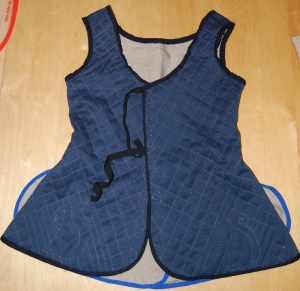
I updated that garment and wore a nearly-completed version at Ti last February but never wrote about the new version: the Squirrel Waistcoat.

Wool hand-quilted to a wool backing and lined with wool, I wore this almost finished at Fort Ti last February, and found it comfortable and cozy. I had imagined its state to be far worse than it was: with a lining in need of piecing, mangled seams, your worst nightmare come true. But no: all it really needed was some binding adjustment, not surprising considering that I stitched the binding by candlelight while chattering away with friends over cider.

The back pieces weren’t bound at all, but because I’d imagined this needed so much more work than it did, I put it aside until now, when I know I will want it for a weekend in Trenton, and another at Ti in December. All it took was a little time, and accepting that the bindings will not match.

DSC_0831
DSC_0826 7.41.36 PM

This wasn’t a long, involved project, really, though I spent lunch hours and evenings working on it last January and February. It is, as so many things are, about patience. Patience and good needles.

The construction was based on the quilted waistcoat I made two years ago, with a pattern derived from Sharon Burnston’s research, using fitting adjustments I’d made to an earlier jacket pattern (long since abandoned due to living in New England).

I don’t fully remember how it fits best, over or under my stays, but I’ll get a couple of opportunities to test drive the layers in the next two weeks. And in the meantime? Squirrel!

Share this:

  • Share on Facebook (Opens in new window) Facebook
  • Share on Pinterest (Opens in new window) Pinterest
  • Email a link to a friend (Opens in new window) Email
  • Share on X (Opens in new window) X
Like Loading...

Gathering Thoughts

25 Saturday Nov 2017

Posted by kittycalash in Clothing, Living History, Making Things, Research

≈ 1 Comment

Tags

apron, classes, Paul Sandby, Research, sewing, sewing project

Someone must watch the baggage.

You only live once, as they say, so you might as well enjoy yourself, and have a nice apron while you’re at it.

At last I have finished the one I made to serve as a demonstration model for the apron class I taught for Crossroads of the American Revolution. Plain, unbleached linen (osnaburg), it will be a good, serviceable garment well suited to getting dirty through use. There’s a lot to be said for filth, and my first-ever apron has acquired a fine patina of stains and wear.

Paul Sandby RA, 1731–1809, British, London Cries: A Girl with a Basket on Her Head ("Lights for the Cats, Liver for the Dogs"), ca. 1759, Watercolor, pen and brown ink, and graphite on medium, cream, slightly textured laid paper, Yale Center for British Art, Paul Mellon Collection
Paul Sandby RA, 1731–1809, British, London Cries: A Girl with a Basket on Her Head (“Lights for the Cats, Liver for the Dogs”), ca. 1759, Watercolor, pen and brown ink, and graphite on medium, cream, slightly textured laid paper, Yale Center for British Art, Paul Mellon Collection
Paul Sandby RA, 1731–1809, British, London Cries: "Do You Want any Spoons...", ca. 1759, Watercolor, pen and brown ink and graphite on medium, cream, slightly textured laid paper, Yale Center for British Art, Paul Mellon Collection
Paul Sandby RA, 1731–1809, British, London Cries: “Do You Want any Spoons…”, ca. 1759, Watercolor, pen and brown ink and graphite on medium, cream, slightly textured laid paper, Yale Center for British Art, Paul Mellon Collection

So why make a new one, aside from needing a teaching aid? Especially when you already HAVE a checked apron that’s looking used, and you have others in your wardrobe: why? One reason was the sheer cussedness of making the plainest, dullest, least-pretty item as finely and carefully as I could. Another was that the more I looked for apron data and examples, the more I noticed plain linen aprons. Yes: the preponderance of aprons are check, but looking at Sandby again made me realize that plain was documented, and under-represented in living history.

Sandby shows working women in checked and in blue aprons, but he also seems to depict women in plain, unbleached linen aprons, particularly the women in the street scenes. All the more reason to make up a plain apron, when your preference is portraying the urban underclass.

DSC_0811
DSC_0824

It’s also a good chance to hone one’s skills and keep in practice when you’re avoiding sewing the things that need sewing, like new shifts. And a basic project is meditative in a way that a new pattern is not: making stitches small and even is to sewing what scales are to piano playing or singing.

The first supervised apron I ever made is described here, and I’m pleased that my skills have improved since.

DSC_0825
DSC_0826

Stroke gathers are worth practicing, since they’re used on shifts and shirts as well as aprons; I’ve even used them on early 19th century garments to evenly distribute fine cotton lawn across the back of a gown. Sharon Burnston explains them here. I don’t know that there’s any one “trick” to them aside from patience and even stitches, but that “trick” will take you far in assembling pretty much every hand-made garment.

Share this:

  • Share on Facebook (Opens in new window) Facebook
  • Share on Pinterest (Opens in new window) Pinterest
  • Email a link to a friend (Opens in new window) Email
  • Share on X (Opens in new window) X
Like Loading...

We Have Data

26 Thursday Oct 2017

Posted by kittycalash in Living History, Making Things, Philosophy, Reenacting, Research

≈ 1 Comment

Tags

authenticity, interpretation, Reenacting, Research, survey

My assistant misunderstood the exercise, and is disappointed that we will not be turning the government over to him.

Data Cat says it’s clear: Cats Rule.

What is clear is that 501 people from around the world (really: people responded from the US, Canada, Australia, Europe, Great Britain) were interested enough to see what we could find out by asking questions about what, how, and why we make and wear these funny clothes. I’m immensely grateful that Google tools are easy to use, as I can present Graphs Without Tears:

Here’s how that breaks down:
Strongly disagree: 1.8%
Disagree: 0.6 %
Neutral: 3%
Agree: 30.9%
Strongly agree: 63.7%

That is, 94.6% of respondents agree that they try to make the most period-correct clothing they can. The “strongly disagree” folks (9 of them) are interesting to me, because it’s a position that’s foreign to me. (This is why recording your email was an option, so I could clarify the data.)

Next, let’s look at Authenticity:
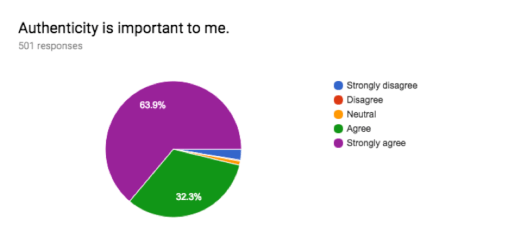
Here’s how that breaks down:
Strongly disagree: 2.6%
Disagree:.2 %
Neutral:1%
Agree:32.3%
Strongly agree:63.9%

And on the use of Primary Sources:

Yes: 94.4%
No: 5.6 %

When I dug into what sources people use, and consider “primary sources,” I realized I have more questions to ask, and there are some folks who could use some research help. Not handed to them on a plate or in a slideshow, but in terms of process, and in recognizing primary versus secondary sources, and how they can be used together for maximum understanding.

Then I asked, Why is documentation important to you? 

Those responses will also inform another round of questions. Many were very revealing of thought processes and approaches; some made me a little sad. A couple of people said, essentially, I don’t want other reenactors to laugh at me.  I think we can do better than that, right? Let’s try empathy on for size, and be as helpful as we can in guiding people to an understanding of what they want to do, and how best to go about it.

Because the answers varied in length, I started reading them to discern the essence of the response, and I came up with five categories; the sixth slice represents the answers left blank.

Accuracy: 73.4%
Immersion: 11.6%
Learning: 6.1%
Respect (of ancestors, history): 4.0%
Personal (fun; satisfaction): 0.5%
No answer: 4.5%

Accuracy is the main reason documentation matters to people, and they gave good answers for why accuracy mattered.

I want to have the resource itself, rather than someone else’s interpretation of it. If everyone bases their impression off of somebody else, rather than going to the source first, it becomes a game of telephone.

It’s like medical documentation. If it’s not written down, it didn’t happen. There’s enough open source imagery and documents on the internet, let alone physical ones or surviving garments, that there really is no excuse for wild supposition.

Because everything else is unsubstantiated conjecture or hearsay and feels inauthentic to me and to those around me.

Because I use my impression to communicate about history, and history is grounded in factual, accurate information.

Documentation is the truth behind the fiction of a living history impression.

Immersion had interesting answers, too:

I want to accurately portray my impression for the public. As an added bonus, wearing the correct clothing and using period correct items, helps me connect with the people I portray on a personal level.

Because the point of living history (to me) is to recreate the past enough to learn from the visceral experience of *living* it, so it needs to be pretty accurate! Documentation is how I can know if what I’m doing is accurate (or close to accurate).

It tells us a lot about the larger picture of what was going on: trade, manufacturing, diplomacy, economics

Learning:
Because if we’re teaching people history, teaching them something that’s wrong is a disservice and an embarrassment on our part. We have the ability to learn what’s correct.

Researching and documenting my impression is why I am proud to put on my clothes. I enjoy the challenge and detective work that comes before I ever cut into any fabric.

Respect:
We owe it to our ancestors to tell their stories as accurately as possible.

For the class of person I represent, documentation can be very difficult to get at. Some documentation indicates that the garment(s) in question possibly existed, 3 pieces of documentation is ideal, but 2 will sometimes do, depending on my instincts about something. I have regretted only going for two in the past because my intention is generally to represent something very common. Documentation is important because it shows respect for the historical people I am trying to represent, it shows respect for my own work and time and it shows respect to the hobby (which, in historical circles, is often far more important than people give it credit for).

There’s a lot to think about in considering what you all think about, and I am really grateful for your help! As I look at the answers over the next days/weeks, I’ll let you know what else I see, and once I figure out how to ask the next round, there will be more questions! Thanks again! (And if you didn’t get to participate this time, no worries: you can join in next time; the easiest way is to follow the Kitty Calash FB page, but I’ll also post a link here.)

Taking the Census. oil on canvas, 1854. Francis William Edmonds. Gift of Diane, Daniel, and Mathew Wolf, in honor of John K. Howat and Lewis I. Sharp, 2006 2006.457 Metropolitan Museum of Art.

Share this:

  • Share on Facebook (Opens in new window) Facebook
  • Share on Pinterest (Opens in new window) Pinterest
  • Email a link to a friend (Opens in new window) Email
  • Share on X (Opens in new window) X
Like Loading...

Clear and Present Danger

24 Tuesday Oct 2017

Posted by kittycalash in Living History, personal, Philosophy, Reenacting

≈ 3 Comments

Tags

authenticity, Critical Theory, difficult interpretations, feminism, interpretation, rant, Revolutionary War, ripostes

A Female Philosopher in Extasy at Solving a Problem. London, England; about 1770 Mezzotint and engraving with watercolor on laid paper
Colonial Williamsburg Foundation

Scandal and outrage rock the reenacting world as reading comprehension lags and The Gentle Author is accused of presentism– or, at least, that’s the most reasonable translation I have for comments made about me last night on social media, including:

Yeah- she’s got great stuff. But I feel awful that she fell into a modern-think trap.

and, my favorite,

I’d say its a post modern Critical Theory think trap. Frankfort [sic] School is gushing from the pores.

Let’s take this apart, shall we? The Frankfurt School (not this place) was a social and political movement based in Frankfurt am Main in the immediate post-World War I years. After 1933, the school, formally known as the Institute for Social Research, moved to Columbia University in New York city. Being insulted by association with the likes of Walter Benjamin and Theodor Adorno is a new experience for me; I’m more usually associated with the ideas of Mary Daly and Jacques Derrida but I’ll take backhanded intellectual flattery where I can get it. (Also, thanks for thinking of me, but Kitty does not require your pity.)

More seriously, the postings last night (which happened while I was in class and have been deleted) brought to mind two powerful issues in living history and the reenacting community: Presentism and Feminism (with its unholy shadow, mansplaining).

Let’s go over these:

Presentism: uncritical adherence to present-day attitudes, especially the tendency to interpret past events in terms of modern values and concepts.

Feminism: The radical notion that women are people. the theory of the political, economic, and social equality of the sexes.

My recent post about MoAR’s Occupied Philadelphia event was accused of presentism, or “falling into a modern-think trap” and a “Critical Theory trap.” Here’s how that post came about:

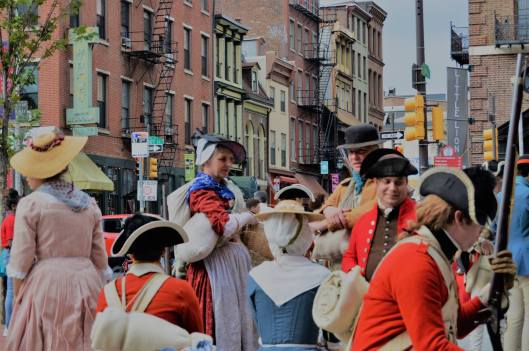
Images were posted to Facebook, and I was tagged in one that showed me in the midst of a crowd that included members of the 17th Regiment of Infantry, one of the forces that occupied Philadelphia in 1777. My cousin, ever the wag, commented:

click to enlarge in a new window

“I suppose you hang out with Confederates, too,” had some bite. What surprised me was my well-educated and thoughtful cousin’s facile conflation of Confederates and British. Is the world that easily black-and-white, good-and-bad, Manichaen? Not usually, and certainly not usually to my cousin. Explanations seemed in order. Why had I done what I did, and what did I do? What was Occupied Philadelphia about?*

To me, it offered the chance for some complicated interpretation that’s more readily accessible via living history than by exhibit panel, or at least significantly more engaging than text. How do you elucidate the complexity of the American Revolution? How do you get people to think about the past in the past’s terms? How do you get them to query and interrogate their accepted understandings of history?

Apparently that position towards living history– that it is complicated, worthy of criticism, can be used to create a complicated look at the past, and can be understood through cultural criticism– is deserving of the dog-whistle scorn of men hiding behind false names on social media. It elicits from them suggestions for interpretation that include impressions already being done, and referenced in the original post. It elicits suggestions based on 1811 paintings of Philadelphia, because of course, nothing helps illuminate 1777 Philadelphia like a genre painting made 34 years later.

If anything, I was suggesting that complicated interpretations (that is, showing how an “occupying force” might be “good” for the population) can further an understanding of the past that helps us understand the present. Isn’t that the mission of most history organizations? Understanding the past to illuminate the present and shape the future? It’s unsettling to realize so immediately how people who practice history use it to reinforce the status quo, and use misreadings of interpretation to further their own sense of superiority.

That’s where feminism comes in: suggesting “new” roles for women in living history (Laundry? How ’bout being a Quaker?) on a page dedicated to women’s history is a dizzying feat of sexist thinking. It is particularly delightful given that the Gentle Author and her associate, Our Girl History, are among the people who have suggested new roles for women, and have organized events that included suggested roles, and in fact required them. But please, tell me what to do. Belittle me by association with some of the leading critics of the 20th century. Because when you do, you reveal yourself not only to me, but to others.

Sarah Churchill, Duchess of Marlborough. Oil on canvas by Charles Jervas.

As Our Girl History wrote recently, women’s voices in living history are too often silenced in the present by excuse of the past. That anti-feminist approach was on view last night, and continues to be the default setting for many men in living history. It reflects a persistent bias against intelligent, educated women, like the Female Philosopher.  It reflects a persistent position that women should “know their place:”

The greatest sin a woman could commit was to participate in any sort of public life, be it theatre, politics, or social causes – this made her immediately ‘difficult’

–Margaret Perry on “difficult” women in the long 18th century.)

It will not remain a viable position for long.


*Brits-as-Nazis is not my origination, but the distillation of a comment made about the dedication of a monument at Guilford courthouse and subsequently reported to me. Despite a commenter’s attempt to attribute the equation to me, it is not mine, as should have been clear from “in certain circles.” Not my circles, not my monkeys.

Share this:

  • Share on Facebook (Opens in new window) Facebook
  • Share on Pinterest (Opens in new window) Pinterest
  • Email a link to a friend (Opens in new window) Email
  • Share on X (Opens in new window) X
Like Loading...

Occupation as Liberation

16 Monday Oct 2017

Posted by kittycalash in Events, History, Living History, Reenacting

≈ 4 Comments

Tags

1777, 17th Regiment of Foot, authenticity, British Army, common people, Occupation, Occupied Philadelphia, Pennsylvania, Philadelphia, Revolutionary War

Philadelphia Ledger, October 10 1777

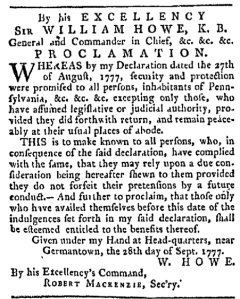
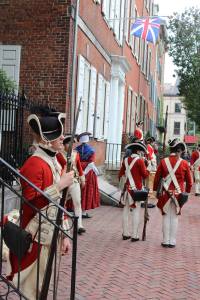
240 years ago, Philadelphia was occupied by British forces under the command of General Howe; the city was taken after a brutal campaign through the outskirts of the city, as you may recall from a few weeks ago— and this is after the Battle of Princeton, with the accompanying ravages upon the populace. This past weekend, interpreters at the Museum of the American Revolution brought the issues of occupation to life for visitors. But what struck me the most when we got home, was my cousin’s comment on this photo:

Hanging with the British and Citizens of Philadelphia

“I suppose you hang out with Confederates, too.”

Ouch, dude. That’s my partner you’re impugning.

Occupation of town/homes.

I understand that, in certain circles, British troops in North America during the American Revolution are equated with Nazis, and I understand that it’s easy to see the world in Manichaen terms (though my cousin usually does not), with good guys and bad guys. But after watching Ken Burns’ and Lynn Novick’s Vietnam War series, I am reminded how (grossly speaking) “one man’s terrorist is another man’s freedom fighter,” and while, as an America citizen, the “good” or “righteous” side should default to the Patriot/Whig cause, interpreting the other side offers room for people to question how they would have behaved in the past, and more importantly, to understand the actions of their country in the present.

There is no right answer.

Studying the past allows us to see the present through new eyes: Philadelphia in 1777 is occupied by a colonial power attempting (in part) to retain control of natural resources. Which side will you be on when the moment comes? Will you side with law and order, or will you side with natural freedoms and the rights of man (some exclusion apply; not all rights are right for you, and do not apply to African Americans, women, or American Indians, or non-property owning white men, etc. etc).

240 years later, what is the point of this hobby, these funny clothes, wandering around outside, talking to strangers? The point is that the past is always present. If we can understand the choices people faced in the past, we can understand our own predicaments better, and one hopes, analyze our options to choose better this time. We operate from a place of self-interest, even when we wish we could be idealistic, honorable. From the outside, actions aren’t always what they seem.

On Sunday (though I have found no photos thus far), I was arrested by the 17th for peddling a calico gown stolen from a room on Hamilton’s wharf, and alleged to be part of the Captain’s baggage. I tried to run, but was caught by two soldiers, and dragged away. From the outside, this looked like something bad: soldiers roughing up a woman. But I wasn’t innocent, and that’s the point: what looks like a bad thing may be a good thing. Costumed interpretation liberates us from the exhibit label, and allows us demonstrate a complicated past more quickly than a text panel can be read, and more engagingly.

When we assume that all Americans are “good,” we gloss over realities of people trying to get by when work, food, and money were scarce, and how “good” people do bad things. To play that well, you need both sides of the story. And that, dear cousin, is why I hang out with the Brits.

Share this:

  • Share on Facebook (Opens in new window) Facebook
  • Share on Pinterest (Opens in new window) Pinterest
  • Email a link to a friend (Opens in new window) Email
  • Share on X (Opens in new window) X
Like Loading...
← Older posts
Newer posts →

Archives

wordpress statistics

Creative Commons License
Kitty Calash blog by Kirsten Hammerstrom is licensed under a Creative Commons Attribution-NonCommercial-ShareAlike 4.0 International License.

Website Built with WordPress.com.

  • Subscribe Subscribed
    • Kitty Calash
    • Join 621 other subscribers
    • Already have a WordPress.com account? Log in now.
    • Kitty Calash
    • Subscribe Subscribed
    • Sign up
    • Log in
    • Report this content
    • View site in Reader
    • Manage subscriptions
    • Collapse this bar
 

Loading Comments...
 

    %d