• Home
  • Completed Costumes/Impressions
  • Emma and Her Dresses
  • Free Patterns and Instructions

Kitty Calash

~ Confessions of a Known Bonnet-Wearer

Kitty Calash

Category Archives: Living History

Short Gown Alert! Griselle en négligé du matin

13 Wednesday Mar 2013

Posted by kittycalash in Clothing, History, Living History

≈ 10 Comments

Tags

18th century clothes, Clothing, common dress, fashion plates, Historical Sew Fortnightly, resources

2a54bb721a01bb282ea52a2f916c53b8

Griselle en négligé du matin, faisant sa provision au Marché des Quinze-vingts

Griselle en négligé du matin, faisant sa provision au Marché des Quinze-vingts

Very roughly, Griselle, in morning undress, goes to the “Three Hundred” market for provisions.

Said to be on Paris maps of 1760 and 1771, the Quinze-vingts Market was probably razed for the Rue de Rivoli. Interestingly, the major ophthalmic hospital in Paris is the Three Hundred, and there has been a Three Hundred hospital since 1260. (Sorry, Mr S: even in history, there is no escaping hospitals or eyeballs.) The neighborhood takes its name from the hospital, so Griselle is headed to her neighborhood market. You wouldn’t go far from home in négligé du matin.

Let’s look at what she’s wearing: It’s the reenactor’s frenemy, the short gown. Griselle here is post-1789, check the raised waist line and the non-cone bosom shape. Is it 1790, 1792ish? Probably in that range. If you don’t want to wing a version of this based on illustrations and Costume Close Up, you can get a pattern for a similar garment. It was workshop tested; my version is here.

What I like are the basic details: turban scarf, kerchief, simple short gown, striped petticoat, clocked stockings, slippers, just a bundle for the market.

The simplicity is key here, also tiny details. Look at the end of her sleeve: buttons. This is fantastic news for those of us who need to get our enormous hands through slender 18th-century sleeves. It’s taking a lot of will power not to head down to the stash and start on a mock up of this short gown right this minute…

The silhouette matches the pouter-pigeon, full-bust look of more formal wear of ca. 1792, so I don’t think she’s gone stay-less. The striped petticoat could be cotton or linen; Wm Booth had some variegated stripe linen that could work for a version of this. Are we seeing her shift, or another petticoat under the stripes? It’s so similar in length, and her shape so full, that I think it is second petticoat and not shift.

The stockings and what I will call their clocks, but look like decorative gussets, that coordinate with the slippers, are a nice touch. Visible beneath this shorter hem, they provide another bit of color and decorative accent to this plain look.

If I didn’t have those guys to sew for, this is what I would have chosen for Peasants and Pioneers. Not that I don’t love my boys…but menswear is time consuming.

Share this:

  • Share on Facebook (Opens in new window) Facebook
  • Share on Pinterest (Opens in new window) Pinterest
  • Email a link to a friend (Opens in new window) Email
  • Share on X (Opens in new window) X
Like Loading...

HSF #5: A Peasant’s Jacket

11 Monday Mar 2013

Posted by kittycalash in Clothing, Historical Sew Fortnightly, Living History, Making Things

≈ 13 Comments

Tags

18th century clothes, common dress, Costume, dress, Historical Sew Fortnightly, living history, sewing, weekend

WIth the buttons to be installed

WIth the buttons to be installed

A Workman’s Jacket…not quite done. I had to work Saturday, so there went 7 hours; I got sick, I got tired, so it’s an almost, oh-so-close jacket. Buttons and buttonholes are all we lack. Of course, for a man’s jacket, that’s, you know, a significant lacking. However, I don’t want to have the crack-addled monkey buttonholes again, so I’m not doing them until I’m not rushed or distracted.

You’ve seen it already here, and know that it has chamois pockets. The Facts:

Buttons, with button holes to come

Buttons, with button holes to come

The Challenge: Peasants & Pioneers

Fabric: Blue wool broadcloth, with a blue and white striped linen lining

Pattern: Kannik’s Korner Double-Breasted Short Jacket

Year: It will be worn for 1775, but can be worn from 1760-1800.

Paul Sandby, A Sandpit. YCBA B1975.3.930

Paul Sandby, A Sandpit. YCBA B1975.3.930

Notions: Linen thread, brass buttons, interfacing, cotton twill stay tape

How historically accurate is it? Well…the fit is a trifle off. It’s better than the base pattern, as I altered the shoulders, but it could use another round of alterations and fitting if the intended wearer would tolerate it.  Still, like the man to the left, the kid is supposed to be working in this, so he’ll need some room.

The edges of the wool are unfinished, as I’ve seen in originals, with the lining turned back. It is all hand sewn. But, I don’t have any documentation for the striped linen lining, (it’s fine for quilted petticoats) so I would not go above 8/10 for this.

Stripes!

Stripes!

Hours to complete: I can remember about 18 to this point, and the buttonholes will add another 5 to 7. They’re about 20 minutes each, with 16 – 18 to do, plus sewing on buttons. Total time likely to be 22-24 hours.

First worn: To be worn April 13, 2013.

Total cost: $79.36 can be accounted for in materials. The broadcloth was purchased from Wm Booth’s remnants and the buttons are Burnley & Trowbridge: those I have numbers for. The striped linen, purchased at Jo-Ann Fabrics,  was in the stash.

Share this:

  • Share on Facebook (Opens in new window) Facebook
  • Share on Pinterest (Opens in new window) Pinterest
  • Email a link to a friend (Opens in new window) Email
  • Share on X (Opens in new window) X
Like Loading...

Three sticks, two kettles, no matches

20 Wednesday Feb 2013

Posted by kittycalash in History, Living History, Reenacting

≈ 2 Comments

Tags

18th century, authenticity, living history, Reenacting, Research, resources, Revolutionary War

Soldiers Cooking, 1798 National Army Museum (UK), 1983-11-63-1

Here’s some visual evidence for why we travel with three sticks, two kettles, and no matches. (We bring the sticks as we suspect the sites where we camp & cook don’t want amateur logging on their grounds.)  I stumbled upon this at the National Army Museum in the UK. Here’s what they say about the image:

Soldiers from an unknown unit attend to their cooking pot on a break from their duties during the Wars of the French Revolution (1793-1802). They are accompanied by their womenfolk. Although only a few men from each unit were officially allowed to marry and have their wives and families accompany them, women would have been found in almost every British military camp. Some worked as cooks, laundry women and sutlers (camp followers who sold provisions), while others were prostitutes.

One of the things one learns when reading about women who followed the armies of the Revolutionary War is that prostitution–at least for those following the American army– was not high on the list of occupations for women.

Why not? Lack of ready cash, folks.

Working for the Army would get you rations, and that literal meal ticket was desirable in a time of shortages and want. If you’d been burned out of your home or farm (I’m looking at you, 54th Reg’t of Foot, Aquidneck Island torchers) what would you eat? What would you do? It depended, of course, but one thing to do would be to follow your husband if he had enlisted.

I know less about the women who followed the British Army, but for a Continental Army start, I recommend the following books:

Belonging to the Army. Mayer, Holly A. USC Press, 1996.

Liberty’s Daughters. Norton, Mary Beth. Cornell, 1980. (My edition, 1996)

Revolutionary Mothers. Berkin, Carol. Vintage Books, 2005.

In Pursuit of Liberty. Werner, Emmy. Potomac Books, 2009.

The last title is about children in the time of the Revolution, not women, but considering who was left home with the children, and in trying to understand what the time might have been like for the Young Mr, I’ve given it a read as well.

As for the camp gear? We keep it at a minimum based on period images. We don’t all sleep in one tent, but we pack as light as we can. It’s nice when authenticity and ease are the same.

Share this:

  • Share on Facebook (Opens in new window) Facebook
  • Share on Pinterest (Opens in new window) Pinterest
  • Email a link to a friend (Opens in new window) Email
  • Share on X (Opens in new window) X
Like Loading...

Bloody Overalls

19 Tuesday Feb 2013

Posted by kittycalash in Clothing, Living History, Making Things

≈ 6 Comments

Tags

18th century clothes, living history, menswear, Revolutionary War, uniforms, weekend

Just started backstitching, already bleeding

But that’s still better than the story I heard yesterday about the incredibly authentic, effluvial-field dipp’d overalls that gave a mender dysentery…you come here for this, right, not the pretty dresses?

My thumb has split– yay, winter!–so everything will be a little trickier. Guess I’ll lay off handling white silk gowns at work, and documents, but the sewing will continue.

The Line of Truth

We went up to the Adjutant’s house yesterday, now that the roads are cleared again, and the lads got measured. Best of all, Mr S got fitted. He has what I ungenerously call “The Hump,” and what the Adjutant describes as “Shoulders Roll Forward.” The Adjutant has tact; I’m the wife, I calls it like I sees it.

It was really helpful. I knew the coat was too big (Mr S is built more like an 18th century soldier than a 21st century office worker), but I knew it had more wrong with it that too much fabric. At left, see the chalk line? The sleeve seam sits at the shoulder point, where I am told it will be uncomfortable as it rubs, which will also wear out the shirt faster. I knew what to do it the sleeve had been on a gown– unstitch it and re-align it under the shoulder strap, mark it and trim the excess off the head. In a way, that’s just what I will do here. There’s also excess to take out of the upper arm, but that’s not too bad for a garment that I made in a hurry and never really fitted to the wearer. And I have until mid-April to do it.

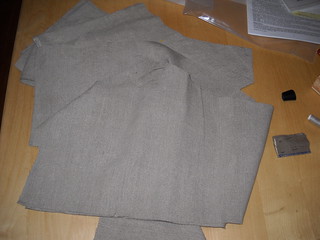
I have two of these greige stacks to transform.

At the same time, I also have to transform two of these piles of pieces into well-fitted, hand-sewn overalls. Despite the pride I’ll feel in accomplishing what I expect will, under guidance, be the best-fitted, most authentic garments I’ve made, saving my green checked apron, there’s a minor measure of terror mixed in to all this…hope those back stitches hold…

Share this:

  • Share on Facebook (Opens in new window) Facebook
  • Share on Pinterest (Opens in new window) Pinterest
  • Email a link to a friend (Opens in new window) Email
  • Share on X (Opens in new window) X
Like Loading...

All that glitters…

13 Wednesday Feb 2013

Posted by kittycalash in History, Living History

≈ 4 Comments

Tags

18th century, cleaning, Hannah Glasse, housework, museum collections, pewter, polishing, silver

An Old Woman Cooking Eggs, Diego Velazquez, 1618. National Gallery of Scotland, NG 2180

An Old Woman Cooking Eggs, Diego Velazquez, 1618. National Gallery of Scotland, NG 2180

…could be pewter. Or do I mean tin? Carolina had excellent points about pewter being, yes, that shiny, though we think it is not. Our perception is probably based in large part upon the extant items in museum collections. And museums don’t polish their pewter–at least we don’t, and I don’t know anyone who does. Is it because we’re so unaccustomed to using pewter daily that we no longer know how to care for it?

Covered chalice, pewter, c. 1756-1780. Philadelphia Museum of Art, 2008-110-1a,b

Covered chalice, pewter, c. 1756-1780. Philadelphia Museum of Art, 2008-110-1a,b

I thought it could be interesting to experiment with polishing pewter (not in the collection) so I turned for advice to that touchstone of housework past, Hannah Glasse.  In The Servants Directory, Part V: The Scullion Mrs Glasse lays out To clean Pewter, Tin, and Copper.

Take a pail of wood-ashes (either from the baker’s dyer’s, or hot-pressers; the latter is the best) half a pail of unslack’d lime, and four pails of soft water; boil them all in a copper together, stirring them; when they have boiled about half an hour, take it all together out of the copper into a tub, and let it stand until cold, then pour off the clear, and bottle for use.

When you clean your pewter, lay a flannel on the dresser; set your dishes one on another by themselves, the plates to likewise; then heat liquor according to the quantity you have to clean, pour some on the uppermost plate and dish, and as you use them pour it on the other. Take a piece of tow to rub them with, then having two little basons of red sand, pour some of the liquor on each; with the first scour your plates well, and rince them in cold water; with the second clean them, rince them into two waters, set them to dry, and they will look like new. Thus you may clean them at any time with very little trouble.

Very little trouble for you, Hannah Glasse! The red sand is definitely something museums won’t do: we have this prejudice about not abrading the collections, or applying chemicals, so the lime/ash/soft water mix probably won’t appear in our workroom either.

Willem Claesz.Heda, Still life with gilt goblet, 1635. Rijksmuseum, Amsterdam

Willem Claesz.Heda, Still life with gilt goblet, 1635. Rijksmuseum, Amsterdam

I also took a look in my books for paintings that showed pewter with sheen, and for objects. I suspect that pewter’s softness will not allow it to achieve the high-gloss shine of tin, but that it can be brought to brightness. I do think the best way to find out is to start polishing, so I’m in the market for some wood-ashes from the hot-pressers, and a good place to lay a fire and boil some chemicals. Who wouldn’t volunteer for open-fire chemical boiling?

Share this:

  • Share on Facebook (Opens in new window) Facebook
  • Share on Pinterest (Opens in new window) Pinterest
  • Email a link to a friend (Opens in new window) Email
  • Share on X (Opens in new window) X
Like Loading...
← Older posts
Newer posts →

Archives

wordpress statistics

Creative Commons License
Kitty Calash blog by Kirsten Hammerstrom is licensed under a Creative Commons Attribution-NonCommercial-ShareAlike 4.0 International License.

Website Built with WordPress.com.

  • Subscribe Subscribed
    • Kitty Calash
    • Join 621 other subscribers
    • Already have a WordPress.com account? Log in now.
    • Kitty Calash
    • Subscribe Subscribed
    • Sign up
    • Log in
    • Report this content
    • View site in Reader
    • Manage subscriptions
    • Collapse this bar
 

Loading Comments...
 

    %d