• Home
  • Completed Costumes/Impressions
  • Emma and Her Dresses
  • Free Patterns and Instructions

Kitty Calash

~ Confessions of a Known Bonnet-Wearer

Kitty Calash

Category Archives: Living History

HSF # 3: Under it All: A shift, and a petticoat

11 Monday Feb 2013

Posted by kittycalash in Clothing, Historical Sew Fortnightly, Living History, Making Things

≈ 10 Comments

Tags

18th century clothes, Clothing, Costume, fashion, Making Things, sewing, weather, weekend

Done at last: the shift. Plus bonus bonnet

Remember that shift I couldn’t finish in time for HSF # 2, UFO? I did get it finished for HSF # 3, and a bonus petticoat as well. They don’t go together, but in honor of the excessive amount of snow we got this weekend, they’re both white. The snow is also how they got done: nothing like snow days and travel bans to keep one home and sewing.

How ‘Bout Them Facts?

Fabric:

  • For the shift, lightweight linen, probably this one.
  • For the petticoat, one of a pair of Ikea curtains found on sale one day. The light-weight cotton appealed to me and suggested filmy late 18th century petticoat better than anything I had seen at a fabric store.

The petticoat, over another petticoat. It’s that sheer.

Back view (again with cat bowl)

Pattern:

Shift:

  • Kannik’s Korner Woman’s shift, 1750-1800 with some amendments. If you haven’t already, read Sharon Burnston on shifts before you make another one.
  • Petticoat: None, draped & patterned myself based on the late 18th/early 19th century riding skirt in Janet Arnold.

Year:

  • Shift: 1775-1783
  • Petticoat: 1795-1800

Notions: Both: Just thread. And some left over white cotton twill tape.

How historically accurate is it?

The shift is pretty close. The fabric is, well, not the linen they had, but it’s as fine as I could afford. It is entirely hand-sewn, and the sleeves have bands and tie closed.

The petticoat is also hand sewn, and uses a historic garment for a basis. (I also looked at bodiced petticoats at the Met.) However, it is made from a curtain and while I unpicked all the seams, the machine stitching holes remain. It gets the job done that I wanted it to do, though: fluffy white stuff.

Hours to complete:

Shift: Killer. Started it last August and have worked on it off and on since then. It went to so many events in the basket that it smelled like woodsmoke. Intensively completing it probably took 24 -30 hours, so it could be a 40+ hour shift. After a while I stop paying attention.

Petticoat: Like candy. Started it Saturday morning, finished it Sunday afternoon. Best guess, about 10 hours.

First worn:

Shift, probably April 13.

Petticoat? Probably Dress U.

Total cost:

No good way to know…the fabric was bought so long ago! The petticoat curtains, when not on sale, are $20, so $10, because I only used one. For the shift, it’s harder to say. I piece aggressively when cutting out, so I bought less than the pattern recommends. Remnants were used for the petticoat bodice and various linings, including the Curtain-Along robe currently underway.

Share this:

  • Share on Facebook (Opens in new window) Facebook
  • Share on Pinterest (Opens in new window) Pinterest
  • Email a link to a friend (Opens in new window) Email
  • Share on X (Opens in new window) X
Like Loading...

Blame the Milk Maid

07 Thursday Feb 2013

Posted by kittycalash in Food, History, Living History

≈ 6 Comments

Tags

18th century, engravings, food, kettles, milk, milk maids, museum collections, pewter, tin, weather

Sandby: A Milkmaid. ca. 1759, YCBA

Sandby: A Milkmaid. ca. 1759, YCBA

Pyne, Milk Woman, 1805, MoL

Pyne: Milk Woman, 1805, MoL

What do pewter and tin have to do with costuming? Well, aside from the many expensive buttons Mr S and the Young Mr wish to sport, I got interested in the milk maids’ pails because of their similarity to the tinned kettles used by RevWar reenactors. The uses converged in December in a conversation I had with a colleague about Carl Giordano’s beautiful kettles. (He made my wash basin, but my kettles came from Missouri because I needed them very quickly; the fur trade & rendezvous reenactors have similar material culture interests and needs, because of time period & culture overlap.)

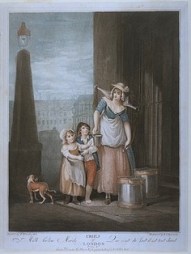
1793: Milk Below Maids, V&A

Milk Below Maids, 1793, V&A

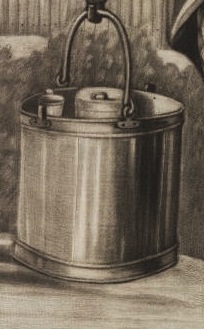
The milk pails look like tin, don’t they? One from ca. 1759, the other from 1805, and both appear to be carrying shiny, seamed metal buckets with brass details at the base and rim. The captions call them pewter, though. So I went to the V&A and the Museum of London looking for pails, but only found more milk maids.

I began to wonder: if the pails were really made of pewter, wouldn’t they be awfully heavy? And wouldn’t there be extant examples? Pewter is highly collectible. There’s a George II pewter milk pail on Worthpoint, but it looks nothing like the pails in the images. Is pewter ever so…shiny? And I’ve never seen seams in pewter the way they appear in the Pyne illustration.
Here’s something that reminds me of that George II milk pail.  I think I trust the Met more than I trust an online seller. On the right is a “bucket carrier” from the National Trust (UK) Collections.

Mid-18th century dinner pail with cover, MMA

Mid-19th century bucket carrier, NTC (UK)

Mid-19th century bucket carrier, NTC (UK)

Google defines pewter thus:

pew·ter

/ˈpyo͞otər/

Noun
  1. A gray alloy of tin with copper and antimony (formerly, tin and lead).
  2. Utensils made of this.
Synonyms
tin
178, Collet: The Sailor's Present, LWL

178, Collet: The Sailor’s Present, LWL

1785: Spring & Winter, LWL

1785: Spring & Winter, LWL

Synonym: tin? That’s pretty interesting, even though I don’t trust Google with etymology.  But don’t these tin kettles look a great deal like the milk maids’ buckets?

Carl Giordano Tinsmith: Kettles

Carl Giordano Tinsmith: Kettles

The Giordano tin kettles can be made with brass ears (that’s the part the bail, or handle, goes through). Look at the ears in the photo, and at this detail from “Spring and Winter:”

Detail, Spring & Winter, 1785, LWL

Detail, Spring & Winter, 1785, LWL

The ears may be the best lead to follow. There are plenty of ears (handle attachments) if you search the Met for bucket or pail and limit the search the metalwork… but they’re bronze, and Roman. The National Trust (UK) doesn’t turn up much, or the Museum of London (yet).

ca. 1750: Silver cream pail, MFA

There’s a silver cream pail at the MFA, and it sort of looks like its handle attaches with ears, but not in the riveted-on kind of way, but in a purposeful and elegant way. This is just about where I start to ask myself why I care, but then a number of other questions present themselves, like:

  • Where are the milk pails? Are there really no milk pails in museum collections? (Yes, this could be true)
  • Was this pewter milk pail with attached measures specific to London, as my colleague thinks?
  • How does milk taste when it spends quality time in pewter (or tin)?
  • How heavy would a pewter milk bucket be?

Things to ponder as we prepare for heavy snow… In this state, that means dashing out for “French toast supplies.” I’m not originally from here, and I solemnly swear we are legitimately out of bread, eggs, and milk.

Share this:

  • Share on Facebook (Opens in new window) Facebook
  • Share on Pinterest (Opens in new window) Pinterest
  • Email a link to a friend (Opens in new window) Email
  • Share on X (Opens in new window) X
Like Loading...

Petticoat Burns

05 Tuesday Feb 2013

Posted by kittycalash in History, Living History, Reenacting

≈ 1 Comment

Tags

18th century, Clothing, common dress, cooking, food, hearth cooking, historical myths, history, living history, myths, The Public

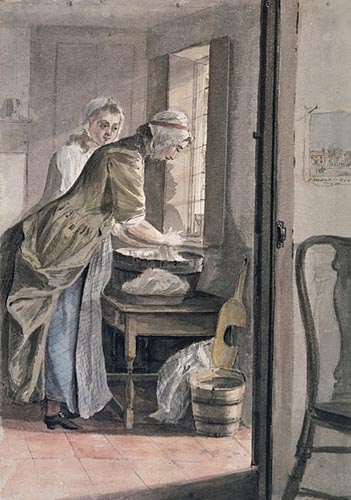
Per Hillstrom, Kitchen Scene

You know this site, right? History Myths Debunked examines the stories about the past many like to think are true, and Death By Petticoat is one of the favorites. Here it is on an English site catering to reenactors. There’s a variation I’d never heard, about wetting petticoat hems to keep them from engulfing the wearer in flames. (OK, mild exaggeration: to keep the petticoat from igniting fully, thus… hat tip to Back Country Maiden for pointing this out.)

As someone who just finished mending a petticoat, you’d think I’d leap at the chance to drench my hem in water to prevent future mending episodes, but not so. For one thing, in the house or in the camp, that’s water I had to haul or cause to have hauled, and I’m not wasting it. Wet the hems and what’s next? Caked lumps of ash, mud, and.or other filth. No thanks.

High-tech historical cooking

High-tech historical cooking

The burns I got in my dress were acquired at the end of the day when we were hearth cooking and were practically in the fireplace ourselves. That is where you must be if you wish to stir the sauce until it thickens, and there was the hoisting of roast in its pan a couple of times, and general playing with fire in pursuit of food. My ca. 1799 dress is longer than my 1770s petticoats and gowns, and the extra inch or two probably contributed to the burns. But I wasn’t engulfed by flames, because the damn thing is wool. Self-extinguishing wool, worn with linen and wool petticoats and a linen apron. not going to go up in flames. Also not going to get dipped in water–and wouldn’t that result in steam and hence scalded shins?

I don’t know where these rumours start, but they could have started with a cynical curator joking with house tour guides who failed to get the joke. Not that I know anything about a story of about Providence kitten named Georgie in honor of George Washington’s visit to a large brick house on a hill .

Share this:

  • Share on Facebook (Opens in new window) Facebook
  • Share on Pinterest (Opens in new window) Pinterest
  • Email a link to a friend (Opens in new window) Email
  • Share on X (Opens in new window) X
Like Loading...

Women’s Work

22 Tuesday Jan 2013

Posted by kittycalash in Events, History, Living History, Reenacting

≈ 5 Comments

Tags

18th century, Events, interpretation, living history, women's history, work

Cooking. Gets you every time.

Cooking. Gets you every time.

Three holes (at least; there might be four) and mending to do. The patches are cut, but I’m thinking now that a wool apron might be a good thing to have. The other thing I’ve been thinking about is what James Thurber called The War Between Men and Women, and how even in educated, enlightened North America, it plays on. [i]

At living history events or reenactments, the work and activities are divided along gender lines. Participants are supposed to follow “the rules,” which keep women on the observer side of the rope line and the men free to run around with muskets. Women sometimes seem purely decorative at the military events, and the relationships between men and women are curious. There’s the sexism between reenactors, and the sexism of the public, who can often assume women know nothing about what’s happening.  Women should, after all, know their place, just as the men know theirs.  Women can cook and clean up after the men, and the men will do all the talking, even when they’re wrong.[ii]

In a more domestic setting, this same historical dynamic can play out: women cook and serve the meals, wash the dishes, fetch the wood and water, and clean the kitchen, while men muck about outdoors until their tools break. Then they lounge about smoking, drinking, and talking.

Sandby, Washing at Sandpit Gate, 1765. Royal Collection.

Sandby, Washing at Sandpit Gate, 1765. Royal Collection.

That’s all OK, to a degree.  But we’re not in the 18th century, and the women in the kitchen don’t enjoy washing other people’s dirty dishes as well as all the cooking pots and tools. We had a system on Sunday evening, but I did notice that some men just can’t be the only guy helping: once the other guys leave the room, they’re out, too, with a kind of desperation, even as the light wanes and we need all the help we can get to finish up.

So what to do? Interpreting the 18th century means facing gender roles that most American women today don’t like or embrace. What’s the best way to interpret women’s history and women’s roles in the past to people today?

On Sunday, I left the house to call the guys to the first meal, and a visitor asked if the sheep in the field were part of the site. “Yes,” I said. “ But I don’t know where the sheep are today; I don’t get to leave the house much.” And that is true: aside from fetching water when I didn’t have a man or boy to ask to do it, there was hardly need, reason, or even time, to leave the house.

I think we do a disservice to the visitors to living history sites of all kinds if we don’t find a way to talk about women’s history, and the roles—proscribed or not—that women could take on. At a RevWar encampment, we can talk about the reasons women followed the armies, the kinds of work they did for pay or rations, and what the Revolution meant for women. At the farm and at the manor, I think it’s important to talk about women’s lives in the Early Republic. How this would work at the farm, exactly, I’m not yet certain; at the manor it is easy enough, for the women who lived there were born just before the Revolution. They were well-educated and expected to choose their own husbands. We know who they were; we know less about the women at the farm, though we know about their work.

How we experience that work isn’t really the point, but the chasm between choosing to spend a day never looking beyond the scope of the hearth and having to spend days that way is enormous. It’s a point I want to make,  in a way more sophisticated than “life was hard and greasy.” It’s something to work on.


[i] This is in no way meant to equate the petty first world problems of a bunch of reenactors/living historians with the larger and more brutal problems elsewhere in the world. But relationships can change when situations change…

[ii] Fortunately, the Second Helping Regiment doesn’t work quite this way, and not just because they’re busy chewing whatever has been made for them. Cooking, and the subsequent chewing, can be used strategically.

Share this:

  • Share on Facebook (Opens in new window) Facebook
  • Share on Pinterest (Opens in new window) Pinterest
  • Email a link to a friend (Opens in new window) Email
  • Share on X (Opens in new window) X
Like Loading...

Weekend at the Farm

21 Monday Jan 2013

Posted by kittycalash in Clothing, Events, Living History

≈ 2 Comments

Tags

18th century, Coggeshall Farm Museum, food, Historical Sew Fortnightly, living history, Museums, Rhode Island, weekend

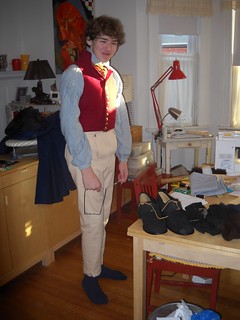
The Young Mr in his new clothes

Fourteen year old boys don’t like to get up early, but we managed to rouse the beast on Saturday, and get him dressed, with only minor hostilities. He’s wearing all new clothes, except for the shirt, which I hope will not have to be replaced before the end of the summer. (I have now guaranteed that his arms will grow several inches in the next week.)

Mr S wore his new waistcoat but it’s hard to see under his jacket. He also got his new hat from Mr B, so he could upgrade from his knitted cap.

New hat, new waistcoat

New hat, new waistcoat

There are more photos here, including a fabulous stuffed leg of lamb. For mid-day Saturday, we ate a meat pie (pork and apples), sugar cakes, coriander biscuits, bread and molasses bread, all brought from home, along with hat from the farm boiled with parsnips, potatoes, carrots and onions and a carrot pudding. We also made a potato-apple-onion pie for the evening meal, though Mr S, the Young Mr and I did not stay. There is a limit to what the child will tolerate.

Sunday, we arrived in time for Mr S to make more fence pegs, while I joined the kitchen to make soup with ham, squash, parsnips, and onions, which we ate with bread and cheese, and the last of the sugar cakes, for lunch. All the while, a leg of lamb was cooking, masterfully prepared by Mrs B, and stuffed with cubed bread, onion, ham, sage and onion. To go with it, we made a rice pudding with apples, wilted greens, salad, squash pudding, and stewed apples. The sauce for the lamb was particularly fine, with drippings, minced onions, what we think was whiskey, butter and cream. I learn so much cooking with Mrs B!

waiting, wanting, hoping

The cats wanted, but were disappointed. They were calmer on Sunday, though extremely attentive kitchen assistants both days. Pity they don’t do dishes. There were plenty to wash. 1799 was definitely greasy. Even the striped cat feels a little greasy, but that could be because he’s handy to wipe your hands on.

Now it’s on to sewing for something else, though whether that will be wool trousers or clothes for Washington’s Birthday, I don’t really know.

Share this:

  • Share on Facebook (Opens in new window) Facebook
  • Share on Pinterest (Opens in new window) Pinterest
  • Email a link to a friend (Opens in new window) Email
  • Share on X (Opens in new window) X
Like Loading...
← Older posts
Newer posts →

Archives

wordpress statistics

Creative Commons License
Kitty Calash blog by Kirsten Hammerstrom is licensed under a Creative Commons Attribution-NonCommercial-ShareAlike 4.0 International License.

Website Built with WordPress.com.

  • Subscribe Subscribed
    • Kitty Calash
    • Join 621 other subscribers
    • Already have a WordPress.com account? Log in now.
    • Kitty Calash
    • Subscribe Subscribed
    • Sign up
    • Log in
    • Report this content
    • View site in Reader
    • Manage subscriptions
    • Collapse this bar
 

Loading Comments...
 

    %d