• Home
  • Completed Costumes/Impressions
  • Emma and Her Dresses
  • Free Patterns and Instructions

Kitty Calash

~ Confessions of a Known Bonnet-Wearer

Kitty Calash

Category Archives: Making Things

The Coats of August

07 Thursday Aug 2014

Posted by kittycalash in Clothing, Living History, Making Things, Reenacting

≈ Comments Off on The Coats of August

Tags

common dress, common people, common soldier, fashion, frock coats, Making Things, sewing, sewing project, style

Coat, Nantucket Historical Association, 1985.0068.001

I could have a coat problem so very easily. Look at that coat!

I was looking for something else when I came across this coat. Pity my friend who got the excited, “Who do you know on Nantucket?” text message, because after I saw this coat and couple others, I was checking out the high speed ferry schedules. (They’re not too great; I’d need to stay overnight at least one night– poor me, right?–which means this must be a winter visit.)

Once you’re hooked on 1812, it’s hard to travel back in time, but travel back I must, for Bennington is just a little over a week away.

What am I thinking? Well, in my madness and in the face of the enormous growth of the Young Mr, here I am thinking Coats in August.

Paul Sandby, 1731–1809, British, London Cries: A Fishmonger, ca. 1759, Watercolor and graphite on medium, cream, slightly textured laid paper, Yale Center for British Art, Paul Mellon Collection

Paul Sandby, 1731-1809, British, London Cries: A Fishmonger, ca. 1759, Watercolor and graphite on medium, cream, slightly textured laid paper, Yale Center for British Art, Paul Mellon Collection, B1975.3.210

I know, Bennington/Walloomsac is 1777, so why am I looking at 1759 coats? Because I’m thinking a short-skirted workman’s jacket for the kid, of striped linen, rather than another frock coat. My plan–such as it is– is to alter the  pattern I know fits him to make these shorter skirts…we’ll see how this experiment goes, and hope for fewer than six toiles!

By next Friday night, I need to complete:

  • One new coat, from a newly drafted pattern
  • One new waistcoat
  • New buttons for a waistcoat
  • Alterations to breeches including new buttons and new knee bands

That doesn’t seem so bad, does it?

Share this:

  • Share on Facebook (Opens in new window) Facebook
  • Share on Pinterest (Opens in new window) Pinterest
  • Email a link to a friend (Opens in new window) Email
  • Share on X (Opens in new window) X
Like Loading...

Hand-woven Linens by Subscription

06 Wednesday Aug 2014

Posted by kittycalash in Clothing, Living History, Making Things

≈ 2 Comments

Tags

18th century clothes, authenticity, Costume, dress, fashion, interpretation, Justin Squizzero, living history, Making Things, resources, sewing, style

In the few short years I have been doing costumed interpretation and living history, I have made three shifts and four shirts and am making up a fifth shirt, with a possible sixth needing to be made, as well as four aprons. I’m not crazy, I just sew that way…for three people (one still growing) who dress for the decades between 1763 and 1812.

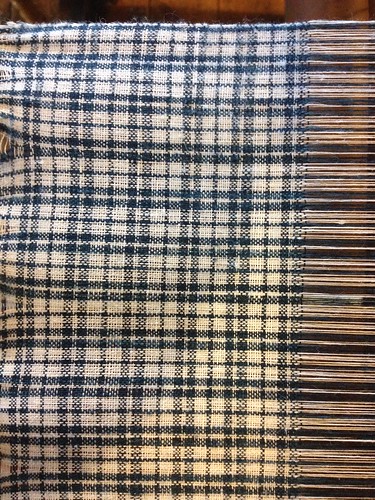
linen sample

Hand-woven linen: the top edge is the selvedge

There are several annoying factors when sewing historic clothing with modern materials– mostly that the modern materials aren’t quite right, and can be quite wrong. As Sharon Burnston explains on her website, much of this has to do with selvedges— which are not hard, and rarely tucked, now. The other trouble is width: many fabrics now come 54 to 60 inches wide, which means that you have to cut them down when making shift.

There is a solution: hand-woven, period-correct linen, available now by subscription from Justin Squizzero [email to order: justin(dot)levi(at)ymail(dot) com].

Mr Squizzero will weave both plain and check to the width you want: 3/4 (27″), 7/8 (31.5″) and yard (36″) widths, perfectly correct for period clothing.

Hand-woven checked linen

Hand-woven checked linen

The prices are $130/yard for plain bleached, $160/yard for checks– and what checks! Indigo dyed blue and white check in a pattern documented to New England at the turn of the 19th century? Oh, yes, please: I must save my allowance and sew only from my stash.

Although we debated fabric weights this past weekend, here’s what I think, and have found through wearing: shirts for soldiers and artisans– but not the elite–can certainly be made of the white and the check; I would made a shift from the white, but I prefer how my heavier shift body feels and behaves under stays. The check would be ideal, too, for an apron, which would require only one yard.

If you’re wearing a coat made from $120/yard wool dyed with documented colors, shouldn’t you wear the most correct shirt possible underneath? Entirely hand-woven (and hand-dyed in the case of the checks), you’re buying art– but isn’t that what you’re making and creating when you hand-sew your clothes and step into the past?

Share this:

  • Share on Facebook (Opens in new window) Facebook
  • Share on Pinterest (Opens in new window) Pinterest
  • Email a link to a friend (Opens in new window) Email
  • Share on X (Opens in new window) X
Like Loading...

Can’t Type: Sewing!

23 Wednesday Jul 2014

Posted by kittycalash in Clothing, Events, Living History, Making Things, Reenacting

≈ Comments Off on Can’t Type: Sewing!

Tags

19th century, 19th century clothing, Federal style, Genessee Country Village Museum, milliner, millinery, millinery shop, Regency, Salem event, tailcoat

What has kept me so busy I can’t blog? Mostly preparing for the millinery shop in Salem, which I am really looking forward to!

Cassandra attempts a Regency Wedgie

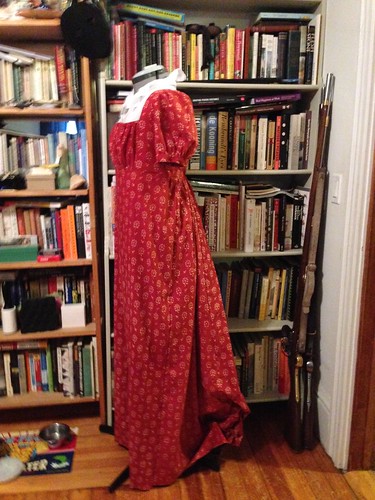
In just about a week, I managed a gown, now needing only a hem.  This based on the roller-printed serpentine stripe gown at Genessee Country Village and Museum, documented nicely at the 19th US site.

This was an easy gown to build up from a shoulder and back piece, once I did the math to scale it up to my size, and with the generous help of Sew 18th Century, who gave me the sleeve pattern I started from. This isn’t a drawstring sleeve, so the gown is not an exact copy of the GCV&M gown. I’m OK with that, since–as far as I can tell– it fits. It may be a little large, but that’s what an apron or sash is for. No, I don’t know when I’ll get the apron made.

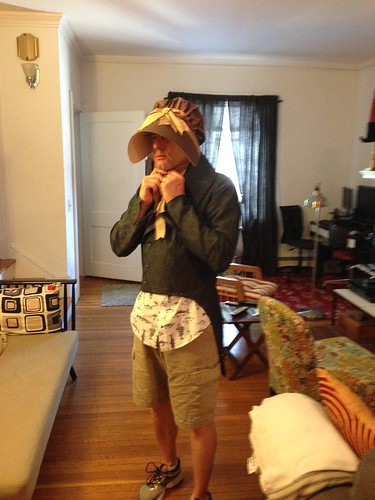
Mr S saves time by modeling *both* coat and new bonnet

There should also be a coat, and many bonnets.

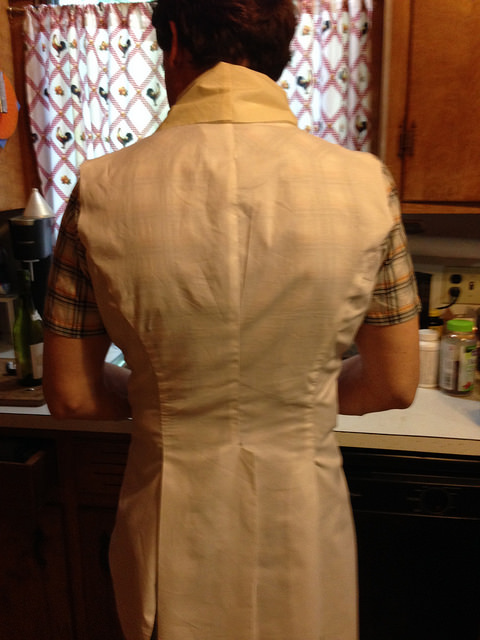
Mr S’s coat seems to be working, and is now faced on the right side, leaving the left, the sleeves, and just a few buttons. He was excited about helping with button manufactory until he realized that the largest tool required was patience. But what are facings and buttons and buttons holes, among friends?

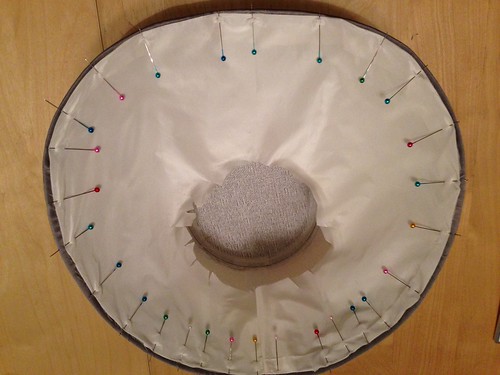
Bonnet Number I Forget

Another bonnet is in the works- can you ever have too many? I think not. It is in the prickly phase, while I work this evening on taking apart a waistcoat that must be altered for the Young Mister for this weekend at Stony Point. Bouncing between 1779 New York and 1812 Salem, when one is also considering 1765 and preparing for 1800 can make telling time a little challenging!

Share this:

  • Share on Facebook (Opens in new window) Facebook
  • Share on Pinterest (Opens in new window) Pinterest
  • Email a link to a friend (Opens in new window) Email
  • Share on X (Opens in new window) X
Like Loading...

Six Toiles, a Coat and a Bonnet

07 Monday Jul 2014

Posted by kittycalash in Clothing, Events, Living History, Making Things, Reenacting

≈ 2 Comments

Tags

1812, 19th century clothing, bonnets, frock coat, living history, menswear, Salem event, sewing, tailcoat

14557116394_73c2d5ea9f_zYes, six toiles.
That’s how many it took to get a coat pattern to fit Mr S the way I thought it should. I finally built the pattern around a sleeve and arm scye that I knew worked and suited the period. From there, I built out the back, altering the center back seam curve to suit Mr S’s figure. Arm scyes are still hard for me to figure out, although sleeves are often my favorite part of a garment. I like how flat pieces become three dimensional in a sleeve, and I enjoy setting sleeves– go figure.

Thanks to the three-day holiday weekend and sitting out a parade to pad stitch, I have a coat body.

IMG_1725
IMG_1727

I’m not thrilled about the size of the lapels, though I have found extant examples and fashion plates showing lapels this size, and sleeves, too. While I’ve pinned up the sleeves in the back, thinking there’s too much fabric there, I can also see from the images that the subject’s posture was not the best– and that was the moment when I realized that I really did want a mannequin for menswear as the subjects are hard to catch at any age, and variable in posture and wiggliness. They also object to being pinned accidentally.

But there is at least a coat body on the way to being done, so I took a break and made a bonnet, which is really the point here <ahem> milliner’s, not tailor’s, shop, after all.

IMG_1738

Pasteboard brim, blue silk taffeta lined with white silk taffeta (they had new things at the fabric store, very exciting!), trimmed with silk ribbon from Wm Booth and paper flowers from the V&A.

Now, more bonnets, two waistcoats, a gown, an exhibition, a lecture, and Stony Point are all that stand between me and the milliners’ shop in Salem…

Share this:

  • Share on Facebook (Opens in new window) Facebook
  • Share on Pinterest (Opens in new window) Pinterest
  • Email a link to a friend (Opens in new window) Email
  • Share on X (Opens in new window) X
Like Loading...

The Taylors’ Instructor

25 Wednesday Jun 2014

Posted by kittycalash in Clothing, History, Living History, Making Things, Reenacting, Research

≈ 4 Comments

Tags

books, Federal style, menswear, Regency, Research, resources, tailcoat

Title page, The Taylors' Instructor

Title page, The Taylors’ Instructor

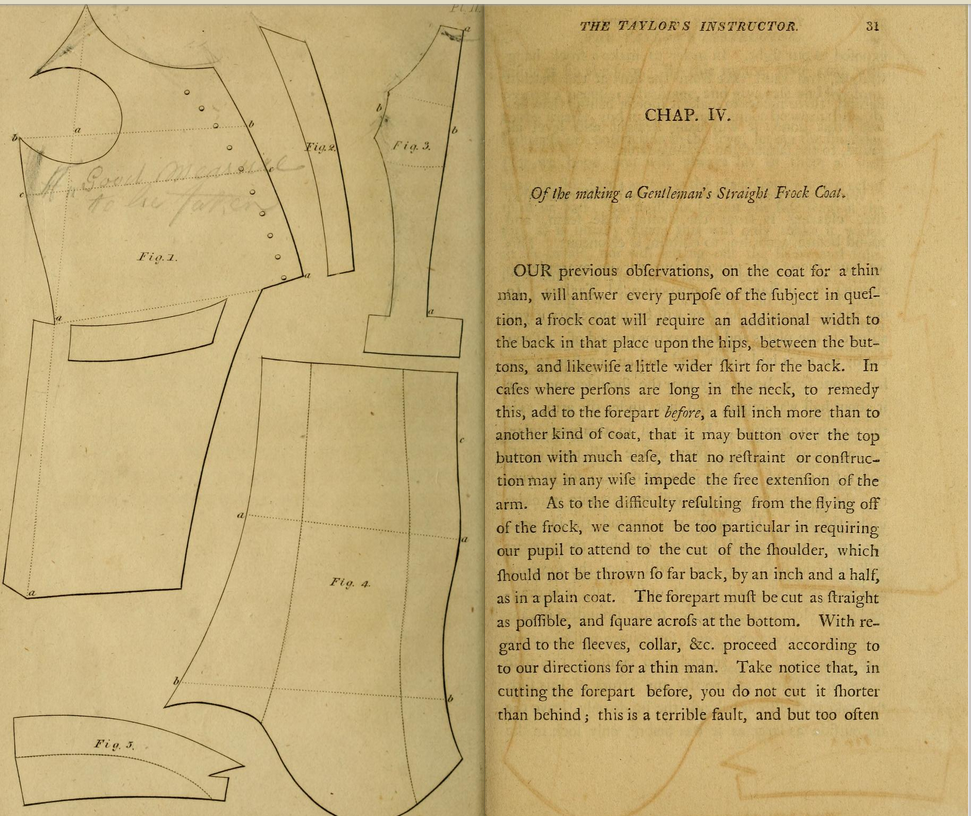
So who else was wondering what Mr Cooke meant by Lapsley and Queen? Wonder no longer, frustrated toile-makers and cuff-detail mavens, it is available on the vast interwebs of knowledge.

Go! Download the PDF and immerse yourself in an 1809 American tailors’ manual published in Philadelphia, with Eight Appropriate Engravings. We may note that there was excited squeaking when I located this, altering my nearest companions to A FIND, and letting them know that yes, I am back, and probably will continue to squeak on and off for some time to come.

From the introduction:

“…there is no situation more awkward than that of a TAYLOR who has cut and mutilated his own or his employer’s Cloth which will frequently be the case when a man has nothing to depend upon but the poor resource of chance or hope, that his clothes will fit.”

The Taylors' Instructor

The Taylors’ Instructor

I can tell from the text on Coats that my subjects will have to be further apprehended and measured, even against their will, but the results will undoubtedly be better than before.

Happy Reading, Historical Sewing Enthusiasts, and a big thank you and hat tip to Henry Cooke for the reference.

Share this:

  • Share on Facebook (Opens in new window) Facebook
  • Share on Pinterest (Opens in new window) Pinterest
  • Email a link to a friend (Opens in new window) Email
  • Share on X (Opens in new window) X
Like Loading...
← Older posts
Newer posts →

Archives

wordpress statistics

Creative Commons License
Kitty Calash blog by Kirsten Hammerstrom is licensed under a Creative Commons Attribution-NonCommercial-ShareAlike 4.0 International License.

Website Built with WordPress.com.

  • Subscribe Subscribed
    • Kitty Calash
    • Join 621 other subscribers
    • Already have a WordPress.com account? Log in now.
    • Kitty Calash
    • Subscribe Subscribed
    • Sign up
    • Log in
    • Report this content
    • View site in Reader
    • Manage subscriptions
    • Collapse this bar
 

Loading Comments...
 

    %d