• Home
  • Completed Costumes/Impressions
  • Emma and Her Dresses
  • Free Patterns and Instructions

Kitty Calash

~ Confessions of a Known Bonnet-Wearer

Kitty Calash

Category Archives: Making Things

Green Indeed

22 Tuesday Oct 2013

Posted by kittycalash in Clothing, Events, Making Things

≈ 7 Comments

Tags

10th Massachusetts, 18th century clothes, authenticity, common dress, living history, Revolutionary War, sacque, sewing project, Spencer

Regency Green: Kochan & Philips + Robert Land = Matchy-matchy.

As expected, Mr Najekci dispatched the K&C wool before the Hook, so last Thursday evening when I arrived home after Gallery Night, there was a box of delicious waiting for me. And, also as expected though mostly hoped for, the wool and shoes were super simpatico. This will be a fun project when I get myself sorted to it.

I have not yet had the time to put all the projects into a spreadsheet, but I think it would help keep things organized and on schedule. For example, I have:

  • to work out the details and rationale of the sacque, vis-a-vis date and style
  • to finalize the Spencer pattern
  • to pattern and fit a frock coat, waistcoat and breeches for Mr S ca. 1775
  • to ask about the regimental for Mr S, which will be wanted eventually
  • to face making a tent by next summer
  • a plan for kettle bags, since I’d like us to pack lighter & more authentically
  • to fix my stays situation
  • an inordinate desire for a splashy bonnet to go with that Spencer
  • two shirts to make up for Mr S and the Young Mr
  • a red short cloak, for easier movement

Once I have a schedule and a plan, making things by deadline is somewhat easier. It’s “bridge” season now, between cooling and heating, summer and winter fashion collections, and that’s as good a time as any to work out plans for the winter. There’s nothing the guys must have for an event that they haven’t got already–for Fort Lee, they can wear their short wool jackets under their 10th MA hunting frocks and be perfectly authentic and warm. (The brown and green coat is 1777, and the Fall of Fort Lee is 1776. The blue and white short-tailed regimentals are 1781. No coat for you!)

So it’s worth taking the time to regroup, even as I rush headlong into projects…and considering I have jury duty (no scissors!) this week, maybe I should add hand-knit stockings to that list.
Share this:

  • Share on Facebook (Opens in new window) Facebook
  • Share on Pinterest (Opens in new window) Pinterest
  • Email a link to a friend (Opens in new window) Email
  • Share on X (Opens in new window) X
Like Loading...

The ‘Bigger’ Issues

18 Friday Oct 2013

Posted by kittycalash in Clothing, Fail, Making Things, Reenacting

≈ 4 Comments

Tags

18th century clothes, authenticity, Clothing, common dress, failure, living history, patterns, sewing

What of those wardrobe issues?

1. The Cross-Barred Gown is Too Big. I will have to take it apart and make it smaller as it is too wide across the back in general and the shoulders. This is fairly simple.

2. The stays are Too Big. I can lift them up and do the shimmy inside them. Seriously. Eighteen months ago, when they were made, I had a two inch gap at the back and the front did not lace closed. Now I can lace them shut front and back.

Whether I have some body image issues or am just a crack-addled monkey can be debated among impolite company some other time, but to solve these problems, here’s the half-baked scheme plan I have in mind:

I re-cut and re-fit my bodice block for an open robe and made it smaller. (For the sacque, I need only trim the sides of the back because I haven’t gotten any farther than that, thank goodness! Now I have a better sense of the shoulder width I need to fill with pleats, also good.) For the Cross-Barred Gown, dis-assembly and re-construction can happen in the spring. Simple enough, and adjustable, too but…

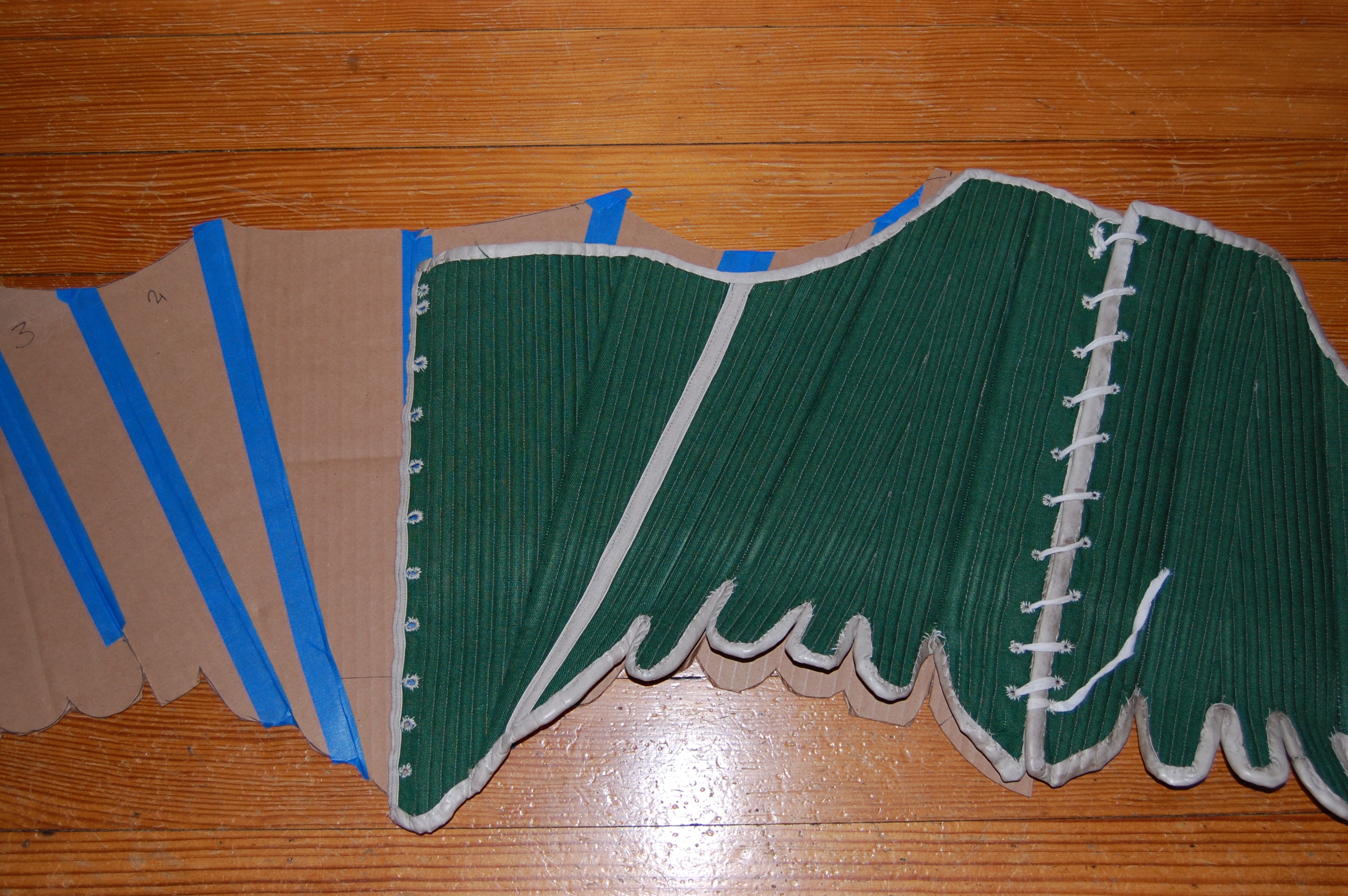
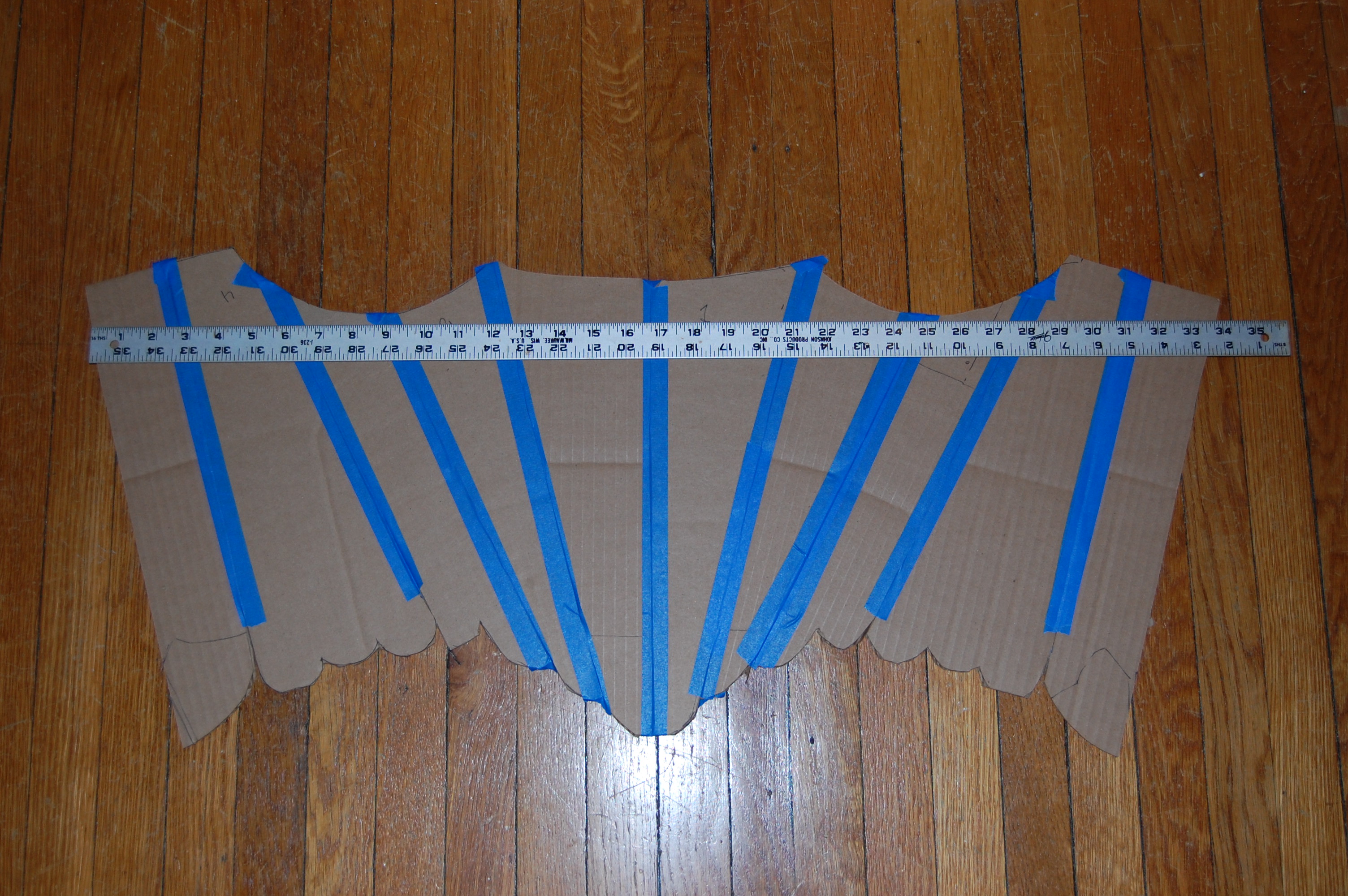
Stay pattern mock-up, measured.

Stay pattern mock-up, measured.

The stays are a little different, and much more serious. I’m not yet sure what to do. I could unstitch the binding and the panels and remove some bones, re-stitch the seams and re-apply the binding…or I could start all over, but make the stays a size smaller. The cardboard mockup measures 33 inches across. With a tape measure snugged up, I measure 37 inches around. Seems like all should be well, no? Two inches, front and back?

32 inches, but they don't fit.

32 inches, but they don’t fit.

It is not. Here you can see the green stays and the yard stick: 32 inches. I should have five inches altogether, right? No. These lace shut front and back (see the back lacing, kindly trust me on the fronts).

How did I not notice this before?

How did I not notice this drop before? (The pale line is the tide line of petticoat waistbands & ties)

Then I compared the mock up and the stays. Curiouser and worser!

Somehow when I assembled this hot mess, I mis-aligned the pieces,and the fronts are lower than they should be. This explains much about the increasingly poor quality of fit as these slide down my ribcage…as you can imagine, the stays can’t do their job when they’re not in the right place to do their job.

If I am to reclaim these and my decorum, the first step will have to be dis-assembly simply to get the various panels into the their proper places. I think it would be fairly simple to do to the fronts, and then I could end some of the madness by sewing the front panels shut and converting these to back-lacing stays. It might be only a temporary fix, but that alone would be worth the effort. Fortunately, I won’t require these until November 23, and in the meantime, I know which gowns are too big, and need to be smaller. With open fronts, at least they’re pretty adjustable.

Share this:

  • Share on Facebook (Opens in new window) Facebook
  • Share on Pinterest (Opens in new window) Pinterest
  • Email a link to a friend (Opens in new window) Email
  • Share on X (Opens in new window) X
Like Loading...

A Swedish Spencer

11 Friday Oct 2013

Posted by kittycalash in Clothing, Historical Sew Fortnightly, Making Things

≈ 3 Comments

Tags

19th century, Costume, Historical Sew Fortnightly, plans, sewing project, Spencer, wool

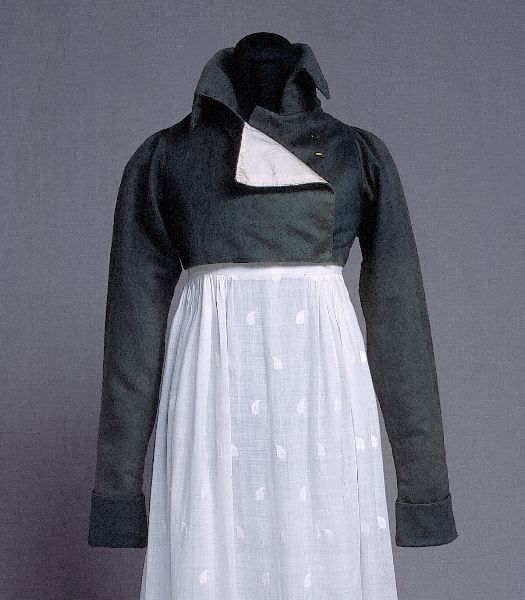
The Swedish Spencer

The Swedish Spencer

Because I lack good sense, I have fixated upon this Spencer from a museum in Lund. I have inflicted it upon people who have no particular interest in women’s wear, and extracted opinions on the fabric. Shameless, really. But I love the simplicity of this garment, and have therefore closed my eyes, written a check for some Kochan & Phillips bottle green broadcloth so that I can pet the wool to cheer myself up while patterning this beast.

To be fair, I have a Spencer half-patterned, and need “only” to work on the sleeves and collar. I have a sense, from examining a friend’s frock coat, of how to construct this stand-and-fall collar. Pad stitching, here I come. I enjoy the challenge of sleeves and hope this will not break me of that. So far, I have not been able to find a photo of the back of this lovely garment, so I’ll have to extrapolate from other examples.

I’d thought about making this for the Historical Sew Fortnightly # 21: Colour Challenge Green, but it took me too long to commit to the K&P wool, and at that price, you can bet I’ll make a careful muslin. While I’m not certain when or where I will wear this, I already know that I will wear it with my black petticoat and green boots, and will have to make a shirt to go under the petticoat, which will be its own challenge.  

Puffy sleeves aren’t my thing, and they won’t fit under these trim Spencer sleeves, but there is at least one extant example of a long-sleeved shirt-like garment. I expect I will feel about chemisettes much the way I feel about caps…but in the end, it will be worth all the tiny hems and the muslins. After all, the Spencer has a huge bonus: it closes with clasps so there are no buttonholes!

Share this:

  • Share on Facebook (Opens in new window) Facebook
  • Share on Pinterest (Opens in new window) Pinterest
  • Email a link to a friend (Opens in new window) Email
  • Share on X (Opens in new window) X
Like Loading...

Chemisettes

16 Monday Sep 2013

Posted by kittycalash in Events, Making Things, Museums, Research

≈ 1 Comment

Tags

1800 event, 18th century clothing, bib and tucker, fashion, John Brown House Museum, patterns of fashion, Rhode Island, Rhode Island Historical Society, style, What Cheer Day

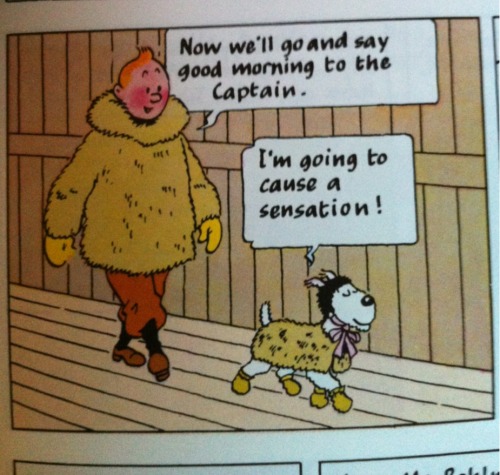
The Shooting Star: Snowy in his “best bib and tucker.”

Chemisette or tucker? By the time The Shooting Star was published in 1941-42, “bib and tucker” had wandered away from their original meanings. Tuckers were worn under women’s and girl’s bodices, taking on the role of neck handerchiefs or fichus, and what some people like to call “modesty pieces,” though the phrase always makes me think of the front panel of desks.

Janet Arnold includes chemisettes in Patterns of Fashion I, and you can buy a very nice one indeed from Cassidy at her Etsy store. (Reviewed here, and modeled, too!) But can you have one in Rhode Island in 1800? That is, of course, the question.

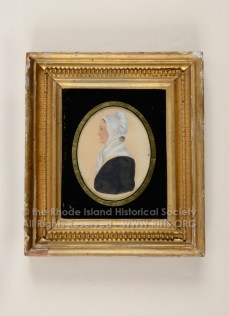
Hannah Weaver Peckham, RIHS 1958.3.2

Hannah Weaver Peckham, RIHS 1953.8.2

Turns out you probably can. Scrolling through the miniatures gallery, there was Hannah Weaver Peckham in her best tucker, and Miss Rhodes, while later, is also sports a chemisette or tucker. (Mrs Peckham looks a bit cranky, doesn’t she? Perhaps her busk is poking her.)

What you’d call it remains an open question.

The 1933 Oxford dictionary we have in the office defines “tucker” as “A piece of lace or the like, worn by women within or around the top of the bodice of the 17-18th C.”

Phoebe Smith Rhodes, RIHS  1918.3.6

Phoebe Smith Rhodes, RIHS 1918.3.6

The same dictionary tells me “chemisette” is 1807, from the French, diminutive of chemise. “1. A bodice, more or less like the upper part of a chemise. 2. An article, usually of lace or muslin, made to fill in the open front of a woman’s dress 1844.”

While I think that one could, in Rhode Island in 1800, wear a garment that filled in the upper part of a bodice, I’m not sure what one wold call that garment. The simplest thing to do is to wear a white kerchief  like Phoebe Smith Rhodes. Have I ever settled for the simplest thing? Not if I can help it.

Share this:

  • Share on Facebook (Opens in new window) Facebook
  • Share on Pinterest (Opens in new window) Pinterest
  • Email a link to a friend (Opens in new window) Email
  • Share on X (Opens in new window) X
Like Loading...

An Unusual Coat

03 Tuesday Sep 2013

Posted by kittycalash in Clothing, Events, Living History, Making Things, Reenacting, Research

≈ 5 Comments

Tags

10th Massachusetts, 18th century clothes, authenticity, Brigade of the American Revolution, common soldier, living history, Reenacting, Revolutionary War, Saratoga, uniforms, Wasmus diary

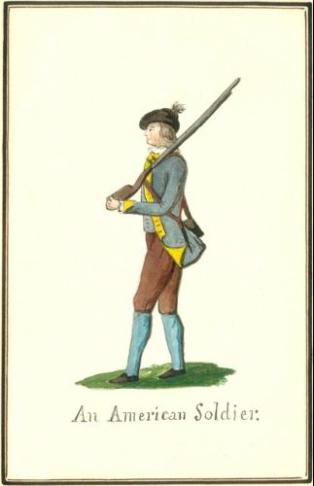
DSCN4288In 1777, the uniforms of the Continental Army remained largely uncodified and, well, non-uniform. At Ticonderoga, German accounts from the spring of 1777 state that “Few of the officers in General Gates’ army wore uniforms, and those that were worn were evidently of home manufacture and of all colors. For example, brown coats with sea-green facings, white linings, and silver dragons(epaulettes or shoulder knots), and gray coats with yellow buttons and straw facings, where to be seen in plenty.”

Brown coats with sea green facings. There’s one in our regiment, and it is a lovely thing. The Adjutant thought it would be interesting for the troops to turn out in these coats at Saratoga, an event to which the coat can be documented (being soon after Fort Ticonderoga) and an event that will take place on the historic site. So we’re making them, in a project that started Saturday, and here we are: ready to have the lapel width adjusted, because my eye tells me it is too big, and yes, I’m told that it was cut a but wide. So this morning, a lapel trim is in order.

An American Soldier. ca.1852 copy of a ca.1777 watercolor by Hessen-Hanau Captain Friedrich von Germann. Niedersächsisches Staatsarchiv, Wolfenbüttel, Braunschweig

An American Soldier. ca.1852 copy of a ca.1777 watercolor by Hessen-Hanau Captain Friedrich von Germann. Niedersächsisches Staatsarchiv, Wolfenbüttel, Braunschweig

But really, these coats.

Here you can see the style that we’re making, with applied lapels and shanked buttons, simple turn backs on the front skirts, and flat collars. The cuffs are also applied, non-functioning cuffs that come to a point in front. (Also, documented blue stockings!)

These coats will be worn with overalls, waistcoats and shoes, because we know from John Buss’s letters that the regiment was issued overalls and shoes in the summer of 1777. No visible stockings, sadly.

This is the kind of project I can get pretty stoked about, with its combination of aesthetics and documentation. A coat described in a German diary, made in pettable wool broadcloth that will be unlike anything else on the field? Of course I want to help make that vision real.

Imagine a moment on the field, with these documented coats, so unusual (the sea green may have been a faded blue, but sea green is what was seen), worn in a place where they were worn. I don’t need to remind you about the authenticity/commemoration thing, do I? Because it’s pretty clear that’s what’ll happen three weeks from now in New  York.

Share this:

  • Share on Facebook (Opens in new window) Facebook
  • Share on Pinterest (Opens in new window) Pinterest
  • Email a link to a friend (Opens in new window) Email
  • Share on X (Opens in new window) X
Like Loading...
← Older posts
Newer posts →

Archives

wordpress statistics

Creative Commons License
Kitty Calash blog by Kirsten Hammerstrom is licensed under a Creative Commons Attribution-NonCommercial-ShareAlike 4.0 International License.

Website Built with WordPress.com.

  • Subscribe Subscribed
    • Kitty Calash
    • Join 621 other subscribers
    • Already have a WordPress.com account? Log in now.
    • Kitty Calash
    • Subscribe Subscribed
    • Sign up
    • Log in
    • Report this content
    • View site in Reader
    • Manage subscriptions
    • Collapse this bar
 

Loading Comments...
 

    %d