• Home
  • Completed Costumes/Impressions
  • Emma and Her Dresses
  • Free Patterns and Instructions

Kitty Calash

~ Confessions of a Known Bonnet-Wearer

Kitty Calash

Category Archives: Reenacting

A Trip to Stonington

17 Wednesday Sep 2014

Posted by kittycalash in Clothing, History, Living History, Museums, Reenacting, Research

≈ 1 Comment

Tags

1812, 19th century clothing, Clothing, Connecticut, Federal style, Research, Stonington, Stonington Historical Society

The view from Stonington Point

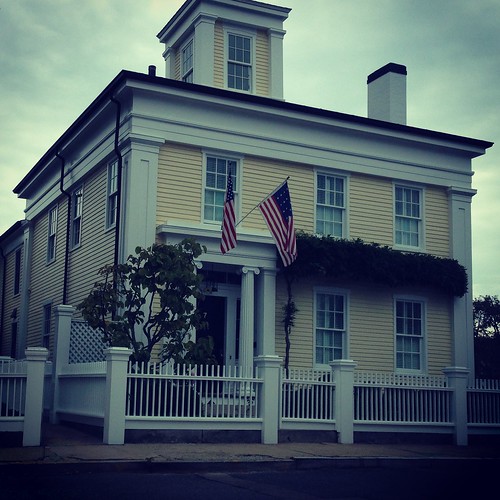
On Tuesday, I drove down to Stonington, CT to visit the Stonington Historical Society’s Lighthouse Museum and look at a coat. Stonington was beautiful as ever, smelling of the ocean and money, and the little Lighthouse Museum was nicely done.

The coat did not disappoint.

It is a truly amazing artifact, having survived despite pretty incredible events. The donor wrote a letter about the coat when he gave it to the SHS in 1914:
“I have heard my father say due to the haste and excitement of the volunteers they failed to properly cool their gun before pouring into its muzzle the powder, which due to the excessive heat of the gun caused the powder to explode prematurely, as you may see by reference to the coat—burned and torn upon the neck and shoulder.” (Coat and letter, Stonington Historical Society, 2009.120.001).

Stonington, CT

As beautiful as the town of Stonington may be, and as much money as there may be on the Connecticut coast, the SHS has a small budget and must use its funds wisely. We had an interesting conversation about the reenactors and museum collections, and what responsibility historical costumers have to the collections that hold clothes they replicate.

Share this:

  • Share on Facebook (Opens in new window) Facebook
  • Share on Pinterest (Opens in new window) Pinterest
  • Email a link to a friend (Opens in new window) Email
  • Share on X (Opens in new window) X
Like Loading...

Half Robe or Jacket: How Do You Wear One?

10 Wednesday Sep 2014

Posted by kittycalash in Clothing, Events, History, Making Things, Reenacting, Research

≈ 3 Comments

Tags

18th century clothing, 19th century clothing, bonnets, Costume in Detail, Costumes, costuming, Federal style, frock coats, half robes, Isaac Cruikshank, living history, National Trust Collections UK, Regency, Research, resources, tailcoat, What Cheer Day, Yale Center for British Art

Half robe, 1790-1800. National Trust Inventory Number 1348749,

Half robe, 1790-1800.
National Trust Inventory Number 1348749,

What Cheer Day is coming, and I hate to miss an opportunity to make a new gown (despite having just made one, and despite needing to make some waistcoats and trousers for the event). While I lay awake last night, I pondered my options, and whether a half gown would be suitable.

Although I have concluded it probably is not, I was curious about how these should be worn. Where can you wear such a garment? Is it only suitable for at-home use?

This is the robe from Nancy Bradfield’s Costume in Detail, replicated by Koshka the Cat here, and approximately by me, here.

CostumeinDetail_p84
CostumeinDetail_page83

Since I will be a housekeeper again, I think a gown is more correct for me, but that doesn’t stop me thinking about half robes, and whilst scrolling images by year at the Yale Center for British Art, I found this by Cruikshank:

ladies in a lending library

Isaac Cruikshank, 1756–1810, British, The Lending Library, between 1800 and 1811, Watercolor, black ink and brown ink on medium, lightly textured, beige wove paper, Yale Center for British Art, Paul Mellon Collection

There’s a lot to love in this image, even with its fuzzy “between 1800 and 1811” date. Not only do we get an array of reading material (Novels, Romance, Sermons, Tales, Voyages & Travels, Plays), we get costume tips and– special bonus– a dog gnawing its leg.

(If you are curious about some of the books in the Library at the John Brown House, check out this tumblr bibliography. I’ve been using it of late, and the representative genres are quite similar to what we see in the Cruikshank.)

We also get a chemisette on the lady at the counter, along with a very dashing hat, a fancy tiered necklace on the lady in pink, who also carries a green…umbrella? Parasol? With just a veil, that seems likelier than the longest reticule ever.

I like our Lady in a Half-Robe and her deep-brimmed bonnet showing curls at her brow. She and her companions show the range of white and not-white clothing seen in early 19th century fashion plates, and the range of head wear, too.

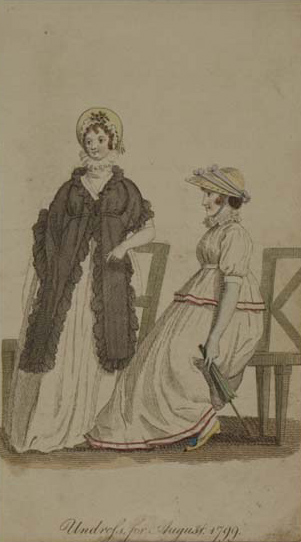
Undress for August, 1799. Museum of London

Undress for August, 1799. Museum of London

The last question I’m asking myself, though, is whether the yellow garment is a half-robe or a short pelisse or a jacket. And can you wear a half robe out of doors? And what did the ladies of the period call that garment?

In this fashion plate (featured by Bradfield on page 84, found by me at the Museum of London), the lady on the right is certainly wearing a short upper body garment, and I’d wager that she’s out of doors or headed that way, since she’s carrying a (green) parasol. Bradfield calls her garment a “jacket,” and until I can find the text of the Ladies’ Monthly Museum for August 1799, perhaps that is the term we should use instead.

While two images aren’t a lot of evidence, it does appear possible to wear a half-robe or jacket out of doors for informal visits in clement weather, and finding two is as good a reason as any to look for more.

Share this:

  • Share on Facebook (Opens in new window) Facebook
  • Share on Pinterest (Opens in new window) Pinterest
  • Email a link to a friend (Opens in new window) Email
  • Share on X (Opens in new window) X
Like Loading...

Malaise or Ennui?

09 Tuesday Sep 2014

Posted by kittycalash in Clothing, Events, Fail, Living History, Making Things, Philosophy, Reenacting

≈ 17 Comments

Tags

19th century, 19th century clothing, authenticity, Clothing, common dress, Costume, Events, fashion, history, interpretation, Newport, Newport Historical Society, Quaker, Quakers, Rhode Island, Rhode Island history, style

image Hard to say which, but I am ill at ease and dissatisfied with my costuming. You might even call it bratty. But I don’t wanna be like Bridget Connor!

It started the week of the Stamp Act protest, when I felt quite tired of being the shabby, unrefined woman of the regiment and street vendor, and wanted a nice cozy shop like the milliner had. I was also looking forward to being a housekeeper again, and several weeks of moving boxes and volumes with red rot at work had me feeling generally filthy and unappreciated. Bratty.

When in doubt, sew. A new dress can’t help but cheer you up, right?

Well… sort of…

Last Thursday, we did a reprise of the Williams family letters program at the Newport Historical Society. The Williams family were Quakers, and the letters were from the early part of the 19th century, so for the program in March, I made a green silk cross-front gown based on the Quaker gown in the back of Costume in Detail. (Check out the schematic on the 19thus.come page; I didn’t see this until I was mostly done with the dress, but thank goodness I got it right!)

But it’s September, and Thursday was expected to be quite warm, so I salved my bureaucratic wounds in the $1.99 loft at the local mill store, and made a new Quaker gown, also suitable for a maid.

I ask you! Even though it’s my very own pattern based on sketches of original drawings, even though it fits, even though it cost $10, even though every seam is overcast and the whole thing is made with period correct stitches, it still fails to make me happy and cheerful and delighted.

image

This brattiness has resulted in a reappraisal of my approach– and a trip to Sewfisticated in Framingham. What did I buy there? Yards and yards of pink taffeta? Gold taffeta? Blue taffeta?

No.

Because they didn’t have the right colors in the right weave– too slubby– or in enough yardage. Brace yourselves: I bought brown.

Many thanks to Sew 18th Century for taking the photos!

Many thanks to Sew 18th Century for taking the photos!

It appears I do not learn from my mistakes. When I think, “Gee, I’d like a pretty dress,” I end up buying fabric based on the texture as much as the color, and I have to tell you, that brown taffeta has the most wonderful l hand and sheen, and I will look much more like a Copley portrait than I ever have before, so that’s something.

It seems I have created a set of mental rules for myself, a mission, if you will, for the historic clothing I sew and the roles I take on, and I only play within those rules.

Share this:

  • Share on Facebook (Opens in new window) Facebook
  • Share on Pinterest (Opens in new window) Pinterest
  • Email a link to a friend (Opens in new window) Email
  • Share on X (Opens in new window) X
Like Loading...

Wash on Monday

02 Tuesday Sep 2014

Posted by kittycalash in History, Laundry, personal, Reenacting

≈ Comments Off on Wash on Monday

Tags

laundry, living history, mindfulness

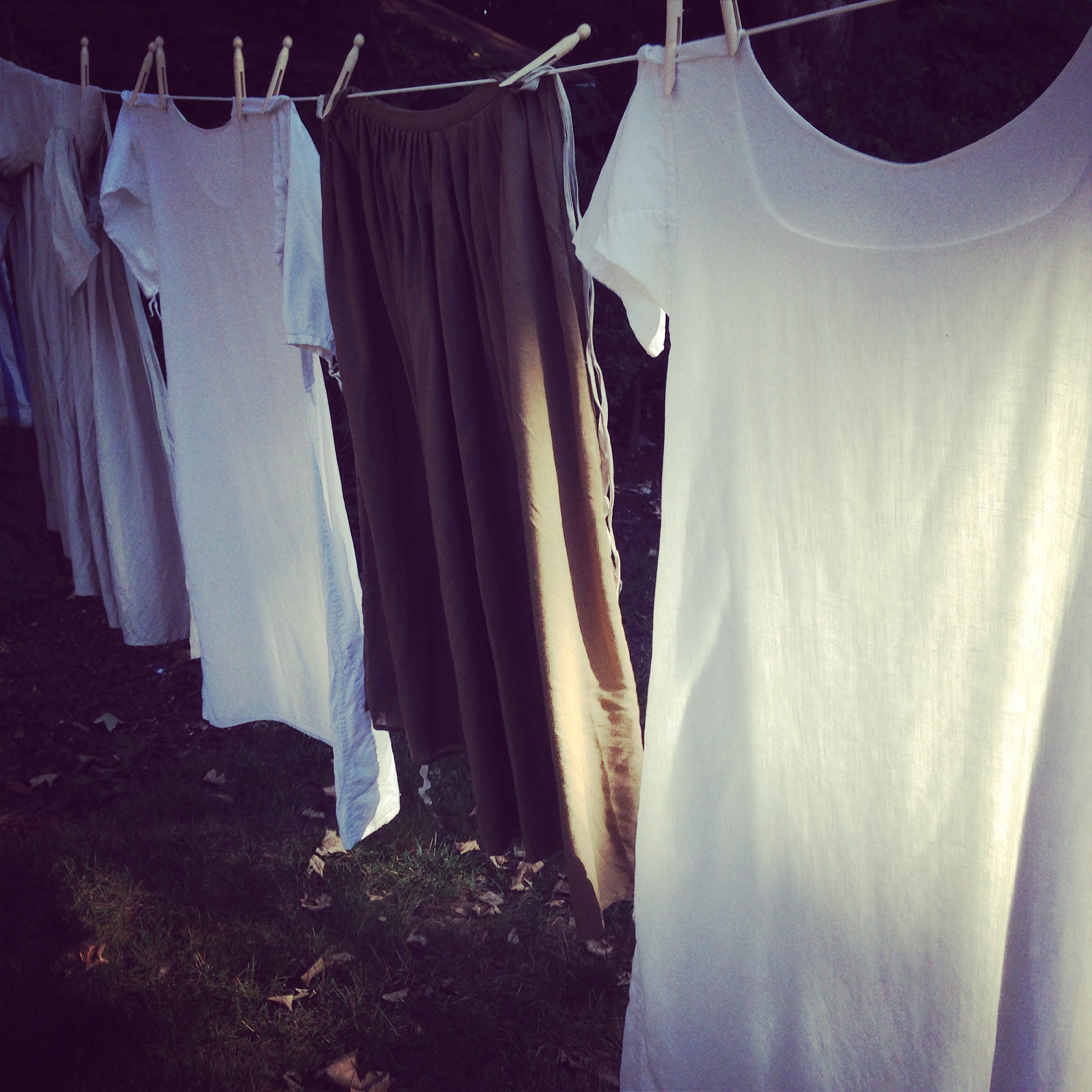
shifts and petticoats on a line

Living history laundry

We spent Labor Day laboring at home: even the Young Mr spent the day working on a five page essay (due Wednesday) for history class. I spent the day tidying the house and washing clothes from all centuries.

Of our historic clothes, I don’t often wash more than body linen (shifts, shirts, stockings) but the petticoats had not been washed in some time; in the end, I washed the tow and blue striped one, but only aired the Virginia cloth and madder linen. Since I may not wear these again this year, washing and airing seemed warranted.

It’s incredibly easy to wash in this century, with the luxuries of indoor plumbing, a hot water heater and a washing machine. At Walloomsac, though I didn’t do any laundry, we were always fetching water, and I think of how much water we use, and how easily.

chintz and checked clothes on a  clothesline

Red, white and blue

While I stitched a dress (new, though the mending pile is growing), I listened to biography of the Buddha, and thought about mindfulness and living history.

What is there to learn from sewing a gown, or hanging my wash on the line? How much does it matter that sunlight makes my shifts brighter, or that the dress in my lap is not a exact replica of an extant garment, but rather one made using period techniques, a close analog of a period fabric, and is cut to period style?

So little remains of the vast middle and smaller lower classes that it would be stifling to limit oneself only to exact replicas. And in any case, we can never recreate the mindset or worldview of the people of the past. We can only mimic their processes, read their words, and study the things they have left behind in our best attempts to understand them.

Share this:

  • Share on Facebook (Opens in new window) Facebook
  • Share on Pinterest (Opens in new window) Pinterest
  • Email a link to a friend (Opens in new window) Email
  • Share on X (Opens in new window) X
Like Loading...

On Wanting to Quit the Hobby

29 Friday Aug 2014

Posted by kittycalash in Fail, Living History, personal, Philosophy, Reenacting

≈ 8 Comments

Sometimes I want to quit this hobby.

It’s usually for selfish, petty reasons: for all I swear that I didn’t see the trash compactors and cars in Newport, spinning wheels, cast iron, and candelabra in dining flies made me nuts at Bennington. Why the difference? In Newport, the modern things were all backdrop and unchangeable. At Bennington, reenactors had choices.

Why would someone else’s cast-iron kitchen make me want to pack up my sticks and go home? Maybe because I’ve been very tired this summer. But more honestly, I have a streak of self-righteous grade-grubber: “I work hard at this, why can’t you?” was surely my internal whine as I surveyed the mess area at Bennington.

My emotional immaturity aside, I think that same “I get this, why can’t you?” is felt by a lot of reenactors/interpreters when they stand in their well-researched, hand-sewn, and agonized-over clothes in a Spartan camp watching the public interact with sofa-print-gown- or baggy-breeches-wearing cooks bent over cast iron in camps littered with slat-back chairs, folding tables, and candlesticks.

We feel unappreciated. We feel like no one recognizes our hard work. We are not getting the grade we deserve.

We need to get over it.

Don’t abandon the authenticity: abandon the attitude. Abandon the eye-rolling, the snubbing, the sneers, and the turning away.

Comparison is the enemy of contentment. Even when you think you’re better.

Stop playing the “I’m more authentic than you” game. It sucks. It makes people want to quit this hobby. It makes people want to skip events.

You want to have events where only people who meet your personal authenticity standards can play? Knock yourself out. Keep it private. In privacy, be as catty as you like with people who enjoy it, but keep it in the real world and not online. Online, it comes off as passive-aggressive cowardice.

Right?

Right?

Not everyone wants to play the same game. But no matter what the game is, it’s never fun to be the butt of meanness, and it’s not really fun to be mean—plus, it’s bad for your health, bad for the hobby, bad for the people around you.

We’re visual creatures: we can over-focus on what we see. We focus on the clothing being worn instead of the person inside those clothes. But really, it is the person who is important.

So maybe we should lighten up a little.

So maybe we should lighten up a little.

Individual choices don’t always affect a group. When choices do affect a group—cars in camp past stated removal times, weapons and fire safety violations—then I think anyone can and should speak up. But violations of published and easily accessible standards should be pointed out to event organizers, and not handled at the individual level. When there are no published and readily accessible shared standards, there’s nothing to enforce. So consider stepping down from the fashion police and enjoying yourself instead. I’ve been to very few events without redeeming factors.

Lighten up!

All that iron at Bennington? Forgotten when I focused on what I was doing: cooking something new in camp, and forgotten even more when I shared the pudding and compote with my friends.

That’s why I don’t quit this hobby: it allows me to share amazing experiences with my friends, I learn new things all the time, and I get far outside my petty worries.

Share this:

  • Share on Facebook (Opens in new window) Facebook
  • Share on Pinterest (Opens in new window) Pinterest
  • Email a link to a friend (Opens in new window) Email
  • Share on X (Opens in new window) X
Like Loading...
← Older posts
Newer posts →

Archives

wordpress statistics

Creative Commons License
Kitty Calash blog by Kirsten Hammerstrom is licensed under a Creative Commons Attribution-NonCommercial-ShareAlike 4.0 International License.

Website Built with WordPress.com.

  • Subscribe Subscribed
    • Kitty Calash
    • Join 621 other subscribers
    • Already have a WordPress.com account? Log in now.
    • Kitty Calash
    • Subscribe Subscribed
    • Sign up
    • Log in
    • Report this content
    • View site in Reader
    • Manage subscriptions
    • Collapse this bar
 

Loading Comments...
 

    %d