• Home
  • Completed Costumes/Impressions
  • Emma and Her Dresses
  • Free Patterns and Instructions

Kitty Calash

~ Confessions of a Known Bonnet-Wearer

Kitty Calash

Category Archives: Reenacting

What (Cheer) to Wear?

07 Saturday Sep 2013

Posted by kittycalash in Clothing, History, Living History, Reenacting, Research

≈ Comments Off on What (Cheer) to Wear?

Tags

18th century, 18th century clothes, authenticity, John Brown House Museum, living history, resources, Revolutionary War, What Cheer Day, work
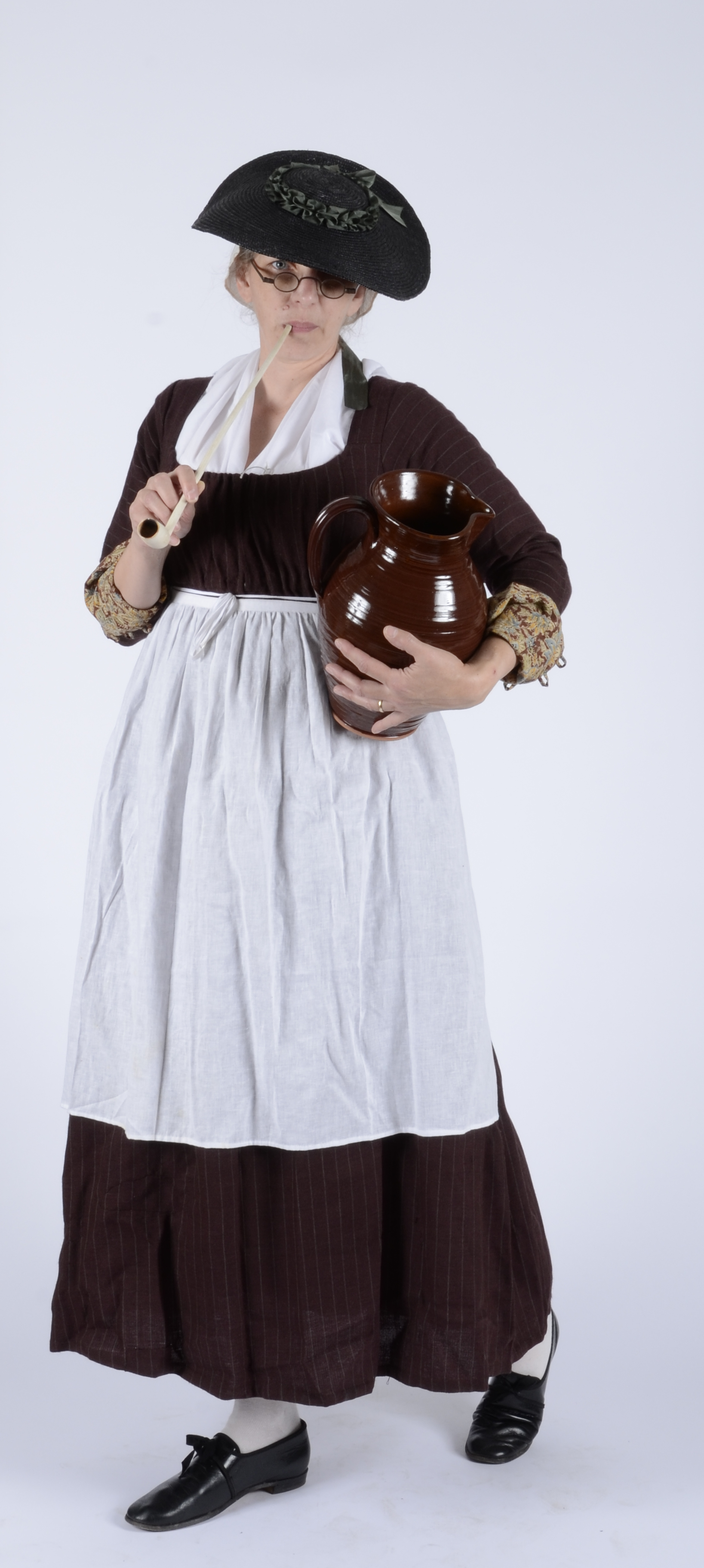
JBs HousekeeperIt’s 1800. Do you know what your housekeeper is doing? I don’t. Or, more accurately, I can’t decide.
I’m hung up on stays, and not wanting to make another pair. I’m indecisive about style, and though Mrs Garnett has her charms, it’s her bonnet I love more than anything.

Here’s what I’ve found, in servant-land:
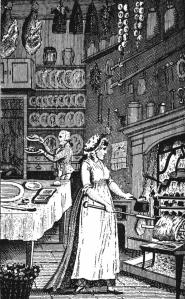
18th-century-kitchen-servants-prepare-a-meal-jane-austen-cookbook-cover-page

Note that this woman is, in the kitchen, wearing an open robe and quilted petticoat.The style of her bodice–which looks  like a cross-over bodice–and the train of the robe suggest the 1790s. Score one for style.

That open robe, where have I seen that before? Why, yes, Mr Sandby showed us that style for a nurserymaid. (It’s interesting, too, that both images show women with their hair quite visible under their caps, and not pulled up and out of sight.)
20130109-061710.jpg

Why does “robe stye” matter? Because I only found 3 and a quarter yards of a brown fabric I like, and even with the most careful cutting, that’s unlikely to make a full gown. However, I have some lightweight black wool that will make a decent petticoat. The bodice style is a bit of a stumper, though: the wool has good drape, so it might work for something other than the usual bodice I make. I did consider whether a very smooth, edge-to-edge, front-closing style of the 1780s would be more appropriate, but I think that I can move the bodice style forward, style-wise, and be correct.
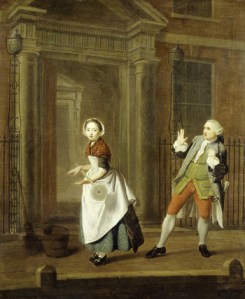
138263

Brown gowns are a fine tradition in the sartorial habits of questionable servants. This young housemaid twirls her mop dry while wearing a brown gown over what could be a dark blue or a black quilted petticoat. The red “bandannoe” is a nice touch, though I don’t think I’ll wear one myself for this event.

In all this there is a compromise: using fabric I like, in a style I know I can make and document, perhaps even without having to make new stays. That would be ideal, because although it’s four weeks to the event, I’ll lose a week of sewing time to other commitments. Three weeks to pattern and hand sew a petticoat, gown, apron and cap seems just manageable.
Share this:

  • Share on Facebook (Opens in new window) Facebook
  • Share on Pinterest (Opens in new window) Pinterest
  • Email a link to a friend (Opens in new window) Email
  • Share on X (Opens in new window) X
Like Loading...

All Over but the Tugging

06 Friday Sep 2013

Posted by kittycalash in Clothing, Events, Living History, Reenacting

≈ 2 Comments

Tags

10th Massachusetts, 18th century clothes, authenticity, Brigade of the American Revolution, common soldier, Costume, living history, Reenacting, Revolutionary War, sewing

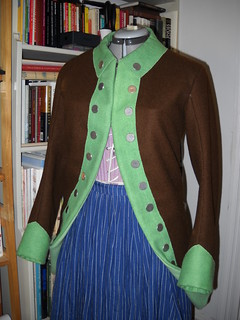
Front view on Cassandra.

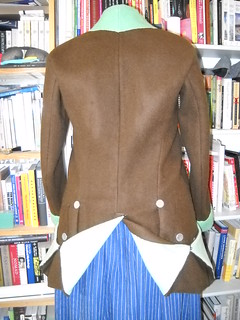
Back view, over petticoats

That’s right, it’s done, in all its brown and green glory, with not one buttonhole in sight.

I imagine Henry Cooke will tug on it, the same way my grandmother used to tug on my clothes, and find the things I need to fix that I can’t even see until he points them out. But that’s OK– what better way to learn?

You can see the progression on the project here, but there’s no tutorial or instruction manual, just visual notes as I went along. It’s Mr Cooke’s pattern and kit.

I think they’ll be glad of wool coats up at Saratoga, and if I didn’t have a new gown and petticoat, and possibly even stays, to make by October 5, I would think hard about making John Buss’s “red Queman’s pattern jacket” and “striped woolen trowsis” for the Young Mr to wear. With luck, he’ll have a borrowed coat to wear; I doubt a hunting frock will be as warm as he’d like by late September. No one, not even Mr Cooke (and I did ask), knows with certainty what a “Queman’s pattern jacket” is, but it might be a short coat or jacket. What I do know is that visions of a short red coat and grey striped trousers dance in my head, and the list of things I want to make just gets longer.

For now, though, this 1777 10th Massachusetts coatee is done, or nearly done, though on Mr S, I predict center back pleat tweaking.

Share this:

  • Share on Facebook (Opens in new window) Facebook
  • Share on Pinterest (Opens in new window) Pinterest
  • Email a link to a friend (Opens in new window) Email
  • Share on X (Opens in new window) X
Like Loading...

An Unusual Coat

03 Tuesday Sep 2013

Posted by kittycalash in Clothing, Events, Living History, Making Things, Reenacting, Research

≈ 5 Comments

Tags

10th Massachusetts, 18th century clothes, authenticity, Brigade of the American Revolution, common soldier, living history, Reenacting, Revolutionary War, Saratoga, uniforms, Wasmus diary

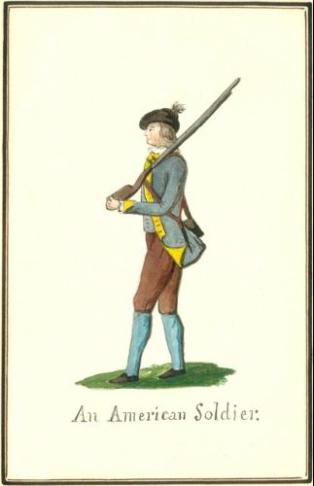
DSCN4288In 1777, the uniforms of the Continental Army remained largely uncodified and, well, non-uniform. At Ticonderoga, German accounts from the spring of 1777 state that “Few of the officers in General Gates’ army wore uniforms, and those that were worn were evidently of home manufacture and of all colors. For example, brown coats with sea-green facings, white linings, and silver dragons(epaulettes or shoulder knots), and gray coats with yellow buttons and straw facings, where to be seen in plenty.”

Brown coats with sea green facings. There’s one in our regiment, and it is a lovely thing. The Adjutant thought it would be interesting for the troops to turn out in these coats at Saratoga, an event to which the coat can be documented (being soon after Fort Ticonderoga) and an event that will take place on the historic site. So we’re making them, in a project that started Saturday, and here we are: ready to have the lapel width adjusted, because my eye tells me it is too big, and yes, I’m told that it was cut a but wide. So this morning, a lapel trim is in order.

An American Soldier. ca.1852 copy of a ca.1777 watercolor by Hessen-Hanau Captain Friedrich von Germann. Niedersächsisches Staatsarchiv, Wolfenbüttel, Braunschweig

An American Soldier. ca.1852 copy of a ca.1777 watercolor by Hessen-Hanau Captain Friedrich von Germann. Niedersächsisches Staatsarchiv, Wolfenbüttel, Braunschweig

But really, these coats.

Here you can see the style that we’re making, with applied lapels and shanked buttons, simple turn backs on the front skirts, and flat collars. The cuffs are also applied, non-functioning cuffs that come to a point in front. (Also, documented blue stockings!)

These coats will be worn with overalls, waistcoats and shoes, because we know from John Buss’s letters that the regiment was issued overalls and shoes in the summer of 1777. No visible stockings, sadly.

This is the kind of project I can get pretty stoked about, with its combination of aesthetics and documentation. A coat described in a German diary, made in pettable wool broadcloth that will be unlike anything else on the field? Of course I want to help make that vision real.

Imagine a moment on the field, with these documented coats, so unusual (the sea green may have been a faded blue, but sea green is what was seen), worn in a place where they were worn. I don’t need to remind you about the authenticity/commemoration thing, do I? Because it’s pretty clear that’s what’ll happen three weeks from now in New  York.

Share this:

  • Share on Facebook (Opens in new window) Facebook
  • Share on Pinterest (Opens in new window) Pinterest
  • Email a link to a friend (Opens in new window) Email
  • Share on X (Opens in new window) X
Like Loading...

You Wear What You Are

02 Monday Sep 2013

Posted by kittycalash in Clothing, Events, History, Living History, Reenacting

≈ 2 Comments

Tags

18th century clothing, Clothing, Costume, fashion, JohnBrownHouse, maids

Part two of a series

Mrs Garnett, Housekeeper, oil on canvas by Thomas Barber. NTPL Ref. No. 42286

Mrs Garnett, Housekeeper, oil on canvas by Thomas Barber. NTPL Ref. No.
42286

I’m minding my own business checking out my friends’ business on Facebook, when Mrs Garnett appears on Joanna Waugh’s blog. Mrs Garnett had been rattling around in my head as “Wait, there’s that housekeeper painting, and she’s got, like, this great bonnet…” which is the art historical equivalent to an ear worm.

Yes, the Kedleston Hall housekeeper. A bit grand for Mr and Mrs Brown, if you compare a fine mansion in Providence to a English County House with a Collection and its Own Catalog, but not too grand if you compare John Brown’s House to Jeremiah Dexter’s, or Stephen Hopkins’.

We are talking about a man who asked his son-in-law to fetch back marble busts from Versailles, during the time of the French Revolution when the scent of blood was, literally, in the air. Mr Brown had pretensions.

This is tough to hang on to because I see that house every week and it is now so familiar that I don’t see it: it’s background. This is both good and dangerous: I need to hold on to the magic and mystery of the overwhelming high style decorative arts of the house, while also feeling ownership and pride in that house. The catch is that the meaning is so different to me now than it would have been to me then. Though to be honest, being a curator is not so different from being a housekeeper. Curator has its roots in the Latin “cura,” to care, and in that root lies the similarity of roles.

So I will care for the house, and care how I represent it: those are keys, I think, that, as Sharon Burnston says, point to a solid, sober-colored worsted. She referred me to the Francis Wheatley “Cries of London” series, which you may recall from earlier posts.

Again, it is hard to shake the familiarity with the street vendor/woman of the army/runaway apprentice chaser I am accustomed to being. But I think the solution to my desire for playfulness lies in thinking closer to 1800 in style, and in a contrasting petticoat. Also, a bonnet. You can never have too many bonnets.

But this is academic, in a way, until I get my fabric samples. I shall will myself to patience, and instead keep sewing the Wasmus Coat for Saratoga. Yes, I realize my idea of a brown gown and pale blue petticoat will replicate the contrast of the coat body and facings. But I do really love those coats!

Share this:

  • Share on Facebook (Opens in new window) Facebook
  • Share on Pinterest (Opens in new window) Pinterest
  • Email a link to a friend (Opens in new window) Email
  • Share on X (Opens in new window) X
Like Loading...

Poetry in Papers

17 Saturday Aug 2013

Posted by kittycalash in Clothing, Events, Living History, Museums, Reenacting

≈ 2 Comments

Tags

18th century clothes, authenticity, Clothing, common dress, Events, fashion, John Brown House Museum, living history, maids, Museums, Rhode Island, sewing

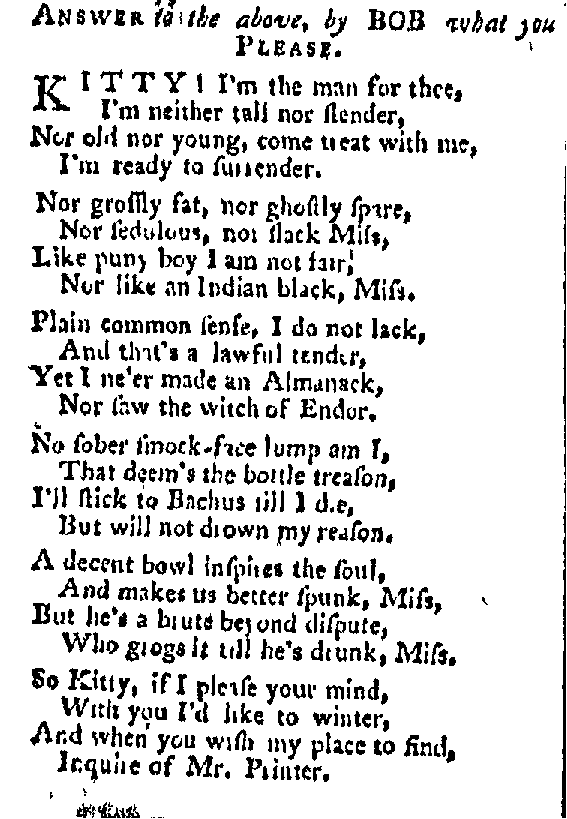
From the Newport Herald, 6/26/1788

From the Newport Herald, 6/26/1788

It’s quite the poem, isn’t it? In October, I’ll be part of an 1800 event at work, and I will be portraying a housemaid, if not quite the housekeeper (we are still trying to sort out the domestic staff; what we can document is far too small a staff for the size of the house).

One of the things I will need is a name, and I thought perhaps I should check my instinct that “Kitty” was an acceptable name for women in the 18th century, and not just for sloops. So to the newspapers I turned, and among listings of the graduates of Philadelphia Seminaries for Girls, and ships cleared through the custom house, I found this poem. It reminded me of Mr S, and I recommend you read it aloud.

The early nineteenth-century maid. By William Brocas (1762-1837), pencil drawing c.1800 (National Library of Ireland)

So, a name: we’ll go with Kitty for now, and I can imagine building a complicated back story that pulls together all of the things I do, from running away outside Philadelphia to encountering soldiers and following them, to ending up a maid in a house in Providence. Except that what I believe about a life like that is this: It would be highly improbable, and I would look wa-a-a-y older than my actual years.

Instead of getting carried away with extreme historical fictions, let’s look at what we can know.

For one thing: clothing. Do you find yourself concerned, ever, that you focus so much upon your historic clothing? Well, you can stop. After a long and excellent conversation this week, think of this: the historical clothing you wear to events of any kind requires a lot of lead time. So you do have to think it through carefully, because every minute will count. It is also a visitor’s first impression of you, from a distance and up close. Getting it right matters, and since that takes so much time, you have to think a lot before you commit scissors to cloth. It does not necessarily mean that you’re a shallow, clothes-obsessed freak. There’s no 18th century mall to go hang out in and watch the leather-breeches boys  posing while they smoke clay pipes.

Benjamin West, Characters in the Streets of London, 1799, YCBA, Paul Mellon Collection, B1977.14.6314

I’ve just about convinced myself that the silhouette we’ve been wearing at the house and formerly at the farm is acceptable. I went looking through the turn-of-the century images I have on Pinterest and I think that a maid would have worn the fashionable silhouette. Another question is age (sigh); all the women in the Benjamin West are younger than I am.

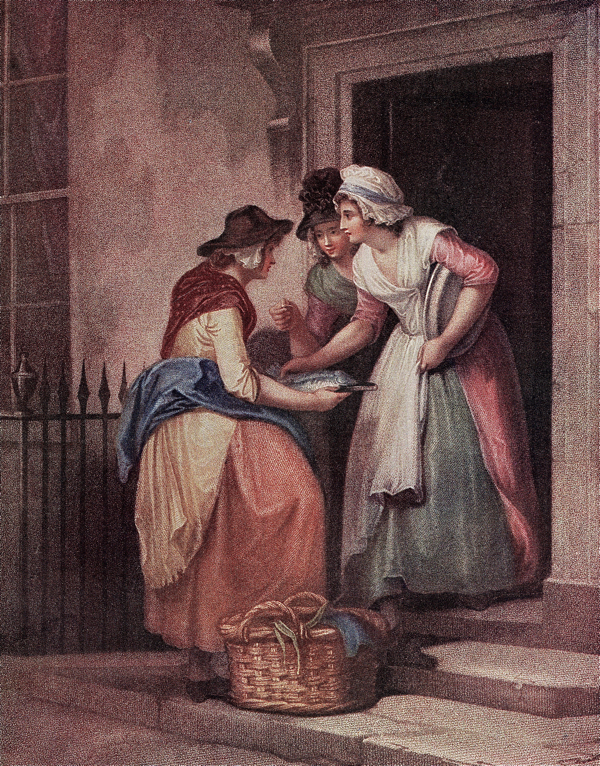
Francis Wheatley, Cries of London. New Mackerel, New Mackerel.

This print from a Wheatley (1792-1795) is useful, though he is such a genre painter and idealizes so much that I use him with caution. (Think of how much grittier–and funny–Sandby is: I trust Sandby more.) But, what can I learn from this? One thing is that I often think and dress more like the people in the street than the people in the houses. This will happen when you spend a lot of time outdoors, with soldiers: you are one of the people in the street. It can be a bit of a trap, historically speaking, and it’s good to challenge yourself to think about another class from time to time.

Back to the doorstep: what I learn here is that I need a white apron that I haven’t spilled on, a white kerchief, and a fancier cap. That cap will tie under my chin, because that’s the cap I see in Providence most often, and that’s the cap that will stay on. I’m not sure if these are maids–I think they are– but they’re women in a brownstone city house. And I can see from the clothes around me that they’ve been made for a woman who sells milk in the street, or works on a farm, or cooks over a fire. They’re not what the richest man in Providence would want his maid to wear answering the door.

You’ll have noticed, too, the different waistlines. The drawing from the National Library of Ireland and the Benjamin West have higher waistlines than the women in the Wheatley. Some of this will depend upon the available corsetry: I have stays that will work for the higher waistline, and I have stays for 1770.  I have a not-quite-right 1790s pair that need revision, but that’s not likely to happen: I have a brown and sea-green coat to make.

Share this:

  • Share on Facebook (Opens in new window) Facebook
  • Share on Pinterest (Opens in new window) Pinterest
  • Email a link to a friend (Opens in new window) Email
  • Share on X (Opens in new window) X
Like Loading...
← Older posts
Newer posts →

Archives

wordpress statistics

Creative Commons License
Kitty Calash blog by Kirsten Hammerstrom is licensed under a Creative Commons Attribution-NonCommercial-ShareAlike 4.0 International License.

Website Built with WordPress.com.

  • Subscribe Subscribed
    • Kitty Calash
    • Join 621 other subscribers
    • Already have a WordPress.com account? Log in now.
    • Kitty Calash
    • Subscribe Subscribed
    • Sign up
    • Log in
    • Report this content
    • View site in Reader
    • Manage subscriptions
    • Collapse this bar
 

Loading Comments...
 

    %d