• Home
  • Completed Costumes/Impressions
  • Emma and Her Dresses
  • Free Patterns and Instructions

Kitty Calash

~ Confessions of a Known Bonnet-Wearer

Kitty Calash

Category Archives: Reenacting

The Past Never Grows Old

18 Tuesday Dec 2018

Posted by kittycalash in Living History, Movie Review, Philosophy, Reenacting, Research

≈ 2 Comments

Tags

movie reviews, movies, public history, Research, They Shall Not Grow Old, world war I

It’s obvious that the people I know and associate with understand the genius of They Shall Not Grow Old, and the importance– necessity– of seeing it. This is a brilliant public history project in the most public sense of all– and not only because it’s a movie made by Peter Jackson, which one hopes will attract a wide audience– but because the mini-documentary after the feature lays bare the bones of the making. Jackson’s explication feels at times as if he is speaking to you through his laptop camera on the best Skype connection you’ve ever had. Despite the occasional weirdness of that, it’s worth staying for, because it makes clear what makes the film powerful: research and meticulous attention to detail (plus phenomenal computing power and the genius of WingNut productions).

Royal Irish Rifles, Battle of the Somme

This film rests on research: 100 hours of footage from the Imperial War Museum, 600 hours of oral history audio. Jackson and his team immersed themselves in the media, and it shows. Their intention was to create a generic experience of the common soldier (I may well have teared up at that), so the description of the assault is generic– is it the Somme? Vimy Ridge? Ypres? It is all of them and none of them.

Now the magic of that choice is not that we hear anything about how a Lee-Enfield works, but rather about the minutiae of getting ready to go over the top. We are in the soldiers’ world, and that world is made up of mud, bread and jam, and tea. Yes, there’s talk of the packs and what they carry, but the descriptions of what the waiting was like, how the officers behaved and gave their orders, are what make the moments so immersive. The words match the abject terror on one private’s face, caught in a grimace more rictus than smile. At the same time, we do get descriptions of the logic of the shelling, what the shells contain, and how the mines work. Matched to footage showing what the veterans describe, we come to understand how terrifying those moments were– and then we hear how, once you go over the top, fear disappears as you walk towards the German lines. (The walking always astonishes me: but that’s how they did it, lines of soldiers walked towards the machine gun nests.)

But it’s the details of the getting ready and the tension of the waiting that make the assault so much more intense, as contrast always will. The assault itself, for which there is no footage because it was too dangerous to send cameramen over the top, is depicted with halftones from The War Illustrated, selected for their realism and lack of heroics. (Published in Britain, it was as much a propaganda tool as a documentary publication, though accuracy improved over time.)

We don’t get the “glory” of a battle. We don’t get heroics. We get descriptions of the most terrifying and dehumanizing “job of work” people (mostly men) are ever asked to do. And we get the aftermath, rendered small. In detail. The descriptions of wounds and deaths are moving, and the tireless work of the doctors, but then there is the desire for a cup of tea. Tea threads through the film, seeping into every aspect of the war. It is, after all, men living daily lives in the most outrageous conditions, where every banal desire– dry feet, strawberry jam, a safe place to defecate–is thwarted by the conditions that make those desires so achingly large and yet dismissable. You have to enjoy what you have and can achieve and laugh at what you cannot, or you won’t survive. No one can ache endlessly.

What makes this film really work is the hyper-attentive focus on detail, on getting everything as right as possible, from the color of the uniforms to the accents giving the soldiers voice. The point of the research is not detail for details’ sake, but immersion. Only when there is nothing to notice– nothing that seems amiss, an entirely seamless world–can we fully enter the other, another time, place, culture. That is what we are seeing: another culture, with its own language, mores, habits and taboos.

This is what we are trying to recreate when we reenact the past: we are reviving a lost culture. To do that correctly and well, we need to apply the same level of care and understanding and empathy visible in Jackson’s film. We need to make sure that the details are correct not because the public will call us out on errors, but because the oversights are disrupting. The difference between a well-researched, highly detailed impression that does not focus on “Want to know how a musket works?” and one that’s musket-centric and approximates the past with “If they’d had it, they would’ve used it” is not actually of quality or necessarily or care. The difference is that one allows both the enactor and the audience to more fully enter the past. It’s like a bubble of time we can step into, one where we get as close as we can to how the people of the past saw, thought, felt, smelled. The other, often excused with “The public can’t tell the difference,” remains performative and distant, only half-reaching the past.

The public can tell the difference. They can tell when what they are seeing comes closer to the past, engages with the material in detail and in attitude, and creates attitude, worldview, empathy rather than a recitation of facts. To reenact the past, we must inhabit it, from the color of the wool to accent of the speech, to the taste of the food. The moments we recreate are specific in time, and, when they embody everything you can know about that moment, help us reach across time to understand both the past and the moment in which we stand.
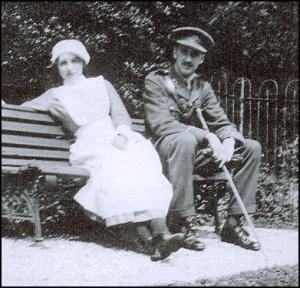
Vera Brittain and her brother, Edward, in 1915. Testament of Youth was my gateway drug to World War I.

I am the last person to tell you I get close to this ideal of detail. I strive for it, and do the best I can to be whatever character I’ve selected. I write this not from the position of someone who has mastered the past, but as someone who has seen technique and principles applied to one medium– film– that are applicable to living history, exhibit design, public programming, and writing. Jackson’s film illustrates the power of knowing details and the power of caring about those details not for trivia’s sake but for the Tommy’s sake. Those specific details serve to create the “everymen” of the War. The research to find which regiments are shown, to get the shoulder badges right, to find how what speech an officer is reading, prove the power of the archives. The past is there, waiting for us, in acid free boxes. We can restore the dignity and humanity of the people of the past by reading their words. Specificity creates archetype.

At the end, Jackson encourages the audience to ask their family members about their history, to find out what stories there are, to find out how the Great War touched them. He reminds us that those memories die with the people who carry them, unless we ask and write them down (or record them). That is perhaps the greatest public history lesson of all: that the past touches us all through the people we know and love, and that by knowing those stories, we can understand not only our family stories, but the history we all share.


Share this:

  • Click to share on Facebook (Opens in new window) Facebook
  • Click to share on Pinterest (Opens in new window) Pinterest
  • Click to email a link to a friend (Opens in new window) Email
  • Click to share on X (Opens in new window) X
Like Loading...

At Your Service

11 Thursday Oct 2018

Posted by kittycalash in Living History, material culture, Reenacting, Research

≈ 3 Comments

At Your Service

Trying something new in Adobe Spark. 

Share this:

  • Click to share on Facebook (Opens in new window) Facebook
  • Click to share on Pinterest (Opens in new window) Pinterest
  • Click to email a link to a friend (Opens in new window) Email
  • Click to share on X (Opens in new window) X
Like Loading...

Go Big When You Go Home

13 Thursday Sep 2018

Posted by kittycalash in 1830s, Clothing, Living History, Reenacting

≈ 2 Comments

Tags

1830s, chintz, Federal New England Fashion, Federal style, handsewn, militia, New England, Old Sturbridge Village, OSV

heading north

A year after moving, Virginia feels like home, even as I continue to experience accent-based misunderstandings and yearn for different apples. But if home is where the heart is, my home is split between the place where my kid grew up and goes to college, and where I live now. After having all vacations cancelled (thanks, Fairfax County Jury System), we scheduled one for the end of the summer, a chance to visit friends, antique (and buy a new school wardrobe for a college sophomore).

You can never have enough eagles or feathers.

The trip hinged on the Militia Days event at Old Sturbridge Village, with Drunk Tailor mustering as a member of the Oxford Light Infantry or “Ollies.” The OLI has a ridiculously shiny and ornamented shako, which contributes to the appeal of the impression. The early Federal-era militia units certainly appeal to me, with gold buttons, chain, tassels, and plenty of eagles everywhere. There’s a lot of visual myth-making to unpack there, and the fact that the muster re-enacts a sham battle makes it ever so much more so wonderful and New England. This is meta-enacting (or re-re-enacting), and I am all for it.

A new time period meant a new dress. And a new bonnet. And new hair– that last complicated by the new summer haircut. (I had a wool gown from the Turkey Shoot several years ago, but wool in August at Sturbridge is possible but not recommended.) So, what to wear? I remembered some lightweight chintz gowns in the Kyoto Costume Institute collections, and happily there’s one on their website (my copy of the book is still in storage). While I prefer the audacity of many of the reproduction cotton prints, the hand of the quilting cottons is often heavier than I want, so I ordered a print from India– one that has been used for many other dresses in different time periods.

With the antique lace collar I did not use, and the cut steel buckle I did.
piped seams!
piped seams!

The pattern is a straight-up version of the Past Patterns Lowell Mill Operative’s gown. The first 1830 gown I made was from the State Historical Society of Wisconsin pattern, which did not fit as well over the collar bones; the Past Patterns neckline resolves well and fits like a dream– the only change I would make the next time around is to make the back pieces smaller. I had way more overlap than I really needed, but otherwise, I was lucky that this required no adjustments to fit pretty well. Every now and then, it’s nice to have a break from drafting my own patterns and fighting with fit.

IMG_5136
IMG_20180901_131522523_HDR

Share this:

  • Click to share on Facebook (Opens in new window) Facebook
  • Click to share on Pinterest (Opens in new window) Pinterest
  • Click to email a link to a friend (Opens in new window) Email
  • Click to share on X (Opens in new window) X
Like Loading...

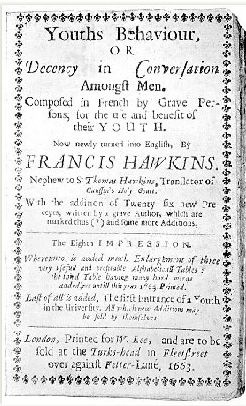
Codes of Conduct & Rules of Civility

11 Tuesday Sep 2018

Posted by kittycalash in Events, Living History, Reenacting

≈ 1 Comment

Tags

civility, codes of conduct, historical reenactors, personal, philosophy, progressive reenacting, Sharon Burnston

These have been a tough couple of years. We are, once again it seems, in a period of polarization and increasing political violence. In times like these, when disagreements flare brighter and behavioural norms are changing, even the things we do for fun can be affected. From online fights that turn nastier than ever to onsite behaviour that runs the gamut from passive-aggressive to hostile, the real world creeps into our fantasy worlds. I have experienced and seen behaviour that I find unacceptable. It was subtle, but not acceptable. When I posted about it online, a lively discussion ensued.

From that, an idea was born: Sharon Burnston suggested a Code of Conduct, which I heartily endorsed. Drawing on her experience organizing and managing events and groups, Sharon wrote a draft code of conduct. Now, with edits and suggestions from others, it is available on her website.

“We are all here at this site/event for the same purpose, to portray events that happened here in the past for the benefit of the public, and for our own enjoyment. We agree to follow the site’s rules for fire safety, gunpowder and weapon safety, curfew, alcohol consumption, and whatever other restrictions they require of reenactors. Just as we have agreed to adhere to standards for our clothing and our kit, it is appropriate that we agree to adhere to standards for our behavior. The standards for our behavior are modern, not period. We are interpreting history, not re-creating historical attitudes to class, gender, or race. We are 21st century people, and 21st century expectations apply.

In its simplest terms, treat everyone else as you would want them to treat you. Don’t be a jerk. But to break it down into specifics, and in order for this community to feel welcoming to the largest possible population, we expect everyone to endorse the following standards of behavior. Anyone who cannot adhere to these simple rules will not be invited to future events.”

Don’t be a jerk.

Seems so simple, right? Apparently not for everyone, because not everyone embraced a fundamental grade-school lesson:

“I will take responsibility for both my actions and my feelings. I have the right to have my feelings respected, I have the right to be heard and understood, I have the right not to feel pressured or browbeaten. I extend the same rights to all other reenactors and to the public.”

For me, this presents an interesting conundrum. You see, I kinda started this when I announced online:

Now, this is in fact a wimpy way to deal with a person who I think treated me pretty shabbily at an event, and who made clearly misogynistic comments at that event, and has posted white nationalist stuff on social media. A quicker-witted person than I would follow Sharon’s precept six:

“I will call out these inappropriate behaviors in others. If I see something, I will say something – either to the offender directly or to an authority figure – a captain, event planner/organizer, or someone I trust. I will stand in solidarity with my fellow reenactors and pledge to stand up to bullies, abusers, and other unpleasant behavior to ensure the safety and comfort of those around me.”

This last is easier for some than for others. It gets easier when one can believe that one will be listened to, heard, and taken seriously. And that is not on the person reporting: that’s on the person hearing. When someone’s feelings are dismissed, or another’s actions excused (he’s a good guy; he’s just insecure), the status quo is maintained, the ranks secured, and the world unchanged. It will take all of us to make places safe and pleasant to be it. A code of conduct we can all agree to is a good place to start.

Share this:

  • Click to share on Facebook (Opens in new window) Facebook
  • Click to share on Pinterest (Opens in new window) Pinterest
  • Click to email a link to a friend (Opens in new window) Email
  • Click to share on X (Opens in new window) X
Like Loading...

Down and Out in Upstate New York

27 Friday Jul 2018

Posted by kittycalash in Events, History, Living History, Reenacting

≈ Comments Off on Down and Out in Upstate New York

Tags

Continental Army, cooking, empathy, Fort Ticonderoga, pain, servants

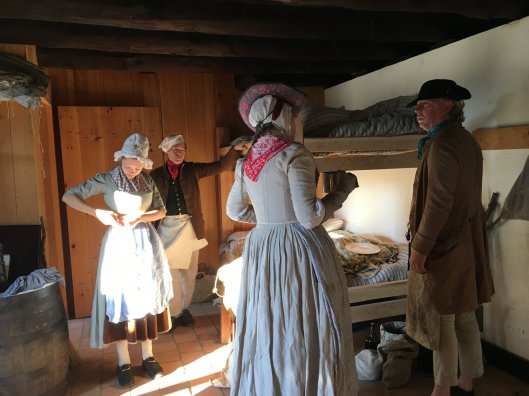
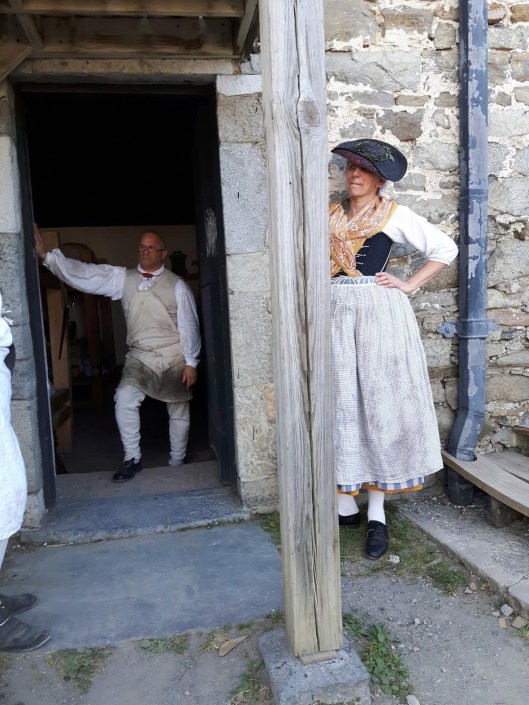
Other folks have covered aspects of this past weekend at Fort Ticonderoga, leaving me with little that needs adding but much to look into. Portraying a British servant is more intuitive for me than portraying an American: the hierarchy of the British is more explicit than the American, especially in a military context. We mimic the British structure, and while I considered that running a fort’s servant set might/should/would mimic that of a Big House, I wonder if that’s true.


Miss S, Mr. B., Your Author, and Drunk Tailor

How did a set of servants from different places, answering to different masters, interact? What  kind of rivalries developed? And who had ultimate below-stairs authority? It’s been a long time since I experienced workplace politics, so the past weekend gave me much to ponder about how the lower sorts managed– and managed up.

For me, the name of the serving game is managing the people you serve to make your own life easier. Servants had so much to do– as many of us do in real life– that the only way to manage the workload was to– well, manage the workload, or at least the person who set it.

As John Brown’s housekeeper, I ran a household of several (three+) servants and six residents. Even a household that small required extensive stair climbing and coordination, even without a working kitchen! The Browns never had more than three or four household servants we could document, which again makes me wonder about the actual number of servants a complement of New England officers would have.

Ow. That’s what my face means. Pierre was a trooper.

Thus far, I’ve found good quantification of servants in Philadelphia households in 1775, but have yet to crack the code on New England or Continental Army servants, so more hours on JSTOR await.

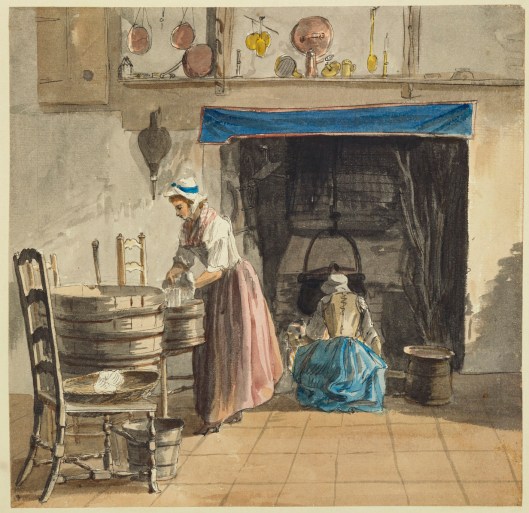
Paul Sandby. At Sandpit Gate circa 1752
Pencil, pen and ink and watercolor. RCIN 914329

No matter what one ultimately decides the research shows about the number of servants and their roles in an American occupied fort, I know I spent the day more immersed than I have been in a long time. Fort Ticonderoga provided a picturesque backdrop, and my body provided a four-dimensional pain experience reminding me of the tribulations of women in the <cough> period </cough>. I spent the majority the day (the part I was awake, anyway) experiencing the full joys of being  female and still fertile. The more I read about archaeology of the 18th century, particularly in the privies and trash pits, the more I think nearly everyone in the past felt pretty awful most of the time. If that hunch is correct, I nailed Saturday despite appearing in undress (which I can at least document to Sandby at Sandpit Gate).

Share this:

  • Click to share on Facebook (Opens in new window) Facebook
  • Click to share on Pinterest (Opens in new window) Pinterest
  • Click to email a link to a friend (Opens in new window) Email
  • Click to share on X (Opens in new window) X
Like Loading...
← Older posts
Newer posts →

Archives

wordpress statistics

Creative Commons License
Kitty Calash blog by Kirsten Hammerstrom is licensed under a Creative Commons Attribution-NonCommercial-ShareAlike 4.0 International License.

Website Built with WordPress.com.

  • Subscribe Subscribed
    • Kitty Calash
    • Join 621 other subscribers
    • Already have a WordPress.com account? Log in now.
    • Kitty Calash
    • Subscribe Subscribed
    • Sign up
    • Log in
    • Report this content
    • View site in Reader
    • Manage subscriptions
    • Collapse this bar
 

Loading Comments...
 

    %d