• Home
  • Completed Costumes/Impressions
  • Emma and Her Dresses
  • Free Patterns and Instructions

Kitty Calash

~ Confessions of a Known Bonnet-Wearer

Kitty Calash

Category Archives: Research

I Fall to Pieces: Extant Garment Fragments

03 Thursday Aug 2017

Posted by kittycalash in Clothing, History, material culture, Museums, Research

≈ 1 Comment

Tags

18th century clothes, CoBloWriMo, fashion, Federal New England Fashion, Rhode Island history, Sally Brown Herreshoff, style
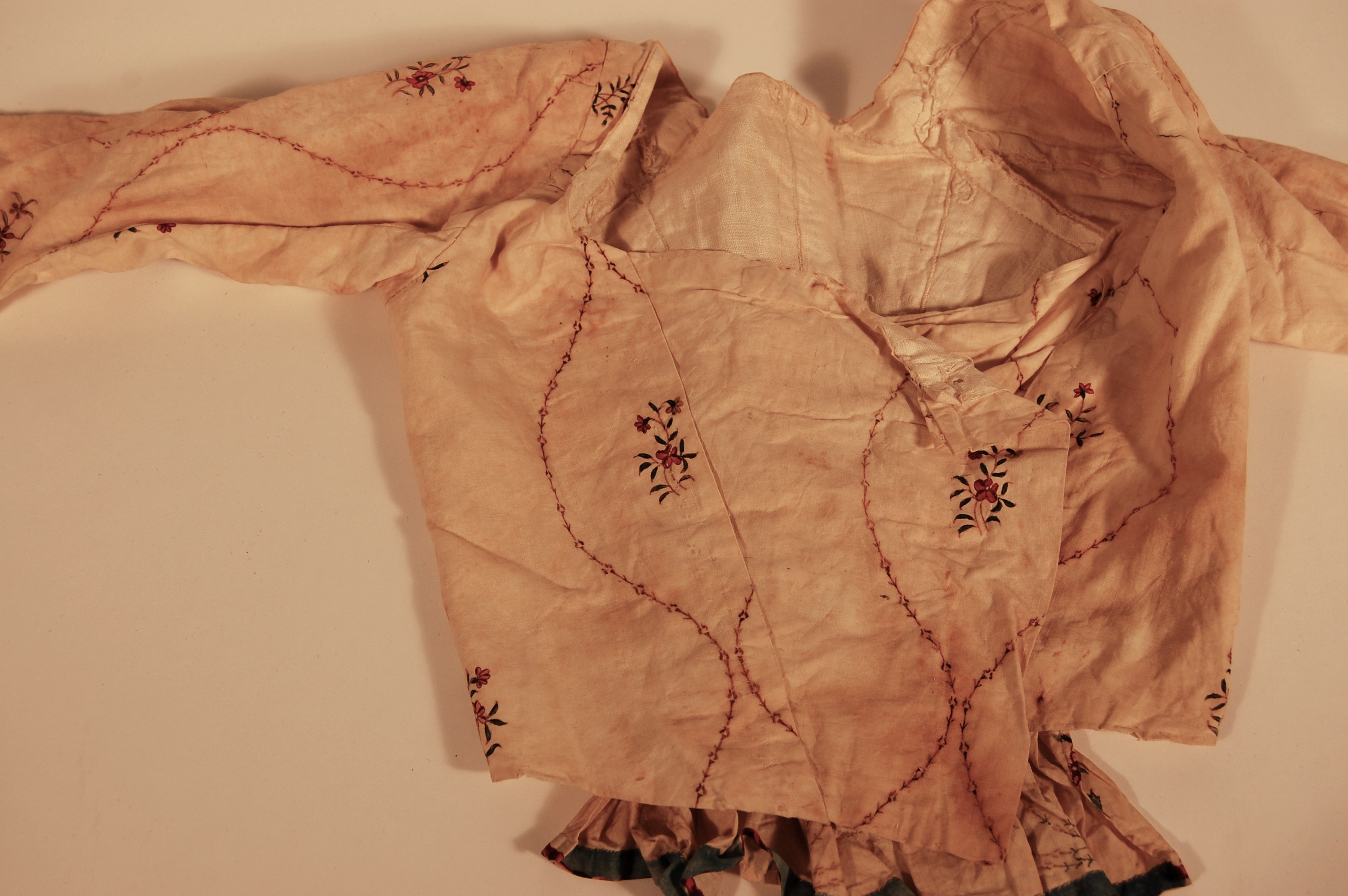
Bodice, painted Indian cotton, 1780-1795 RIHS 1990.36.27

Bodice, painted Indian cotton, 1780-1795
RIHS 1990.36.27

Once upon a time, not very long ago, when I worked in a historic house museum, I was asked to present at a conference in Worcester. I chose to talk about these fragments, and I still like to think about them. The delicate fabric was saved as a pair of sleeves, a bodice with a tiny peplum, a skirt.
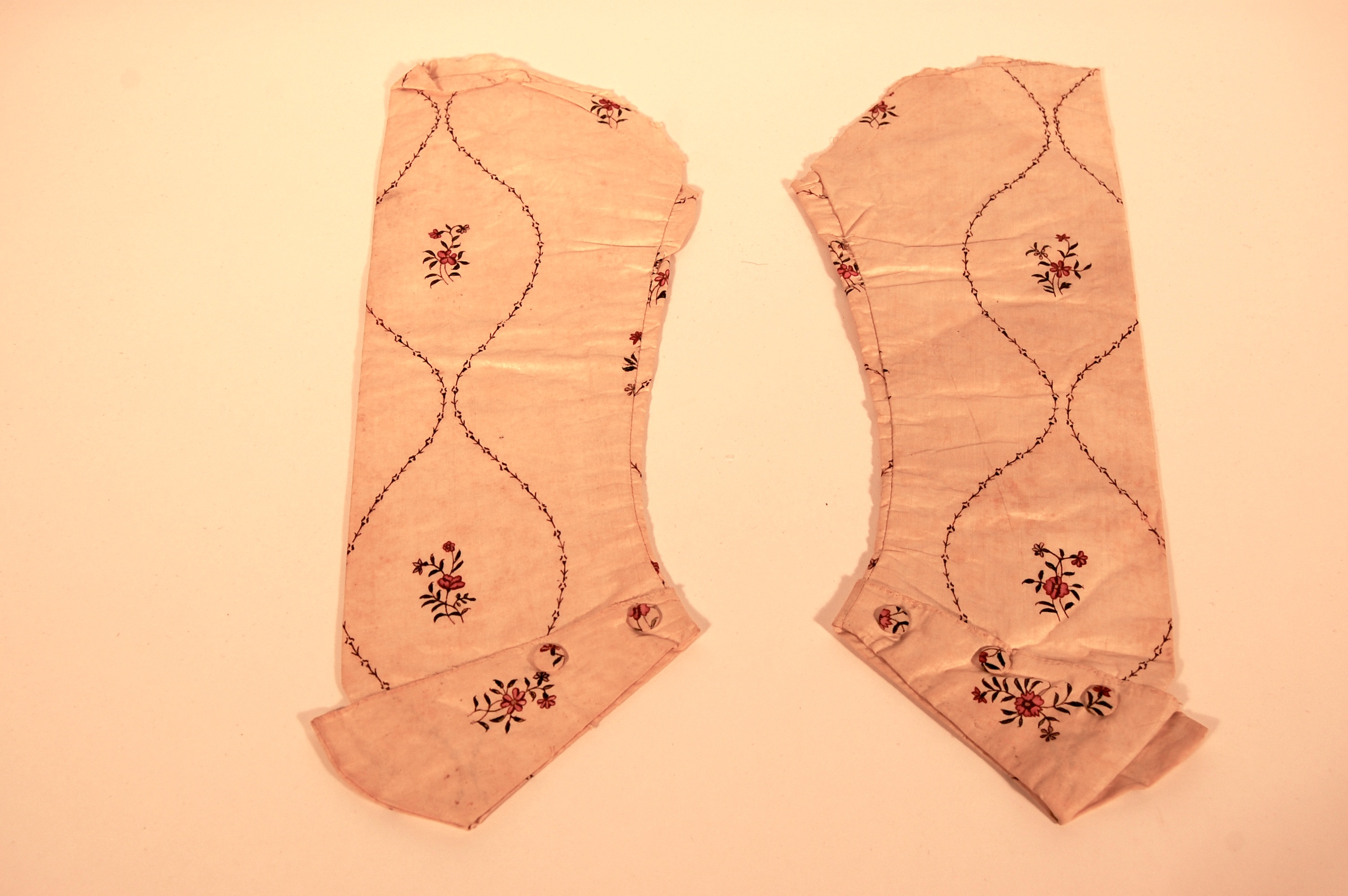
Sleeves, removed from bodice 1990.36.27. RIHS 1990.36.25A-B

Sleeves, removed from bodice 1990.36.27.
RIHS 1990.36.25A-B

The pieces appear to have been part of a pieced-back closed-front gown with a matching petticoat circa 1785. I think someone decided (quite rightly) that the style was too passé for 1795, and altered the gown significantly.

Not only is there evidence of new sleeves being fitted into the gown’s armscyes, we have the sleeves-that-used-to-be. And my dear! No one is wearing sleeves like that this season!

I find these garments in limbo really fascinating. Was that bodice finished and worn with a matching petticoat? (Yes, there’s a panel of that left, too; what a lovely hem!)
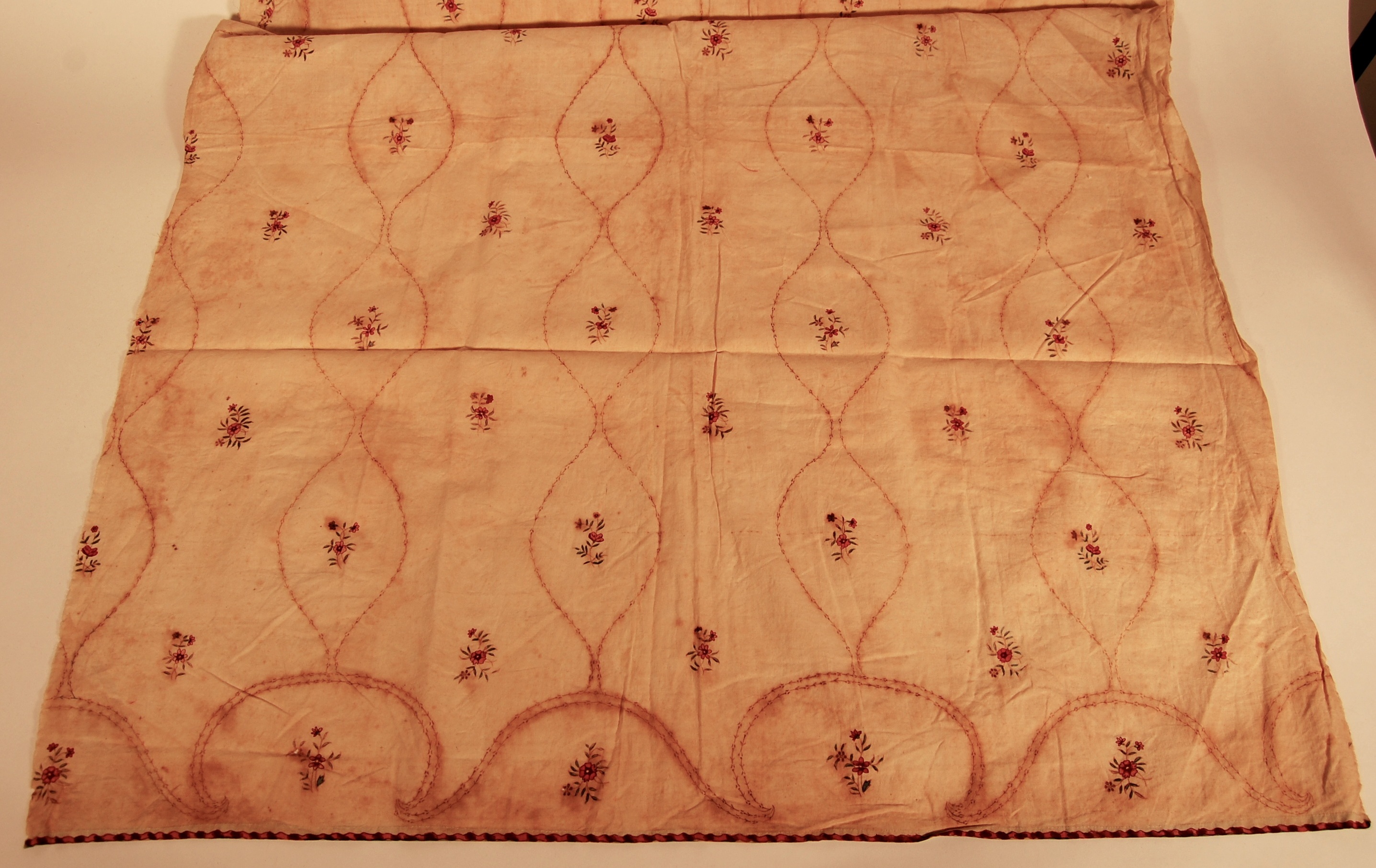
Skirt panel, painted Indian cotton. RIHS 1990.36.33

Skirt panel, painted Indian cotton.
RIHS 1990.36.33

Who wore the gown? Was it Sally Brown, born in 1773? And did she alter it, or did her sister’s mantua maker, Nancy Smith? We can only guess at this point, as so many documents remain in private hands. The alterations are not as finely done as the original gown, so I think there are two hands at work here– whose were those hands? There’s always more to think about and learn.

In case you’re wondering, thanks to the Met, we can see what the gown probably looked like in its first incarnation, and then what the alterations were meant to achieve. (Link to the gown on the left; link to the gown on the right.)

Robe a l'anglaise, 1785-1795 MMA 2009.300.647
Robe a l’anglaise, 1785-1795 MMA 2009.300.647
Gown and petticoat, 1790-1794 MMA C.I.45.6a,b

Share this:

  • Share on Facebook (Opens in new window) Facebook
  • Share on Pinterest (Opens in new window) Pinterest
  • Email a link to a friend (Opens in new window) Email
  • Share on X (Opens in new window) X
Like Loading...

Au courant? Un canezou

02 Wednesday Aug 2017

Posted by kittycalash in Clothing, Living History, Research

≈ 5 Comments

Tags

19th century, 19th century clothing, CoBloWriMo, fashion, fashion plates, Federal style, living history, Salem Maritime Festival

Collier de Lapis. Canezou a Manche[?]

This.

Because, August (or Aôut). The Salem Maritime Festival is nearly upon us, so there’s a flurry of bonnet and accessory and other making happening chez Calash as there usually is in summer. It’s one of my favorite things to do, and this year I was asked if the millinery setup could be more of a demonstration.

That’s a kind of relief, actually, as it allows me to bring bonnets from multiple years in a variety of levels of completion, which allows me the luxury of talking about evolving styles and a variety of construction methods. Whether or not I’ll manage a drawn bonnet is still up in the air; it’s a lot of hand sewing for someone with carpal tunnel.*

Because any trip to Salem affords me the opportunity to join the mercantile class, I like to take the opportunity to make something new and non-working class when I go up there. This year, I was taken with the canezou. What’s a milliner to do, but stay as up-to-date as possible? What the heck is a canezou?

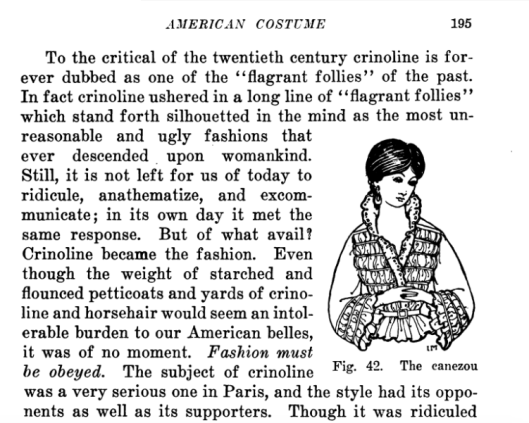
Well….roughly, from the French and English costume history books, the canezou is a short, Spencer-like garment, often in white, lightweight cotton, worn over another garment. The canezou seen here clearly has sleeves, and the plate is dated 1811, giving the lie to the wikipedia’s assertion that it’s circa 1835. (The later evolutions have become more scarf or fichu-like, but are again worn over other gowns- though apparently it enjoys a brief time as the cambric blouse worn with a riding habit. And then there’s another definition, by another fashion historian, in which the canezou is described as being like a man’s shirt.

Well, that’s all cleared up then….

With this information in hand, and the fashion plate before me, I perused the contents of the Strategic Fabric Reserve, and lit upon those popular Ikea curtains which have appeared here before as a gown and as a petticoat and now as a canezou.

I modified a Spencer pattern for the base lining of white cotton, and then draped, stroke gathered, and stitched the curtain fabric to form the floofy bodice. The lace on the cap sleeves is reclaimed from a late 19th century negligee lurking in Drunk Tailor’s collection of usable old fabrics, while the lace at the bottom was reclaimed from an antique petticoat before I picked it up in Sturbridge, MA a few years ago.

To complete this, a bodiced petticoat with an embroidered hem (machine embroidered, of fabric I may have picked up from a remnant table in Pawtucket, RI), a pair of trimmed shoes, a necklace (here of sapphire blue stones, unless I can teach myself hand-knotting by Friday), and a bonnet of blue and white check silk that arrived just in time from India. Five new items in two or three weeks: the price of fashion is slightly mad.

*Hand-sewing everything has, at last, caught up with me. I find soaking my hands in cold water helpful, as well as sleeping in those super attractive hand braces. Imma need some surgery, but for now, braces, Aspercreme, and ice water must do.

Share this:

  • Share on Facebook (Opens in new window) Facebook
  • Share on Pinterest (Opens in new window) Pinterest
  • Email a link to a friend (Opens in new window) Email
  • Share on X (Opens in new window) X
Like Loading...

Circles and Lines

10 Monday Apr 2017

Posted by kittycalash in Events, personal, Research

≈ 2 Comments

Tags

dancing, Events, Federal New England Fashion, Federal style, Regency

Merrymaking at a Wayside Inn, watercolor on paper by John Lewis Krimmel. 1811-1813. Metropolitan Museum of Art, 42.95.12

By some miracle, I did not have the Polecats in my head all weekend, despite spending most of Saturday only dancing. It has been some time since I danced (February’s adventure notwithstanding) and after two hip replacements, my Giant son is correct: I’m still re-training my muscles. My feet remember more than my hips do, but at least some of my muscles remember!

The Commonwealth Vintage Dancers Regency Weekend was this past weekend, and while I could only manage Saturday (Sundays are for chores when you’re expecting houseguests for Easter), I had a wonderful time and sincerely hope I can retain what I was taught. The company was very friendly and quite genteel, though I can report that I did experience a variety of partners, and, in one unfortunate case, became so confused I had to step out of the dance entirely. (Mixed rhythms and mixed-up steps became far too jumbled in my poor brain.)

The Five Positions, from An Analysis of Country Dancing, T. Wilson, 1811.

The entire day reminded me strongly of being in a novel, or, as Drunk Tailor said on hearing the description, a movie. Let us merely note that some gentleman are more enthusiastic appreciators of music than others, and that a partner can be left feeling a bit flung about in some of the figures that involve the mouliner. My rusty memories of French came in handy: mouliner and mill connect easily enough for me (seen here, in Prince Kutusoff) and the Boulanger made much more sense when I connected it to mixing bread dough. Hey– whatever gets you through the set without stepping on your own, or anyone else’s feet!

I’d like to think I will remember something of this business the next time I get to dance, whenever that may be. The patterns can be found on line in manuals (as in this description of Sir Roger de Coverly) with some occasional, bearable, videos— and, as always, resources close to home.

Next time: the dress. Until then, I’m posting more on Instagram.

Share this:

  • Share on Facebook (Opens in new window) Facebook
  • Share on Pinterest (Opens in new window) Pinterest
  • Email a link to a friend (Opens in new window) Email
  • Share on X (Opens in new window) X
Like Loading...

Sleeping on the Job

03 Friday Feb 2017

Posted by kittycalash in History, Living History, Museums, Research

≈ Comments Off on Sleeping on the Job

Tags

authenticity, common people, interpretation, John Brown House Museum, Museums, Research

img_9092

Last night, as I lay in the tester bed we slept in on What Cheer Eve, I wondered again what it was like to live and work in the house over the course of its life, and how the servants had been treated. In the late 18th and early 19th century, the notion of “service” was still evolving in New England. Help was common, and while northern and urban slavery existed, and we know the Browns traded in and owned enslaved people, we have no evidence of them in the house.

We know there was a white woman between 45 and 60, and four “all other free people,” we have names –Mary, Jonathan, and Gideon– for some of the people associated with the family, but don’t know their details. How did the Browns treat them? What was the relationship like? Were they invisible? Thanked? Chastised?

Goody Morris makes up a bed. Photograph by J. D. Kay

Goody Morris makes up a bed. Photograph by J. D. Kay

Diary entries that record “my babe takes tea with Ma’s Mary” suggests that there was some level of familiarity, and hints at the friendly relationship children and servants sometimes had in these houses, when both were seen as less civilized, less refined, and (clearly) less educated than the adult homeowners. Physically, service stairs kept chamber pots, laundry, food, servants, and children out of view, sequestered into smaller, dimmer, less-finished spaces.

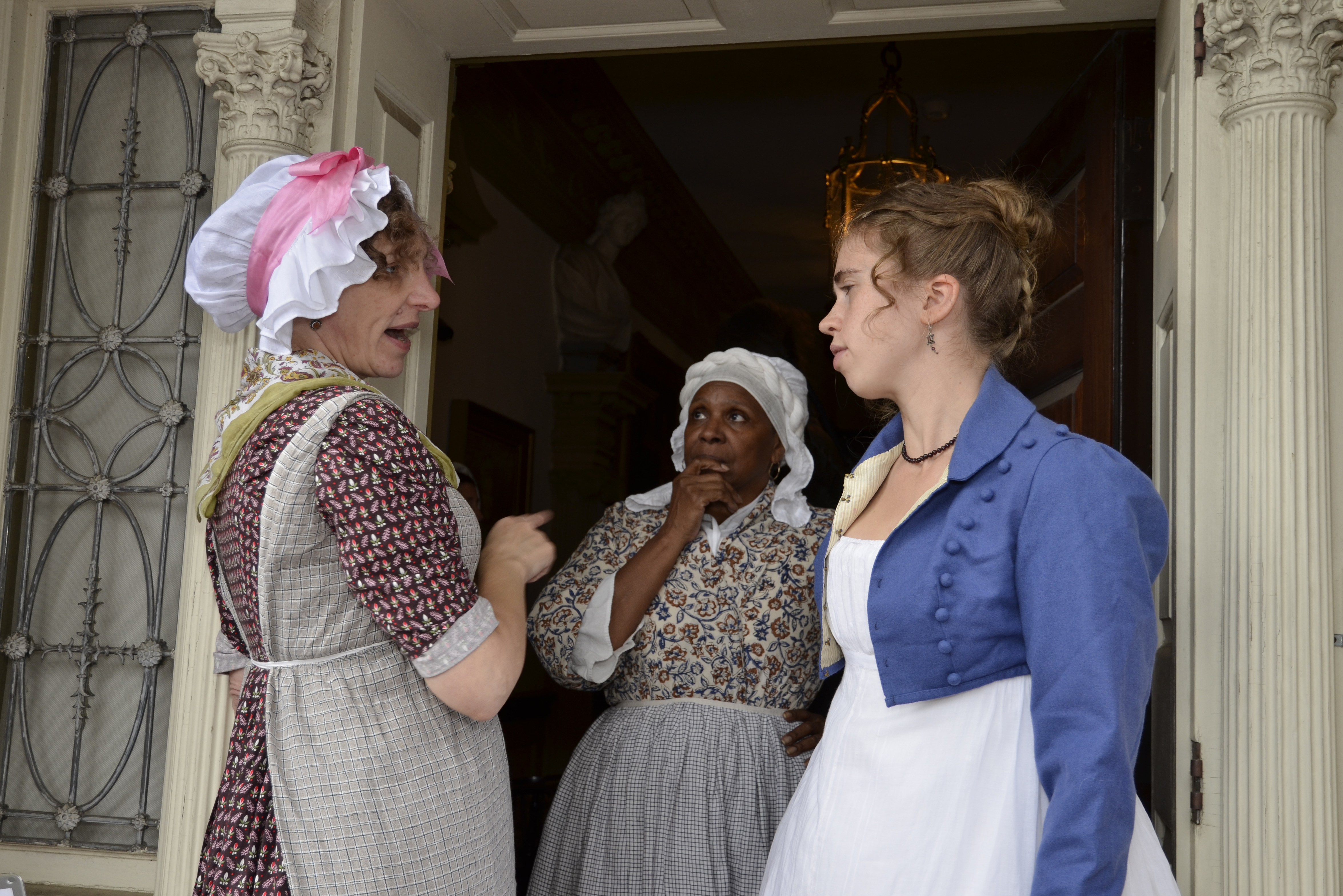
Petulant Alice faces her first hurdle, Kitty and Goody Morris. Photograph by J. D. Kay

Petulant Alice faces her first hurdle, Kitty and Goody Morris. Photograph by J. D. Kay

We’ll never really know how the Browns really treated their servants, or felt about them; these are people who matter only enough to be remarked upon in passing. Perhaps even more frustrating is that we’ll never know what the servants thought of the Browns, of their businesses and moods, loves and appetites. These barely-documented people could tell us so much, if only the past could talk.

Share this:

  • Share on Facebook (Opens in new window) Facebook
  • Share on Pinterest (Opens in new window) Pinterest
  • Email a link to a friend (Opens in new window) Email
  • Share on X (Opens in new window) X
Like Loading...

Frivolous Friday: Fashion Flashback

18 Friday Nov 2016

Posted by kittycalash in Frivolous Friday, History, Making Things, personal, Research, Thanks

≈ 3 Comments

Tags

18th century clothing, authenticity, Costume, cotton print, East India trade, fashion, friends, party clothes, sewing, thanks

IMG_6945
I don’t know about you, but the past ten days or so have been surreal in a way that I haven’t experienced in a dozen years or so. Numerous creative folks I know are working hard to find new, engrossing projects and sharing what they find with others. As always, Satchel Paige has excellent advice: Don’t look back, something might be gaining on you.

What project shall I take up again, to distract myself from the shorter days and colder temperatures?

This is actually making reasonable progress, and might even be done by early December.
dscn4571

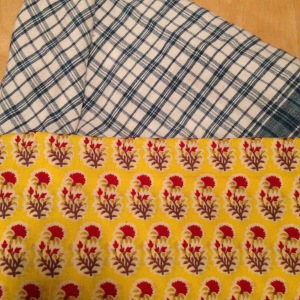
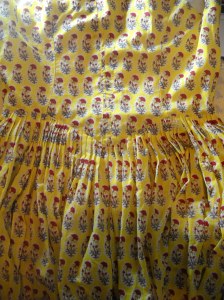
It’s satisfying work, pleating and stitching this lightweight cotton, tiny stitches in white linen thread. I’ve made some modifications to the pattern, but not many, aiming for a 1780-1782 style. Judicious cutting and generous friends will, fingers crossed, even yield a matching petticoat, which is very exciting indeed– and an unusual fashion statement chez Calash. Here, we focus on clash, but the fabric itself takes care of that for me.

dscn4572
dscn4573

Now, if only I had bright red morocco leather shoes to wear with this, that would be a sight indeed.

Share this:

  • Share on Facebook (Opens in new window) Facebook
  • Share on Pinterest (Opens in new window) Pinterest
  • Email a link to a friend (Opens in new window) Email
  • Share on X (Opens in new window) X
Like Loading...
← Older posts
Newer posts →

Archives

wordpress statistics

Creative Commons License
Kitty Calash blog by Kirsten Hammerstrom is licensed under a Creative Commons Attribution-NonCommercial-ShareAlike 4.0 International License.

Website Built with WordPress.com.

  • Subscribe Subscribed
    • Kitty Calash
    • Join 621 other subscribers
    • Already have a WordPress.com account? Log in now.
    • Kitty Calash
    • Subscribe Subscribed
    • Sign up
    • Log in
    • Report this content
    • View site in Reader
    • Manage subscriptions
    • Collapse this bar
 

Loading Comments...
 

    %d