Petticoat Burns

Tags

, , , , , , , , , ,

Per Hillstrom, Kitchen Scene

You know this site, right? History Myths Debunked examines the stories about the past many like to think are true, and Death By Petticoat is one of the favorites. Here it is on an English site catering to reenactors. There’s a variation I’d never heard, about wetting petticoat hems to keep them from engulfing the wearer in flames. (OK, mild exaggeration: to keep the petticoat from igniting fully, thus… hat tip to Back Country Maiden for pointing this out.)

As someone who just finished mending a petticoat, you’d think I’d leap at the chance to drench my hem in water to prevent future mending episodes, but not so. For one thing, in the house or in the camp, that’s water I had to haul or cause to have hauled, and I’m not wasting it. Wet the hems and what’s next? Caked lumps of ash, mud, and.or other filth. No thanks.

High-tech historical cooking

High-tech historical cooking

The burns I got in my dress were acquired at the end of the day when we were hearth cooking and were practically in the fireplace ourselves. That is where you must be if you wish to stir the sauce until it thickens, and there was the hoisting of roast in its pan a couple of times, and general playing with fire in pursuit of food. My ca. 1799 dress is longer than my 1770s petticoats and gowns, and the extra inch or two probably contributed to the burns. But I wasn’t engulfed by flames, because the damn thing is wool. Self-extinguishing wool, worn with linen and wool petticoats and a linen apron. not going to go up in flames. Also not going to get dipped in water–and wouldn’t that result in steam and hence scalded shins?

I don’t know where these rumours start, but they could have started with a cynical curator joking with house tour guides who failed to get the joke. Not that I know anything about a story of about Providence kitten named Georgie in honor of George Washington’s visit to a large brick house on a hill .
Sense and Sensibility and Secretions

Tags

, , , , , , ,

Mended holes

I managed to mend my dress this weekend, motivated primarily by its odor and the desire to hang it up for an airing.  The holes at the hem were such that the patch had to be applied over the fabric and not behind. It tends to wiggle, but the mends are done and the dress is hung up to “air,” which means  it is “in the drafty front hall trying to make my coats smell like wood smoke, tallow, and animal secretions.”

I told you my feet were big.

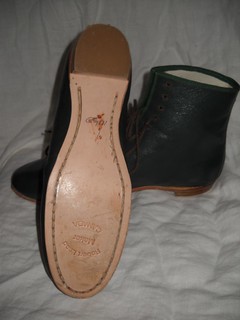
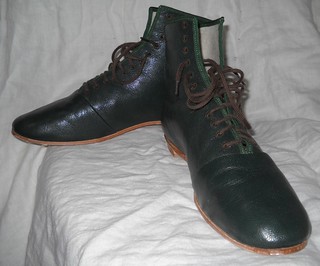
The Robert Land shoes arrived on Saturday, along with a heavy box of wool. That’s tucked away for now (trousers and overalls come first, oh my) but not the boots. Ignore the size marked on the sole–that’s a vanity size–but note the smears. I believe that for the shoemaker, as for so many of us, the historic item is not done until you have bled upon it.

I should note here that the shoes really make ones feet look like the feet of women in fashion plates. Those trippy little poses with dainty toes are achievable in these, and the minute I find someone to photograph that, I will. It’s a very different foot experience from 18th century buckle shoes.

It’s not done until you’ve bled on it.

In a mark of solidarity, I bled on the ribbon that’s going on my new bonnet. I spent Saturday making, and unmaking, a remaking, a late 1810s bonnet. I’m still not quite satisfied with the shape, but have the silks and ribbons ready for when I convince myself to go ahead and stitch it up. Sunday I made a late 18th century/early 19th century bonnet. After bleeding on the trim, I finally had the sense to stop.

Feeling 1820ish

Tags

, , , , ,

Walking Dress, 1820

Walking Dress, 1820

For no good reason, I’ve been feeling 1820ish. This is a huge distraction from my primary objectives, which for the short term are 1775, 1799, and points in between. The in-betweens depend on what unit Mr S is fielding with, and at which event. Monmouth, for example, is the 235th of the battle fought June 28,1778 in New Jersey. The Second Helping regiment was at that Battle, (I checked the order of battle and know from diaries like Jeremiah Greenman‘s) and that means that his regular old hunting frock (called the “fluffy shirt” by my Facebook friends) would do, if—and only if—he fields with the Second Helpings. If not, then it is another piece of work altogether. Major casualties at that engagement were from heatstroke, by the by, so it may be that wearing two layers of wool in New Jersey in June is not recommended by most physicians.

But I digress, yet again.

e14fa91f099434a95ac644c723e8cfaa

I am feeling 1820sish because Robert Land has, at long last, shipped my Regency Lady’s Boots. They should arrive by Saturday, and for having ordered them in mid-October for a mid-January event, we are actually on fairly normal Robert Land time. Sigh. I’d get mad, but the man’s shoes fit my pedal extremities, which really are colossal.

So the boots are on their way, in green, and while they won’t be exactly like these, they can be modified, with blue laces to begin with, and tape later. 

And that has led me to think about the obstreperous bonnets of the 1820s, like this fantastic quilted item from the MFA,

Quilted Bonnet, MFA

There are dresses at the V&A for which I have comparable fabric, and Spencers at the Met, and many fashion plates to delight (see the Pinterest board. I may not get any of these things made, but they’re fun to think about—especially the bonnets.

This is all supposed to be fun, isn’t it? It’s surely more fun than moving 18,240 books (some of them twice) which we did this past week at work.

Projects A-Waiting and Awry

Tags

, , , , , ,

One of things I like about the HSF series is that it keeps me sewing. It’s good to have accountability, and the challenge provides it. Structure, and deadlines: good for the soul.

And then there’s that factor known as work. We’ll call it that, as the effects are often described in language not suitable for the New York Times, last bastion of manners. Poor William Shawn spins as each New Yorker is printed: he’d never let douchebag pass.

But I digress.

Things changed in the schedule and now I don’t have to sew delicious frock coats and corduroy breeches for February. The good news is that I will not have to wrangle the unwilling to be fitted immediately, and I will be that much more skilled by Fall, when the clothes will be wanted. It also means (sort of) that there is actually time to sew for me. This is a very good thing, as I am planning to attend Dress U and even to teach (heaven help us all) two classes, one on using museum records and collections online and in person, and another on what Reenactors and Costumers can learn from each other. So while I’m thinking about 1790s wool jackets and trousers, a Battle Road-worthy wool gown (pfft! Gowns seem easy now!), Battle Road men’s wear (a little queasy, not so easy) and at least one more pair of overalls (unprintable, really) I am also thinking about how much I don’t want to be the tiara-less, non-sparkly girl again.

What does that mean? That means silk, and the Curtain-Along Gown, which I think I have figured out. (Figuring out the silk part will come later, I’m just happy to have gotten this far…)

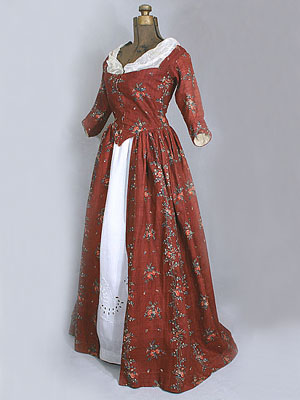
1780-1790 chintz gown

1780-1790 chintz gown

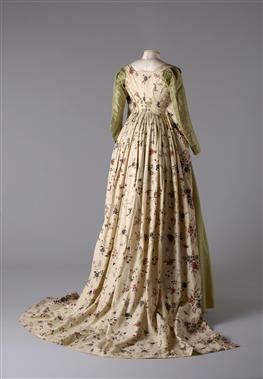
Fairfax House

Fairfax House

Historical Sew Fortnightly  #3 Under It All: I meant to do my shift, but that changed. Voila, petticoat. I have Ikea cotton curtains that will make a lovely petticoat that can be worn with a Curtain—Along gown of the dark red Waverly chintz, which I plan to make in the style of one of these gowns. An all-cotton, all-curtain ensemble makes me laugh: I am a Carol Burnett fan.

If I get the petticoat done, then I will have to make the pretty dress, at least eventually, which should be sometime between overalls (April 20) and Dress U (May 31).

10th Mass LI at Nathan Hale

10th Mass LI at Nathan Hale

That leaves time for something wicked regimental this way comes by June 15. Oh, yes, I expect Monmouth is in my future, humidity, turnpike and all. Why would I miss that?

A Visit with the Ladies

Tags

, , , , , ,

The apple never falls far from the tree, my mother used to say, of me and my grandmother, her mother, Elsa. Elsa went to a woman’s college, majored in botany, graduated in the mid-twenties, and went back to western New York State, where she opened an eponymous dress shop.

Elsa, Studio Portait ca 1935

Elsa, Studio portrait ca 1935

Elsa managed that shop for more than 50 years, dressed most of the women in town (or at least the type of woman who knew how to dress, and be dressed), and even dressed a woman who later became a donor to the architectural collection I managed in St. Louis.

She was a controlling woman, no doubt, and carefully managed and cared about her appearance. She was also a lady of a steely, ladder-climbing type native to the 1940s and 1950s, full of the foibles and desires of the daughter of immigrants who spoke Swedish at home. The stories they told about her would make a cat laugh: the day the local radio station called and Elsa answered the phone (on air? That part was never clear) to find out that the household had won a month’s supply of white bread.

“Oh no,” she said. “I don’t believe we care for that,” and hung up.

Not of the quality to which she had become accustomed, you see: she insisted on some picky particular white sandwich bread for fancy lunches, and otherwise ate the limpa rye the cook or  Ingeborg made. All the household help was Swedish, as were the women who did alterations at the shop.

Elsa married late, at 35, and her husband moved into the house she shared with my great-aunt and their father, August, known as Morfar after my mother was born. Buying trips to New York for her store resulted in the delivery of boxes from Saks Fifth Avenue, deliveries that came so often, in such quantity that my grandfather questioned her.

“I don’t know,” she said. “They just keep sending them.”

Elsa in Italy ca. 1980

Elsa in Italy ca. 1980

They were boxes of shoes, spectators and sling backs, pumps, court shoes, Cuban heels, stilettos, peep toes, sandals, every kind of shoe you can imagine, and all in brown, tan, beige, ecru, off-white, cream, none of them black or red or blue or green. Beige: that was her signature color, beiges and browns with occasional accents of coral or green or gold. She assigned blue to her younger sister, my great-aunt Gladys, and when Gladys once dared to buy a beige dress she liked, Elsa had a temper tantrum. A quiet one, but effective.

She died before she could meet my husband, died before I was married, and I am sorry about that. But I remembered her this week when I went with my friend (and Registrar) to visit two older ladies, sisters, on the East Side. We picked up a collection of clothing worn when the two ladies (now in their early 90s and late 80s) were babies, the wedding dress their mother wore in 1918, the dress one wore in 1939 that her daughter wore again in 1970, with quite the wrong black moccasins, at a Christmas Eve party in Georgetown.

The sisters reminded me of my grandmother and aunt, and the clothes reminded me of what my grandmother sold and boxed and wrapped in her store. Sitting at the mahogany table for lunch, drinking tea and eating a slightly stale roll, I missed Elsa and Gladys terribly, but was glad for all they’d taught me about how to behave and what the world was like for independent women in the 1940s and 1950s