Objectivity

Tags

, , , , ,

Recently I’ve had more than my share of time to think about museums and objects, and what they mean to me and why I love them, and have dedicated my life to them, albeit a bit accidentally.

Transferware in open storage, Metropolitan Museum of Art, May 2013.

In the hours I spent alone in a curatorial office, listening to the murmur of school tours on the other side of the door, I began to see that curation and registration are means of managing the evidence locker of the future. We collect, tag, and maintain the means by which the future will understand the past, and it’s our job to be a neutral as we can—to refrain from laying the thumb of our prejudices on the scale—as we collect objects, images, and documents. It’s a game of forecasting, trying to guess what will best explain us and our time to the future, as well as Monday morning quarterbacking as we both weed and augment what was collected in the past to better reflect how we understand history now.

I was always a stickler for good data and record editing (and have raccoon-eyed photos of a catalog launch to prove it), and I make unkind sport of museum databases on a regular basis when I see misidentified and misdated objects. Good data matters—it’s everything, really—because if you don’t know what you have, and where it is, you might as well not have it. But more than that, compendia of data can show you things you didn’t expect to find.

RIFA Record 4925

Yale’s Rhode Island Furniture Archive is a good example of how a massive amount of data can be used. Take this record of side chair possibly made by John Carlile and Sons, and scroll down. That’s a lot of associated chairs. And they all look very similar. Examining the materials, especially secondary woods, of a labeled chair and comparing the style, make, and materials with other very similar chairs can help identify chairs, associate them with a maker, and provide a sense of Carlile’s production volume.

And Carlile’s easy! Looking at hundreds of pieces of furniture with some location provenance, reading probate inventories and other documents helped untangle James Halyburton or “Ally Burton” as a maker.


James Halyburton in the RIFA

When you can see enough things at once, you can discern patterns and better understand exactly what it is you’re seeing. Good data makes that possible, makes concrete what was once solely seen as connoisseurship, and helps bring unknown stories, unrecognized people, to light. Data analysis is a powerful tool for better understanding the past: that’s why museum collections matter, and why I think it’s so important for museums to make their data accessible. It’s one of the ways we understand our collective past.

Ceci n’est pas une assiette

Tags

, , , , , , ,

Historic American Buildings Survey, George F.A. Palmer, Photographer, 1937 DETAIL OF PARLOR FIREPLACE. – Jeremiah Dexter House, 957 North Main Street, Providence, Providence County, RI

Last weekend, Drunk Tailor and I delivered the Giant to his new life as a college student back in New England, and paid a call on of my oldest friends, a 96-year-old former OSS agent and descendent of the Dexter family. My eldest friend had something she wanted to give me: a souvenir of the Dexter House, in recognition of the hours I’d spent working with her identifying and organizing several hundred years of family papers.

In the photo at left, the coffee pot on the mantle is now in a museum collection, as are the miniatures, the bellows, and the pipe box (which is now on display in a historic house museum). What my eldest friend gave me is not in the image of the house, but resembles the plate to the left of the fireplace: a Staffordshire transferware “Village Church” pattern plate with a wild rose border, ca 1825.

Transferware soup plate ca. 1825. Unknown maker, Staffordshire, England.

I’m a fan of blue and white china, and while I prefer earlier Canton ware, this plate is more special to me than the ones I’ve bought at auction or in New Bedford antique shops: because of course it’s not a plate, it’s memory, or an emotion, made solid.

Drunk Tailor and I spent an early Sunday afternoon on my friend’s porch listening to stories about her children, in particular about her daughter Mary, now an artist living in Mexico. Is it a comfort or an annoyance to learn that schools have been misjudging children since schools were invented, trying hard to fit round pegs into square holes? Mary, always more interested in drawing than in lectures, once left a classroom when the teacher said, “If anyone doesn’t want to hear this lesson, then they can leave now.” Out Mary went, three other girls following her out to play on a beautiful spring afternoon.

That story, and many others, aren’t apparent in the plate with its crazed face and discoloration. Only my memories (and anything I write down and keep with the plate) make the associations. But it is always the stories about the objects that make them important (even big-ticket dec arts items, like Plunkett Fleason easy chairs.)

Last night, before Drunk Tailor and I watched The Maltese Falcon, we watched Adam Savage’s TED talk on his obsession with objects. The TED talk is worth a watch for anyone interested in material culture and objects. Our human fascination with things goes beyond the shiny surface of new things (tabernacle mirrors or iPhones) as they become repositories of memory, symbols of feelings or moments.

War correspondents and personnel of the Office of Strategic Services, leaving from the Railhead, Camp Patrick Henry, Virginia, enroute overseas. NARA. National Archives Identifier: 542171 Local Identifier: 336-H-17(E8671)
Creator: War Department. Army Service Forces. Office of the Chief of Transportation. 3/12/1943-6/11/1946

This: In my desk drawer, I have a buckeye Drunk Tailor picked up and handed to me in a garden in New Jersey. It’s useless: inedible, too light to be a paperweight, but it reminds me of that November afternoon, the soft green of the garden, and how shy I felt. Anyone cleaning out my desk would toss that bit of organic matter, even as I keep it as a talisman of one of our first dates: the places, the smells, and the feelings.

And this, too: My friend is 96. I may never see her again, though when I left her, she was healthy and cheerful, making plans for the fall with her children, grandchildren, and great-grandchildren coming to visit. Given my reticence and her old-fashioned New England reserve, I may never be able to tell her how much she means to me (I try), or how interesting I think she is. (“I’m not interesting, dear, I just worked hard,” is what she says when I try to convince her to donate her personal papers to an archive.) But I have a plate that was in a house that had a great deal of meaning to her, and my best guess is that her gift of that plate to me means she knows how much I like and admire her. It reminds me of her, and reminds me of how little time there is before all that’s left is the plate and my memories.

Headspace: Where I Work

Tags

, , ,

An Ikea secretary of my own keeps most stuff organized.

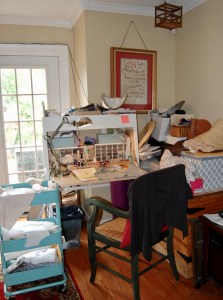
I haven’t had a proper studio since I was just out of grad school and living in a three room apartment with one room dedicated to making. Since then, as I’ve taken on the baggage and responsibilities that come with two- and four-legged associates, I’ve given up a room of my own. Instead, I have have a desk of my own. And the dining table when I need it, which is most days until it’s dinner time. It works within the space we have, and best of all, the secretary can be folded closed when we go away, protecting delicious feathers and tempting beads and ribbons from marauding cats.

And the dining room table, of course.

Whatever space I have, or you have, I find the most important space is the one in my head. That’s where projects are born and die, where they’re planned and tweaked, where problems are solved. It’s the first space you have to get in order if you’re going to do your best work. Walks help. When I get stuck writing or sewing, walking usually shakes loose the next idea or solution.

A break from sewing, coming soon to the shop

To keep that headspace clear and organized, and happy working, I find music more helpful than TV, though many a Nazi Mega Weapons or screwball comedy has eased an evening of backstitching long seams. Lately, Spotify has been my go-to, thanks to these playlists. Listening to them is listening to how someone else’s brain works, which is incredibly enlightening. Whatever your art form, stepping outside your usual genre can be more inspiring than endlessly revisiting the same galleries and sources. Who better than the writer of Hamilton to show us the way?

Draping and Dreaming

Tags

, , , , , ,

Why have just one dream project when you can have more than you can possibly achieve? Here, in no particular order, are things I’d like to make or achieve but probably never will:

Charles James (American, born Great Britain, 1906–1978)
“Cossack”, 1952
American,
wool; Length at CB: 46 in. (116.8 cm)
The Metropolitan Museum of Art, New York, Brooklyn Museum Costume Collection at The Metropolitan Museum of Art, Gift of the Brooklyn Museum, 2009; Gift of Muriel Bultman Francis, 1966 (2009.300.402)

Charles James: American master of draping fabric. I have nowhere and no reason to make or wear this coat, but the lines and fabric appeal to me. This skill level is currently beyond me, but I recognize that I have enough historical clothing that I could get out of the 18th and 19th centuries to concentrate on learning the couture techniques of the 20th century. Many muslins went into making this, and a deep understanding of fabric. One of the best things about the Met’s Charles James collection is the large number of muslins. Costume and clothing designers’ sketches, muslins give us a good sense of how a designer thought, and what steps went into a garment.

Balenciaga is another favorite. Evening gowns, suits, and coats, all deliciously draped.

House of Balenciaga (French, founded 1937)
Rain ensemble, fall/winter 1965–66
French,
cotton ; Length (a): 42 1/2 in. (108 cm) Length (b): 24 in. (61 cm)
The Metropolitan Museum of Art, New York, Gift of Rachel L. Mellon, 1987 (1987.134.23a, b)

Lest you think I only like coats, the “Tulip” dress is equally interesting.

House of Balenciaga (French, founded 1937)
Evening Dress, 1964
French,
silk ;
The Metropolitan Museum of Art, New York, Gift of Baroness Philippe de Rothschild, 1973 (1973.21.8)

Thanks to the V&A, there are digital animations of the construction of the tulip dress, which has deceptively simple pattern pieces. The video was created in support of teh V&A’s Balenciaga exhibition, which I am sorry not to be able to see.

Equally out of reach is this: a remodeled silk lampas gown. The idea is to make the first gown– that is, the gown suitable for the fabric’s earliest date (which is probably not 1790, but closer to 1740-1750) and then alter that gown to the late 18th century style.

Unknown maker. Gown, 1790. French, silk, The Metropolitan Museum of Art, New York, Purchase, Irene Lewisohn Bequest, 1964, (C.I.64.32.2)

This last “dream” project is more achievable, though somewhat academic. Silk lampas fabric can be found, and there’s a simpler alteration project in lampas at the V&A

Gown, Spitalfields silk, ,
1740 – 1749 (weaving) 1740 – 1749 (sewing)
1760 – 1769 (altered) 1950 – 1959 (altered)
Given by Mrs H. H. Fraser Victoria and Albert Museum, T.433-1967

.

Goose Me, Baby, One More Time

Tags

, , ,

Ironing en plein air: Mr Hiwell with Voldemort

Pro tip: PRESS. Press ALL the things.

Press the seams, the sleeves, the joins, the skirts. Press it good. Press it again.
Press as you go, and your clothes will fit better and go together more easily.
Press your clothes before you wear them, and they’ll look better.

I have a Rowenta iron affectionately known as “Voldemort” for its tendency to hiss and belch when waiting to be used. The iron is so noisy that my son once said, “Gesundheit” reflexively when it sat between seam pressings.

Voldemort himself

It’s a “Pro Master” model, from a clearance rack at Bed, Bath and Beyond (which is why I could afford it).  While it’s not the top of the Rowenta line, it’s heavier and steamier than my previous Rowenta, which was knocked to the floor by someone else too many times in early morning shirt-and-tie pressing sessions. That iron developed a nasty over-heating habit, and was eventually chucked into the yard where it burned a neat iron-shaped hole in the grass… don’t drop your irons, kids.

In addition to the Rowenta, I have a Sunbeam  with a retractable cord,  purchased to replace the overheating Rowenta. It, too, is heavy and steamy, and was my go-to iron until I used someone else’s better Rowenta at a sewing workshop.

The best steam iron you can afford is worth every penny for the difference it will make in the drape and finish of your garments.

Lance needles: the best I’ve used.

Bonus Pro Tip: Use the smallest, sharpest needles you can work with. Smaller needles = smaller stitches.