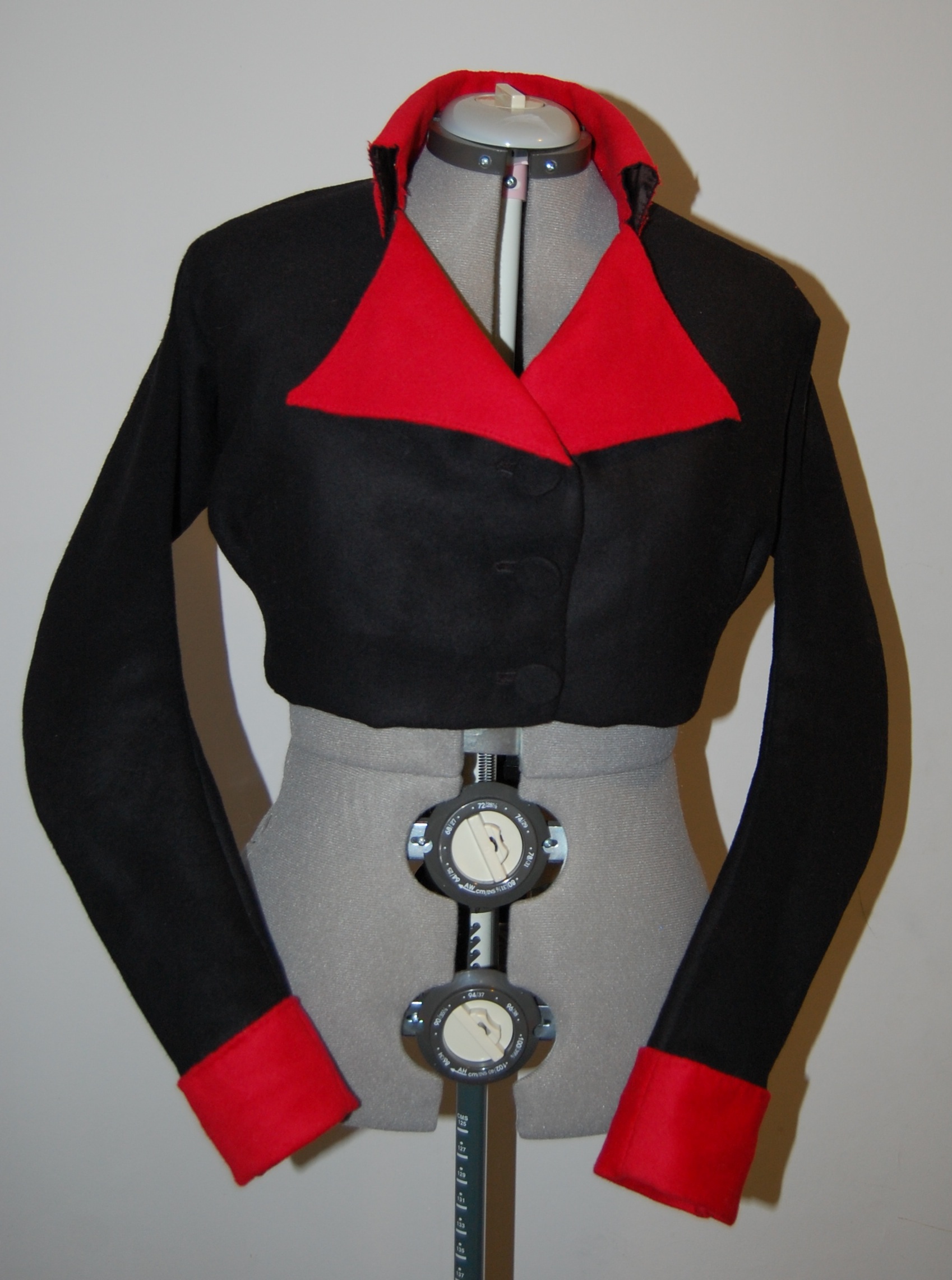
HSF # 26: Celebration Spencer

Tags

, , , , , , , ,

Cassandra in her new Spender.

Cassandra in her new Spencer.

This was supposed to be for #25: One Metre (yard) but things went awry. now it’s cause or #26, Celebration.

Make something that is celebration worthy, make something that celebrates the new skills you have learned this year, or just make something simple that celebrates the fact that you survived HSF ’13!

Heck, I survived the last two weeks of 2013, and that’s reason enough to celebrate. Water at work, relatives at home, high-stress holidays: if you can’t say anything nice, don’t say anything. So on to those pesky facts!

The Challenge: #26, Celebration! with a backward glance at #25, One Metre

Fabric: 34 inches of double-faced Italian wool, bought at Apple Annie Fabrics as a 50% off remnant after she found it in a pile. The collar is lined with black silk taffeta and interfaced with buckram. The sleeves are lined with black silk Persian from Wm Booth Draper, but I used taffeta on the bodice to give it more body. Technically, that’s almost two yards because it’s two kinds of fabric. Initially I didn’t plan to line this, but the edge did not hold as well as expected so I ended up breaking the rules in order to make a better garment. Celebrate rule breaking! Also, better sewing skills!

The pattern pieces on 34 inches of fabric. One cuff is pieced.

Pattern: My own, mostly. I started with the Sense & Sensibility pattern, and then modified it to make the first Spencer, working my way towards the double-breasted broadcloth of the Swedish Spencer. I first modified the lapels, and then, in order to match the arm scye to the sleeve correctly, modified the bodice at the side, and at the shoulder point. I used the Janet Arnold Spencer/riding habit as a reference, and then measured up the Leloir pattern to check my work. The two-part sleeves are borrowed from Henry Cooke’s 1770s man’s frock coat pattern taken from that extant suit; the collar and cuffs came from the same place.

Once I reshaped the sleeves from the elbow to the wrist (as I do not have a gentleman’s forearms of steel), I concentrated on adapting the bodice to make the seam sit properly on the shoulder line. Watching Mr Cooke manipulate Mr S’s garments made this a lot easier to do.
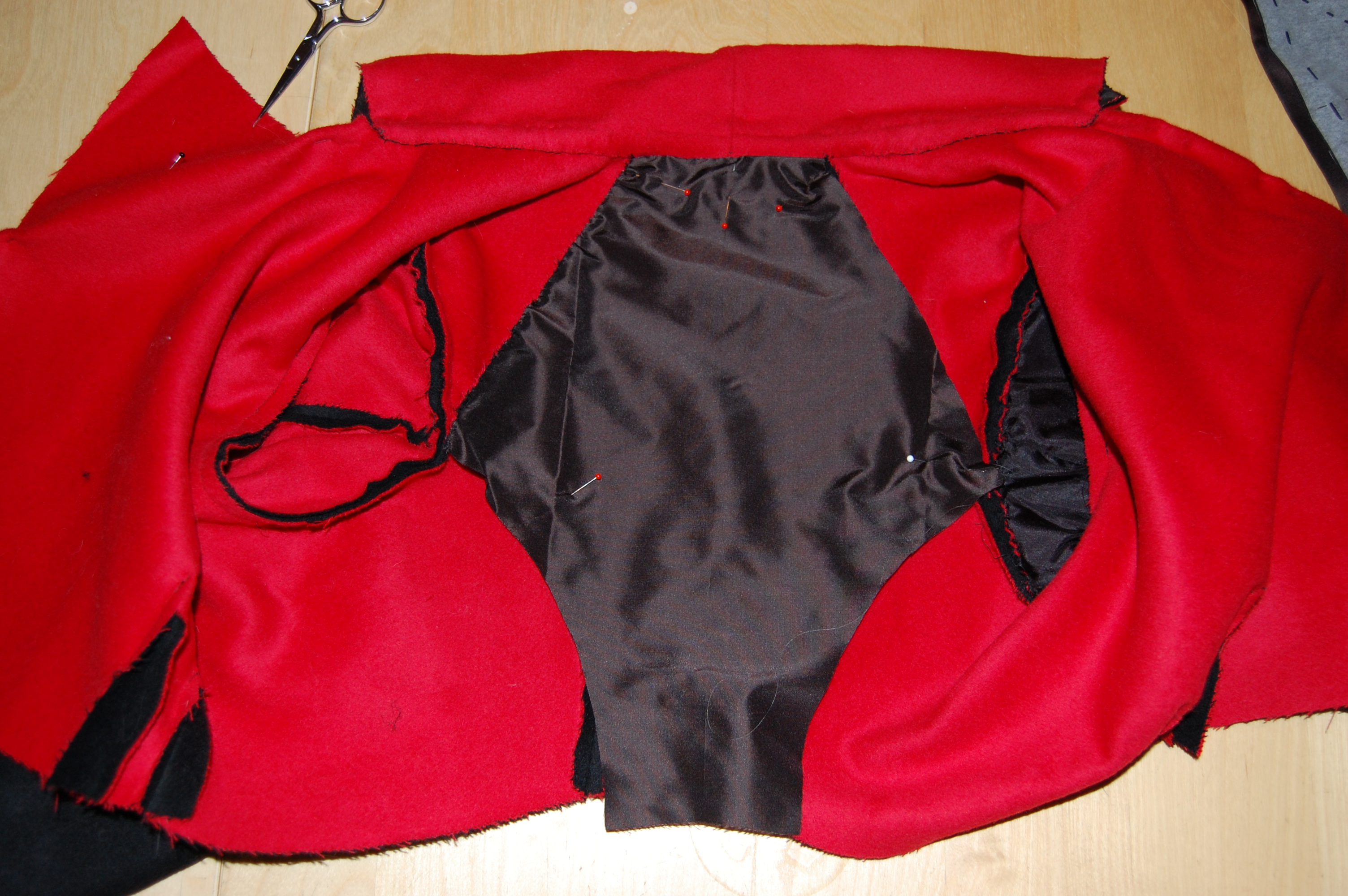
Inside view in progress.

Inside view in progress.

My theory was that if you thought of a Spencer as a miniature frock coat, starting with a man’s pattern might be the way to go. I played with that in a theoretical way, but did not pursue it fully, as I was committed to the double-breasted look.

Year: 1797, if you take the Amazon as the inspiration and marker, which I do. This style, and even the revers, persists for a while, at least in fashion plates. 1797-1800 seems about right. (See the expanded Pinterest board for examples)

Notions: Thread counts, right? Also button molds. But that was it.

How historically accurate is it? This is always the toughest part! I have verified the revers, the style, the fit, and the pattern pieces. The garment is entirely hand-sewn of the most period-appropriate materials I could find. I found reference to a very similar example in a Danish museum; if I had possessed enough fabric for a cape, I would have made one. The inaccuracies will be in details of techniques and the lining materials, which were chosen to ameliorate the very snug fit. Is it 90%, with points off for not being able to time-travel back to buy my fabrics from Providence merchants in 1797? Aside from the Andes Candies coat, I think this is the most accurate and nicest thing I’ve made yet.

The shaped back piece.

The shaped back piece.

Hours to complete: 12 to 18 for the pattern and muslins. Each sleeve took 30 minutes to pin and stitch into the armscye, but the long seams were more time consuming. 12 hours of sewing, perhaps? It seems like more than 30 hours, but once the pattern was done, parts of this moved quickly. (Personally, I love setting sleeves and sewing curvy back pieces.)

First worn: Not yet. As soon as I can talk Mr S into taking photos, I’ll wear it, but right now I have no firm plans for wearing it, which makes me sad. Wouldn’t it be a fun thing to ice skate in? Except for the very authentic way it pulls your shoulders back, which could compromise your balance.

Total cost: $15 for the wool, $6.50 for thread, and $2.80 for button molds; $8 for the amount of silk Persian for the sleeves, the taffeta was in the stash, so $24.30.

Mischief Managed

Tags

, , , ,

Providence during the Great New England Hurricane of 1938

Providence during the Great New England Hurricane of 1938

Who doesn’t wish they could wave a wand and make a collections emergency disappear? You have to be a serious masochist not to want that.

But as my architect says, Silver linings, silver linings.

Every disaster has a silver lining. We’ve had what we call a “water event” at work. That’s a terrible thing in a place full of historic and irreplaceable items. But there is good news!

1. We found it and contained it quickly.
2. We had rapid response from staff, building mitigation professionals, mechanical engineering contractors, and our architect.
3. No one was hurt.
4. Collections were moved off-site and into freezers rapidly.

We were lucky: we have an emergency preparedness plan and we’ve been through several smaller events both in the Museum and in the Library, so we know when to roll out the wet-vac, call the HVAC technicians, and call the NEDCC hotline. We know to make lists and document as we work. We know who is good at what, and how to work together, and we trust each other.

Because of our plan, our rapid response and super team, we were able to contain the problem and less than 1% of the affected items, which is phenomenally good fortune, were actually “wet.” Everything else was “damp.”

We’re also very lucky to have responsive vendors who are already familiar with our systems and our rules, and who we always pay on time. Some shared history) helps, too.

So, what will help you successfully manage your next emergency?

  • A response plan that you have updated, practiced and tested
  • Fully-stocked response kits
  • Clearly defined and understood team roles
  • Respectful relationships between team members
  • Excellent relationships with vendors you trust
  • Each of these things takes time to build. We’re re-vamping our kits now and have already seen improvements based on this experience. Why not make a New Year’s resolution to make a plan for home or for work? You’ll never regret it if you need it!

    Overtaken by Events

    Tags

    , ,

    The Great Gale of 1815

    The Great Gale of 1815

    I had a plan for this week, but was overtaken by events. Eventually I’ll have a post for HSF # 25, along with thoughts about ways to estimate laundry tub diameters. Until then, make sure your emergency response plans are current and your sidewalks cleared of snow.

    Washington Memorialized

    Tags

    , , , ,

    An Indian Mourning Washington, Chinese School ca. 1799. American Museum in Britain, 58.124

    Today marks the 214th anniversary of the death of George Washington, memorialized here in a Chinese reverse-on-glass painting. I suspect that the figure of the Indian personifies the North American continent rather than the actual tribes, given Washington’s role in the French and Indian war, but that’s only a guess.

    Lucy Child, 1800. RIHS Museum Collection, 1922.4.1

    Washington was memorialized in Rhode Island as he was everywhere else, with eulogies and speeches, and letter of condolence to his widow, who wrote back to four young ladies of Providence, enclosing a lock of hair.

    Memorial samplers and embroidered pictures were popular projects for girls and young women in 1799, and the RIHS Collection holds a [sadly worn] tribute to Washington.

    Fortunately, the National Society of Colonial Dames of America holds a sampler with the same text, made in 1803.

    Columbia’s fair daughters forever shall / mourn While genius stands weeping at / Washington’s Urn. Let hope still support / you Fair daughters arise. In faith that your / Washington’s soard to the skies. Where / still as your guardian he’ll ever preside. / To virtue and goodness the Polestar and / guide.

    They just don’t write poetry quite like that anymore.

    Breaking into Museums (for research, silly)

    Tags

    , , , , ,

    Curator’s storeroom, World Rugby Museum

    So, how do you get into museums?

    Most of us come into through the front door, pay a fee or show a membership card, and enjoy whatever spectacle we’re after. Some of us like jelly fish, some of us like taxidermy, some of us like clothes.

    A universal constant for going behind the scenes is a specific, and not a general, request. You can say, “Show me all your spoons,” but not even please is going to help when there are thousands of spoons.

    I like researchers: they’re always interesting, they see the collections in ways I don’t, and they have insights that are valuable and useful. But someone who wants to see all the spoons, or all the chairs, or shoes, or fire buckets is really hard to help: There are too many of each of those things. Specific shoes, chairs, fire buckets or coats are manageable and realistic. “May I make an appointment to see spoon 1492.1.12, please?” is a question a curator, registrar, or collections manager can work with. One spoon, two spoons, five spoons, a few pairs of shoes: Studying these few things can take a great deal longer than you might expect.

    STEAM Museum of the Great Western Railway storeroom

    Think about it this way: in a Special Collections Library, you generally don’t begin with, “I’d like to see all your material on the Civil War.” For one thing, that will be a lot of stuff. Chances are good you won’t be interested in all (or even much) of it. What you’re really after is usually more specific. “All your home front diaries written by women over the age of 44,” or perhaps it’s “Battle accounts written by chaplains in the field.” Those requests archivists and librarians can and will gladly handle, and through a reference interview, can help you identify not just specific items on your topic, but help you think about your topic. But asking to see all the diaries (or anythings!) at once, is usually a non-starter. They’re all in separate collections, in separate boxes, on separate floors. Heck, I work in a place with hundreds of diaries, and I am pretty sure they’d call my therapist and the cops if I asked to see all the diaries at once. (Tempting thought that it is.)

    Once in my life have I seen “all the somethings” pulled out from storage in a museum.  The Curator of  Photographs and Prints and a visiting (contracted) scholar were selecting daguerreotypes for an exhibition, and in my very junior role as the Curatorial Assistant, I got to pull out all the daguerreotypes by Thomas M. Easterly and help spread them out on an enormous mahogany table. I’ll never forget how beautiful that was, and how special, to see so same silvered plates and brass mats spread out on a dark surface. If this link is stable, you can get a sense of what it was like. Once, in a quarter century of working in museums. Sad, isn’t it? more people should get this chance, but it’s rare. However, this rule is in place for the preservation and security of the objects.

    Yes, I want this wall of chairs. The Röhsska Museum, GÖTEBORG, Sweden

    These kinds of restrictions are part of why museums have open storage, and it’s why I wish we could have open storage. But most museums don’t, so the key to getting into the storerooms (or the research rooms) is to ask the right way. I did a presentation on the process, and there’s more good advice over at the Still Room Blog.

    Always, in museums or in libraries, if there’s a catalog, start there! You can narrow down your choices with database searches and questions in advance so that you can make the absolute most of the time you have. Your time is precious. Focusing in on what you really want to see will help the museum’s staff help you better. And if you really enjoy a collection, please consider supporting it financially, with a donation to a collections care fund, annual fund, or a membership. Your dollars count, they’re noticed, and they’re truly appreciated.