Dogs in Coats

Tags

, , , , , , , ,

[An amazonian dress]. London : Pubd. May 26, 1797, by G.M. Woodward, Berners Street. Lewis Walpole Library Image Number lwlpr08972, Call Number 797.05.26.02

[An amazonian dress]. London : Pubd. May 26, 1797, by G.M. Woodward, Berners Street. Lewis Walpole Library Image Number lwlpr08972, Call Number 797.05.26.02

I was wondering about contrast revers on women’s clothes, and if I could really get away with such a detail on a Spencer, when I happened upon this image on Pinterest. Well found indeed from 1797, and very nice hat as well. Bonus: Giant Muff.

The dog has a coat, too, and now that it’s cold in New England, the local whippets are turning out in their winter coats. Mr S and  I had a slightly crazy notion to dress a dog we know in a canine-scaled replica of a certain very special coat, but would need access to the hound (for measurements) and a particular scrap pile. With those circumstances not in the offing, let’s just be delighted that dogs in 1797 wore coats, and had bows in their topknots, which means that the end of civilization has been coming for a lot longer than previously thought.

Of course it may be that the dog has to dress as a human to keep from being eaten by the ENORMOUS and possibly carnivorous MUFF of DOOM. I think you could make one from the sheepskins at Ikea, if you could settle for white.

HSF # 24: Re-Do (Thank goodness it’s done!)

Tags

, , , , , , , , ,

Shirt, view number one

Shirt, view number one

Like a zombie, I’ve returned to the Historical Sew Fortnightly with an undead shirt. I was working on it in August 2012, and at long last, it is really complete. So I offer it up as the Re-Do for HSF #11: Squares, Rectangles and Triangles, as it has no curves at all. (Well, aside from any wonky cutting I may have done.) It would also work for HSF #15, White, as it is actually white. Things happened in the basket along the way to getting done, and the half-made body had to washed.

The thing about shirts is that they don’t look like much unless they’re well photographed, preferably on a human or a mannequin with arms. I lack the latter, and the former specimens were not worth asking, since they’d been made to work all weekend.

So, some facts are in order. right?

The Challenge: #22, Re-Do. (# 11 and/or #15)

Fabric: White Linen, 5.3 ounce, I think. It was a while ago.

Pattern: This would have been cut from the Kannik’s Korner shirt pattern, though more by using the pieces to mark and measure and make sure I had all the small squares and bits the pattern takes.

Year: 1770-1790, depending. At their class level, the guys can keep wearing this kind of shirt for a long time. (It will be the Young Mr’s.)

Notions: Two thread buttons, one bone button; all three from my strategic reserve as the new selection of thread buttons has vanished (I blame the cat).

How historically accurate is it? Well, let’s give it 75%. It’s all linen, but the selvedges aren’t right, the stitching is variable and the insides are not all finished correctly. Patience, Iago, patience…there will be time for the last felling over whipstitching. I suppose for the common shirt it is, the coarser linen and variable stitching might boost the accuracy a bit. 82% for intentions, points still taken off for knowing what’s wrong with it.

Hours to complete: Freaking endless. I lost count, but in the end, probably five hours to finish button holes, felling, hems, and side gussets. The problem is that it’s repetitive and boring: back stitch, prick stitch, slip stitch, hem, all in straight lines. And this was shirt number three (four is right behind for Mr S) so the thrill’s gone out a bit.

First worn: Rejected in nearly-finished but unhemmed state by the Young Mr at Fort Lee, thoughit would have stayed in his trousers better than his too-small-clothes, he’ll wear this shirt in February at a celebration of Washington’s birthday.

Total cost: $17.74 for the fabric, I forget for the buttons and there’s always thread in the house. Call it $20 all told.

Sweeping Clean

Tags

, ,

Sweeper 1746, Etching with some engraving Harris Brisbane Dick Fund, 1953 MMA 53.600.588(56)

This is how we’ve spent our time off: quite a bit of cooking, though I did much in advance (the oven is large enough to cook only a turkey and nothing else, at one time), and even more cleaning and clearing and rearranging. After all, my mother will arrive in three weeks, which is not very much time at all when you have working weekends along the way.

with any luck, there will be a tidied up office/ironing room in which I could sew out of the way of certain felines, but at this point I’d settle for folded laundry and calmer cats. They remain convinced that cleaning is an exercise in cat assassination, though they can offer no proof that any cats have ever succumbed to death by vacuum cleaner.

Servant Girl Plucking a Chicken
Follower of Nicolas Bernard Lépicié, French, 1735–1784
MFA Boston, 65.2650

Living history, reenacting, historic costuming: whatever you want to call what we do most weekends, it runs to a lot of gear, in the end. The year we took my mother to Fort Lee, she remarked on how much baggage we had. “You’ve got lives in two centuries,” she said, and it’ true. We just about do. So how to store all that stuff, while making more and improving what you do have, is a challenge. Most reenactors I know have somewhat cluttered houses, or at the least houses where the historical items are integral to the decor. That is probably the most rational tactic, since most of us love what we do and enjoy how chairs or mugs remind us of fun, if challenging, weekends.

We have tried to be ruthless this weekend chez Calash, channeling deaccession rules (duplicate? unrelated? irrelevant? away it goes!) and hoping that when we are done we will have only what is necessary, useful, and beautiful. Or, at the least, a clean house to survive my mother’s eye.

to render sincere Thanks

Tags

, , , ,

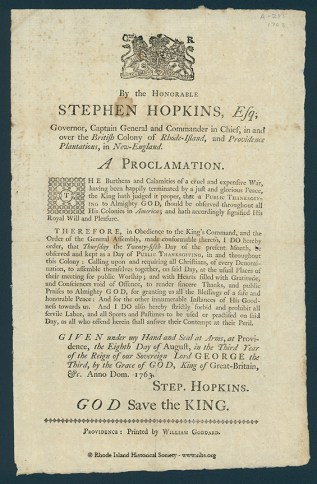
Proclamation of Thanksgiving, Stephen Hopkins, 1763. RIHS G1157 Broadsides 1763 No.7

Proclamation of Thanksgiving, Stephen Hopkins, 1763. RIHS G1157 Broadsides 1763 No.7

It’s the cheater’s way out, but here you are: the Rhode Island Proclamation of Thanksgiving celebrated at the end of the Seven Year’s or French & Indian War, in August, 1763.

And the transcription, in case the long form ‘s’ gives you trouble. You’ll note that Hopkins does “strictly forbid and prohibit all servile Labor, and All Sports and Pastimes to be used or practiced on said Day,” so that lets some of us out of football games, if not the servile labor of cooking a meal.

We’re not ones for shopping (truly, my heart sank when the Young Mr reported the urgent need of long-sleeved shirts, as this is the time of year when I frequent only the victualers), so this weekend will find us tidying up the house and arranging our gear.

We’re thankful for all the usual things, like jobs and family and friends, and for all the places we’ve been and have yet to go. May you have much to be thankful for, too. The regularly scheduled festivities will return tomorrow or the next day, depending on the progress we make on the house cleaning and on a bottle of sherry.

A Good Day for a Greatcoat

Tags

, , , ,

A greatcoat or driving coat from 1812

A greatcoat or driving coat from 1812

It is lashing rain on the windows chez Calash, and soon enough the present-day chariot known as the Subaru will commence hauling Mr S to the train station and the Young Mr to school. Bikes and buses are unpleasant in the rain, though the Young Mr is always (and only) driven to school on Wednesdays due to a peculiar busing and schedule arrangement.

But what if they lacked this luxury, and had to venture out? The way it sounds out there, the smartest choice would be to stay at home by the fire, but someone  has to fetch the wood and the water, and someone has to milk the cow and fetch the fool cat in.

b201bb1306af9b5d4dfbbe8fdb321ea8

Greatcoat, Chester County Historical Society. from Fitting and Proper, by Sharon Burnston. Scurlock Publishing, 1999.

If you could afford one, you’d wear your greatcoat (new or second-hand).

Made of broadcloth, this would be your non-flammable water-resistant choice for inclement weather. Woven and then milled, the fabric would be dense enough to resist water and hold a cut edge, which makes those capes a more winning proposition.

Over a slim-cut body, layered capes can emphasize and exaggerate shoulder width, making these utilitarian garments sexier than you’d expect. (Of course, I have a thing for guys dressed like this, so your mileage may vary. But by the Civil War, the lines are boxy and, well, yawn.)

Greatcoats aren’t even remotely on my list for this year, but someday I’d like to make one, if only to borrow it. Baby, it’s cold outside.