• Home
  • Completed Costumes/Impressions
  • Emma and Her Dresses
  • Free Patterns and Instructions

Kitty Calash

~ Confessions of a Known Bonnet-Wearer

Kitty Calash

Tag Archives: 18th century

Sewing for the Adjutant

25 Thursday Apr 2013

Posted by kittycalash in Clothing, Living History, Reenacting

≈ 3 Comments

Tags

10th Massachusetts, 18th century, 18th century clothes, common dress, menswear, Revolutionary War, sewing, uniforms

Falling In, OSV 2012

Falling In, OSV 2012

We were invited to join a Massachusetts regiment after the event at Old Sturbridge Village last summer, and we did. This has been a good thing, though it’s sometimes a little tricky to figure out which unit to “be” with. It is also a challenge because even though the Rhode Island unit has careful (if unwritten and slightly out-of-date) standards, the Massachusetts unit is another thing altogether.
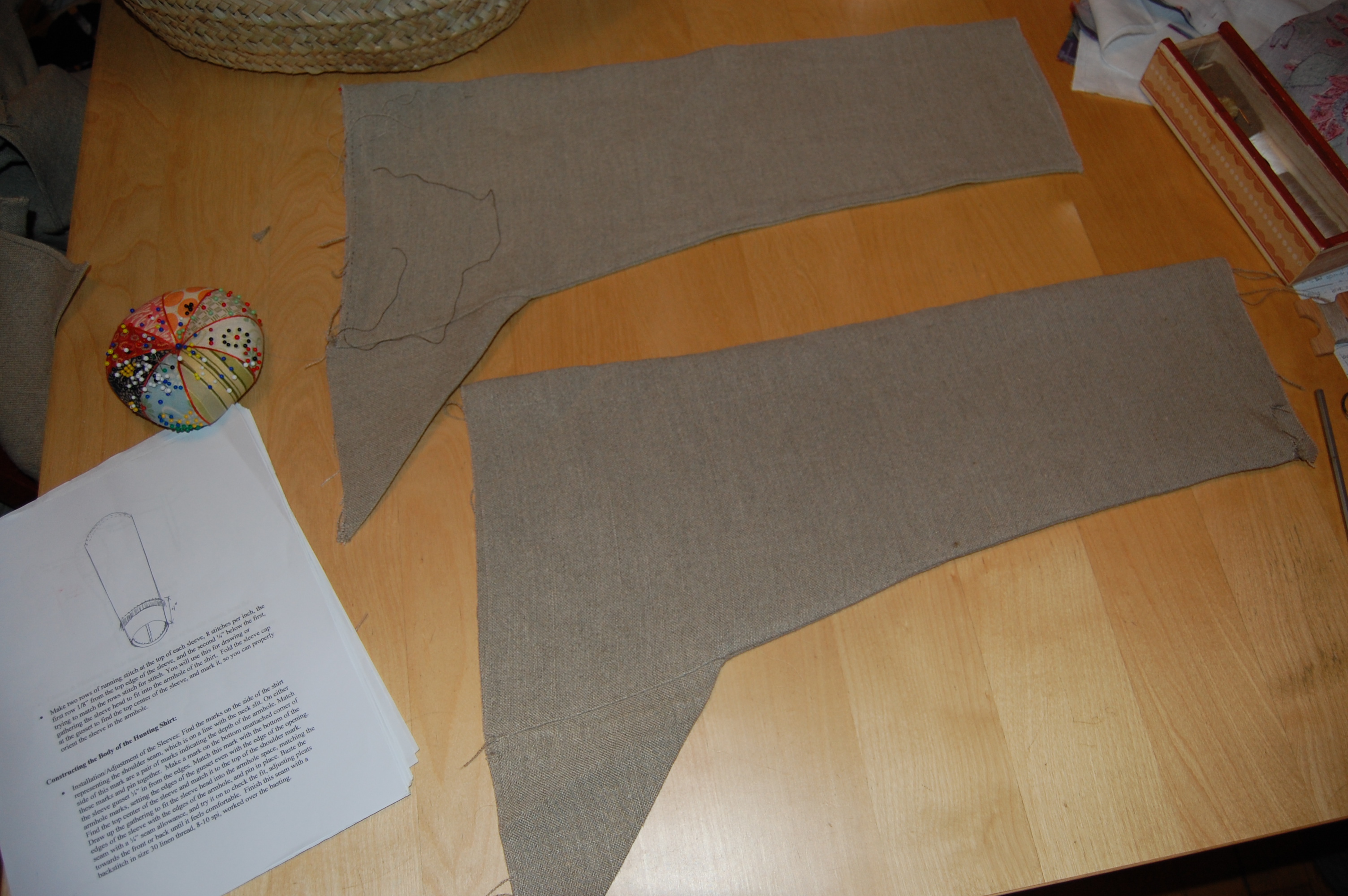
Gathering the first sleeve head. Destination: Saturday afternoon

Gathering the sleeve heads. Saturday is soon!

The women last weekend kept asking what I was working on so assiduously. It was the hunting shirt (to become a frock) for the Young Mr for the new unit. Cut by the master, entirely hand-sewn by me. This is not something they would do.

“Sewing for The Adjutant, ” I said, “is another thing altogether.”

“Don’t even try. Who can sew like that? He’s a professional,” I was told.

What we're aiming for.

What we’re aiming for.

Well, yes.

So wouldn’t that be the very thing to reach for? It’s not like he’s not helpful. I have his shirt to copy, he answers my questions patiently, and I haven’t yet felt like an idiot.

The skill I have I owe in part to my mother and grandmother, and to the Dress U workshop with Sharon Burnston.  Stroke gathers, two-by-two stitching, using the tiniest needle possible are all things I learned or honed in Sharon’s workshop. And thanks to that workshop, this hunting shirt-(perhaps)-soon-to-be-frock is a great deal easier to tackle.

The other part of skill is practice. It’s as true for piano or soccer as it is for sewing. Just keep stitching, and it will come.
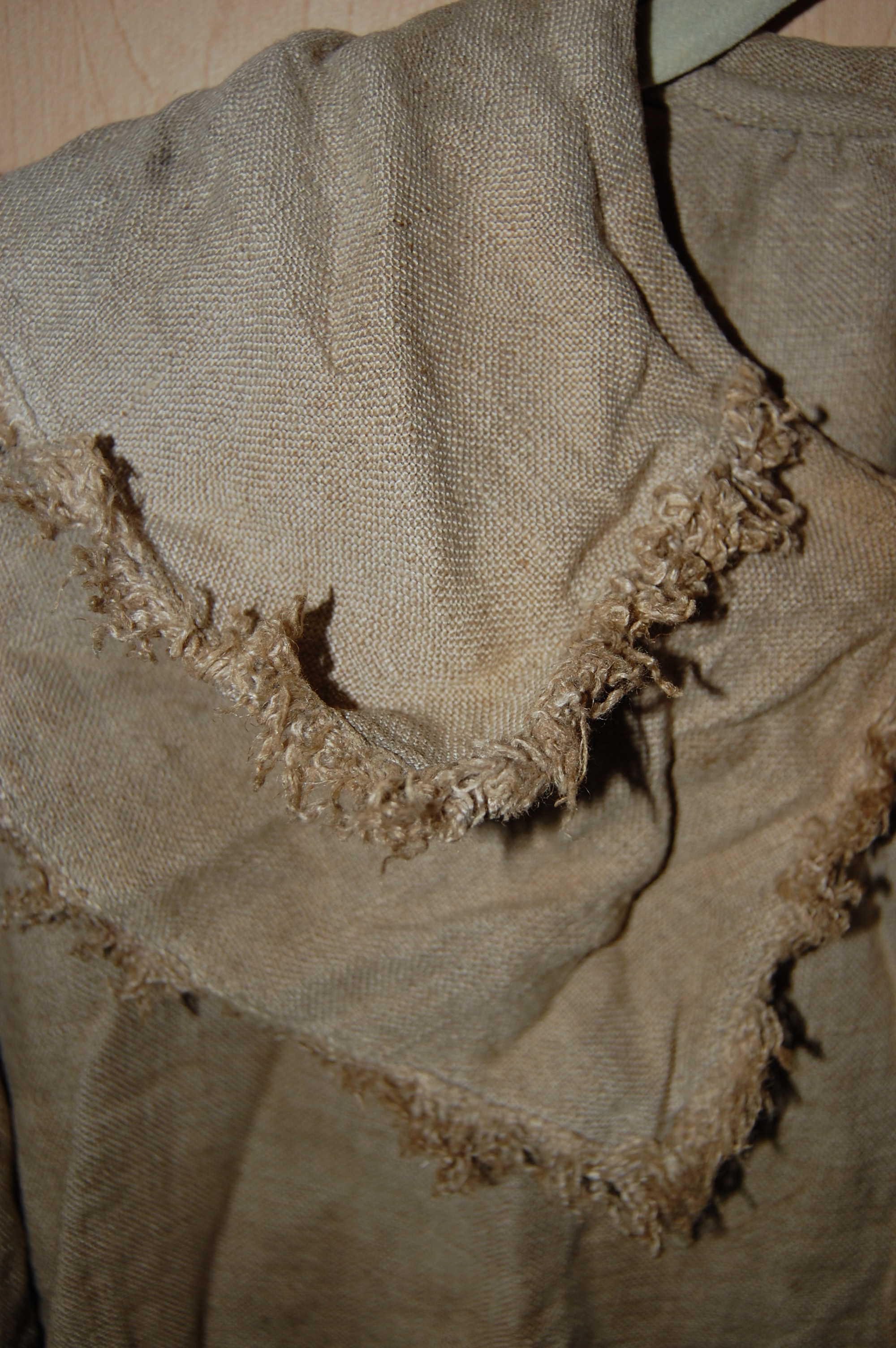
And after the fitting, the fringing. That's for someone else to do.

After fitting comes fringing. That’s for someone else to do.

What I find hardest is fit: not only is it hard for me to judge how much to take in a garment to achieve 18th century fit while maintaining enough ease for the wearer to swing an ax (or to accommodate teenage wriggling), alterations annoy me. I suspect that the key may well be not to fit at the end of a day, but at a beginning, or at least a middle. Fitting after a long day of sewing could make you think you were tossing away a whole day of work. It also feels, still, like taking a car to the mechanic or the cat to the vet. There’s something wrong, and I don’t quite understand it. Yet. But with Shoulders Roll Forward and Monkey Arms, I bet I’ll understand more soon.

Share this:

  • Share on Facebook (Opens in new window) Facebook
  • Share on Pinterest (Opens in new window) Pinterest
  • Email a link to a friend (Opens in new window) Email
  • Share on X (Opens in new window) X
Like Loading...

Townspeople, 1763

24 Wednesday Apr 2013

Posted by kittycalash in Clothing, Events, History, Reenacting

≈ 5 Comments

Tags

1763, 18th century, 18th century clothes, Costume, dress, fashion, Reenacting, Research, Thomas Marshall's Boston Militia

I have this friend, DC: I can call him a friend now, but when we worked together, he was more of a nemesis, mostly because of his OCD tendencies, intense perfectionism, and complete inability to meet deadlines. It was a classic example of Mr Failure-to-Plan working poorly with Miss Contingency-Plan-Required. We literally knocked heads installing an exhibition, and I can still feel the hollow ringing pain. But it’s been six years, and with that distance, friendship is possible.

I'm only in this for the cannon.

I’m only in this for the artillery.

But he’s got this idea.  In August 1763, Boston celebrated the Treaty of Peace ending the Seven Years War (known here as the French and Indian War). There are fantastic descriptions of the celebrations and Thanksgiving Proclamations issued by the colonies, and you can read more about it in the Boston Gazette 8-15-1763.

My friend’s idea is to re-create this celebration, complete with cannons and volleys, and to that end he has enlisted local re-enactors, including a unit he didn’t realize I was part of when he asked me if I had a 1763 impression. True to form, we are asking questions he’s not yet prepared to answer… including, what sort of people do you want these townspeople to be? With the calendar as packed as it is, stitching up militia and my own clothes needs to start now, what with the regular regimental requirements due in June and again in August, and oh yes, actually maintaining life and a tolerable standard of cleanliness in the home.  (DC is moving to Europe in the Fall. After this event, when he leaves North America, I expect we’ll be better friends.)

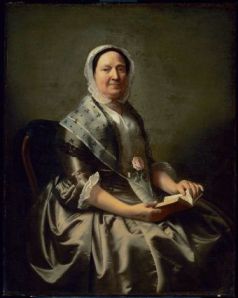
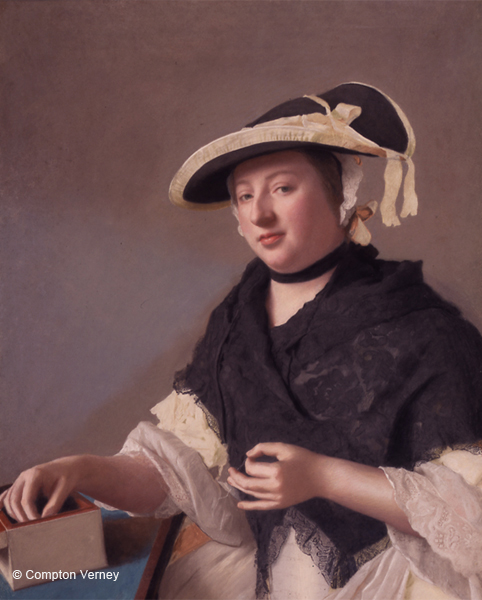
Jean-Etienne Liotard (1702-1789) Portrait of a Woman called Lady Fawkener circa 1760

Jean-Etienne Liotard (1702-1789) Portrait of a Woman called Lady Fawkener circa 1760

The reason I want an answer now is simple: I want a hat. After steaming and cramming The Hat onto Mr S’s head, I deeply desire my own Hat. I don’t covet much, really, and a hand-made piece of headwear made by someone you know and respect seems a very innocent thing to covet, even if coveting is wrong.  But to give the Favorite Hatmaker time to create a hat like the one at left, and me time to trim same, I need to know rather soon if I should be a lady or a cherry-seller.

I started a Pinterest board (when all else fails, collect images) of 1763 ideas. It’s a pretty simple thing, really, gown with robings, cap, blah blah petticoats blah blah, but: isn’t it all about the fabric? And the trims? And, lest we forget, the coveted hat!

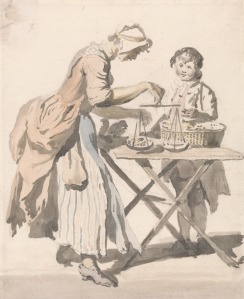
Paul Sandby, London Cries: Black Heart cherries... ca. 1759. YCBA,  B1975.3.206

Paul Sandby, London Cries: Black Heart cherries… ca. 1759. YCBA, B1975.3.206

The Sandby cherry seller can probably be replicated with an open gown with robings made from B&T’s Virginia cloth; the question is merely of color, drape, and patience waiting for swatches. (Wish Wm Booth still had that yellow and blue striped linen, but my blue and white linsey-substitute would have to do.) This is simple enough, really; I have a cap like the cherry-seller’s cut out, somewhere, or linen to make one, anyway.

Paul Sandby, London Cries: The Fishmonger (detail), 1759. YCBA B1975.3.210

Paul Sandby, London Cries: The Fishmonger (detail), ca. 1759. YCBA B1975.3.210

Maybe the compromise is this, yellow, with a black hat. I suspect this hat is straw, but perhaps I could combine the hat above with this idea. The black hat and black cape are very appealing. The answer, of course, is all in research: find out about the men in Thomas Marshall’s Boston Militia, and from there I can find out about, or make intelligent surmises, about the women. But that’s irritating, as military/militia-based history often is–to be dependent on the men. Perhaps the less annoying route lies through JSTOR…. and following up on the memory of a Boston widow-businesswoman.

In the end, I’m realistic enough to know that I shall be lucky to get a new hat trimmed at all, given all the menswear there is to complete between now and August. Even my plans for chitzy sewing this week turned late yesterday into, “Oh, but I thought you liked the Adjutant. We’re going up Saturday for fitting.” I suppose that means they think I’ll finish something enough for fitting.

Share this:

  • Share on Facebook (Opens in new window) Facebook
  • Share on Pinterest (Opens in new window) Pinterest
  • Email a link to a friend (Opens in new window) Email
  • Share on X (Opens in new window) X
Like Loading...

Eating in the Field: Single-Day Events

28 Thursday Mar 2013

Posted by kittycalash in Events, Food, Living History

≈ 5 Comments

Tags

18th century, Battle Road 2013, Events, food, recipes, resources

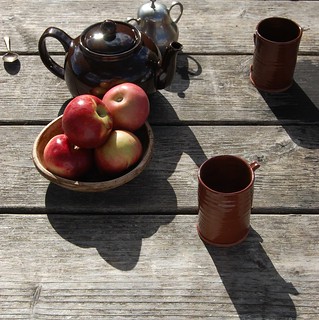
Tea Time at Nathan Hale, 2013

I’m not an expert, and your results may vary, but here’s what I’ve learned.

Single Day Events without Fires

(e.g. Battle Road, parades, Fort Lee)
For single-day, warm-weather events, ice packs covered in cloths at the bottom of a basket or slipped into a market wallet can keep food cold.

Pasties are self-contained, period appropriate, and require no “hardware” to eat. I wrap them in parchment or plain white paper and tie them with string, or wrap them individually in plain white cloths. Because the filling is cooked and then baked in the pastry, they keep and travel very well. I have a basic receipt here for pork pies; they’re good with chicken, too. Keep the filling a little on the dry side, and  you won’t need a plate. I’ve never made an all-vegetable pasty, because I live with T-Rex in a hoodie, but I imagine it would be delicious with parsnips, squash, and maybe even kale.

Another single-day-event solution is bread and cheese. John Buss of the 10th Massachusetts was all about cheese. He writes home longing for cheese, and writes, too, that he can eat cheese again because he’s recovered from the small pox. (That’s one of those historic statements that I try not to imagine too much about.) I’ve never had the time to bake bread from the Amelia Simmons’ cookbook, but I’ve had bread made from it, and it’s great. Pressed for time? Worked later than you thought you’d have to? Whole Foods Take-and-Bake baguettes have played the role of home-made bread, as have various loaves from other grocery stores.

The Hive blog has some good recommendations to fill your basket, so with some repackaging and artful packing, you can assemble an 18th century pick-a-nick basket, or stuff a market wallet with suitable foods. Just please, please: peel stickers off the fruit, and don’t pack bananas, which aren’t seen in the U.S. much before 1880.

Share this:

  • Share on Facebook (Opens in new window) Facebook
  • Share on Pinterest (Opens in new window) Pinterest
  • Email a link to a friend (Opens in new window) Email
  • Share on X (Opens in new window) X
Like Loading...

Eating in the Field

27 Wednesday Mar 2013

Posted by kittycalash in Events, Food, Living History

≈ 3 Comments

Tags

18th century, Events, food, living history, preparations, Reenacting, resources, Revolutionary War, weather

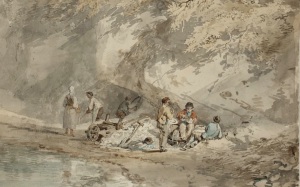
Workmen Lunching in a Gravel Pit circa 1797 Joseph Mallord William Turner 1775-1851

Workmen Lunching in a Gravel Pit, circa 1797. Joseph Mallord William Turner 1775-1851

A compatriot asked how we handle food and cooking in the field. What do we do about “yucky stuff?” by which she meant meat.

She was doing just about the same stuff we were doing, and with Battle Road around the corner, I thought I’d write about food in the field, and ways we handle it. Other people will have other ideas, but the main things I think about are:

  • Maintaining authenticity and food safety (Nobody wants flux.)
  • Historical eating is seasonal, local eating
  • Gear: less is not only more, but easier

Food safety is one of those things where you really don’t want to compromise too much, though from eating at the farm, I think there is more leeway than we admit. I will confess that when I was poor and in school, I stored dairy products on the windowsill of my studio when there was no fridge, so eating at the farm is like eating… when I was a whole lot younger.

Here are my principles. I’m not an expert, your mileage may vary, but this is where I begin.

Universal Truths

Start with who you are.
Objects you bring, and food you eat, should be true to your impression.
Authenticity goes beyond the date of accouterments: a porcelain tea set may be quite correct for a 1778 Newport or 1763 Boston parlor, but it makes very little sense if you are with a Continental private. One chipped plate is different for a woman to carry, or a piece of pewter. How long either would last you is another story, but at least you’d have a story. If you are the Colonel’s wife, it’s a different matter, even more so if it’s a British Colonel.

Food safety trumps purest authenticity.
Cloth covered, hidden ice packs will hurt no one and may save you misery later.

Stay Hydrated.

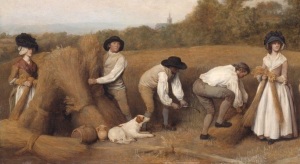
Reapers 1785 George Stubbs 1724-1806

Reapers, 1785. George Stubbs 1724-1806

Soldiers drank water.

In a hot summer camp, we keep a large pitcher full of water (see the Stubbs painting at left). Covered with a white linen or cotton cloth, it will keep coolish and free of dust & insects (or dog fur & fleas, if you’re in the Stubbs painting). We sliced limes into our enormous pitcher, and refilled it all day from the pump at OSV.

Limes are in period; justifying a source can be tricky, but at a certain level, safety trumps authenticity. 98 degrees and 90% humidity means drinking a lot of water.

Chances are you’re a caffeine addict like me, so what do you do? Boil water in a kettle, and bring tea in a screw of clean white paper is one answer. What’s your justification? I’m a personal fan of ‘stole it from my master,’ but in small quantities, perhaps you got it from home, or did a farm woman  a favor. Or stole it from her. John Smith (I kid you not), Sergeant in Colonel Lippitt’s Rhode Island State Regiment, in Continental Service, writes in his diary* of apprehending geese and chickens who failed to respond with the correct password when challenged.

*Published as “Sergeant John Smith’s Diary of 1776”, edited by Louise Rau, in Mississippi Valley Historical Review, No. 20, 1933, pages 247 – 270. NB: Kitty Calash recommends reading, not stealing.

Tomorrow: Food-related recommendations by event type.

Share this:

  • Share on Facebook (Opens in new window) Facebook
  • Share on Pinterest (Opens in new window) Pinterest
  • Email a link to a friend (Opens in new window) Email
  • Share on X (Opens in new window) X
Like Loading...

Choosing a Gown

19 Tuesday Mar 2013

Posted by kittycalash in Clothing, Events, History, Living History, Making Things

≈ 1 Comment

Tags

18th century, 18th century clothes, authenticity, Battle Road 2013, Clothing, common dress, Costume, fashion, history, living history, Research, Revolutionary War

Here’s a good question (I love questions): how do you choose which [historic example] to make?

The answer, as almost always: Research.

I start with a date. For Battle Road, the dress must be typical of New England in April, 1775 and appropriate for my impression or persona.  As I imagine my character from the past, she’s in her 40s, from the upstart town of Providence, married to a tradesman or craftsman. She has one child, and I haven’t thought about whether or not it’s one only or one surviving—too busy chasing the One Child Who Eats Like Ten.

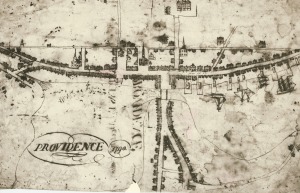
Providence, 1790. John Fitch, RIHS Map #30

Providence, 1790. John Fitch, RIHS Map #30

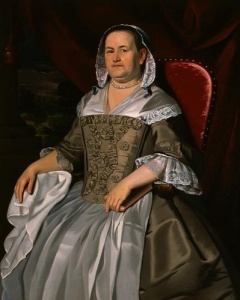
Mrs Nathaniel Ellery, J S Copley, 1765, MFA Boston

Mrs Nathaniel Ellery, 1765, MFA Boston

Living in a port city means my character—we’ll call her Kitty—has access to new goods and ideas, a town where you can buy almost anything, but where staymakers are less common than in Newport.  It’s less refined than Newport, brassier, but competitive and striving and with plenty of money in some hands. Providence is where the Gaspee affair was plotted; in 1790, residents from around the world are recorded here—men from Java, living in Providence—it’s polyglot, mercantile, striving.

Given that Kitty is of the middling sort in a town, she can wear linen and wool and camblet and even some silk. Her clothes will be fashionable but not high style, “a thought behind the current moment,” as Lord Peter says of someone’s hat. What’s the purpose of this brown gown? Everyday wear, that, with accessories, can be dressed up, or dressed down. Eventually, who knows, I might manage a crewel work stomacher and nice linen cuff-ruffles for my shift, though a filthy apron, burned skirt, and a striped rough linen petticoat are more likely…

Mrs. James Otis (Mary Allyne Otis). JS Copley, ca. 1760. Wichita Art Museum

Mrs. James Otis ca. 1760. Wichita Art Museum

Making an everyday dress means not copying the silk dress from Williamsburg, and honestly, I couldn’t wear that wedding cake frosting on my chest, nor what Mrs. Otis has on her stomacher. How about that lovely Norwich wool gown? Well…almost. But I can’t sew that well, and haven’t got fabric that lovely, couldn’t afford it now, wouldn’t have had it then. I have brown wool. Have I seen Mrs. John Brown dressed like one of Copley’s women? Perhaps (if you take Copley as evidence, which you must do carefully.) Have I looked at the lovely brown silk satin and thought, I could do that. Possibly.

Black Heart Cherries, Paul Sandby, ca. 1759. YCBA B1975.3.206

Black Heart Cherries, Paul Sandby, ca. 1759. YCBA B1975.3.206

What we do know is that in New England, gowns are found more often than any other kind of garment (i.e. short gowns or jackets or riding habits). We know that wool is common, but that linen is found in towns and cities, wool more often in the country, and that the pretty, but expensive, cotton prints are popular. Open robes are more common earlier, and “hatchet” cuffs (pleated tubes) predominate. The style is worn by Copley’s women and Sandby’s girls, and it’s seen in images from 1760 on. That means it’s a good choice for a base style for any class level.

Here’s my process, more or less:

Determine the date, that sets the style.
1775 means stomacher front gown.

Determine the character, that sets the fabric and trims.
Kitty’s New England middling, so she’ll have a wool gown with robings but not trims, a plain stomacher, cuffs and not ruffles, and a matching petticoat.

Determine the event, that sets the accessories.
Battle Road is a hard one for me: as a woman, I shouldn’t be there, and as a Rhode Islander, I really shouldn’t be there. (RI militia were stopped at the border by the governor to prevent them joining Massachusetts men after news of the events at Lexington and Concord reached Rhode Island. They did get there eventually and participated in the siege of Boston, but you see what I mean…) So I have to construct a story for how to dress, and the best I can manage is going out, either to a shop or to pay a casual call on family. So what I plan is a matching petticoat, white neck handkerchief, clean check apron, and bonnet over a clean white cap. (This emphasis on clean should remind me to wash and iron a thing or two.)

That’s my story, and I’m stickin’ to it. For now, anyway, till I get a better idea.

Share this:

  • Share on Facebook (Opens in new window) Facebook
  • Share on Pinterest (Opens in new window) Pinterest
  • Email a link to a friend (Opens in new window) Email
  • Share on X (Opens in new window) X
Like Loading...
← Older posts
Newer posts →

Archives

wordpress statistics

Creative Commons License
Kitty Calash blog by Kirsten Hammerstrom is licensed under a Creative Commons Attribution-NonCommercial-ShareAlike 4.0 International License.

Website Built with WordPress.com.

  • Subscribe Subscribed
    • Kitty Calash
    • Join 621 other subscribers
    • Already have a WordPress.com account? Log in now.
    • Kitty Calash
    • Subscribe Subscribed
    • Sign up
    • Log in
    • Report this content
    • View site in Reader
    • Manage subscriptions
    • Collapse this bar
 

Loading Comments...
 

    %d