• Home
  • Completed Costumes/Impressions
  • Emma and Her Dresses
  • Free Patterns and Instructions

Kitty Calash

~ Confessions of a Known Bonnet-Wearer

Kitty Calash

Tag Archives: authenticity

Mind the Gap, or, The Basket Case

22 Wednesday Jul 2015

Posted by kittycalash in Clothing, Events, History, Living History, Philosophy, Reenacting, Research

≈ 5 Comments

Tags

18th century, authenticity, common people, fashion, historical reenactors, interpretation, living history, lower, philosophy, Reenacting, style

I was in the midst of planning yet another maid’s dress (some of us have all the luck) when a friend alerted me to an online discussion that drew from my recent post on baskets. The comments — which I skimmed but twice– made me think about philosophy and intent.

Engraved by John Raphael Smith, 1752–1812, British, A Lady and Her Children Relieving a Cottager, 1784, Mezzotint and line engraving on medium, slightly textured, cream laid paper, Yale Center for British Art, Paul Mellon Collection

Engraved by John Raphael Smith, 1752–1812, British, A Lady and Her Children Relieving a Cottager, 1784, Mezzotint and line engraving on medium, slightly textured, cream laid paper, Yale Center for British Art, Paul Mellon Collection

There are two approaches to developing a living history persona and appearance I’ll consider here: one prescriptive, and one not. The prescriptive, didactic approach tells you what to wear and carry. Some folks like that. It is completely correct in some cases: soldiers, for example. You want to fall in with a unit of Light Infantry in 1777, it’s generally more convincing if you don’t wear the 1781 coat. Not everyone cares: some people will keep on wearing the Brighty Whitey Hunting Frocks and 1780 coats at reenactments commemorating events of 1776. Those folks can no longer be reached by prescriptive standards, and my preferred approach probably won’t reach them either.

Joshua Cristall, 1768–1847, British, Young Woodcutter, 1818, Watercolor with scraping over graphite on moderately thick, slightly textured, beige wove paper, laid on thick, slightly textured, beige card, Yale Center for British Art, Paul Mellon Collection

Joshua Cristall, 1768–1847, British, Young Woodcutter, 1818, Watercolor with scraping over graphite on moderately thick, slightly textured, beige wove paper, laid on thick, slightly textured, beige card, Yale Center for British Art, Paul Mellon Collection

Mindful reenacting or living history sounds pretty nutty, but that’s what I would encourage. Thoughtfulness. Consideration. Not just the what, but the why. Why you wear or carry something can be as important and interesting as what you’re wearing and you’ll be all the more convincing for thinking it through. Thinking, not rationalizing. How appropriate is it to be in your best clothes carrying a basket also used to carry fire wood? You have to answer that for yourself, and if you’re doing it right, the answer will not always be the same– nor will the question!

Print made by James Bretherton, ca. 1730–1806, British, A Maid, 1774, Etching on moderately thick, rough, blued white laid paper, Yale Center for British Art, Paul Mellon Collection

Print made by James Bretherton, ca. 1730–1806, British, A Maid, 1774, Etching on moderately thick, rough, blued white laid paper, Yale Center for British Art, Paul Mellon Collection

This isn’t the easiest way to go about anything, asking all these questions, but for some of us, the experiences make it worthwhile. You won’t always be able to do, carry, or wear what you want.* But the picture you create of the past will be more accurate and more engaging if you think more and justify less.

Look, I threw down about that floppy bird basket, but I have to provide food to troops this Saturday in Cambridge. What the heck will I carry it in? What will I take my sewing in?**

Probably a wallet and a bag, unless I can pack that floppy basket convincingly– it is entirely suitable to my lower sorts-stained gown impression– but if I can’t, I won’t take it. And that’s just one less thing to carry.

*I’m pretty much always the maid to make scenarios work, and while it doesn’t come naturally, art imitates life.

**Prays no one gets the bright idea to bring (shhh) tents to work on.

Share this:

  • Share on Facebook (Opens in new window) Facebook
  • Share on Pinterest (Opens in new window) Pinterest
  • Email a link to a friend (Opens in new window) Email
  • Share on X (Opens in new window) X
Like Loading...

Context is Critical

15 Wednesday Jul 2015

Posted by kittycalash in Clothing, Events, Fail, Living History, Research

≈ 10 Comments

Tags

18th century, 18th century clothes, authenticity, common dress, common people, Events, fashion, living history, Research, Revolutionary War

Context: it’s everything, right? We so dislike our statements taken out of context. But what about our clothes? They make statements, too, and so do our accessories.

A friend noticed that market baskets were fairly prominent carriers used by reenactors portraying the Boston gentry greeting L’Hermione this past weekend, and asked, “What gives? Is there something I missed?”

There are two images that people often turn to in documenting these baskets:

The Farmer’s Return, by Zoffany

Johan Joseph Zoffany RA, 1733–1810, German, active in Britain (from 1760), David Garrick and Mary Bradshaw in David Garrick’s “The Farmer’s Return”, ca. 1762, Oil on canvas, Yale Center for British Art, Paul Mellon Collection

and

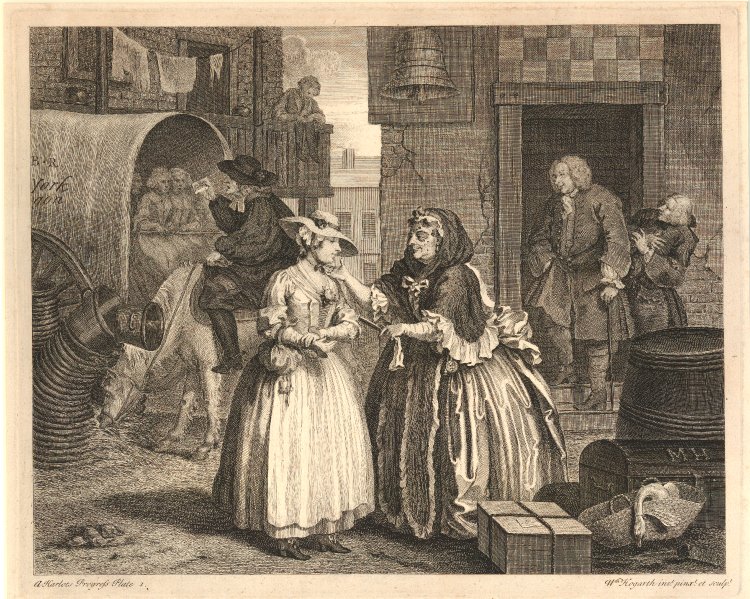
The Harlot’s Progress, Plate 1

The Harlot's Progress, Plate 1. William Hogarth.

The Harlot’s Progress, Plate 1. William Hogarth.

In both of these, the context is working class and food-oriented. As my friend asked, “Are these floppy baskets for floppy birds?”

Two images from 1740 to 1760 aren’t a lot of documentation to go on for 1775-1783, so I checked the Rhode Island newspapers for 1770-1790, searching for “basket.” No mention in ads, but “baskets of grapes” appeared in stories, and a mention of Chinese dogs in cotton-lined baskets (apparently the “basket dog” is the 18th century equivalent of today’s purse dog).

As satisfying as basket-dogs might be, they’re not helpful in this instance.

The Yale Center for British Art helpfully adds keywords or tags to their catalog records, which allows one to look for “basket.” Aside from The Farmer’s Return, this ovoid, market-basket form isn’t really seen. What is seen?

For one thing, not many upper-class women carrying baskets, or any kind of burden or bundle. A woman carrying a kind of ovoid basket over her arm is shopping for food, not perambulating.

The upper class girl with her father has an open basket full of flowers (hint: probably symbolic) which appears to be made of what we lump into “wicker,” in an open design. (BTW, that’s not a pinner apron; zoom in and you will see shoulder straps. Fight at your leisure.)

Arthur Devis, 1712–1787, British, An Unknown Man with His Daughter, between 1746 and 1748, Oil on canvas, Yale Center for British Art, Paul Mellon Collection

In the most class-appropriate image, The Virtuous Comforted by Sympathy, the workbasket at the woman’s feet is a tidy, round form with a lid, more similar to Nantucket baskets* than to market baskets. It really doesn’t look like the kind of thing you’d leave home with. It’s a sewing basket.

Edward Penny RA, 1714–1791, British, The Virtuous Comforted by Sympathy, 1774, Oil on canvas, Yale Center for British Art, Paul Mellon Collection

Edward Penny RA, 1714–1791, British, The Virtuous Comforted by Sympathy, 1774, Oil on canvas, Yale Center for British Art, Paul Mellon Collection

On balance, I think it appears that public basket carrying is more suited to carrying foodstuffs than personal items, and that the most common use of baskets in this period is to collect and carry food, whether from a greengrocer, fish stall, or gathering apples— at least if you are trying to be quite precise in the use of documented accessories. If you’re using a market basket to carry food, you do so knowing that it’s only (thus far) documented to England, and that the handles must be woven and not leather riveted to the side.

The material from which the baskets are made is another question altogether, along with the proper woven form. As I noted to my friend, I don’t care that much. And why?

Balthazar Nebot, active 1730–1762, Spanish, active in Britain (from 1729), Fishmonger's stall, 1737, Oil on copper, Yale Center for British Art, Paul Mellon Collection

Balthazar Nebot, active 1730–1762, Spanish, active in Britain (from 1729), Fishmonger’s stall, 1737, Oil on copper, Yale Center for British Art, Paul Mellon Collection

Pockets, of course. My enormous pockets contain multitudes, sometimes even camera and water bottle along with wallet and phone, even if that much stuff distorts the line of my skirts somewhat. I can also fit my knitting in a pocket, and a slim, if dangerous novel (perhaps Moll Flanders). For carrying more than that, a wallet is probably best, or a cloth bag, or a portmanteau. But for a day in town, even if you’re a lady, you can carry quite as much in your pockets as I can as Bridget, though of course of a better quality.

* I am not advocating carrying Nantucket baskets, to be quite clear.

Share this:

  • Share on Facebook (Opens in new window) Facebook
  • Share on Pinterest (Opens in new window) Pinterest
  • Email a link to a friend (Opens in new window) Email
  • Share on X (Opens in new window) X
Like Loading...

Itching for Style

09 Thursday Jul 2015

Posted by kittycalash in 1830s, Clothing, Living History, Reenacting, Research

≈ 3 Comments

Tags

10th Massachusetts, 19th century, 19th century clothing, authenticity, common dress, Costume, fashion, living history, style

Dress Date: 1830s Culture: American Medium: wool Dimensions: Length at CB: 53 1/2 in. (135.9 cm) Credit Line: Gift of John Eastman and Gerard L. Eastman, 1976 Accession Number: 1976.209.2

Dress, 1830s. American, wool.
Gift of John Eastman and Gerard L. Eastman, 1976.209.2 Metropolitan Museum of Art

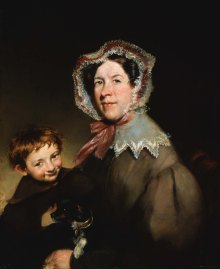
Wool. It’s a thing. This dress from the Met has many of the markers of everyday fashion– a vernacular form, if you will, of what Deliverance Mapes Waldo is wearing in this portrait

Deliverance Mapes Waldo and Her Son about 1830 Samuel Lovett Waldo (American, 1783–1861 American) DIMENSIONS 77.15 x 64.45 cm (30 3/8 x 25 3/8 in.) ACCESSION NUMBER 45.891 MFA Boston

Deliverance Mapes Waldo and Her Son, about 1830
Samuel Lovett Waldo. 45.891 MFA Boston

Of course, dating these things is never a science when they don’t come with a clearly labeled tag you can affirm with research. The extant garment first. The sleeves say 1820s, the waistline says 1830s. Could it be 1840s? Perhaps. Without provenance, it’s really hard to know.

Mrs Waldo’s sleeves are clearly 1830s sleeves: full on gigot, sloped shoulder. It’s the contrast between her sleeves and the Met’s dress that makes me question their date (along with the fashion plates we saw yesterday).

Here’s a wool gown from England, land of the fabulous wools.

Dress, England, Great Britain.  1836-1838. Printed wool, trimmed with printed wool, lined with cotton, hand-sewn Given by Mrs H. M. Shepherd, T.11-1935. Victoria & Albert Museum.

Dress, England, Great Britain. 1836-1838.
Printed wool, trimmed with printed wool, lined with cotton, hand-sewn
Given by Mrs H. M. Shepherd, T.11-1935. Victoria & Albert Museum.

Here the sleeves are starting to be narrowed at the shoulder, taming the gigot. That places this 1836 or later, which is helpful. The bodice style is still not the pleated or smocked front of the 1840s, so that’s another marker for mid-to-late 1830s.

What will I do? I don’t know. I’ve ordered two patterns (and one for a new chemise, sigh). The Past Patterns Lowell Mill Girl dress appears to make up quite nicely, but I also ordered the Wisconsin Historical Society pattern for comparison. (Hey, when you can’t examine originals, you have to use the patterns.) Fabric is always a question, but if I’m feeling plain wool, there’s always Burnley & Trowbridge’s “Virginia Cloth.” I’ve worked with it before, so I know how it handles, and while the color looks itchy, it’s actually pretty soft.

Share this:

  • Share on Facebook (Opens in new window) Facebook
  • Share on Pinterest (Opens in new window) Pinterest
  • Email a link to a friend (Opens in new window) Email
  • Share on X (Opens in new window) X
Like Loading...

Gigot or Gigantic?

08 Wednesday Jul 2015

Posted by kittycalash in Clothing, Events, Living History, Making Things, Research

≈ 6 Comments

Tags

10th Massachusetts, 1833, 19th century, 19th century clothing, authenticity, Clothing, common dress, fashion, fashion plates, living history, Making Things, style

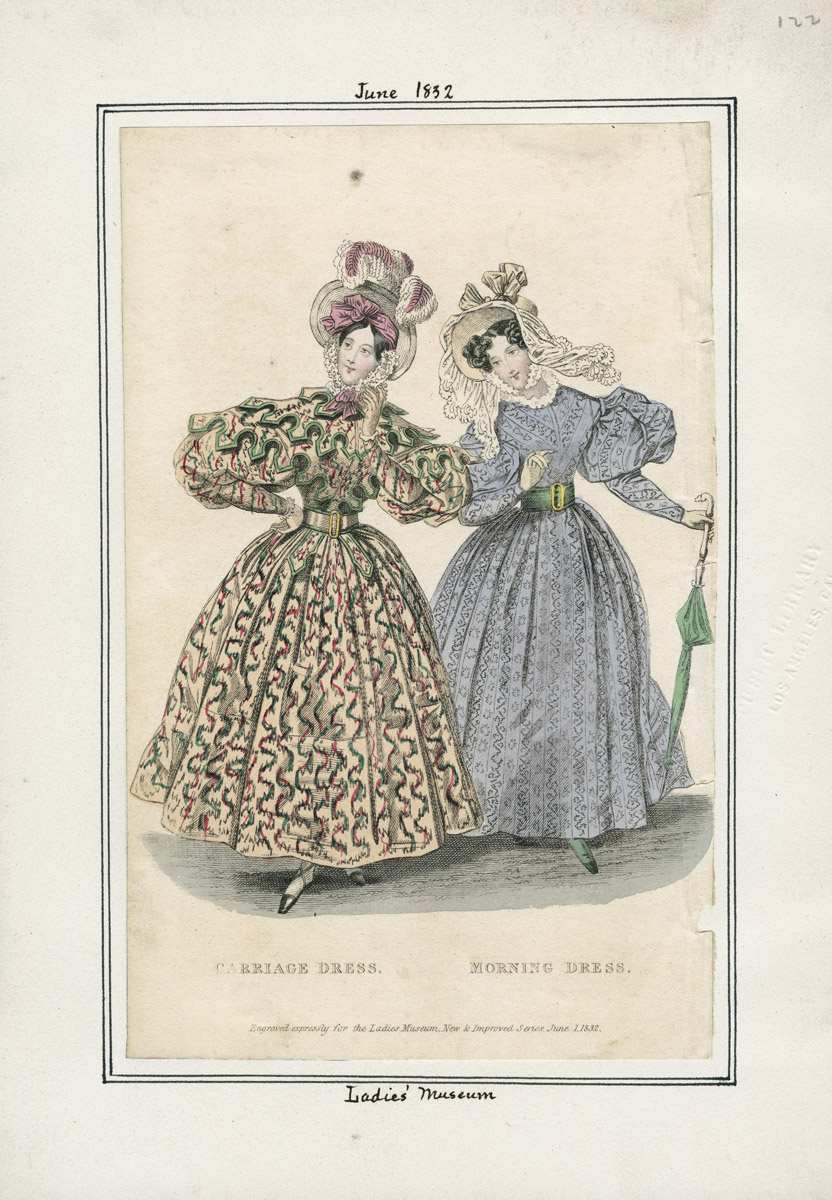
Carriage and Morning Dress, 1832. LAPL Fashion Plate Collection

Carriage and Morning Dress, 1832. LAPL Fashion Plate Collection

So, about that 1833 thing…

No, it’s not that I’m reconsidering. It is merely that as I consider the options, the fashion plates are a bit overwhelming. On the other hand, I am getting really good at recognizing the look of the 1830s in undated portraits. There’s an upside to everything.

Extant garments are fairly plentiful in the Usual Suspects’ Collections; there’s even a Tumblr. There’s a Tumblr for everything.

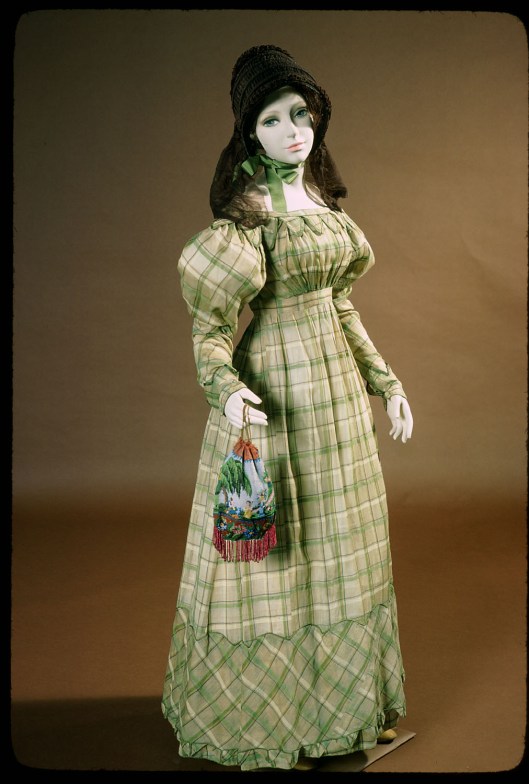
Woman's Green, Tan, Yellow and Blue Striped/Plaid Gown. OSV, 26.33.63

Woman’s Green, Tan, Yellow and Blue Striped/Plaid Gown. OSV, 26.33.63

Fortunately, there are some tamer garments out there, with sleeves less likely to result in flight in a high wind. Bonus: not floral, and not silk. Printed wool seems to have been fairly common, but the weight is just impossible to find. I did some looking in New York, but nothing convinced me with print or price.

This is a milita muster, so there will be time outside. I’m toying with a habit or Amazone (hard to resist a garment with that name) though the most I know about horses is that they have four legs. It’s tailoring that attracts me, not use. Also, wool. Mid-September might warrant wool, even if that’s hard to imagine today. (The downside, of course, is that there’s menswear to be made, too, so a simple dress is surely the best option.)

Share this:

  • Share on Facebook (Opens in new window) Facebook
  • Share on Pinterest (Opens in new window) Pinterest
  • Email a link to a friend (Opens in new window) Email
  • Share on X (Opens in new window) X
Like Loading...

Smell Ya Later

16 Tuesday Jun 2015

Posted by kittycalash in Clothing, Fail, History, Laundry, Living History, Reenacting, Research

≈ 9 Comments

Tags

19th century, 19th century clothing, authenticity, clothes, Clothing, common people, historical clothing, historical myths, historical reenactors, history, interpretation, laundry, smell

Wool on hooks, cat on prowl

Wool on hooks, cat on prowl

One of the most common questions you get when you’re wearing historical clothing is the undying, “Aren’t you hot in those clothes?”

A heavily perspiring visitor wearing practically nothing usually asks this question, and the standard reply is a variation of “Aren’t you hot? In really warm weather, everyone is hot. But natural fibre clothing wicks the moisture from the skin and helps to keep you cool.” My internal response (vocalized only once) is, “Why yes, I am—and thank you for noticing. I work hard for this look.”

The “aren’t you hot” question is often followed by, “Wow, and they didn’t bathe, so everyone really smelled.” You try not to think of that Monty Python sketch about Britain’s deadliest joke program in WWII and move the conversation on to weekly laundering of body linen, multiple shifts, shirts, and under-drawers, and the general hygienic practices of the past.

What struck me after a sticky weekend is how much I noticed the smell of modern people.

two tailors and a tailoress

two tailors and a tailoress

My traveling companions and I bathed on Friday morning, drove for 7+ hours in muggy weather, slept in our clothes, wore wool, cotton and linen in rain and thick humidity, sweated in the tailor’s shop, slept in our clothes again, and spent another warm, close, day in muggy weather, including grave digging and pall bearing. But as feral as my shift may have been on Sunday night, I never smelled us.

Mr H reported that his wool trousers were really stinky in the rain, and I think his white Spencer was well-seasoned even before this weekend, but I didn’t notice anything. Mr S’s soaking greatcoat was whiffy only at extremely close range.

What I did smell were modern perfumes, deodorants, and hair products. Those linger around their wearers and trail behind them, sometimes eye-watering in their intensity. I encountered lingering perfume in a bathroom at the museum, and we were overwhelmed by cologne at diner Monday morning: wow, people must really smell now, of petrochemicals.

more wool

more wool

This is not to say that homeless people and sulky teenagers don’t smell of unwashed bodies and clothes, but people in the past may not have smelled quite as badly as we think. They washed, if not bathed (bathing being full immersion washing) and by changing body linen and airing their clothes, they kept reasonably clean.

There was plenty to whiff in the past: wastes of all kinds, stagnant bodies of water used as dumps, rotting foods and corpses. But I’m not convinced that we haven’t simply exchanged one set of smells for another of different origin and intensity.

Share this:

  • Share on Facebook (Opens in new window) Facebook
  • Share on Pinterest (Opens in new window) Pinterest
  • Email a link to a friend (Opens in new window) Email
  • Share on X (Opens in new window) X
Like Loading...
← Older posts
Newer posts →

Archives

wordpress statistics

Creative Commons License
Kitty Calash blog by Kirsten Hammerstrom is licensed under a Creative Commons Attribution-NonCommercial-ShareAlike 4.0 International License.

Website Built with WordPress.com.

  • Subscribe Subscribed
    • Kitty Calash
    • Join 621 other subscribers
    • Already have a WordPress.com account? Log in now.
    • Kitty Calash
    • Subscribe Subscribed
    • Sign up
    • Log in
    • Report this content
    • View site in Reader
    • Manage subscriptions
    • Collapse this bar
 

Loading Comments...
 

    %d