• Home
  • Completed Costumes/Impressions
  • Emma and Her Dresses
  • Free Patterns and Instructions

Kitty Calash

~ Confessions of a Known Bonnet-Wearer

Kitty Calash

Tag Archives: common soldier

Indocent Exposure

28 Tuesday Jun 2016

Posted by kittycalash in Events, Fail, History, Living History, Reenacting, Thanks

≈ 2 Comments

Tags

18th century, authenticity, common people, common soldier, Events, interpretation, living history, New Jersey, Revolutionary War

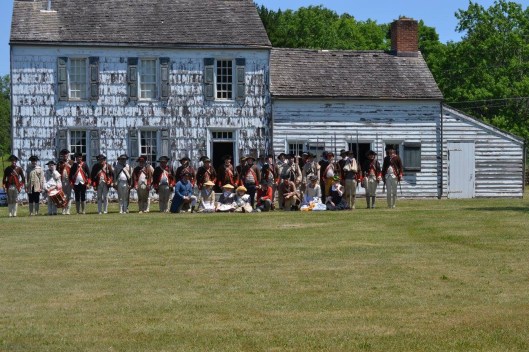
IMG_7288 Or, Confusion into Confusion.

Docents and volunteers: the backbone of any non-profit organization, right?

Well…sort of. I’ve worked with docents for more than a decade, and along the way I’ve learned what does and doesn’t work. What does work is intensive engagement and participation, though the occasional shock to the system can be necessary and useful. For special events, though, and in cases of turf, diplomatic relations must be opened with the enemy early and often.

That is not to fault the organizers of the “Order Out of Confusion” event this past weekend, for I was one of the people organizing the civilian, non-marching end of things, and due to turbulence in my own life, I failed to plan adequately in the arena of Docent Relations.

IMG_7296

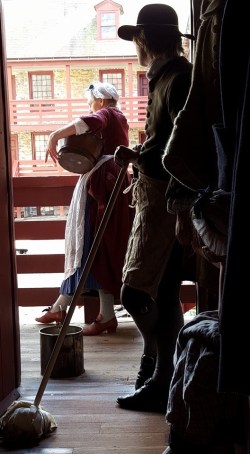
We had a Retaliator, a Pine Robber, a Quaker, and a Slave-Owning Patriot. We managed a debate or two over slavery. We begged people to take the Quaker home with them. But we did not occupy the house, for the house was occupied by red-shirted volunteers who gave at least some of us the five cent Condescension Tour punctuated with, “But I suppose you’re not interested in that.”

IMG_7298

Actually, that look was one of sheer disbelief, sir, at the farm implements in a bedroom, the tidy piles of perfectly formed ashen coals under the cookware in the fireplace, and the roomful of flax accented with a snake charmer’s basket. In my line of work, I enjoy house tours, but find they generally go better when tour guides don’t point out all the flaws to me. Complaining about the state (which owns the site) and onerous regulations that make repairs expensive will also increase my look of horror and disbelief. But really, if you want full-on horror, kindly inform the Quaker that Japanese POW camps “really weren’t that bad” because we are thriving on confusion today.
IMG_7297

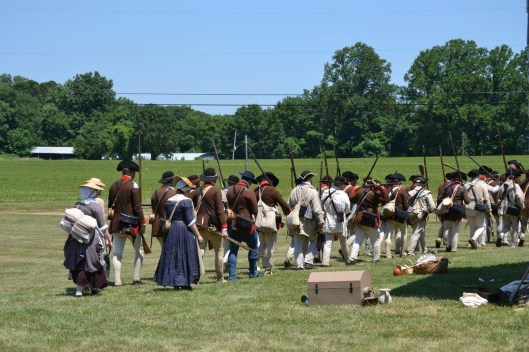
The volunteers were thrilled by the marchers, and were clearly very positive about the event. They love Craig House, and the battlefield, but that sense of pride and ownership made it impossible for them to share the house with us, or to see us as anything but invaders– an Army of Occupation in our own right.

It’s my fault that I’m not an agile enough negotiator to convince recalcitrant octogenarians that my friends and I are safe to play with and will respect the house, and it’s my fault that I didn’t put in place all the lessons I’ve learned in the past decade. Then again, I don’t know that I would have had time to travel for meetings with the volunteers to generate buy in and support, given the maelstrom that was my life this past spring.
IMG_7289

But it’s a lesson well-learned: interpreters will read voraciously, acquire tons of material, and turn that research into appropriately-dressed characters making interpretive points, but unless you work with the site and its volunteers or staff to create agreement about presentation, you’ll get about half the value of the work you put into the planning.

Many heartfelt thanks to everyone who participated, and to the organizers for letting me try out my interpretive model. Next time, I know I have to work with the site staff and volunteers to make sure that execution matches vision.
Share this:

  • Click to share on Facebook (Opens in new window) Facebook
  • Click to share on Pinterest (Opens in new window) Pinterest
  • Click to email a link to a friend (Opens in new window) Email
  • Click to share on X (Opens in new window) X
Like Loading...

Mopping Up Action

05 Tuesday Apr 2016

Posted by kittycalash in Events, History, Living History, Museums, Reenacting

≈ 4 Comments

Tags

18th century, authenticity, barracks, cleaning, common people, common soldier, interpretation, living history, women's history, women's work, work

Photo by Asher Lurie

Photo by Asher Lurie

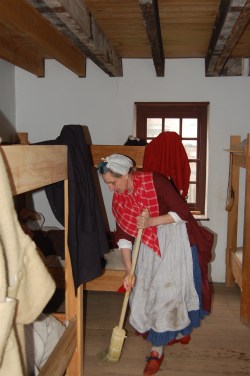
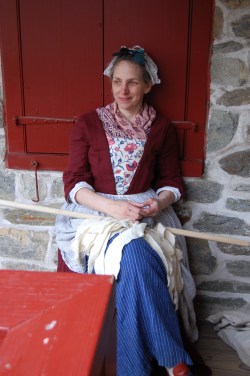
This past weekend, I took my show on the road down 95 to Trenton’s Old Barracks Museum, where once again, soldiers’ rooms needed cleaning. Hannah Glasse exhorts servants (housemaids and housekeepers) to clean household rooms daily, and I can tell you this: if you’re cleaning 18th century spaces using period techniques, daily is the way to go.

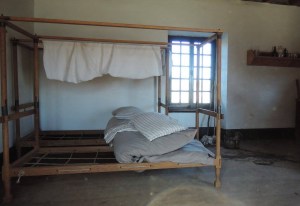
Unpaved streets and sidewalks meant people tracked significantly more mud and grit indoors, and soldiers would have brought the parade ground indoors every time they crossed a threshold. Not a pretty thing– and then there’s the straw mattresses (to be changed monthly at a minimum), wool uniforms, skin, hair, and vermin that could accumulate as well. Filth: a major contribution to ill health if not managed properly.

DSC_0348

Brandy-new broom sweeps clean. Photo by Drunk Tailor

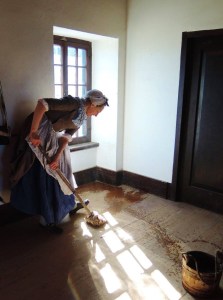
Being possessed of a particularly detail-oriented mind, I went in search of a more 18th-century correct broom at an affordable price and found a broom enthusiast on Etsy who agreed to make and priority mail custom brooms just in time for the trip to New Jersey. On the whole, I’m very pleased with these. They make a satisfying sound as they move across the floor, and draw a fair quantity of dirt. Turns out that strewing wet sand on the floor before you sweep is remarkably effective and absolutely the way to go. The damp sand keeps the dust down and is swept out the door with the filth without harming the floor.

Mop making: surprisingly contemplative.

Mop making: surprisingly contemplative. Photo by Drunk Tailor

After sweeping, mopping. Once again, I used the lavender-infused vinegar in the mop water (though I forgot to strain the solution this time). The mixture has a unique but not unpleasant smell, and as the floors dry, the room retains the odor, a sure indication of cleanliness.

This weekend was also the first run for a new wool scrap mop, which was proven the best mop yet. Many thanks to my secret source for the contribution to the effort. It’s clear that mops could easily have been made by binding rag strips to pole handles, and whether made by poor house inmates or soldiers, mop making is cheap, low-tech busy work.

Share this:

  • Click to share on Facebook (Opens in new window) Facebook
  • Click to share on Pinterest (Opens in new window) Pinterest
  • Click to email a link to a friend (Opens in new window) Email
  • Click to share on X (Opens in new window) X
Like Loading...

The Dirt on Ti

22 Tuesday Mar 2016

Posted by kittycalash in Events, History, Living History, Museums, Reenacting, Research

≈ 3 Comments

Tags

authenticity, common people, common soldier, domestic life, everyday, Fort Ticonderoga, history event, interpretation, living history, servants, women's history, women's work

On the road in: dirt.

Seen on the way in to Fort Ti: dirt. (Kitty Calash photo)

The dirt on Fort Ti came home on my shoes. And my petticoats. And my gown. And possibly my face, which could explain the reactions I got when I stopped for gas on the Pike Saturday evening.

It’s incredible how how dirty, dusty, and straw-filled a room can get– and that’s just the officer’s room. For all I know, a horse had been sleeping in the back corner of the barracks room we cleaned– who else would leave so much straw?

Regular readers know I have a thing about portraying women’s work in the past, as well as historical cleaning methods and what I like to call “experimental archaeology” and other people call “that crazy hobby- thing- where you get cold and dirty.” We started with mop making, of course, and when I loaded the car on Friday morning, I was pretty well pleased with my swag.

Cleaning swag. (Kitty Calash photo)
Supper time! (Kitty Calash photo)

So, what happened? How did it go? What did we do? Our Girl History provides a descriptive photo essay overview of the day. My experiences were more limited, as befits someone of my status: officer’s servant.

Every good experience begins with a meal. Friday night supper included bread, cheese, pork loin and apple, imported from Rhode Island. Yes, I also helped myself to bacon, to ensure none was wasted. Bedtime for officers’ servants comes early: I’m not a stranger to rope beds, but found this straw tick far more comfortable than a previous arrangement elsewhere. 

Ticks rolled back for cleaning
Start in one corner…don’t stop!

After formation, to tasks. I was ably assisted by Miss Sam, who was a better height for the brooms than I. The brooms are speculative on the one hand, and later on the other. The corn broom was markedly more effective than the broom straw, which disintegrated with use, though not for lack of care in making. We were up against some serious accumulation.

IMG_6361

Housekeeping and servants manuals from the period, like Hannah Glasse, tell you the cleaning must be done every day. It’s certainly something I heard within my own lifetime, though an ideal I continually struggle to achieve despite the advances of Mr Kenmore. The general rule is to begin at the top and work your way down: gravity is, at last, your friend. I use brushes– a large, soft round paint brush and a stiffer circular whisk– to remove dust and dirt from upper surfaces, and cobwebs from corners, and other wall-borne detritus. Gentlefolk: your cleaning ladies know much about you in any century.

After sweeping (yes, into the fireplace or out the door, it’s that simple), scrubbing. I scrubbed the baseboards first with vinegar and water (the vinegar infused with lavender for several years). Filth, my friends. Then we mopped. Again, filth.

IMG_6363

I would have preferred to do another dust collection on the floor– the water did pool a bit on the dry dust that remained, but swabbing seemed to work and I believe we left the floor cleaner than it had been. The three mops we tested (wool, cotton, and linen strips) each had benefits and deficits.

The cotton and wool caught on the rough floor boards, but did a good job spreading water around the floor and lifting dirt. The linen strips were better at not catching and at scrubbing.

No matter what, the water got filthy and took on the look and nearly the consistency of the chocolate we drank that day. Remember the iron museum rule: don’t lick it! That rule applies everywhere.

IMG_6364

Everyone and everything got cleaned Saturday. Miss V broached the laundry with vigor, but discovered that possibly untoward things had been done in her laundry tub. Things that might involve shoes, and blacking. Marks were left on shifts and shirts, so even the wash tub got a scrub this garrison weekend.

Some of the best comments came after the fact: I’ve never heard cleaning called “one of the coolest things” seen all day, but when someone says it helps them see a space in an entirely new way, I’m incredibly happy. There’s so much about the everyday use– and maintenance– of space and objects and each other that we take for granted in our own lives. Surely the people of the past who had servants took all that work for granted.

But for me, enamored as I am of details and of the quotidian, transforming a space through the everyday work of women is a job with doing. Thanks to Fort Ti’s staff for giving me the chance to step back in time and enjoy (really, I mean it) a day of hard work bringing the mundane back to life.

Unless otherwise noted, all photos by Eliza West, courtesy of  Fort Ticonderoga.

Share this:

  • Click to share on Facebook (Opens in new window) Facebook
  • Click to share on Pinterest (Opens in new window) Pinterest
  • Click to email a link to a friend (Opens in new window) Email
  • Click to share on X (Opens in new window) X
Like Loading...

Fort Moonrise Kingdom

06 Sunday Dec 2015

Posted by kittycalash in Events, History, Living History, Reenacting

≈ 2 Comments

Tags

#nobletrain, 18th century, authenticity, common people, common soldier, Costume, Events, feminism, Fort Ticonderoga, history, interpretation, living history, progressive reenacting, women's history, women's work

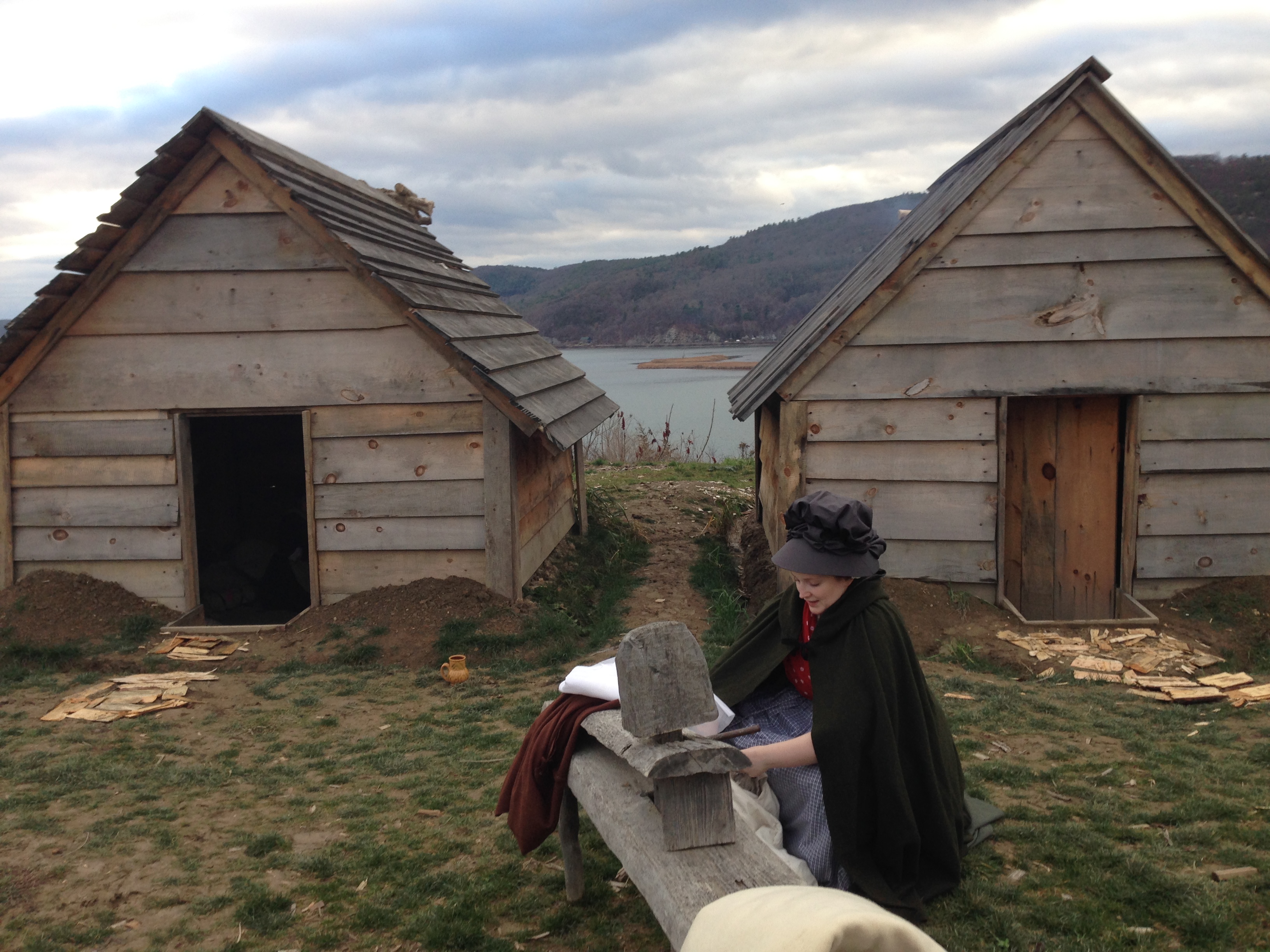
Fort Ti was described to me as “Disney World for Re-enactors,” but my vote is for Living History’s Moonrise Kingdom.

Idyllic, ain't it?

Idyllic, ain’t it?

I almost didn’t go when my Saturday night roomshare cancelled on Monday and then I developed an ear ache on Wednesday, but on Thursday, Low Spark , Mlle Modiste and I arranged a carpool, so on Friday morning, a Carload of Rhode Islanders (a thing to behold and to be wary of) set off for points north.

Our initial plan was to to sleep in the soldiers’ huts, but they proved extremely crowded and smokey, so when Mlle Modiste and I were offered a bunk in the barracks, we took it… unfortunately, only one of the blankets I’d brought for us did not make it back up to the fort or into the car heading home.

Mlle Modiste at the huts

Mlle Modiste at the huts

Before supper, we stuffed bed ticks, started a fire, startled a bat (I was not the source of the shriek that brought officers, women, and soldiers running), and stuffed straw in the hole we thought it flew into (thank goodness I’m tall, I guess).

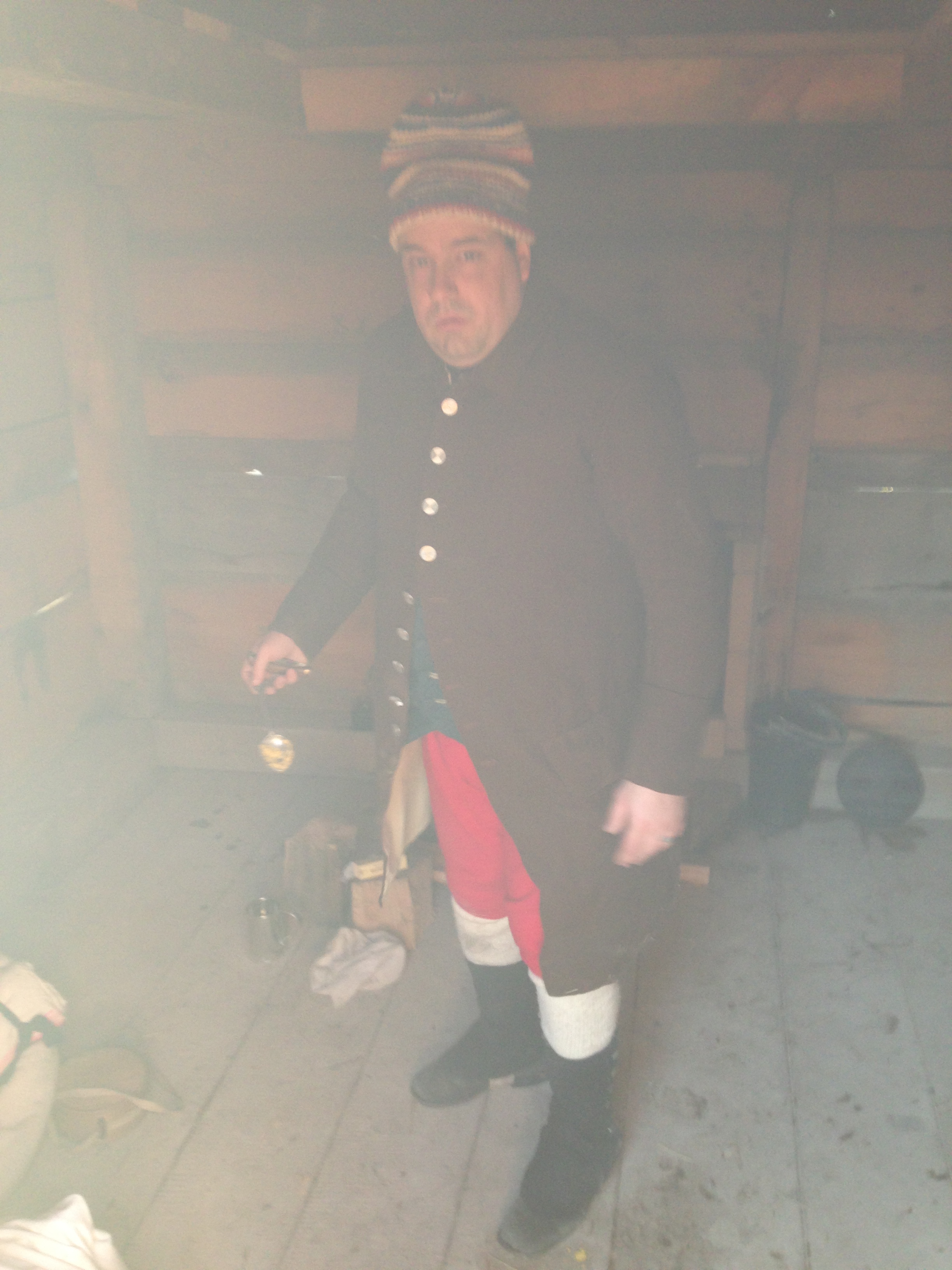
Smoke didn't just get in your eyes...

Smoke didn’t just get in your eyes…

The tavern moved up to the would-be armory at the barracks, though I’m certain multiple political deals and presidential candidacies could have been plotted and bought down at the smoke-filled huts. Instead, it was reenactor politics as usual: parallel experiences for men and women (not ladies, thank you, and if I hear you use “distaff” about me, expect to find one has become part of your anatomy). Just because I’m used to it doesn’t mean I don’t notice it, understand it, and still dislike it.

We’d expected to attend to “sick” soldiers in the hospital, but Saturday was such a lovely day that we spent most of it outdoors, starting and tending a fire to boil laundry and make dinner for the women’s mess. This pleased me mightily, even as I may have distracted troops despite my advanced age as I crouched at the fire being a human bellows. You try getting low in stays and see how you do: immodesty, thy name is fashion.

While I kept the fire going, much credit should go to Rory, a bad-ass woman in men’s clothing who split wood a-plenty for us.  Rory made me want badly to make myself a suit and wield an axe. I find myself wanting to do the same work as the men (I have always been this way), and I was intrigued by the debate that was reported to me: should a woman do men’s work in women’s clothes, or in men’s clothes? In the end, they chose men’s clothes, and Rory wore them well. Reader: I was jealous. I was also covetous of an axe, having realized all the cutting and hewing tools are no longer domiciled with me.

Aunt Kitty's coming' for you. boys.

Aunt Kitty’s comin’ for you, boys.

Saturday really revolved around three things for me: food, free agency, and feminism:

  • I ate some interesting things, including a smoked chocolate cake (left overnight in a hut, I can describe its flavor best as sucking diesel exhaust through a chocolate cupcake).
  • Now that I’m a free agent attending events sans unit, I have much more fun.
  • I am determined and dedicated to effecting well-researched roles for women in living history events of all kinds.

Share this:

  • Click to share on Facebook (Opens in new window) Facebook
  • Click to share on Pinterest (Opens in new window) Pinterest
  • Click to email a link to a friend (Opens in new window) Email
  • Click to share on X (Opens in new window) X
Like Loading...

A Day in Time

08 Thursday Oct 2015

Posted by kittycalash in Uncategorized

≈ 5 Comments

Tags

authenticity, common people, common soldier, history, interpretation, living history, Reenacting

You know what’s wrong with most reenactments and living history events?

They’re not actual days. They’re fragments of many days jammed together like a fractured mosaic.

It’s tough and tiring to imagine and script and play out a whole day—all the simultaneous pieces—but if living history or reenacting events were run as A Day In Time, there would more likely be:

• Roles for More [kinds of] People
• Contextualization of Events
• Boring Bits like Paper Work
• No Time for Spinning
• Moar Drilling
• Rations & Messes, Actually
• Moar Drilling
• Courts Martial
• Small Acts of Drama Amid the Quotidian

Of course, y’all would have to work together…but imagine the power if an entire event ran the way a military camp should be, would have been, run. Orderly books provide plenty of ideas, entire days of stuff to do and get in trouble for.

Stop splitting, start lumping, and these events will, at last, become truly engaging on both sides of the rope line.

Share this:

  • Click to share on Facebook (Opens in new window) Facebook
  • Click to share on Pinterest (Opens in new window) Pinterest
  • Click to email a link to a friend (Opens in new window) Email
  • Click to share on X (Opens in new window) X
Like Loading...
← Older posts
Newer posts →

Archives

wordpress statistics

Creative Commons License
Kitty Calash blog by Kirsten Hammerstrom is licensed under a Creative Commons Attribution-NonCommercial-ShareAlike 4.0 International License.

Website Built with WordPress.com.

  • Subscribe Subscribed
    • Kitty Calash
    • Join 621 other subscribers
    • Already have a WordPress.com account? Log in now.
    • Kitty Calash
    • Subscribe Subscribed
    • Sign up
    • Log in
    • Report this content
    • View site in Reader
    • Manage subscriptions
    • Collapse this bar
 

Loading Comments...
 

    %d