• Home
  • Completed Costumes/Impressions
  • Emma and Her Dresses
  • Free Patterns and Instructions

Kitty Calash

~ Confessions of a Known Bonnet-Wearer

Kitty Calash

Tag Archives: dress

HSF #5: A Peasant’s Jacket

11 Monday Mar 2013

Posted by kittycalash in Clothing, Historical Sew Fortnightly, Living History, Making Things

≈ 13 Comments

Tags

18th century clothes, common dress, Costume, dress, Historical Sew Fortnightly, living history, sewing, weekend

WIth the buttons to be installed

WIth the buttons to be installed

A Workman’s Jacket…not quite done. I had to work Saturday, so there went 7 hours; I got sick, I got tired, so it’s an almost, oh-so-close jacket. Buttons and buttonholes are all we lack. Of course, for a man’s jacket, that’s, you know, a significant lacking. However, I don’t want to have the crack-addled monkey buttonholes again, so I’m not doing them until I’m not rushed or distracted.

You’ve seen it already here, and know that it has chamois pockets. The Facts:

Buttons, with button holes to come

Buttons, with button holes to come

The Challenge: Peasants & Pioneers

Fabric: Blue wool broadcloth, with a blue and white striped linen lining

Pattern: Kannik’s Korner Double-Breasted Short Jacket

Year: It will be worn for 1775, but can be worn from 1760-1800.

Paul Sandby, A Sandpit. YCBA B1975.3.930

Paul Sandby, A Sandpit. YCBA B1975.3.930

Notions: Linen thread, brass buttons, interfacing, cotton twill stay tape

How historically accurate is it? Well…the fit is a trifle off. It’s better than the base pattern, as I altered the shoulders, but it could use another round of alterations and fitting if the intended wearer would tolerate it.  Still, like the man to the left, the kid is supposed to be working in this, so he’ll need some room.

The edges of the wool are unfinished, as I’ve seen in originals, with the lining turned back. It is all hand sewn. But, I don’t have any documentation for the striped linen lining, (it’s fine for quilted petticoats) so I would not go above 8/10 for this.

Stripes!

Stripes!

Hours to complete: I can remember about 18 to this point, and the buttonholes will add another 5 to 7. They’re about 20 minutes each, with 16 – 18 to do, plus sewing on buttons. Total time likely to be 22-24 hours.

First worn: To be worn April 13, 2013.

Total cost: $79.36 can be accounted for in materials. The broadcloth was purchased from Wm Booth’s remnants and the buttons are Burnley & Trowbridge: those I have numbers for. The striped linen, purchased at Jo-Ann Fabrics,  was in the stash.

Share this:

  • Share on Facebook (Opens in new window) Facebook
  • Share on Pinterest (Opens in new window) Pinterest
  • Email a link to a friend (Opens in new window) Email
  • Share on X (Opens in new window) X
Like Loading...

Sweet Danish!

28 Thursday Feb 2013

Posted by kittycalash in Clothing, Museums

≈ 1 Comment

Tags

dress, Museums, National Museum of Denmark, patterns, Research, resources, Tidens Toj

That dress!

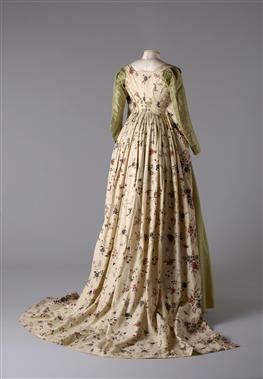
You know the fabulous 1797 wedding gown from the Danish Museum? It turns up on blogs as the Tidens Toj gown. Many of the links to the pattern and the gown are broken now, but fear not, it only moved. Wouldn’t know anything about museum website links changing…

You may know this already, but it’s here now. The National Museum of Denmark has a nice set of Pinterest boards,  which is how I found the dress. The PDF is still available from the catalog record, and has a link here.

English Dress, 1780

The Fashion History- Future Clothing exhibit is still up, and many of the garments have PDF patterns. There is a pretty post-RevWar era “English Dress,” which also has a pattern. The translation that Google provides is a trifle (no, actually, quite) hilarious. Don’t trust it…you’ll end up with sweaters and wrinkles instead of Brunswicks and pleats.

Share this:

  • Share on Facebook (Opens in new window) Facebook
  • Share on Pinterest (Opens in new window) Pinterest
  • Email a link to a friend (Opens in new window) Email
  • Share on X (Opens in new window) X
Like Loading...

Projects A-Waiting and Awry

29 Tuesday Jan 2013

Posted by kittycalash in Historical Sew Fortnightly, Making Things

≈ Comments Off on Projects A-Waiting and Awry

Tags

18th century clothes, Clothing, Costume, dress, Events, Historical Sew Fortnightly, sewing

One of things I like about the HSF series is that it keeps me sewing. It’s good to have accountability, and the challenge provides it. Structure, and deadlines: good for the soul.

And then there’s that factor known as work. We’ll call it that, as the effects are often described in language not suitable for the New York Times, last bastion of manners. Poor William Shawn spins as each New Yorker is printed: he’d never let douchebag pass.

But I digress.

Things changed in the schedule and now I don’t have to sew delicious frock coats and corduroy breeches for February. The good news is that I will not have to wrangle the unwilling to be fitted immediately, and I will be that much more skilled by Fall, when the clothes will be wanted. It also means (sort of) that there is actually time to sew for me. This is a very good thing, as I am planning to attend Dress U and even to teach (heaven help us all) two classes, one on using museum records and collections online and in person, and another on what Reenactors and Costumers can learn from each other. So while I’m thinking about 1790s wool jackets and trousers, a Battle Road-worthy wool gown (pfft! Gowns seem easy now!), Battle Road men’s wear (a little queasy, not so easy) and at least one more pair of overalls (unprintable, really) I am also thinking about how much I don’t want to be the tiara-less, non-sparkly girl again.

What does that mean? That means silk, and the Curtain-Along Gown, which I think I have figured out. (Figuring out the silk part will come later, I’m just happy to have gotten this far…)

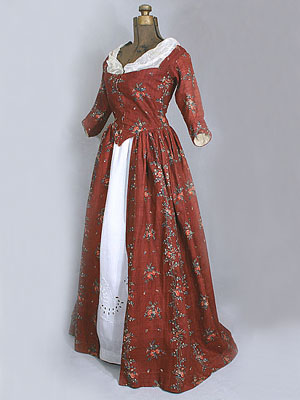
1780-1790 chintz gown

1780-1790 chintz gown

Fairfax House

Fairfax House

Historical Sew Fortnightly  #3 Under It All: I meant to do my shift, but that changed. Voila, petticoat. I have Ikea cotton curtains that will make a lovely petticoat that can be worn with a Curtain—Along gown of the dark red Waverly chintz, which I plan to make in the style of one of these gowns. An all-cotton, all-curtain ensemble makes me laugh: I am a Carol Burnett fan.

If I get the petticoat done, then I will have to make the pretty dress, at least eventually, which should be sometime between overalls (April 20) and Dress U (May 31).

10th Mass LI at Nathan Hale

10th Mass LI at Nathan Hale

That leaves time for something wicked regimental this way comes by June 15. Oh, yes, I expect Monmouth is in my future, humidity, turnpike and all. Why would I miss that?

Share this:

  • Share on Facebook (Opens in new window) Facebook
  • Share on Pinterest (Opens in new window) Pinterest
  • Email a link to a friend (Opens in new window) Email
  • Share on X (Opens in new window) X
Like Loading...

HSF # 1: 1813(ish) waistcoat

16 Wednesday Jan 2013

Posted by kittycalash in Clothing, Historical Sew Fortnightly, Living History, Making Things

≈ Comments Off on HSF # 1: 1813(ish) waistcoat

Tags

Clothing, Costume, dress, fashion, Historical Sew Fortnightly, patterns, sewing, waistcoat

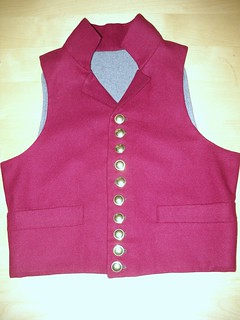
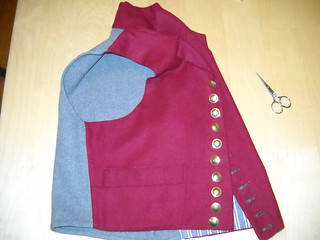
Waistcoat, my waistcoat

The Challenge: #1, __13

More photos here.

Fabric: Fronts, 100% wool leftover yardage from a petticoat. Back, wool broadcloth left over from remnant (is that a remnant remnant?) purchased for Mr S’s short jacket. Lining, heavy-weight linen.

Pattern: Kannik’s Korner Man’s Waistcoats, 1790-1815

Year: You can call it 1813. This style works for a couple of decades, though it will be worn for 1799 this weekend. Time machine, anyone?

Snazzy, right? This color is closer to the actual color.

Notions: 10 domed brass buttons with rims; silk buttonhole twist, both Wm Booth Draper, and some interfacing from the Franklin Mill store.

Red Waistcoat, MMA

How historically accurate is it? Well…the pattern has good documentation and the fabric is within reason for the period. The waistcoat is entirely hand-sewn, and the coarse linen pocket linings match extant garments in collections. So I know that’s good. And as it turns out, I completely and inadvertently made…this! So excited to find this! More excited than you’d expect! First quarter 19th century means 1813 is A-OK!!Also, that waistcoat is HOT! So I think I have achieved pretty accurate, even if it will be used in a time machine back to 1799. 

Hours to complete: This was much faster than the first one. 12 hours for cutting and sewing, with about 3 hours just on button holes.

First worn: To be worn by the new owner (The Young Mr) January 19, at the Winter Frolic

Total cost: Since I used fabric left over from a petticoat and the jacket, I’d say the cost was really only in the buttons, so $14.50.

Share this:

  • Share on Facebook (Opens in new window) Facebook
  • Share on Pinterest (Opens in new window) Pinterest
  • Email a link to a friend (Opens in new window) Email
  • Share on X (Opens in new window) X
Like Loading...

Sandby’s Women

11 Friday Jan 2013

Posted by kittycalash in Clothing, History, Museums

≈ 3 Comments

Tags

18th century, 18th century clothes, common dress, Costume, dress, fashion, fashion plates, museum collections, Museums, Paul Sandby, Research, resources, watercolors, Yale Center for British Art

20130109-061710.jpgSara Hough’s date of ca. 1805 piqued my curiosity and Cassidy was suspicious, too. So I went looking into Paul Sandby a little bit more.

Many of us know him for the sketches and watercolors of working people in mid-18th century England. They’re oft-used references for people doing Rev War reenacting as they’re full of the kinds of details seen in the watercolor of Sara Hough. I hadn’t thought of Sandby for later 18th century references, which shows how little I was thinking.

Sandby: Figure with Lute & Tamourine, YCBA

Sandby: Figure with Lute & Tamourine, YCBA

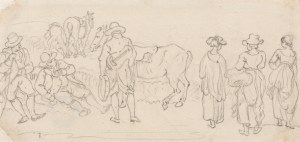
Thanks to the 18th Century Material Culture Resource Center, I found the Sandby “People and Places” presentation, which led me back to the Yale Center for British Art, and this image of musicians, horses and women. There’s no date in the record, though the presentation calls it ca. 1785. There seems to be a series or portfolio of Sandby sketches similar in size and type from about 1785, so it’s a reasonable assumption…with the usual caveat about assumptions, but no aspersions on the compiler of the presentation.

Sandby, detail, YCBA

Sandby, detail, YCBA

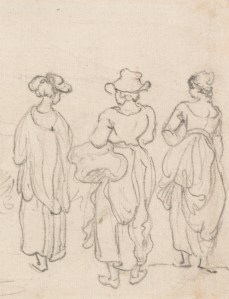
Sandby: Two Women and a Basket, YCBA

Sandby: Two Women and a Basket, ca. 1759 YCBA

Let’s look at a detail of the women in the drawing. Their waists are higher than we see in earlier Sandby drawings, and their profile slimmer, more classical, particularly the figure on the far right. Her bodice looks to me like a late 18th-century bodices.

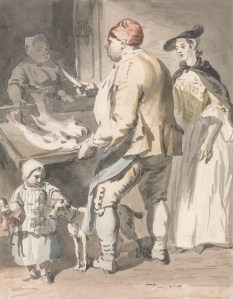
Sandby: A Fishmonger, YCBA

Sandby: A Fishmonger, ca. 1759 YCBA

Sandby had the skill to depict clothing with minimal gestures, as he does below in A Fishmonger, part of the London Cries series.

It’s that circa that gets you. I believe it for the ca. 1759, all the way. The figures fit into the visual continuum of Sandby’s mid-century work as I know it. (You’ll just have to trust me that I have a visual memory, and that, for once, the years of art school matter.)

And I kept wondering if he really had worked late into the 18th century, and then I found this:

Sandby: Family in Hyde Park, YCBA

Sandby: Family in Hyde Park, YCBA

Again, no date, but there are distinctive markers to tell us this is post-1780, even inching to the early 1790s. The waistcoats on the adolescent boys are shorter and double-breasted. The shape of the boy’s hats has changed: these aren’t cocked hats, and they’re not soft round hats. But look even closer and you’ll see the ties at the knees of their breeches, very typical and fashionable for the 1790s. All this before we’ve even gotten to the woman! Look at what she’s wearing: that’s certainly a plausible ensemble for 1794, isn’t it? The waist has moved up, the skirts are lighter, likely mull or muslin, and the skirt of what I interpret as an open robe, much like Sara Hough‘s, is trained on the ground. If this is a Sandby drawing, which I don’t doubt, then I think we definitely see him working into the mid-1790s.

And just for one final kick, I checked the Met again, where they have a Paul Sandby drawing dated 1798-1799. I wonder…but the coat collar and waistcoat might have it.

Sandby, Group of 4 Children and a Dog, MMA

I’m still not sold on ca. 1805 for Sara Hough (why no ‘h’ on Sara when the drawing is inscribed by Sandby, “Sarah Hough…”?) but I’d endorse 1795. The tricky part, as always, is the circa: so much depends on how a museum interprets ‘circa.’ For some, it’s 5 years either side of the date; for others, it’s 10. When I see a circa date, I get skeptical, and start doing math.

Share this:

  • Share on Facebook (Opens in new window) Facebook
  • Share on Pinterest (Opens in new window) Pinterest
  • Email a link to a friend (Opens in new window) Email
  • Share on X (Opens in new window) X
Like Loading...
← Older posts
Newer posts →

Archives

wordpress statistics

Creative Commons License
Kitty Calash blog by Kirsten Hammerstrom is licensed under a Creative Commons Attribution-NonCommercial-ShareAlike 4.0 International License.

Website Built with WordPress.com.

  • Subscribe Subscribed
    • Kitty Calash
    • Join 621 other subscribers
    • Already have a WordPress.com account? Log in now.
    • Kitty Calash
    • Subscribe Subscribed
    • Sign up
    • Log in
    • Report this content
    • View site in Reader
    • Manage subscriptions
    • Collapse this bar
 

Loading Comments...
 

    %d