• Home
  • Completed Costumes/Impressions
  • Emma and Her Dresses
  • Free Patterns and Instructions

Kitty Calash

~ Confessions of a Known Bonnet-Wearer

Kitty Calash

Tag Archives: Events

Sturbridge: Always Something to Learn

06 Tuesday Aug 2013

Posted by kittycalash in Events, Living History, Reenacting

≈ 3 Comments

Tags

10th Massachusetts, anxiety, Events, family, living history, parenting in public, weekend

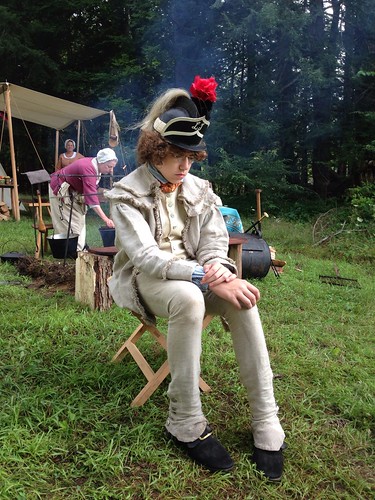
Adorable, right? But so very miserable.

This year, it was about anxiety.

After some too-public parenting and a minor diversion home and back to Sturbridge this past weekend, I can say that yet another event has taught me yet another set of lessons.

To wit:

  • Adolescents do not think clearly and will not tell you what is going on except under duress. Expect tears.
  • Keep the kid busy.
  • First aid help exists, use it.
  • Pack Gatorade.
  • Bed sacks increase warmth and comfort immensely.

The Young Mr, seen above in Full Pout Mode, had a roiling head full of anxiety made worse by heat and dehydration, for which he refused water and the suggestion of luxuriating in the air conditioned splendor of the upholstered sofette in the lobby of the Bullard Tavern. He made it through one activity and then I took him home because he felt so unwell, complaining of a headache and a stomach ache and feeling hot and then cold that I thought he was really ill. (We’ve had some tense “will-he-or-won’t-he puke-in-my-purse” train rides home, so I tend to overreact.)

Here he is as the ensign, displaying the colors.

Not until Auburn and a large bottle of Gatorade later, when suddenly his stomachache and headache were gone, did I figure out that it was mild heat exhaustion and anxiety, not flu or something worse. And then realized I could have taken him to the first aid station instead of home. But, once home, after a nap and a fight and a dish of curry, he’d promised to go back up on Sunday, which was much better.

Their lyrics were hilarious.

Again, he got to serve as ensign and carry the colors, marching behind the guys as they sang their way through the village. But somehow, Sunday, everything seemed better than it had the day before, when he hadn’t told me how much he fears the start of high school, and how worried he is about his future.  No more reading the New York Times for him…

This isn’t the costume or action report you might want, but living history with an adolescent is challenging. The Young Mr is just too young to field (he’s only 14 but almost 15) and he doesn’t want to be a drummer. It’s a challenge to find things that he can legally and safely do that integrate him into the unit of guys, which is what he really craves. Perhaps it’s because he gets to try out what it’s like to be a man, while still being a boy.

Share this:

  • Share on Facebook (Opens in new window) Facebook
  • Share on Pinterest (Opens in new window) Pinterest
  • Email a link to a friend (Opens in new window) Email
  • Share on X (Opens in new window) X
Like Loading...

In a Pickle

01 Thursday Aug 2013

Posted by kittycalash in Food, Living History

≈ Comments Off on In a Pickle

Tags

cooking, Events, food, Hannah Glasse, living history, recipe, Research

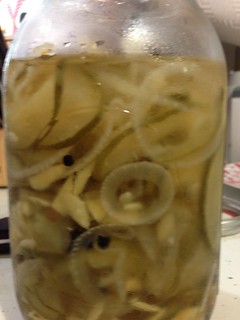
Yes, for breakfast.

I like pickles. I don’t like being in a pickle, and I have to say that work this week has been as bitter-tasting as any week since February, so it’s a fine thing that the pickles I made last weekend are ready for eating.

The recipe is based on the Hannah Glasse recipe my co-commissariat made for Cambridge, and which I sampled in the NPS staff kitchen. I thought they were delicious, and so proceeded to make my own version, with some variations.

Here’s my version:

  • 3 large cucumbers
  • 1 medium onion
  • white vinegar
  • salt
  • whole peppercorns
  • fresh ginger
  • ground mace

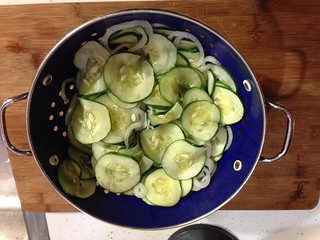
Slice the cucumbers and onion thinly and evenly (I used my old Martha Stewart Everyday mandolin from K-Mart). Layer alternately, sprinkling with salt, in a shallow dish or bowl, and cover, for 24 hours, in the fridge. Drain in a colander, pressing with paper towel to remove excess water.

Place the drained cucumber and onion slices in a bowl and cover with white vinegar for at least four hours, or while you go to work and are unable to leave early as you had planned. Pour the vinegar into a saucepan and boil with a little salt.

Peel and slice the ginger into sticks, and add to the cucumbers and onion. Sprinkle all with mace to taste, and add whole peppercorns as desired. Pour the boiled vinegar over all, decant into clean, boiled jars and seal.

I tasted these first over the weekend, and they were strong and spicy! The ginger made them a little hotter and sweeter than the ones I had in Cambridge. They seem a little mellower now (I had some with breakfast this morning) and I think they will be OK at OSV this weekend…if I take them. Glass jars seem crazy to pack for camping.

Share this:

  • Share on Facebook (Opens in new window) Facebook
  • Share on Pinterest (Opens in new window) Pinterest
  • Email a link to a friend (Opens in new window) Email
  • Share on X (Opens in new window) X
Like Loading...

Washington’s Army En-scamp-ment

17 Wednesday Jul 2013

Posted by kittycalash in Events, Living History, Reenacting

≈ 2 Comments

Tags

10th Massachusetts, authenticity, common soldier, Events, living history, Reenacting, Revolutionary War

It is known that the troops serving as the Army of Observation in the months after Lexington and Concord lacked discipline. General Washington found them sorely wanting when he took command of what became the Continental Army, superseding General Artemus Ward. You can read the measures Washington put in place here, from Artemus Ward’s orderly book in the collections of the Massachusetts Historical Society.

This lad became Washington’s Aide-de-camp, scampering out of trouble…barely….

When you have this kind of documentation, it makes recreating an event that much easier, and more fun. (We did note that sometimes striving for authenticity makes us behave very seriously; perhaps a little more fun is in order.)

Luckily for us, the Young Mr was assigned to be General Washington’s aide-de-camp. Aide-de-scamp would be more like it. He thoroughly enjoyed carrying the General’s equipment and accouterments, handling the items with obvious care and confusion–he was clearly impressed by what he was carrying, acted (rightly) as if he’d never seen things so fine, and then proceeded to place them carefully on the ground outside the general’s tent…respectful but not quite right, thus a little disappointing, but setting the proper tone.

After lunch, the sergeant standing guard caught the aide-de-camp stealing fruit from the general’s table. This made a fine show with the sergeant yelling at the aide-de-scamp and shaking him by the scruff of his jacket (the sergeant being shorter than the scamp). The scamp continued to eat the peach, but it was ripe, and part of it went flying off the pit, fortunately not into the sergeant’s face. All were pleased by this little scene, no one more than the scamp.

The Lexington Training Band was busted for card playing, and for drying their dirty laundry on the general’s tent. The scamp was accused of stealing stockings, and chased, in another very satisfying scene. Next weekend, he’ll have General Gage to reckon with. I expect to find him in irons.

Share this:

  • Share on Facebook (Opens in new window) Facebook
  • Share on Pinterest (Opens in new window) Pinterest
  • Email a link to a friend (Opens in new window) Email
  • Share on X (Opens in new window) X
Like Loading...

Fun and Feasting in Cambridge

16 Tuesday Jul 2013

Posted by kittycalash in Events, Food, Living History, Reenacting

≈ 2 Comments

Tags

10th Massachusetts, 18th century, common soldier, cooking, Events, food, living history, Reenacting, Revolutionary War

Well, we didn’t feast, it was too hot. But I helped make a feast. I didn’t document it with  photos because I didn’t think my companion would appreciate it. But here’s what we did.

General Washington was set to dine with the gentry, so a repast needed to be made. The captain’s wife volunteered to provide the meal and I served as scullery maid, a role I do find comfortable. (Anyone else identify with Daisy on Downton Abby? She’s the character I feel most like.)

The menu:

Salmagundi
Onion Pie
Bread & Cheese
Pickles
Fruit
Ratafia Cakes
Claret

We worked in the NPS staff kitchen in the carriage house behind Longfellow House: air conditioned, but the kitchen is in a former bathroom. Still, there was a sink and some counter space, so we were set.

A salmagundi is a kind of mixed salad, by which I do not mean tossed. It is perhaps most similar to a chopped, layered salad today. Colonial Williamsburg has an adaptation here, and that formed the basis of our creation.

We used one bag of pre-washed leaf lettuce, one roasted chicken (I did not have to rip it up! I got to chop eggs instead), two tins of anchovies, a medium ham, a lemon, etc. Although we had wooden bowls for prep work, we ran out of places to put the chopped ingredients, so ended up using the NPS staff containers from the dish drainer. With a glass full of egg yolk, a bulk food container of egg white, a black plastic dish of ham and a plastic water cup of anchovies arranged on the crowded sink, we achieved a workable if slightly bizarre mise en place.

What’s astonishing is how much space all that food takes up. You think it’s not enough when it’s contained, but get it on a platter and wow! That’s a shockingly large amount of food. The captain and his wife will be enjoying that salmagundi all week, I fear.

The onion pie was pre-baked from the CW recipe as well. I favor Chesire Pie, and know it is a unit favorite (since four of us devoured one for breakfast at Monmouth…mmmm, pie….)

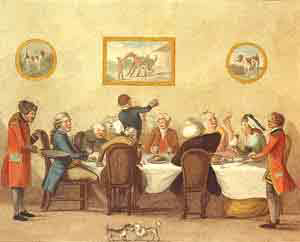
The pickles were amazing! Made from a 1747 Hannah Glasse recipe, pickled cucumber slices are pretty simple. You may, of course, wish to reduce the quantities:

“To pickle large cucumbers in ſlices. TAKE the large cucumbers before they are too ripe, ſlice them the thickneſs of crown pieces in a pewter-diſh ; to every dozen of cucumbers ſlice two large onions thin, and ſo on till you have filled your diſh, with a handful of ſalt between every row : then cover them with another pewter-diſh, and let them ſtand twenty-flour hours, then put them in a cullender, and let them drain very well ; put them in a jar, cover them over with white wine vinegar, and let them ſtand flour hours ; pour the vinegar from them into a copper ſauce-pan, and boil it with a little ſalt ; put to the cucumbers a little mace, a little whole pepper, a large race of ginger ſliced, and then pour the boiling vinegar on. Cover them cloſe, and when they are cold, tie them down. They will be fit to eat in two or three days.”

Read more at Celtnet: http://www.celtnet.org.uk/recipes/glasse-of-pickling-14.php
Copyright © celtnet

Ratafia cakes are funny little things. I only had one, when they came back from the table (I did mention Daisy, right?) but I might try them. They are not ideal for camp eating–in fact, they would be downright inappropriate–mostly because they are rather fragile and travel poorly.

The rest of us–the privates and sergeant and the Young Mr, who was playing Washington’s aide de camp as a young scamp–ate bread and cheese and fruit in the shade of a tree. It was too hot to eat much.

Share this:

  • Share on Facebook (Opens in new window) Facebook
  • Share on Pinterest (Opens in new window) Pinterest
  • Email a link to a friend (Opens in new window) Email
  • Share on X (Opens in new window) X
Like Loading...

Drawing Beef and Flour

26 Wednesday Jun 2013

Posted by kittycalash in Food, Living History, Reenacting, Research

≈ Comments Off on Drawing Beef and Flour

Tags

10th Massachusetts, 18th century, cooking, Events, food, Research, Revolutionary War

The Durham Ox: yet to come in 1778

Drawn meat: The Durham Ox.

Or beeve and flower, depending on how you’re spelling in 1778.
John Buss of the 10th Massachusetts complained mightily of the rations he drew, and the quality of the beef, pining in his letters home for cheese and cider. His affection for cheese has become part of the unit’s lore and an in-joke, so I did make certain to have plenty of cheese for Monmouth. Bread, cheese, ham, fruit in season, beef stew: yawn, after a while.

Trying to cook authentically in the field could result in dull, repetitive menus, recreating the soldiers’ experience, but unless everyone you’re feeding has signed up for that, you may have an unhappy crowd on your hands. Mostly they just want food, but people will grumble if you are cooking the same thing every week (and that opportunity exists). When I was a kid, my mother cooked chicken and broccoli every Sunday night, and to this day, I won’t eat chicken and broccoli unless it is in satay sauce.

Sorry, Private: not in this man's Army.

Sorry, Private: not in this man’s Army.

The 10th can count themselves lucky that they weren’t on the expedition to Quebec, when Newfoundland was on the 2nd Rhode Island’s menu, as well as squirrel-head-and-candle-wick soup. (Try explaining this Newfoundland business to your creative writing group. I tried historical fiction and got a reputation for being “dangerous,” and you can, too.)

At Monmouth, we served as another regiment’s….disposers…on Sunday morning, and were treated to the extra steaks they cut from a ham. Grilled and stacked on bread with hard cheddar cheese, this was delicious. Our conversation turned quickly to the question of grilling. After all, we only have kettles and sticks. I said I’d buy and carry a grate if they wanted ham so much, but the Adjutant proposed weaving a grid of green sticks and holding that over coals, and just brushing off the ashes when the meat fell into the coals. The minor detail left out is what we would use to retrieve the meat, though it must be a stick by any other name.

One cannot fry in or on tinware: the tinning will melt. We know soldiers carried as little as they could even in the regular infantry, so light infantry units were packing nothing but what they had to carry. No frying pan; no grate. Upon reaching this conclusion, we turned our sad-eyed stares on the other regiment with their table and stools and grill and ham, and were rewarded with another grilled ham piece each. Dogs have got a good thing going.

Begging and sharing aside, what about ham? The joke we make at home about ham being the natural prey of cats who butcher, brine, and cook the ham they beg for applies just as much to light infantry troops and their hangers-on. (They shouldn’t really have me along, but they are stuck and I’m pretty handy for getting the meals out, the canteens filled, and the wounds bandaged.) But a ham? Harder still to justify. Salt pork, yes; salt beef, yes. But the attractive and portable boneless hams at the supermarket are, sadly, more delicious than authentic.

One can take on the task of preparing meat properly oneself, in one’s copious spare time, but that won’t fix July and August’s meals. Staring sad-eyed at other regiments seems a parasitic and reputation-destroying plan. What to do?

Tune in next time for more adventures in historic meats!

Share this:

  • Share on Facebook (Opens in new window) Facebook
  • Share on Pinterest (Opens in new window) Pinterest
  • Email a link to a friend (Opens in new window) Email
  • Share on X (Opens in new window) X
Like Loading...
← Older posts
Newer posts →

Archives

wordpress statistics

Creative Commons License
Kitty Calash blog by Kirsten Hammerstrom is licensed under a Creative Commons Attribution-NonCommercial-ShareAlike 4.0 International License.

Website Built with WordPress.com.

  • Subscribe Subscribed
    • Kitty Calash
    • Join 621 other subscribers
    • Already have a WordPress.com account? Log in now.
    • Kitty Calash
    • Subscribe Subscribed
    • Sign up
    • Log in
    • Report this content
    • View site in Reader
    • Manage subscriptions
    • Collapse this bar
 

Loading Comments...
 

    %d