• Home
  • Completed Costumes/Impressions
  • Emma and Her Dresses
  • Free Patterns and Instructions

Kitty Calash

~ Confessions of a Known Bonnet-Wearer

Kitty Calash

Tag Archives: Federal style

Pink on My Brain

29 Thursday Nov 2018

Posted by kittycalash in Making Things, material culture, Research

≈ Comments Off on Pink on My Brain

Tags

fashion, fashion plate, Federal style, handsewn, Regency, sewing project

I no longer remember where in the wilds of the interwebs I found this charming servant, but find her I did, three years ago. I probably came across her researching servants, and found her striking (since she is), so saved the image while moving on to Pyne or Krimmel for more geographically appropriate sources. Still, I’d picked up a remnant of brown and pink printed cotton at Genesee, and had a start to this ensemble.

IMG_3855
IMG_3851

A scrap of that print was in my pocket when my dear friend (formerly m’colleague) and I went took the train down to New York for a fabric spree. We went in late June (Genesee was early that year), trying to use up vacation time so we didn’t lose it before the end of the fiscal year– any year I didn’t have a hip replacement, I tended to lose a week of vacation so we were motivated to take time off.

I remember that my favorite dress demonstrated a peculiar friendliness, and required a safety pin for modesty’s sake. I remember m’colleague being overwhelmed in the crosswalks at Herald Square, and taking her hand to get her through the sea of bodies and cars. (She grew up in a very small town in northern Rhode Island, where apple orchards were within walking distance; I grew up on the north side of Chicago, taking the bus to the Loop.) But at Mood, I found the fabric that I knew would make the petticoat.

Pink tropical weight wool, don’t ask me how much a yard. I don’t remember, but it was certainly more than I’d paid for any fabric before, with the exception of silk dupioni I bought for a wedding dress. Madness, I thought– but beautiful madness. I started on the short gown (see above) with an extant European garment as inspiration (probably found through Sabine’s work); then I started on the petticoat.

And promptly dropped the project while I changed my life completely. The short gown I finished, and wore as a housekeeper for some Wednesday afternoon programs, but I never managed to get that petticoat finished– until this past week. The pink and black bonnet needed an ensemble, and half of it was present, in the form of the Spencer.

But what I wanted to do was to recreate that plate, short gown, cap, and all. I’m still short the black silk apron, and my cap will always be Anglo-American, but I got close enough to be satisfied that I reached the goal I set three years ago. What I did discover in trying to replicate this image was slightly unexpected, and entirely useful. Just as fashion images are exaggerated today, so too were they exaggerated in the past. M’lady in the image at top is elongated– I’m nearly six feet tall, and I cannot achieve her length. Granted, the waist on my short gown is lower than hers, but still: she’s drawn as if she has the proverbial “legs up to here.” What’s useful about this, and about trying to recreate images from the past, is that these exercises reveal some of the foibles and preferences of the past, which help us see past the filter of the present and get closer to understanding the past.
Share this:

  • Click to share on Facebook (Opens in new window) Facebook
  • Click to share on Pinterest (Opens in new window) Pinterest
  • Click to email a link to a friend (Opens in new window) Email
  • Click to share on X (Opens in new window) X
Like Loading...

Capote de Velour garnis en satin

27 Tuesday Nov 2018

Posted by kittycalash in Clothing, Making Things

≈ 7 Comments

Tags

19th century, bonnets, fashion plate, Federal style, handsewn, Jane Austen, millinery, Regency

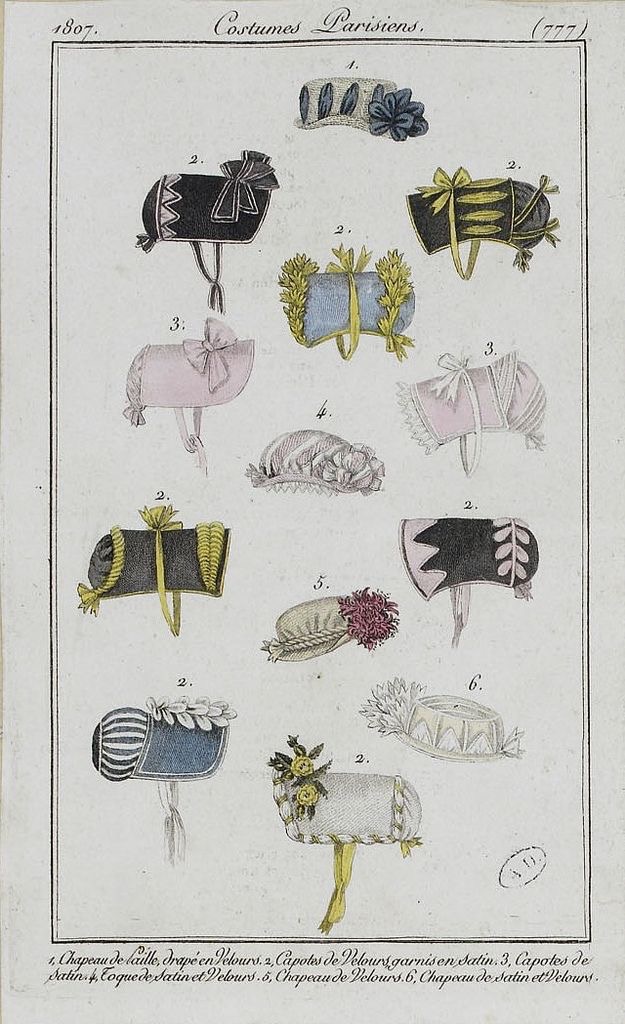
Costumes Parisiens, 1807

This plate has stuck with me for years: those mailbox shapes, in velour! In 1807, velour was not what we think of today (and I don’t mean Zapp Branigan). Valerie Cumming’s Dictionary of Fashion defines velour as “Wool or wool mixture cloth, soft and smooth with a closely-cut pile or nap resembling velvet.” Not having access to wool velour in the scrap bins at work, or in the fashion aisles at the local fabric store, I opted for velvet; the scrap bin provided pink silk taffeta, which I thought made a nice contrast to the texture and finish of the velvet. It is true that “velure” dates to the 17th century, and describes imitation velvet. The wool velour I’m familiar with from upholstery is too dense and heavy to drape well over a bonnet (it’s really made for sofas and armchairs), so erring on the hand of the fabric seemed a reasonable choice. Wool velour with silk satin would be an amazing textural contrast, but with this color combination, almost any fabrics will give a pleasant optical shock.

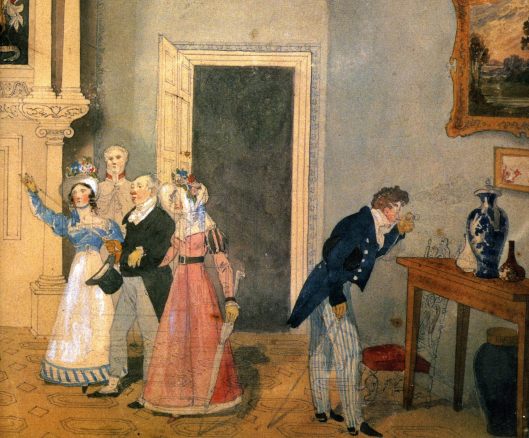
French 19th Century, Les Invisibles en tête-à-tête (Tête-à-Tête with Poke Bonnets), c. 1805, etching with publisher’s hand coloring in watercolor on pale green laid paper, Katharine Shepard Fund 2015.49.4

Shaping the brim was an exercise in paper and pasteboard, winging it a bit until I achieved a length and width that was mailbox-like but not too drainage tunnel. The cartoons of the period make clear that these are deep brimmed bonnets. I do like that the bonnet on the left is trimmed so like the ones in the fashion plate; the one at right is probably corded or reeded, judging by the ridges.

The trickiest bit was shaping the silk to the compound curve of the brim. Three patternings got me there– until I realized the silk needed body to hold up to binding, and took a short cut. Ask not of the sin of fusible interfacing, for I have learned my lesson. Yes, the silk piece shrank and no longer curved evenly from the front edge. Thank goodness Drunk Tailor was watching The Pacific, so any foul language I may have used was disguised by movie dialogue. The binding is bias-cut silk, easy enough. After the debacle of the Vandyke trim, I opted not to cut and bind the leaf shapes, but rather to cut the ovals with pinking shears and attach them along a silk band. Would I do it differently another time? Possibly, if only because I like to imagine the different ways an American milliner might interpret a French fashion plate.

Once I settled on making the bonnet, I decided it was time to finish a pink wool petticoat I started in 2015 after a trip to Mood. It’s a tropical weight Australian wool, according to its selvedge, and has a high-waisted bodice with a drawstring closure. I covered the bottom drawstring (and added some bling) with a black velvet belt closed with a period paste buckle. (Every now and then someone doesn’t know what they’ve got, and lets it go for a price I can afford.) On top, the gathered back cotton velveteen canezou/Spencer made for my first trip to Genesee. Having a wardrobe extensive enough to mix-and-match almost the way I do from my modern closet is pretty satisfying, if a little crowded.

This isn’t a bonnet for wearing while crossing a busy street, though it will successfully shelter the wearer and a cat from any sudden downpours, and one is unlikely to get sunburned wearing this. I didn’t find it distracting to wear– but I didn’t go far, and I had a companion. But what price fashion?

Share this:

  • Click to share on Facebook (Opens in new window) Facebook
  • Click to share on Pinterest (Opens in new window) Pinterest
  • Click to email a link to a friend (Opens in new window) Email
  • Click to share on X (Opens in new window) X
Like Loading...

Go Big When You Go Home

13 Thursday Sep 2018

Posted by kittycalash in 1830s, Clothing, Living History, Reenacting

≈ 2 Comments

Tags

1830s, chintz, Federal New England Fashion, Federal style, handsewn, militia, New England, Old Sturbridge Village, OSV

heading north

A year after moving, Virginia feels like home, even as I continue to experience accent-based misunderstandings and yearn for different apples. But if home is where the heart is, my home is split between the place where my kid grew up and goes to college, and where I live now. After having all vacations cancelled (thanks, Fairfax County Jury System), we scheduled one for the end of the summer, a chance to visit friends, antique (and buy a new school wardrobe for a college sophomore).

You can never have enough eagles or feathers.

The trip hinged on the Militia Days event at Old Sturbridge Village, with Drunk Tailor mustering as a member of the Oxford Light Infantry or “Ollies.” The OLI has a ridiculously shiny and ornamented shako, which contributes to the appeal of the impression. The early Federal-era militia units certainly appeal to me, with gold buttons, chain, tassels, and plenty of eagles everywhere. There’s a lot of visual myth-making to unpack there, and the fact that the muster re-enacts a sham battle makes it ever so much more so wonderful and New England. This is meta-enacting (or re-re-enacting), and I am all for it.

A new time period meant a new dress. And a new bonnet. And new hair– that last complicated by the new summer haircut. (I had a wool gown from the Turkey Shoot several years ago, but wool in August at Sturbridge is possible but not recommended.) So, what to wear? I remembered some lightweight chintz gowns in the Kyoto Costume Institute collections, and happily there’s one on their website (my copy of the book is still in storage). While I prefer the audacity of many of the reproduction cotton prints, the hand of the quilting cottons is often heavier than I want, so I ordered a print from India– one that has been used for many other dresses in different time periods.

With the antique lace collar I did not use, and the cut steel buckle I did.
piped seams!
piped seams!

The pattern is a straight-up version of the Past Patterns Lowell Mill Operative’s gown. The first 1830 gown I made was from the State Historical Society of Wisconsin pattern, which did not fit as well over the collar bones; the Past Patterns neckline resolves well and fits like a dream– the only change I would make the next time around is to make the back pieces smaller. I had way more overlap than I really needed, but otherwise, I was lucky that this required no adjustments to fit pretty well. Every now and then, it’s nice to have a break from drafting my own patterns and fighting with fit.

IMG_5136
IMG_20180901_131522523_HDR

Share this:

  • Click to share on Facebook (Opens in new window) Facebook
  • Click to share on Pinterest (Opens in new window) Pinterest
  • Click to email a link to a friend (Opens in new window) Email
  • Click to share on X (Opens in new window) X
Like Loading...

Black and Blue

21 Tuesday Aug 2018

Posted by kittycalash in Clothing, Events, History, Making Things

≈ 6 Comments

Tags

1790s, bonnets, fashion plates, Federal style, millinery, Regency Society of Virginia, Spencers

IMG_4756
IMG_4760

Unlike some of my earlier posts, this Black and Blue refers to a different kind of historical effect: the purely aesthetic. (Yes, it is a departure for me. Moving below the Mason-Dixon line has been curious, as my encounters at the bank regularly make me wonder if I have stumbled into the Invasion of the Body Snatchers or Pleasantville. Surely real humans aren’t this nice! I thought the people of Rhode Island were just fine, but maybe my standards were warped by growing up in a Major Midwestern City.) In any case, times change and so do people. Onward, to the aesthetic!

First, there was the new waistcoat. That should be enough to refresh an outfit, right?
Wrong.

The armscye sits way back over the shoulder blades

The set of the armscye didn’t coordinate with the white gown I made two summers ago, so a new item would be in order. I thought this would be the case in the muslin, but when I basted up the blue silk (selected because I had enough material to make a waistcoat and a cap), it was clear something new would have to go underneath.

The original waistcoat’s date of ca. 1797 helped narrow down my choices, and a 1799 fashion plate helped as well. Blue over white: pretty snazzy. I sketched up the plan for the white wrap-front gown, re-imagined that when I got batiste after asking for voile, and figured I’d be fine. A blue silk cap trimmed in black wool lace or gold silk cord still seemed like a good solution.


But the fashion plate showed a black hat or bonnet, and whilst trolling Etsy with a Manhattan in hand, searching for an 1830s-appropriate buckle, I took a look at one of my favorite shops, just to see.

Reader, I saw.

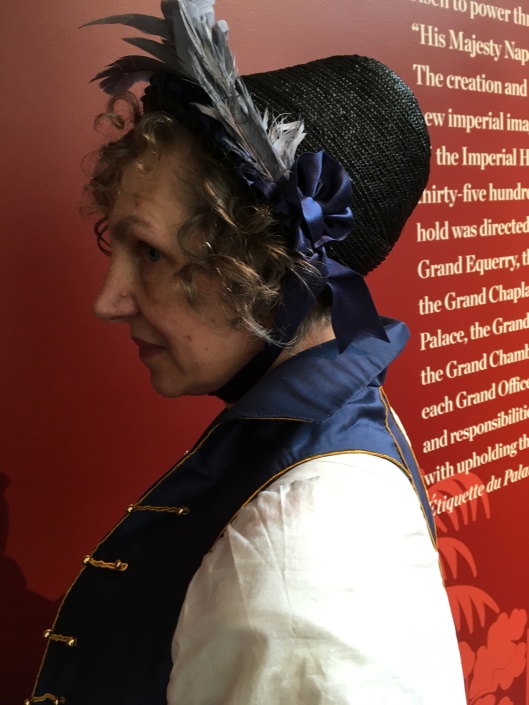
The “overly honest milliner” confessed that this style would not flatter everyone. Challenge accepted! In truth, though, I have a small head, and having cut my hair short for the summer, can (must) wear a slightly different kind of headware. I’ve also tried on enough of Anna’s millinery to know what will and won’t work for me, so I was pretty certain this bonnet would suit me well.

I trimmed it with some blue silk double-faced satin ribbon recovered from a failed bonnet attempt of several years ago, and then cast about for something else. Something different. Wednesday found me steaming feathers– as you do– while Drunk Tailor pulled KP duty. I hid the feather quills (more or less) with a ribbon rosette, and the considered fastening. Many early-nineteenth century bonnets don’t tie under the chin, and in any case, I didn’t have enough ribbon left to pull that off.

Parking lot selfie, with sweat, curls, and feathers. I like the way the feathers contrast with the curls.

The solution? Another rosette. On the feather side, I stitched the straight tail of the ribbon to the bonnet. The second rosette attached to the ribbon, which I then ran under my chin and pinned. Bonnet secured, more or less, though the feathers necessitate caution when exiting a vehicle.

Share this:

  • Click to share on Facebook (Opens in new window) Facebook
  • Click to share on Pinterest (Opens in new window) Pinterest
  • Click to email a link to a friend (Opens in new window) Email
  • Click to share on X (Opens in new window) X
Like Loading...

Tripping in Richmond

20 Monday Aug 2018

Posted by kittycalash in Clothing, Events, History, Museums

≈ 5 Comments

Tags

art history, Costume, Federal style, Museums, Regency Society of Virginia, Travel, Virginia Museum of Fine Art

Visiting the Stately Home: an early touristic diversion

Friday night, Drunk Tailor and I waited until the worst of rush hour in NOVA was over and headed south to Richmond, surprised not to be engulfed in a terrific thunderstorm of the kind we are becoming accustomed to driving in. We had planned a weekend trip to see the Napoleon: Power and Splendor exhibition at the Virginia Museum of Fine Arts. It’s a traveling exhibit, but this is the first time I’ve been close enough to see it, and we had the added benefit of being able to attend in costume with the Regency Society of Virginia. (Reader: I required a new outfit.)

The idea of visiting a museum in costume is incredibly appealing, and all the more so when you can visit galleries of objects from the time period your costume replicates. Add to that the layer of traveling on the weekend in the clothes from the time when tourism first became a “thing” (at least among the monied classes), and you have a recipe for an excellent adventure.

(Somehow, while often at events together, Drunk Tailor and I are rarely seen “together,” so images like this are nice to have.)

If you are going to play the tourist, especially if you are visiting the “spoils” of the former emperor, you have to dress appropriately. American tourists today may travel in camo crocs and backwards baseball caps, but people in the past dressed for touring and it seemed appropriate to dress for this trip.

Admiring the panorama. (Cropped only to enhance periodicity)

This trip, with the fun of visiting in period clothes, reminds me of the books still in storage, and the books I have yet to read — one on early country house tourism— that document the changes in how people spent their time and consumed goods, and the reasonably concurrent rise of both the museum and the department store.

Raptures about the mounting, I think, but we might as well we shopping.

Peale and Zola have more in common than you might think, or at least Mr. Peale and Mr. Selfridge. These compendia of material goods are similarly structured — both organized around themes or types, whether ladies’ lingerie or Oceanic art– and have similar aims of edification and [cultural] consumption.

When your hat sees its cousin in a case….

All in all, an excellent trip, with much to see and talk about. After finishing our tour of the Napoleon exhibit, we lunched (another experience similar to the department store) and toured more of the museum, and had a day well spent.

Share this:

  • Click to share on Facebook (Opens in new window) Facebook
  • Click to share on Pinterest (Opens in new window) Pinterest
  • Click to email a link to a friend (Opens in new window) Email
  • Click to share on X (Opens in new window) X
Like Loading...
← Older posts
Newer posts →

Archives

wordpress statistics

Creative Commons License
Kitty Calash blog by Kirsten Hammerstrom is licensed under a Creative Commons Attribution-NonCommercial-ShareAlike 4.0 International License.

Website Built with WordPress.com.

  • Subscribe Subscribed
    • Kitty Calash
    • Join 621 other subscribers
    • Already have a WordPress.com account? Log in now.
    • Kitty Calash
    • Subscribe Subscribed
    • Sign up
    • Log in
    • Report this content
    • View site in Reader
    • Manage subscriptions
    • Collapse this bar
 

Loading Comments...
 

    %d