• Home
  • Completed Costumes/Impressions
  • Emma and Her Dresses
  • Free Patterns and Instructions

Kitty Calash

~ Confessions of a Known Bonnet-Wearer

Kitty Calash

Tag Archives: food

Pouting over Putnam

30 Wednesday Oct 2013

Posted by kittycalash in Events, Fail, Reenacting

≈ 2 Comments

Tags

10th Massachusetts, Brigade of the American Revolution, Events, failure, food, living history, Reenacting

James Malton, 1761-1803, A Military Encampment in Hyde Park, 1785, Watercolor with pen in black ink, with traces of graphite on moderately thick, moderately textured, beige, laid paper, Yale Center for British Art, Paul Mellon Collection

James Malton, 1761-1803, A Military Encampment in Hyde Park, 1785, Watercolor with pen in black ink, with traces of graphite on moderately thick, moderately textured, beige, laid paper, Yale Center for British Art, Paul Mellon Collection

This Saturday is the BAR event at Putnam Park in Redding, CT. This is an event with an early set-up time, one of those “early enough to be worth packing the car Friday night” events, as Mr S will need to depart at the time he usually gets up. I’m pouting not because of the early departure time, but because I won’t be going.

The Young Mr has his first swim meet Sunday, so Saturday he’ll have to get his homework done. That means someone has to stay home, or he’ll sleep till noon and spend the rest of the day eating meat and playing video games, all normal for a 15-year-old, but not helpful when most of Sunday will be spent marinating in chlorine.

I did a strange and awful thing to my back in an altercation with the face plate of an UPS unit for a server, and find that two weeks on, I still have a mis-aligned rib and occasional searing pain when reaching for Amelia Simmons’ cookbook to find something for Mr S to take with him to Putnam Park. At first, it seemed that it would be like Fort Lee, where one does not cook.

However, it seems that a camp kitchen is planned and there could be cooking, if only someone could tend the fire during the tactical, but no. I will not be there to stir meat of any kind, in any way, and the gentlemen, if one can call them that, will have to scrounge in the corners of their haversacks, take pot luck from the Boy Scouts, or find other means of nourishing themselves. I’ve also been told that it might be as well for me not to lace up my stays and push my ribs around, though on the whole, I think I might be better off wearing them more often. No matter what, home I shall I be, and the gentlemen will have to shift for themselves. Having seen them in action, I have no doubt that they will do well for themselves, and I might still bake them a pie.

Share this:

  • Click to share on Facebook (Opens in new window) Facebook
  • Click to share on Pinterest (Opens in new window) Pinterest
  • Click to email a link to a friend (Opens in new window) Email
  • Click to share on X (Opens in new window) X
Like Loading...

Animal Apples

08 Sunday Sep 2013

Posted by kittycalash in Food, History

≈ 2 Comments

Tags

apples, food, history, Rhode Island

apple-tree-056fb57ed927bf3668ef04e5b9850e99363b87fe-s6-c30The neighborhood where we live is part of the old rural past of our college town: it’s up the hill from the oldest settlement area, and slopes downhill to a plateau that runs out towards the other river, where the land drops precipitously. The house we live in was built in the 1920s, about the time of the junior high school and the stadium below us. The streets are named for the people who settled and farmed here, and two of the early houses remain, one frame and one stone.

Even into the 1940s, there was a dairy farm in this area, and a milk wagon; paintings from the first quarter of the twentieth century show an orchard named for one of the settlers, and there’s possible physical evidence of an earlier existence: apple trees in the verge around the corner from us.

I don’t know if these are new trees or old, though apple trees can live a long time. Well established and productive, the apples look like Paula Reds, but then again, so do Devonshire Quarrendens. (Paulas are a 1968 apple introduction, based on McIntosh apples.) What I do know is that they’re early season and good for eating, though we don’t like to pick too many: it feels like stealing, though no one ever seems to picks them. Mr S finally heard why: they’re Animal Apples.

1-squirrel-apple

A man and his son were on bikes at the corner under the tree; the man told his son the apples were not for eating: “Those aren’t for people. Those are animal apples.”

Those apples are delicious, and if it didn’t feel like stealing, I’d go up there with a basket. So many go to waste, and I suppose it’s because people have this “animal apple” idea.

There’s good foraging in the city, if you look, blackberries and raspberries in scrub ground, the apple trees, and the lettuce I let go to seed that flourished in the cracks of the walk down the side of our house. The idea that apples on a city tree aren’t for people  is sad. I ate mulberries off the tree in our yard in Chicago, where we grew rhubarb in the yard that fronted a busy street.

I don’t know what I find most disturbing about Animal Apples: the possibility that we’re so far removed from food that people can’t tell the difference between eating apples and ornamental apples, or that we’re so far from where our food originates that we fear anything that’s not assembled, processed, or obviously tamed and presented for our consumption.

Share this:

  • Click to share on Facebook (Opens in new window) Facebook
  • Click to share on Pinterest (Opens in new window) Pinterest
  • Click to email a link to a friend (Opens in new window) Email
  • Click to share on X (Opens in new window) X
Like Loading...

In a Pickle

01 Thursday Aug 2013

Posted by kittycalash in Food, Living History

≈ Comments Off on In a Pickle

Tags

cooking, Events, food, Hannah Glasse, living history, recipe, Research

Yes, for breakfast.

I like pickles. I don’t like being in a pickle, and I have to say that work this week has been as bitter-tasting as any week since February, so it’s a fine thing that the pickles I made last weekend are ready for eating.

The recipe is based on the Hannah Glasse recipe my co-commissariat made for Cambridge, and which I sampled in the NPS staff kitchen. I thought they were delicious, and so proceeded to make my own version, with some variations.

Here’s my version:

  • 3 large cucumbers
  • 1 medium onion
  • white vinegar
  • salt
  • whole peppercorns
  • fresh ginger
  • ground mace

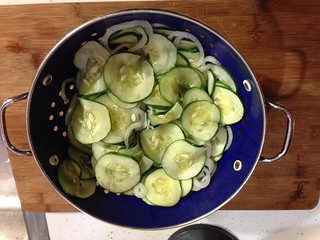
Slice the cucumbers and onion thinly and evenly (I used my old Martha Stewart Everyday mandolin from K-Mart). Layer alternately, sprinkling with salt, in a shallow dish or bowl, and cover, for 24 hours, in the fridge. Drain in a colander, pressing with paper towel to remove excess water.

Place the drained cucumber and onion slices in a bowl and cover with white vinegar for at least four hours, or while you go to work and are unable to leave early as you had planned. Pour the vinegar into a saucepan and boil with a little salt.

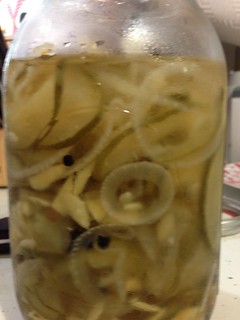
Peel and slice the ginger into sticks, and add to the cucumbers and onion. Sprinkle all with mace to taste, and add whole peppercorns as desired. Pour the boiled vinegar over all, decant into clean, boiled jars and seal.

I tasted these first over the weekend, and they were strong and spicy! The ginger made them a little hotter and sweeter than the ones I had in Cambridge. They seem a little mellower now (I had some with breakfast this morning) and I think they will be OK at OSV this weekend…if I take them. Glass jars seem crazy to pack for camping.

Share this:

  • Click to share on Facebook (Opens in new window) Facebook
  • Click to share on Pinterest (Opens in new window) Pinterest
  • Click to email a link to a friend (Opens in new window) Email
  • Click to share on X (Opens in new window) X
Like Loading...

Flummery, and other flimsy excuses

22 Monday Jul 2013

Posted by kittycalash in Food, Living History, Making Things

≈ 2 Comments

Tags

18th century, cooking, food, recipe, weekend

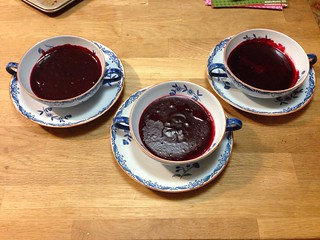
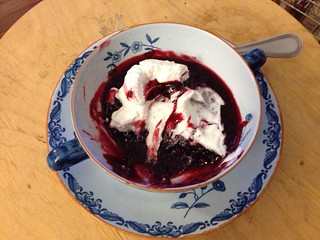
Flummery, in Oest India bowls.

We did not go to Salem. If you were there, you already know this. Mr S was only willing to go up on Saturday, but I wanted to go on Sunday. After looking at the schedule, we couldn’t figure out why the Young Mr would ever want to go. A bored teenager is a terrible thing to be around. So what did we do instead?

We cleaned, for one thing. We laid in provisions, which disappear at an alarming rate each week. We went to the weird antique place and found a brass kettle and a copper skillet. We went to the lumberyard, twice, and bought lumber, once. We did several loads of laundry. (By now, I know you are incredibly jealous of this glamorous lifestyle; I assure you, it gets better.) I cleaned the bathrooms and replaced the shower curtain.

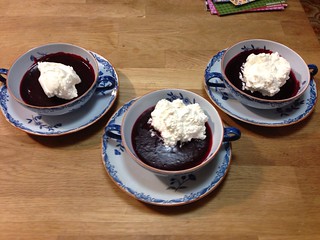
Served!

What incredible banality! But this is what the kid wants: weekends where we are home, cooking and cleaning and being normal. At a certain point, if I cannot figure out what he’ll do at an event and assure him that he will be busy, he does not want to go. (Not that I blame him, for I like to be busy as well.) So a weekend of normal, when we have drilling next week and OSV the next, is probably worth having, for family peace.

Of course, I’d rather be busy in another century, so I cleaned the tub early and moved on to more engaging tasks, flummery, for one.

The guys weren’t sure about this at first, but it is fabulous. It would make an excellent “blood” pudding for a vicious pirate banquet. The recipe is ridiculously easy.

Blackberry Flummery
4 Cups Blackberries
2/3 cup sugar (up to ¾ cup if you prefer sweeter)
½ cup hot water
Juice from ½ lemon, strained of seeds
½ cup cold water or milk
2 T corn starch (AKA corn flour if you’re not in the US; the fine white stuff)

Excellent with cream.

Wash the blackberries and put into a large saucepan with sugar and hot water over medium high heat. Bring to a soft boil and cook until the fruit is soft and falling apart.
Remove from heat, and push through a fine sieve with a spoon. Discard seeds and cores.

In a small bowl, whisk cornstarch into milk or water.

Return fruit to pan and place over heat, bringing to a soft boil again. Stir in cornstarch mixture until completely blended and fruit begins to thicken.

Slowly stir in lemon juice, taking care to keep fruit from thinning or thickening too much.
When blended, remove from heat.

Pour into 3 to 8 individual ceramic or glass serving dishes; portions will depend on audience.
Chill for at least two hours. Serve with whipped cream or yogurt.

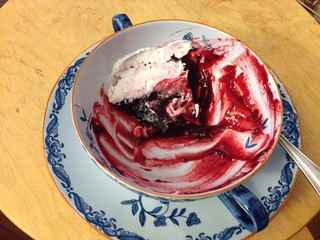
Almost gone!

I made three servings, because I thought that was right, but I think six would have been better, based on intensity rather than richness. Not to worry: we ate it all.

Cooking this up is easy, but the blackberry mixture does have a tendency to get everywhere and make you and your kitchen look like your hobby is home butchery. Don’t wear white, and keep your sponge handy.

Share this:

  • Click to share on Facebook (Opens in new window) Facebook
  • Click to share on Pinterest (Opens in new window) Pinterest
  • Click to email a link to a friend (Opens in new window) Email
  • Click to share on X (Opens in new window) X
Like Loading...

Fun and Feasting in Cambridge

16 Tuesday Jul 2013

Posted by kittycalash in Events, Food, Living History, Reenacting

≈ 2 Comments

Tags

10th Massachusetts, 18th century, common soldier, cooking, Events, food, living history, Reenacting, Revolutionary War

Well, we didn’t feast, it was too hot. But I helped make a feast. I didn’t document it with  photos because I didn’t think my companion would appreciate it. But here’s what we did.

General Washington was set to dine with the gentry, so a repast needed to be made. The captain’s wife volunteered to provide the meal and I served as scullery maid, a role I do find comfortable. (Anyone else identify with Daisy on Downton Abby? She’s the character I feel most like.)

The menu:

Salmagundi
Onion Pie
Bread & Cheese
Pickles
Fruit
Ratafia Cakes
Claret

We worked in the NPS staff kitchen in the carriage house behind Longfellow House: air conditioned, but the kitchen is in a former bathroom. Still, there was a sink and some counter space, so we were set.

A salmagundi is a kind of mixed salad, by which I do not mean tossed. It is perhaps most similar to a chopped, layered salad today. Colonial Williamsburg has an adaptation here, and that formed the basis of our creation.

We used one bag of pre-washed leaf lettuce, one roasted chicken (I did not have to rip it up! I got to chop eggs instead), two tins of anchovies, a medium ham, a lemon, etc. Although we had wooden bowls for prep work, we ran out of places to put the chopped ingredients, so ended up using the NPS staff containers from the dish drainer. With a glass full of egg yolk, a bulk food container of egg white, a black plastic dish of ham and a plastic water cup of anchovies arranged on the crowded sink, we achieved a workable if slightly bizarre mise en place.

What’s astonishing is how much space all that food takes up. You think it’s not enough when it’s contained, but get it on a platter and wow! That’s a shockingly large amount of food. The captain and his wife will be enjoying that salmagundi all week, I fear.

The onion pie was pre-baked from the CW recipe as well. I favor Chesire Pie, and know it is a unit favorite (since four of us devoured one for breakfast at Monmouth…mmmm, pie….)

The pickles were amazing! Made from a 1747 Hannah Glasse recipe, pickled cucumber slices are pretty simple. You may, of course, wish to reduce the quantities:

“To pickle large cucumbers in ſlices. TAKE the large cucumbers before they are too ripe, ſlice them the thickneſs of crown pieces in a pewter-diſh ; to every dozen of cucumbers ſlice two large onions thin, and ſo on till you have filled your diſh, with a handful of ſalt between every row : then cover them with another pewter-diſh, and let them ſtand twenty-flour hours, then put them in a cullender, and let them drain very well ; put them in a jar, cover them over with white wine vinegar, and let them ſtand flour hours ; pour the vinegar from them into a copper ſauce-pan, and boil it with a little ſalt ; put to the cucumbers a little mace, a little whole pepper, a large race of ginger ſliced, and then pour the boiling vinegar on. Cover them cloſe, and when they are cold, tie them down. They will be fit to eat in two or three days.”

Read more at Celtnet: http://www.celtnet.org.uk/recipes/glasse-of-pickling-14.php
Copyright © celtnet

Ratafia cakes are funny little things. I only had one, when they came back from the table (I did mention Daisy, right?) but I might try them. They are not ideal for camp eating–in fact, they would be downright inappropriate–mostly because they are rather fragile and travel poorly.

The rest of us–the privates and sergeant and the Young Mr, who was playing Washington’s aide de camp as a young scamp–ate bread and cheese and fruit in the shade of a tree. It was too hot to eat much.

Share this:

  • Click to share on Facebook (Opens in new window) Facebook
  • Click to share on Pinterest (Opens in new window) Pinterest
  • Click to email a link to a friend (Opens in new window) Email
  • Click to share on X (Opens in new window) X
Like Loading...
← Older posts
Newer posts →

Archives

wordpress statistics

Creative Commons License
Kitty Calash blog by Kirsten Hammerstrom is licensed under a Creative Commons Attribution-NonCommercial-ShareAlike 4.0 International License.

Website Built with WordPress.com.

  • Subscribe Subscribed
    • Kitty Calash
    • Join 621 other subscribers
    • Already have a WordPress.com account? Log in now.
    • Kitty Calash
    • Subscribe Subscribed
    • Sign up
    • Log in
    • Report this content
    • View site in Reader
    • Manage subscriptions
    • Collapse this bar
 

Loading Comments...
 

    %d