• Home
  • Completed Costumes/Impressions
  • Emma and Her Dresses
  • Free Patterns and Instructions

Kitty Calash

~ Confessions of a Known Bonnet-Wearer

Kitty Calash

Tag Archives: history

D-Day: Robert Capa

06 Thursday Jun 2013

Posted by kittycalash in History, Museums

≈ 2 Comments

Tags

art history, D Day, history, Magnum Photos, photo editing, photography, photojournalism, Robert Capa, World War II

Robert Capa, American, b. Budapest 1913 - d. Indochina 1954

Robert Capa, American, b. Budapest 1913 – d. Indochina 1954 © International Center of Photography

Once upon a time in the Midwest, I worked in a Department of Photographs and Prints. (That’s where I met Mr S, when he was hired as the first museum Photographer, though he was initially known as the Badger in the Basement for the tenacity with which he defended his studio.)

I am fortunate to have a visual memory, and that’s part of how I got my job, and part of how I got to be an Assistant, and then a full, Photo Editor of the museum’s magazine. I love images, and I love photography, and I suppose I must love photographers, too, since there’s one around here somewhere in this place that I call home.

FRANCE. Normandy. June 6th, 1944. Landing of the American troops on Omaha Beach. Robert Capa, International Center of Photography

FRANCE. Normandy. June 6th, 1944. Landing of the American troops on Omaha Beach. © Robert Capa © International Center of Photography

One of the best assignments was photo editing an article based on the World War II diary and service of a local doctor who served in the Army infantry. He wasn’t the most enlightened or unbiased man, but in the 1940s, I suppose that was sadly normal. I read the piece for placement and image ideas, not for tone or subtlety. North Africa, Monty, Casserine, Messina, Easy Red and Omaha: that’s what I underlined.

My go-to for WWII photography was Robert Capa first and last. There’s Blood and Champagne, but the book I read first was Slightly Out of Focus. It was written by Capa, just as he wrote Images of War. (I discovered these killing time on summer weekends in the air-conditioned fine art reading room of the downtown public library.) Capa did not love war, even as he thrived in the combat photography environment, and said, “If your photographs aren’t good enough, you’re not close enough.” But he also noted, like Cartier-Bresson, that you had to like people to take good photographs of them.

His images are dark: not just the imagery, but the prints themselves. A well-printed Capa has deep, rich, dark tones (D-Day images excepted, thanks to a horrendous processing error), and even decades later, a vintage Capa print has magic.

I called Magnum, back in the days when one called, described what I had seen, cited the books I’d read, listed what I wanted prints of to use in the magazine. I think I knew enough to get a little more: vintage prints of images I hadn’t seen. They arrived, sandwiched in cardboard, in a FedEx envelope.

TALY. Near Troina. August 4-5, 1943. Sicilian peasant telling an American officer which way the Germans had gone. Robert Capa, International Center of Photography

TALY. Near Troina. August 4-5, 1943. Sicilian peasant telling an American officer which way the Germans had gone. R © Robert Capa © International Center of Photography

There were photos like this one, and one of a soldier shaving, using his helmet as a basin. There were images I’d seen, and some I had not. They were dark, and sympathetic, and captured the war and humanity as no other images I’ve seen have ever done.

His portfolio was huge, and includes not just war photography, but fashion and film and humorous photos, too. Holding one of his prints–or at least a print made close to the time when he had shot the negative, and might have been alive–was as close as I was ever going to get to meeting Robert Capa. For all he lived through–escaping Fascism, documenting the Spanish Civil War, the Rape of Nanking, the Blitz, all of World War II– Robert Capa died after stepping on a land mine on the road to Thai Binh in what was then French Indochina.

INDOCHINA. May 25, 1954. Vietnamese troops advancing between Namdinh and Thaibinh. This is one of the last pictures taken by Robert Capa with his Nikon camera before he stepped on a landmine and died at 14.55. © Robert Capa © International Center of Photography

INDOCHINA. May 25, 1954. Vietnamese troops advancing between Namdinh and Thaibinh. This is one of the last pictures taken by Robert Capa with his Nikon camera before he stepped on a landmine and died at 14.55. © Robert Capa © International Center of Photography

It seems so sad, and yet one has to remember that he died working, doing not just what he loved–taking photographs–but what he had to do. He didn’t love war, but he loved people. The beauty of the images he made almost undoes their purpose, in recording war’s horrors, but the real affection for people that comes through in those contrasty prints redeems the violence, I think, giving us sympathy for the people uprooted, displaced, used and abused by war, whether soldier or civilian. Through that love,Capa found courage and we can find truth. Keep looking: there is more to see.
Share this:

  • Share on Facebook (Opens in new window) Facebook
  • Share on Pinterest (Opens in new window) Pinterest
  • Email a link to a friend (Opens in new window) Email
  • Share on X (Opens in new window) X
Like Loading...

The Drowsy Dame

14 Tuesday May 2013

Posted by kittycalash in Clothing, History, Research

≈ 2 Comments

Tags

18th century, history, knitting, Research, resources

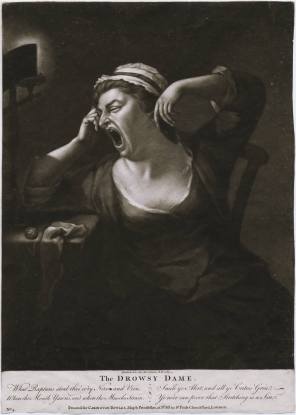
The Drowsy Dame, 1769. LWDL, 769.00.00.11+

The Drowsy Dame, 1769. LWDL, 769.00.00.11+

Like many people, I could sleep better. Lately, the middle-of-the-night waking has been caused by the Young Mr sneaking down the creaking stairs at 2:30, ostensibly to get a drink. Sounded more like a snack to me, but either way, I was awake at in the middle of the night and am yawning this morning.

The 18th century prints are full of domestic details not always found in formal portraits– and certainly this is  an image never to be found in a formal portrait. Prints gave artists a chance to play with light in a different way; lithographs, by their nature, allow this kind of chiaroscuro imagery and informality.

knittingNeedles 1768

On the table next to the “Drowsy Dame” is what really caught my eye: the stocking. This print, from 1769, goes very nicely withWm. and Joseph Russell’s ad in the Providence Gazette and Country Journal, 1768. That ad included knitting needles.

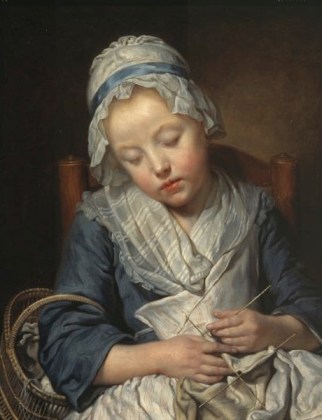
Young Knitter Asleep, Jean-Baptiste Greuze, ca. 1759. Huntington Museum, 78.20.8

Young Knitter Asleep, Jean-Baptiste Greuze, ca. 1759. Huntington Museum, 78.20.8

At this time, needles are slender steel rods, not bamboo or wood or anodized aluminum (or plastic) we use today. Hand knitting is done in the round, as you can see in the hands of this sleepy young knitter. (Is it the repetitive nature of stockings that lulls these knitters to sleep?) For more in historical knitting, there’s Colleen Humphrey’s blog, Mara Riley’s website, as well as English sources. It’s not my thing–I’m able, but like these women, I cannot finish a stocking, though there are plenty of published patterns.

Share this:

  • Share on Facebook (Opens in new window) Facebook
  • Share on Pinterest (Opens in new window) Pinterest
  • Email a link to a friend (Opens in new window) Email
  • Share on X (Opens in new window) X
Like Loading...

Aspirational Shopping

11 Saturday May 2013

Posted by kittycalash in History

≈ Comments Off on Aspirational Shopping

Tags

18th century, 18th century clothes, advertising, common dress, consumer culture, historical myths, history, newspapers, Providence, Research, resources, Rhode

So, I always thought that window shopping was a product of the late 19th or early 20th century, the plate glass windows of the Bon Ton, and The Lady’s Paradise.

Providence Gazette and Country Journal, 4-18-1772

Providence Gazette and Country Journal, 4-18-1772

I was wrong.  Check out the last line in this ad from the Providence Gazette and Country Journal of April, 1772:

“Any Person not wanting to purchase, but having a Mind to see the greatest Pennyworths, shall be waited on with great Chearfulness, by their very humble Servant, PAUL ALLEN.”

In case we forget, the past is there to remind us that the consumer culture started much, much earlier than we think it did. Stop blaming Don Draper: I give you Paul Allen.

Share this:

  • Share on Facebook (Opens in new window) Facebook
  • Share on Pinterest (Opens in new window) Pinterest
  • Email a link to a friend (Opens in new window) Email
  • Share on X (Opens in new window) X
Like Loading...

I came, I saw, I sewed

23 Tuesday Apr 2013

Posted by kittycalash in Events, Living History, Reenacting

≈ Comments Off on I came, I saw, I sewed

Tags

18th century clothes, Clothing, common dress, Costume, Events, history, living history, Reenacting, Revolutionary War

The usual view: the backs of the bellowers.

My usual view: the backs of the bellowers.

Last weekend was the BAR School of Instruction at the New Windsor Cantonment in Vails Gate, NY. April is an interesting month for travel: changeable weather can land you in a serious fog/cloud, some places aren’t open yet, but the crowds are, mercifully, small.

The meetings and discussions were interesting, and I think its useful for reenactors to continue to ask themselves questions about what they do, and how they do it–questions beyond authenticity. I still think there are great unspoken truths in the Temple Building: in the 21st century, a male dominated, volunteer-run organization will not thrive in its current form.

Chase with sticks.

Chase with sticks. He needs drum instruction.

Movement towards demonstrations that make effective use of the actual numbers of soldier who turn out makes sense. as do roles for men retired from the field. More formal interpretive roles for women might strengthen the organization … but for now, I’ll try to learn as much as I can. Laundry: that’s something to work on.

Patina, not dirt.

Patina, not dirt.

Of course, they don’t want their clothes washed. That’s not dirt, that’s patina. I have this for a time to help me figure out how to put together one for the Young Mr, and eventually, for Mr S. It’s less crunchy now that it has hung up for a while, and I do understand the desire for patina. Mr S likes to get his overalls filthy, and his hunting frock. But where would that leave the washer woman?

Mending, I suppose, though I know women were employed by RI state troops to make shirts (there are receipts). We don’t need shirts right now, we need hunting shirts, which it turns out were probably actually hunting frocks, tied at the front with tapes.

Alterations ahead?

Alterations will be ahead for this, though can you call them alterations before the thing is even finished? I started on Wednesday with just the cut pieces, and got this far, plus a completed but not attached sleeve, by mid-day Sunday. (Photos here.) As one of the women at the SOI said, “Without us, they’d be naked and hungry. You think they’d learn to appreciate it.” Probably not until they are actually naked and hungry…

Les Fleur d' Inde

Les Fleur d’ Inde

For relief from the plain linen, I cut out a chintz jacket; the remnant was just enough to get a front-closing short jacket cut. It shouldn’t take too long to make, and will be a nice thing to have in warmer months. And it’s just enough pretty fabric that I might have been able to afford it.

Share this:

  • Share on Facebook (Opens in new window) Facebook
  • Share on Pinterest (Opens in new window) Pinterest
  • Email a link to a friend (Opens in new window) Email
  • Share on X (Opens in new window) X
Like Loading...

Fog on the Hudson

21 Sunday Apr 2013

Posted by kittycalash in Museums

≈ 1 Comment

Tags

common people, historic houses, history, imperfections, Museums, tours, vacation

20130421-072045.jpg Up on the Hudson, it gets foggy. We drove through fog, which was probably a cloud, and remarked on how very different from home it is here. And once again, I demonstrated an inability to navigate through anything but a conventional New England rotary: I have over-adapted.

We went to the West Point Museum (far too warm, folks; artifacts and visitors alike will cook at 72+ F) and enjoyed the artifacts and dioramas. It’s a classical museum, chronological and linear as you would expect it to be. I don’t object to this format at all: it supports limited labeling, which I consider a blessing, really, and allows the objects to speak for themselves and leaves room for the visitor to wonder, find a label, and read more. I did take photographs, but forgot the adapter for downloading the camera.

From there we visited Fort Montgomery, which may well be the site of future shivering.
Here, I did not take photos, especially after I was warned off touching the glass by the curator or site superintendent (honest, I didn’t leave a smudge).

The last stop on Friday was at Boscobel, which I knew of from a book at work. The house is as lovely as you would expect from a place furnished by the former curator of American Decorative Arts at the Met, and funded by Lila Wallace’s fortune. It’s a guided house tour, with an audio tour for the grounds. We lasted through the guided tour (there were only the three of us) and a portion of the grounds.

I’m really glad I lifted the no photography rule at work. Boscobel has some lovely objects. I was interested in several for which there are no catalog images online, no postcards, and no images in their books. I couldn’t capture the sense of place in the house, or the room the way I saw it, and I find that archaic and frustrating.

The tour itself was everything you’d expect a tour given by retired women of means to be: genteel, focused on furniture, and docile. To their credit, they do a good job with photographs to explain how the commodes work, and by the second floor our guide had loosened up a little bit in her blue blazer. But there was little about the family and their lives, nothing about the servants, and some basic misapprehensions about how a house of that size worked. (The cast iron cylinder in a water or tea urn was never heated in the parlor fire, and never by the mistress; sparks! fire! mess on mahogany! Nope, it all happened in the kitchen.)

In the end, Boscobel was lovely and I am envious of the decor and some of the objects and details, but as the tour guide noted, I most liked the “imperfect rooms” (the pantry, the kitchen, the bathing area and the servant’s bedroom).

Huzzah for imperfections! Time to dress for the last day of the common, imperfect soldier before we tear off for home.

Share this:

  • Share on Facebook (Opens in new window) Facebook
  • Share on Pinterest (Opens in new window) Pinterest
  • Email a link to a friend (Opens in new window) Email
  • Share on X (Opens in new window) X
Like Loading...
← Older posts
Newer posts →

Archives

wordpress statistics

Creative Commons License
Kitty Calash blog by Kirsten Hammerstrom is licensed under a Creative Commons Attribution-NonCommercial-ShareAlike 4.0 International License.

Website Built with WordPress.com.

  • Subscribe Subscribed
    • Kitty Calash
    • Join 621 other subscribers
    • Already have a WordPress.com account? Log in now.
    • Kitty Calash
    • Subscribe Subscribed
    • Sign up
    • Log in
    • Report this content
    • View site in Reader
    • Manage subscriptions
    • Collapse this bar
 

Loading Comments...
 

    %d