• Home
  • Completed Costumes/Impressions
  • Emma and Her Dresses
  • Free Patterns and Instructions

Kitty Calash

~ Confessions of a Known Bonnet-Wearer

Kitty Calash

Tag Archives: history

Choosing a Gown

19 Tuesday Mar 2013

Posted by kittycalash in Clothing, Events, History, Living History, Making Things

≈ 1 Comment

Tags

18th century, 18th century clothes, authenticity, Battle Road 2013, Clothing, common dress, Costume, fashion, history, living history, Research, Revolutionary War

Here’s a good question (I love questions): how do you choose which [historic example] to make?

The answer, as almost always: Research.

I start with a date. For Battle Road, the dress must be typical of New England in April, 1775 and appropriate for my impression or persona.  As I imagine my character from the past, she’s in her 40s, from the upstart town of Providence, married to a tradesman or craftsman. She has one child, and I haven’t thought about whether or not it’s one only or one surviving—too busy chasing the One Child Who Eats Like Ten.
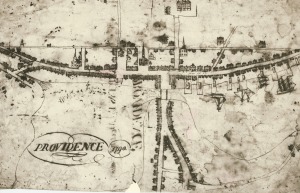
Providence, 1790. John Fitch, RIHS Map #30
Providence, 1790. John Fitch, RIHS Map #30

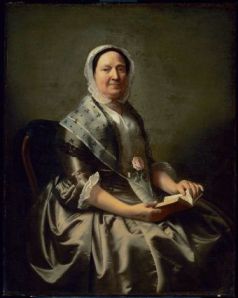
Mrs Nathaniel Ellery, J S Copley, 1765, MFA Boston

Mrs Nathaniel Ellery, 1765, MFA Boston

Living in a port city means my character—we’ll call her Kitty—has access to new goods and ideas, a town where you can buy almost anything, but where staymakers are less common than in Newport.  It’s less refined than Newport, brassier, but competitive and striving and with plenty of money in some hands. Providence is where the Gaspee affair was plotted; in 1790, residents from around the world are recorded here—men from Java, living in Providence—it’s polyglot, mercantile, striving.

Given that Kitty is of the middling sort in a town, she can wear linen and wool and camblet and even some silk. Her clothes will be fashionable but not high style, “a thought behind the current moment,” as Lord Peter says of someone’s hat. What’s the purpose of this brown gown? Everyday wear, that, with accessories, can be dressed up, or dressed down. Eventually, who knows, I might manage a crewel work stomacher and nice linen cuff-ruffles for my shift, though a filthy apron, burned skirt, and a striped rough linen petticoat are more likely…
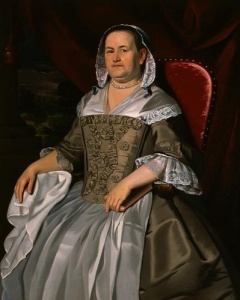
Mrs. James Otis (Mary Allyne Otis). JS Copley, ca. 1760. Wichita Art Museum

Mrs. James Otis ca. 1760. Wichita Art Museum

Making an everyday dress means not copying the silk dress from Williamsburg, and honestly, I couldn’t wear that wedding cake frosting on my chest, nor what Mrs. Otis has on her stomacher. How about that lovely Norwich wool gown? Well…almost. But I can’t sew that well, and haven’t got fabric that lovely, couldn’t afford it now, wouldn’t have had it then. I have brown wool. Have I seen Mrs. John Brown dressed like one of Copley’s women? Perhaps (if you take Copley as evidence, which you must do carefully.) Have I looked at the lovely brown silk satin and thought, I could do that. Possibly.
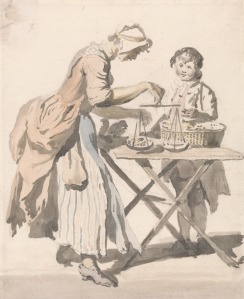
Black Heart Cherries, Paul Sandby, ca. 1759. YCBA B1975.3.206

Black Heart Cherries, Paul Sandby, ca. 1759. YCBA B1975.3.206

What we do know is that in New England, gowns are found more often than any other kind of garment (i.e. short gowns or jackets or riding habits). We know that wool is common, but that linen is found in towns and cities, wool more often in the country, and that the pretty, but expensive, cotton prints are popular. Open robes are more common earlier, and “hatchet” cuffs (pleated tubes) predominate. The style is worn by Copley’s women and Sandby’s girls, and it’s seen in images from 1760 on. That means it’s a good choice for a base style for any class level.

Here’s my process, more or less:

Determine the date, that sets the style.
1775 means stomacher front gown.

Determine the character, that sets the fabric and trims.
Kitty’s New England middling, so she’ll have a wool gown with robings but not trims, a plain stomacher, cuffs and not ruffles, and a matching petticoat.

Determine the event, that sets the accessories.
Battle Road is a hard one for me: as a woman, I shouldn’t be there, and as a Rhode Islander, I really shouldn’t be there. (RI militia were stopped at the border by the governor to prevent them joining Massachusetts men after news of the events at Lexington and Concord reached Rhode Island. They did get there eventually and participated in the siege of Boston, but you see what I mean…) So I have to construct a story for how to dress, and the best I can manage is going out, either to a shop or to pay a casual call on family. So what I plan is a matching petticoat, white neck handkerchief, clean check apron, and bonnet over a clean white cap. (This emphasis on clean should remind me to wash and iron a thing or two.)

That’s my story, and I’m stickin’ to it. For now, anyway, till I get a better idea.

Share this:

  • Share on Facebook (Opens in new window) Facebook
  • Share on Pinterest (Opens in new window) Pinterest
  • Email a link to a friend (Opens in new window) Email
  • Share on X (Opens in new window) X
Like Loading...

Brown Gown

18 Monday Mar 2013

Posted by kittycalash in Clothing, Making Things

≈ 2 Comments

Tags

18th century clothes, authenticity, Battle Road 2013, Clothing, common dress, en fourreau, history, living history, Making Things, robe a l'anglaise, sewing

Gown, ca. 1765. CW 1985-117,1

Gown, ca. 1765. CW 1985-117,1

The very first dress in the Costume Close Up book matches my measurements pretty well, so I thought I’d be quite clever and pattern it up for my own use. I want a stomacher front open robe for Battle Road and a 1763 event this summer, so what better place to start than with an original ca. 1756-1760 gown?

I laced up my stays on Friday and spent much of the day measuring, drawing, cutting, and sewing. By mid-afternoon, I had a muslin with the devil’s own sleeve and a large measure of frustration.

Yes, I ate, it wasn’t just low blood sugar that caused all this unhappiness. For the public safety, there are no photos of the ensuing debacle. But the situation was not irreparable, as I have been in this miserable place before.

Patterned up from the little illustration.

( To add to the fun, my stays have stretched, and now give the impression that they slip down throughout the course of the day. They do this even while I am not especially active: I’d dismissed the sensation at Fort Lee. Oh, it’s the hours in the non-18th century seat, it’s running around the site, it’s one more lame excuse I’m making up. Nope. Suckers have stretched and will require attention. Also, for being slightly more than one year old, ought they to have wear marks from tying on petticoats? Next time, I’m using cotton, since it doesn’t stretch like linen.)

Gown, 1750-17651988-223, CW

Gown, 1750-1765,  CW 
1988-223

I got out the basic bodice block I’d patterned in June, and adjusted that to have a straighter, more horizontal waist line and made the bodice fronts narrower. The robings with be pleated to have a layered look, for which this Norwich wool gown at CW is the inspiration. I stitched up a muslin of the altered bodice block, and wouldn’t you know, it fit. It’s a relief to know that some measure of frustration eventually pays off. Maybe.

By Saturday night, I had the lining sewn up and Sunday morning, I attached the lining sleeves (I like to check the fit and have something to beat the fashion fabric sleeve against.) That meant I was ready for the terrifying step of cutting and sewing the actual wool. I have enough of it that I can mess up and redeem the problem, what I don’t have enough of is time. Certain gentlemen have garments in need of alteration, and creation, you see.

The back, with pleats sewn down, and skirts on their way.

Since this is the third or fourth or fifth time I have wrestled with the 18th century gown cut en fourreau, I know what I am getting in to. I know about the three hours for four pleats. I know the heartache of hand stitching the back only to realize you have introduced a wiggle. What I don’t know is how to keep this in perspective.

I followed along with Koshka the Cat’s en fourreau tutorial, which I found incredibly helpful. It won’t keep you from introducing a wiggle into your seams, but you will get the seams in pretty much the right place, as long as you’re honest about your measurements. It’s only a little bit Richard III up there in the center seam….

It’s good to be a perfectionist, but sometimes you have to just let go and sew. I’m still learning how to live with that.

Share this:

  • Share on Facebook (Opens in new window) Facebook
  • Share on Pinterest (Opens in new window) Pinterest
  • Email a link to a friend (Opens in new window) Email
  • Share on X (Opens in new window) X
Like Loading...

Dressing and Undressing in Newport

24 Sunday Feb 2013

Posted by kittycalash in Clothing, History

≈ 3 Comments

Tags

18th century clothes, Clothing, common dress, Costume, history, living history, Research

A lady and her maid

The Ladies, Dressed, in Newport

Last Thursday evening, my friend and I went to the Colony House in Newport  for the “Undressing History: What Women Wore in the 18th Century” program presented by the Newport Historical Society.

There were excellent questions from children (I loved, “What would you wear for pajamas?”) and adults, including:

If you were not a wealthy woman, or you were an enslaved woman, what did you wear on laundry day?

At Sandpit Gate, Paul Sandby, 1765. RCIN 914329

At Sandpit Gate, Paul Sandby, 1765. RCIN 914329

The image that sprang into my mind was Paul Sandby’s women at Sandpit Gate, doing laundry work. They’re wearing their shifts, stays, petticoats, neck handkerchiefs, caps and shoes. (I particularly like the woman working at the tub; you can see the angle of her stays diverging from her spine as she bends forward; it’s a fine little detail and very accurate.)

So women wore one of their shifts, their stays, petticoat(s), stockings and shoes.

And that brings us to the question, How many shifts did they have?

Several months ago I had the luxury of doing some research in the manuscript collections at work, and found MSS 957, the Stafford Family Papers. In those papers there is an undated estate inventory, thought to be from ca. 1780-1799. It’s extensive, and while I have a hand-writen transcription of the whole, I’ll quote the most relevant entry:

5 shifts [illegible]

Yes, five shifts. A woman who owned five slaves had five shifts. They were not for her slaves (though that leads to yet another set of questions about people who were property owning property…and where might that be enumerated?). And if she was laid out in a shift, or wearing one when she died, was it counted, too?

With five shifts, this unidentified woman could have worn each for two days and managed a washing every week–or rather, managed for another day or two or three while her slave women washed, dryed, and ironed her clothing.

In The Dress of the People, Styles points out in Chapter 2 that the largest differences between what the rich and poor wore lay in “numbers, quality and value,” (p. 31) and tables in the back lay out the different number of shifts lost by different women in a fire on an afternoon in May, 1789, in Brandon, Suffolk, England. A blacksmith’s wife lost six shifts, the mantua maker lost one. We can’t know if that emphatically means the mantua maker had but two shifts, or if she saved more than the blacksmith’s wife; one servant lost seven shifts! What we can tell is that women had more than one shift.

We can’t take one undated inventory as typical of 18th century clothing inventories in Rhode Island, (more research lies ahead of me) but counting shifts would be an interesting exercise. Based on my own experience, I can verify that one wants more than one shift. I think it likely that inventories will turn up multiple shifts for women, and shirts for men, no matter where we look, and that this will probably hold true even for slaves. Styles reminds us that the differences are not just numbers, but quality and value.

Share this:

  • Share on Facebook (Opens in new window) Facebook
  • Share on Pinterest (Opens in new window) Pinterest
  • Email a link to a friend (Opens in new window) Email
  • Share on X (Opens in new window) X
Like Loading...

Eat, Not Just Meat

22 Friday Feb 2013

Posted by kittycalash in Food

≈ 1 Comment

Tags

18th century, food, history, vegetables

Good advice for every day, if you’re not t-rex

The Young Mr has been  unsupervised some of this week (he’s old enough but not always as mature as one might prefer) and I have left him notes to help him with some basics, as he does prefer to rise long after I’ve left for work. In the bathroom, BRUSH YOUR TEETH is affixed to the mirror (should’ve added + HAIR). In the kitchen, another note is taped to the Christmas Cactus above the sink.

My coworkers, many of whom have known the Young Mr since he was in a stroller and had nicknames like Possum Baby and Seal Monkey (he just shivered a small death when you read those names), found this note hilarious. The kid has a reputation as a one-human plague of locusts: he once ate a third of a pound of ham in a 20-minute span while his father and I went to the grocery store. He will eat a large head of lettuce in the hours between when he gets home from school and I get home from work. Entire tins of Altoids vanish suddenly, and all I get is a sulky, guilty look.

So I found this blog  post, What’s For Supper? very interesting, as I had been thinking of late, How would I feed the kid in the 18th century winter?

Fantastic Hairdress with Fruit & Vegetable Motif, 65.692.8, MMA

Fortunately, there would have been vegetables. And whether the beds were hot with manure or straw, there would have been some greens. At the farm we had salad in January; would it make it to February, or March? Don’t know, but I love the idea of spinach. Parsnips store well (scrub hard) and are delicious, and apples, too.

I think we forget we did not invent the larger world: it was big before we got here, with ships circumnavigating the globe and caravans crossing mountains long before container ships began losing sneakers on the ocean.

Share this:

  • Share on Facebook (Opens in new window) Facebook
  • Share on Pinterest (Opens in new window) Pinterest
  • Email a link to a friend (Opens in new window) Email
  • Share on X (Opens in new window) X
Like Loading...

Petticoat Burns

05 Tuesday Feb 2013

Posted by kittycalash in History, Living History, Reenacting

≈ 1 Comment

Tags

18th century, Clothing, common dress, cooking, food, hearth cooking, historical myths, history, living history, myths, The Public

Per Hillstrom, Kitchen Scene

You know this site, right? History Myths Debunked examines the stories about the past many like to think are true, and Death By Petticoat is one of the favorites. Here it is on an English site catering to reenactors. There’s a variation I’d never heard, about wetting petticoat hems to keep them from engulfing the wearer in flames. (OK, mild exaggeration: to keep the petticoat from igniting fully, thus… hat tip to Back Country Maiden for pointing this out.)

As someone who just finished mending a petticoat, you’d think I’d leap at the chance to drench my hem in water to prevent future mending episodes, but not so. For one thing, in the house or in the camp, that’s water I had to haul or cause to have hauled, and I’m not wasting it. Wet the hems and what’s next? Caked lumps of ash, mud, and.or other filth. No thanks.

High-tech historical cooking

High-tech historical cooking

The burns I got in my dress were acquired at the end of the day when we were hearth cooking and were practically in the fireplace ourselves. That is where you must be if you wish to stir the sauce until it thickens, and there was the hoisting of roast in its pan a couple of times, and general playing with fire in pursuit of food. My ca. 1799 dress is longer than my 1770s petticoats and gowns, and the extra inch or two probably contributed to the burns. But I wasn’t engulfed by flames, because the damn thing is wool. Self-extinguishing wool, worn with linen and wool petticoats and a linen apron. not going to go up in flames. Also not going to get dipped in water–and wouldn’t that result in steam and hence scalded shins?

I don’t know where these rumours start, but they could have started with a cynical curator joking with house tour guides who failed to get the joke. Not that I know anything about a story of about Providence kitten named Georgie in honor of George Washington’s visit to a large brick house on a hill .

Share this:

  • Share on Facebook (Opens in new window) Facebook
  • Share on Pinterest (Opens in new window) Pinterest
  • Email a link to a friend (Opens in new window) Email
  • Share on X (Opens in new window) X
Like Loading...
← Older posts
Newer posts →

Archives

wordpress statistics

Creative Commons License
Kitty Calash blog by Kirsten Hammerstrom is licensed under a Creative Commons Attribution-NonCommercial-ShareAlike 4.0 International License.

Website Built with WordPress.com.

  • Subscribe Subscribed
    • Kitty Calash
    • Join 621 other subscribers
    • Already have a WordPress.com account? Log in now.
    • Kitty Calash
    • Subscribe Subscribed
    • Sign up
    • Log in
    • Report this content
    • View site in Reader
    • Manage subscriptions
    • Collapse this bar
 

Loading Comments...
 

    %d