• Home
  • Completed Costumes/Impressions
  • Emma and Her Dresses
  • Free Patterns and Instructions

Kitty Calash

~ Confessions of a Known Bonnet-Wearer

Kitty Calash

Tag Archives: interpretation

Rumours of Bore

03 Monday Aug 2015

Posted by kittycalash in Events, Living History, Reenacting

≈ 2 Comments

Tags

fail, historical reenactors, interpretation, Redcoats and Rebels, Reenacting, Revolutionary War, The Public

Detail, The Letter. Pietro Longhi, 1746. Metropolitan Museum of Art, 14.32.1

Detail, The Letter. Pietro Longhi, 1746. Metropolitan Museum of Art, 14.32.1

My time-travel was cut short this weekend after a trip to eight-nine-teen-something in Salem, as I had a trip to the Central Fly Over* for work instead. Still, through the magic of telephony and the interwebs, I heard about the Sunday OSV Experience and the Great Drawn Sabre of Saturday. (Caution: Strong language) One presumes and hopes that aside from whatever disciplinary action OSV will take– and they will–the CL commanders will address this clear safety violation.

The news photos show the usual collection of baggy menswear (are those painters’ pants? is this 1812?) and the Bodice of Myth and Legend (St. Pauli, anyone?) along with obligatory musket firing and “gotcha” shots of fallen soldiers sneaking peeks at the action. I don’t even have to say what we all think when we see those images.

But the Sunday report that struck me the most was this: The tactical went on for 45 minutes, very few soldiers fell, and the public began to leave before it was over. Got that? They got bored. As the teller of this tale said, The magic is gone. You can consider that a public endorsement of either more civilian events or a re-imagined tactical. I prefer the former, you may prefer the latter. But either way, if you’re going to use The Public as your justification for playing armed dress up on a hot day, you’d better engage that public. What that could mean will have to wait for another time, but when people head for the exits, the show won’t last.

* More on that later

Share this:

  • Share on Facebook (Opens in new window) Facebook
  • Share on Pinterest (Opens in new window) Pinterest
  • Email a link to a friend (Opens in new window) Email
  • Share on X (Opens in new window) X
Like Loading...

Mind the Gap, or, The Basket Case

22 Wednesday Jul 2015

Posted by kittycalash in Clothing, Events, History, Living History, Philosophy, Reenacting, Research

≈ 5 Comments

Tags

18th century, authenticity, common people, fashion, historical reenactors, interpretation, living history, lower, philosophy, Reenacting, style

I was in the midst of planning yet another maid’s dress (some of us have all the luck) when a friend alerted me to an online discussion that drew from my recent post on baskets. The comments — which I skimmed but twice– made me think about philosophy and intent.

Engraved by John Raphael Smith, 1752–1812, British, A Lady and Her Children Relieving a Cottager, 1784, Mezzotint and line engraving on medium, slightly textured, cream laid paper, Yale Center for British Art, Paul Mellon Collection

Engraved by John Raphael Smith, 1752–1812, British, A Lady and Her Children Relieving a Cottager, 1784, Mezzotint and line engraving on medium, slightly textured, cream laid paper, Yale Center for British Art, Paul Mellon Collection

There are two approaches to developing a living history persona and appearance I’ll consider here: one prescriptive, and one not. The prescriptive, didactic approach tells you what to wear and carry. Some folks like that. It is completely correct in some cases: soldiers, for example. You want to fall in with a unit of Light Infantry in 1777, it’s generally more convincing if you don’t wear the 1781 coat. Not everyone cares: some people will keep on wearing the Brighty Whitey Hunting Frocks and 1780 coats at reenactments commemorating events of 1776. Those folks can no longer be reached by prescriptive standards, and my preferred approach probably won’t reach them either.

Joshua Cristall, 1768–1847, British, Young Woodcutter, 1818, Watercolor with scraping over graphite on moderately thick, slightly textured, beige wove paper, laid on thick, slightly textured, beige card, Yale Center for British Art, Paul Mellon Collection

Joshua Cristall, 1768–1847, British, Young Woodcutter, 1818, Watercolor with scraping over graphite on moderately thick, slightly textured, beige wove paper, laid on thick, slightly textured, beige card, Yale Center for British Art, Paul Mellon Collection

Mindful reenacting or living history sounds pretty nutty, but that’s what I would encourage. Thoughtfulness. Consideration. Not just the what, but the why. Why you wear or carry something can be as important and interesting as what you’re wearing and you’ll be all the more convincing for thinking it through. Thinking, not rationalizing. How appropriate is it to be in your best clothes carrying a basket also used to carry fire wood? You have to answer that for yourself, and if you’re doing it right, the answer will not always be the same– nor will the question!

Print made by James Bretherton, ca. 1730–1806, British, A Maid, 1774, Etching on moderately thick, rough, blued white laid paper, Yale Center for British Art, Paul Mellon Collection

Print made by James Bretherton, ca. 1730–1806, British, A Maid, 1774, Etching on moderately thick, rough, blued white laid paper, Yale Center for British Art, Paul Mellon Collection

This isn’t the easiest way to go about anything, asking all these questions, but for some of us, the experiences make it worthwhile. You won’t always be able to do, carry, or wear what you want.* But the picture you create of the past will be more accurate and more engaging if you think more and justify less.

Look, I threw down about that floppy bird basket, but I have to provide food to troops this Saturday in Cambridge. What the heck will I carry it in? What will I take my sewing in?**

Probably a wallet and a bag, unless I can pack that floppy basket convincingly– it is entirely suitable to my lower sorts-stained gown impression– but if I can’t, I won’t take it. And that’s just one less thing to carry.

*I’m pretty much always the maid to make scenarios work, and while it doesn’t come naturally, art imitates life.

**Prays no one gets the bright idea to bring (shhh) tents to work on.

Share this:

  • Share on Facebook (Opens in new window) Facebook
  • Share on Pinterest (Opens in new window) Pinterest
  • Email a link to a friend (Opens in new window) Email
  • Share on X (Opens in new window) X
Like Loading...

Smell Ya Later

16 Tuesday Jun 2015

Posted by kittycalash in Clothing, Fail, History, Laundry, Living History, Reenacting, Research

≈ 9 Comments

Tags

19th century, 19th century clothing, authenticity, clothes, Clothing, common people, historical clothing, historical myths, historical reenactors, history, interpretation, laundry, smell

Wool on hooks, cat on prowl

Wool on hooks, cat on prowl

One of the most common questions you get when you’re wearing historical clothing is the undying, “Aren’t you hot in those clothes?”

A heavily perspiring visitor wearing practically nothing usually asks this question, and the standard reply is a variation of “Aren’t you hot? In really warm weather, everyone is hot. But natural fibre clothing wicks the moisture from the skin and helps to keep you cool.” My internal response (vocalized only once) is, “Why yes, I am—and thank you for noticing. I work hard for this look.”

The “aren’t you hot” question is often followed by, “Wow, and they didn’t bathe, so everyone really smelled.” You try not to think of that Monty Python sketch about Britain’s deadliest joke program in WWII and move the conversation on to weekly laundering of body linen, multiple shifts, shirts, and under-drawers, and the general hygienic practices of the past.

What struck me after a sticky weekend is how much I noticed the smell of modern people.

two tailors and a tailoress

two tailors and a tailoress

My traveling companions and I bathed on Friday morning, drove for 7+ hours in muggy weather, slept in our clothes, wore wool, cotton and linen in rain and thick humidity, sweated in the tailor’s shop, slept in our clothes again, and spent another warm, close, day in muggy weather, including grave digging and pall bearing. But as feral as my shift may have been on Sunday night, I never smelled us.

Mr H reported that his wool trousers were really stinky in the rain, and I think his white Spencer was well-seasoned even before this weekend, but I didn’t notice anything. Mr S’s soaking greatcoat was whiffy only at extremely close range.

What I did smell were modern perfumes, deodorants, and hair products. Those linger around their wearers and trail behind them, sometimes eye-watering in their intensity. I encountered lingering perfume in a bathroom at the museum, and we were overwhelmed by cologne at diner Monday morning: wow, people must really smell now, of petrochemicals.

more wool

more wool

This is not to say that homeless people and sulky teenagers don’t smell of unwashed bodies and clothes, but people in the past may not have smelled quite as badly as we think. They washed, if not bathed (bathing being full immersion washing) and by changing body linen and airing their clothes, they kept reasonably clean.

There was plenty to whiff in the past: wastes of all kinds, stagnant bodies of water used as dumps, rotting foods and corpses. But I’m not convinced that we haven’t simply exchanged one set of smells for another of different origin and intensity.

Share this:

  • Share on Facebook (Opens in new window) Facebook
  • Share on Pinterest (Opens in new window) Pinterest
  • Email a link to a friend (Opens in new window) Email
  • Share on X (Opens in new window) X
Like Loading...

Frivolous Friday: A Feather Kerfluffle

22 Friday May 2015

Posted by kittycalash in Clothing, Events, Fail, Frivolous Friday, History, Living History, Reenacting, Research, Snark

≈ 3 Comments

Tags

18th century clothing, Costume, interpretation, millinery, Research, some snark

Miss Caroline Vernon by François-Xavier Vispré (c.1730 – London 1790). pastel on paper. ©National Trust Images/John Hammond.

I troll the interwebs in the fishing and not the under-the-bridge sense: there’s a lot to read out there. Still, I’ve kept one eye on the feather-and-flower kerfluffle that erupted in certain circles this week, but have been much more interested in documentation of one kind and another.

Miss Vernon is really my favorite image of feathers on hats, and I wish I could say that a) I have replicated this fabulous creation or b) that I have seen such a thing, but alas! I have not.

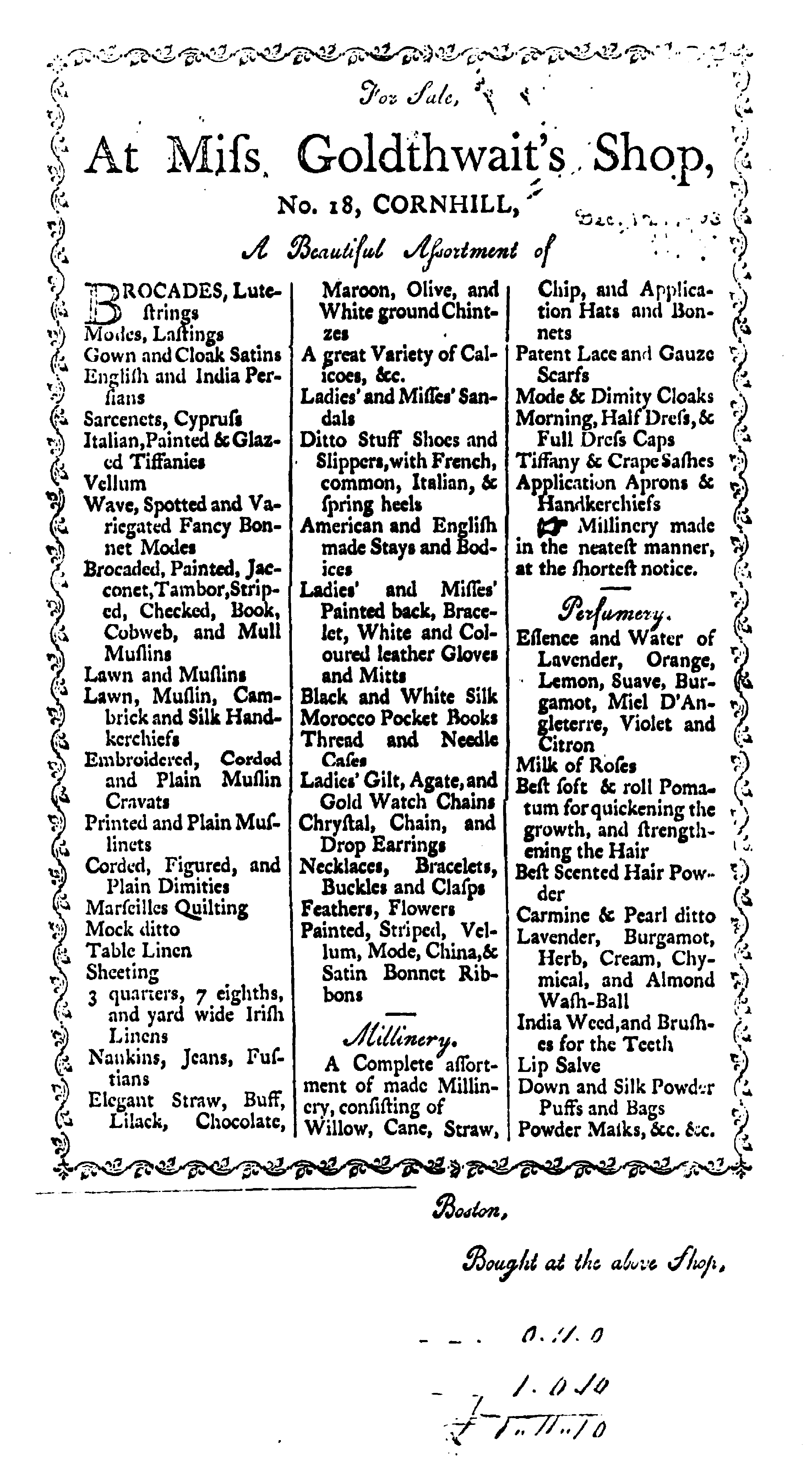
Still, scouring sundry repositories for tayloring manuals (more on that another time), I found this delightful broadside. We can’t use 1782 to document 1780, and no means of using any of these items is mentioned or implied. Still, there they are, those inflammatory terms: Feathers, Flowers.

1782 Broadside. Early American Imprints, Series 1, no. 45771  (filmed)

1782 Broadside. Early American Imprints, Series 1, no. 45771 (filmed)

To paraphrase Max, Let the wild rumpus continue.

Share this:

  • Share on Facebook (Opens in new window) Facebook
  • Share on Pinterest (Opens in new window) Pinterest
  • Email a link to a friend (Opens in new window) Email
  • Share on X (Opens in new window) X
Like Loading...

Room, Officers’, for the use of.

30 Thursday Apr 2015

Posted by kittycalash in Events, Food, Living History

≈ 6 Comments

Tags

10th Massachusetts, 18th century, common soldier, Events, interpretation, living history, Reenacting, Revolutionary War

IMG_3458
IMG_3461

Sometimes I feel like a third wheel at Rev War events. There is not always a lot for women to do besides chores, and the public often ignore us. Still, there is one maxim I know to be true: if you’re bored, work.

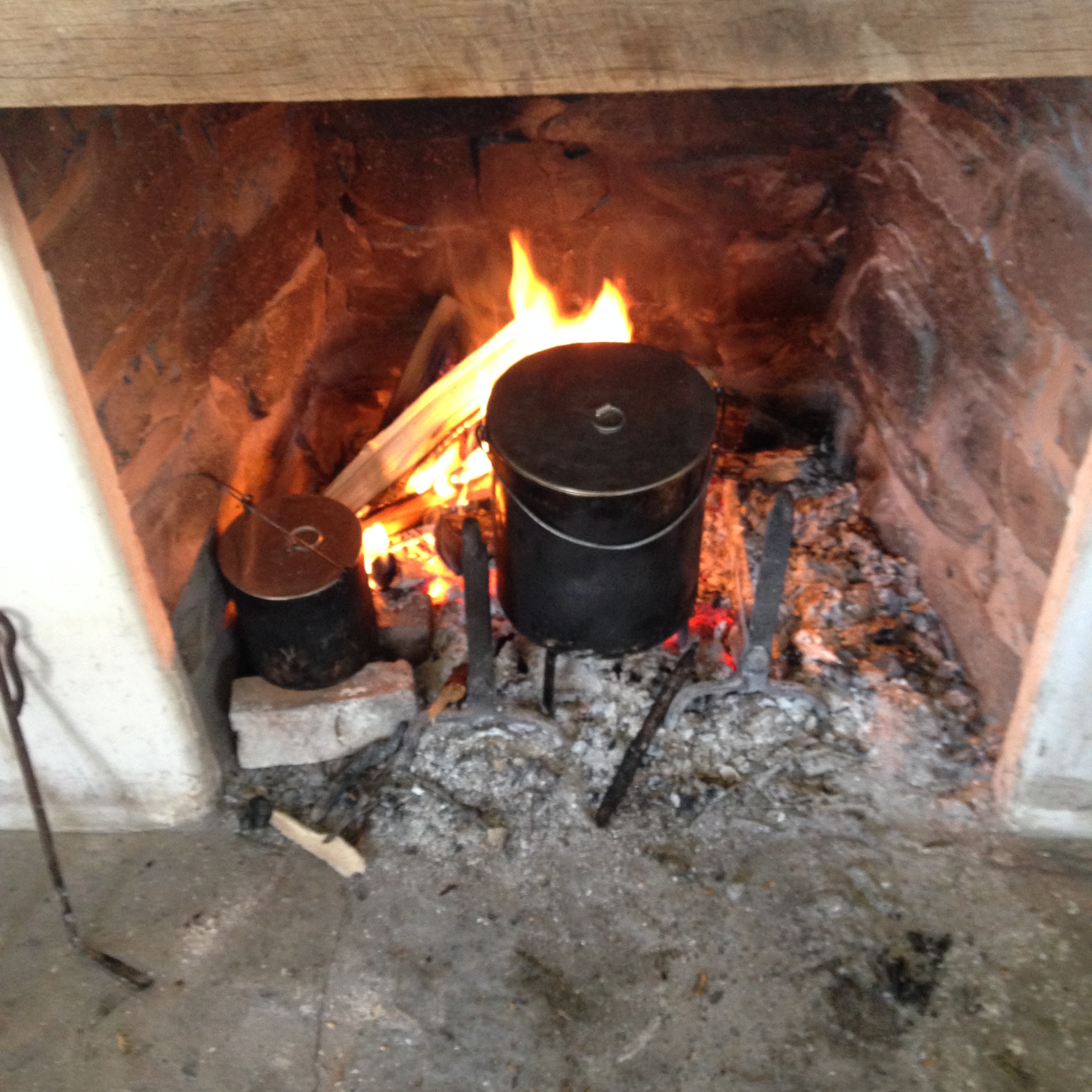
Thus, when I found myself drifting off Saturday, I started dinner. The best part was where I got to make dinner: in a chamber off the main room of the Temple at the New Windsor Cantonment. These two rooms were occupied by the 10th Mass this year. Last year, the unfinished room had been the scene of Dirt Stew.

Cutting vegetables on a table was a major upgrade; last year, I think I used the kettle lid, the floor being too gritty even for me.

IMG_3470

It’s End of Stored Root Vegetable season here, so largish carrots and parsnips went into the pot, along with potatoes, onions, and a cooked chicken disjointed by hand (a task I have experience in).

This year, we brought the only iron we own, a small trivet-like stand to put the big kettle on; the little one went on bricks from the Temple’s other fireplace. Was that slim piece of iron wrong? Probably, but in a place where we can’t dig a kitchen or make a fire outdoors, we compromised in the name of keeping supper unspilled.

IMG_3471

Why no fires outdoors? Red flag warnings, due to high winds and low RH. That all hobbies will be affected by climate change was clear on Saturday, as we discussed invasive species, transporting wood across state lines, and various site rules on using brush to build shelters. It’s not just about digging fire pits or kitchens and archaeology anymore.

Share this:

  • Share on Facebook (Opens in new window) Facebook
  • Share on Pinterest (Opens in new window) Pinterest
  • Email a link to a friend (Opens in new window) Email
  • Share on X (Opens in new window) X
Like Loading...
← Older posts
Newer posts →

Archives

wordpress statistics

Creative Commons License
Kitty Calash blog by Kirsten Hammerstrom is licensed under a Creative Commons Attribution-NonCommercial-ShareAlike 4.0 International License.

Website Built with WordPress.com.

  • Subscribe Subscribed
    • Kitty Calash
    • Join 621 other subscribers
    • Already have a WordPress.com account? Log in now.
    • Kitty Calash
    • Subscribe Subscribed
    • Sign up
    • Log in
    • Report this content
    • View site in Reader
    • Manage subscriptions
    • Collapse this bar
 

Loading Comments...
 

    %d