• Home
  • Completed Costumes/Impressions
  • Emma and Her Dresses
  • Free Patterns and Instructions

Kitty Calash

~ Confessions of a Known Bonnet-Wearer

Kitty Calash

Tag Archives: interpretation

Taking Tea

04 Tuesday Feb 2014

Posted by kittycalash in Events, History, Living History, Museums, Research

≈ 5 Comments

Tags

Henry Sargent, historic interiors, interpretation, John Brown House Museum, Museum of Fine Art Boston, Museums, paintings, Research, social life and customs, tea party, The Tea Party
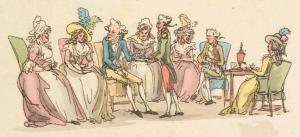
Detail, Picturesque studies and scenes of everyday life watercolor by Thomas Rowlandson, 1790. Royal Collection Trust. RCIN 810396

Detail, Picturesque studies and scenes of everyday life. Handcolored etching by Thomas Rowlandson, 1790. Royal Collection Trust. RCIN 810396

Hat tip to Jane Austen’s World for the image at left, which helped me start visualizing another program I’m involved with, this time ‘at home’ in Providence.

When we started reinterpreting the house museum, we began going back through primary sources to figure out how rooms might have been used, and furniture arranged (we don’t have inventories, so we read the house and diaries and letters– but that’s for another post).

Detail, The Tea Party. Oil on canvas by Henry Sargent, 1824. MFA Boston, 19.12

Detail, The Tea Party. Oil on canvas by Henry Sargent, 1824. MFA Boston, 19.12

One of the things I remember most vividly was the description of the uncomfortable tea parties Providence women gave, where the guests sat in chairs against the walls of the rooms, balancing a tea cup in one hand and plate in another. Several hard drives later, I’m not sure where that primary source is (the hunt begins tomorrow) but it conjured images of every hostess in Providence a Hyacinth Bucket, and every guest a quivering Elizabeth Next Door.
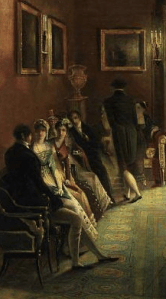
Detail, The Tea Party. Oil on Canvas by Henry Sargent, 1824. MFA Boston, 19.12

Detail, The Tea Party. Oil on Canvas by Henry Sargent, 1824. MFA Boston, 19.12

Surely that couldn’t be true? I thought I must be making it up, but then the Rowlandson turns up on the interwebs and there they are, in a row. More famously and closer to home, Henry Sargent’s painting of a Boston tea party in 1824. (The catalog description is rather nice.)

Here’s an 1824 tea party in Boston. While this is later than the tea party we’ve planned at work, it is still full of useful hints about how early, formal tea parties were conducted. We think– or I do, anyway– of ladies in frilly hats seated a tables with cakes heaped on stands and floral tea pots. I hear “tea party” and I think “doilies,” but this is not your grandmother’s tea party. It’s a different kind of social occasion, both more formal and more relaxed.
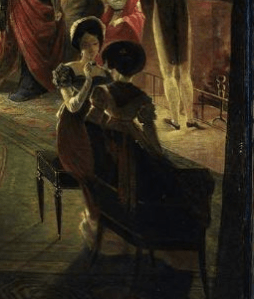
Detail, The Tea Party, oil on canvas by Henry Sargent, 1824. MFA Boston, 19.12

Detail, The Tea Party, oil on canvas by Henry Sargent, 1824. MFA Boston, 19.12

There’s not a central table to sit around, but instead chairs lined up against the wall, groups of guests, chatting. Others guests stand close to the fireplace, and a pair of ladies have taken a settee and a stool for their close conversation. We can just make out the tiny tea cup in the lady’s gloved hand.

In many ways, this depiction reminds me more of contemporary cocktail parties or open houses with the guests in small, changing groups, and no place to put your cup. Of course, most of us don’t have waiters (that’s who you see in the detail above with his back to us) or fabulous houses on the Tontine Crescent in Boston.

In so many ways, the social customs, habits and mores of the past are lost to us, and as we try to recreate them, the we excavate them from a combination of unlikely sources. Accounts, paintings, diaries, and etiquette manuals serve as sources, but it’s easier to recreate the economics of tea than the structure of a tea party. And once we do have an approximation, will it be a party anyone wants to go to?
Share this:

  • Share on Facebook (Opens in new window) Facebook
  • Share on Pinterest (Opens in new window) Pinterest
  • Email a link to a friend (Opens in new window) Email
  • Share on X (Opens in new window) X
Like Loading...

“All sorts and conditions of women”

13 Monday Jan 2014

Posted by kittycalash in Clothing, History, Laundry, Living History, Reenacting, Research

≈ Comments Off on “All sorts and conditions of women”

Tags

10th Massachusetts, 18th century clothes, authenticity, camp life, common dress, common people, common soldier, cooking, dress, fashion, interpretation, James Peachey, living history, Revolutionary War, tents

img094

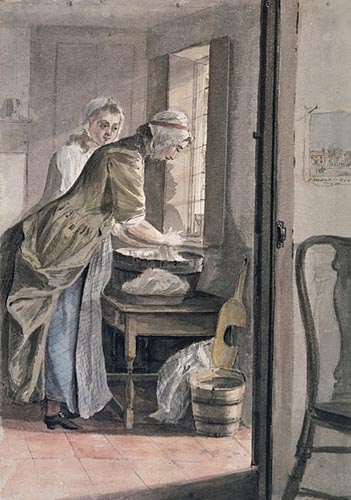
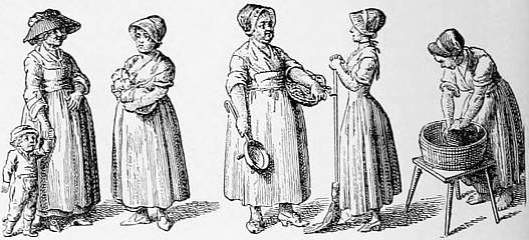
Ever on the track of laundresses and working women, I came upon The Project Gutenberg EBook of The History of Modern Painting, Volume 1 (of 4), by Richard Muther. I was rewarded with  a laundress and a cook holding a spider. Daniel Chodowiecki, a German artist, seems to have been as drawn to the common people as Paul Sandby. The caveat of course is that is he German, so details may not always be correct for American interpretations (pinner aprons, for example).

Still, we have the classic washtub-on-a-table set up, and the laundress is barefoot, which makes very good sense, though my feet hurt just from thinking about standing barefoot on the stubble of the field at Saratoga.

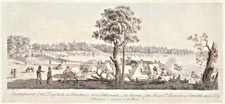
Encampment of the Loyalists at Johnstown, a New Settlement, on the Banks of the River St. Lawrence in Canada, taken June 6th 1784, James Peachey.

Encampment of the Loyalists at Johnstown, a New Settlement, on the Banks of the River St. Lawrence in Canada, taken June 6th 1784, James Peachey.

Laundresses come with style, too, though I am asking myself, “Is that a fabulous hat, or is your head just in front of some balled-up, sleeping livestock?” Was is discernible is that her hair is down, and she is leaning on the washtub. The tent seams are also clearly visible, and she does have the iconic washtub on a table set up.

Encampment of the Loyalists at Johnstown, a New Settlement, on the Banks of the River St. Lawrence in Canada, taken June 6th 1784. James Peachey

Encampment of the Loyalists at Johnstown, a New Settlement, on the Banks of the River St. Lawrence in Canada, taken June 6th 1784. James Peachey

In another detail of the same image, we have a woman who is clearly wearing a black bonnet, tending a kettle on a fire. Here’s yet another piece of evidence for the three sticks-two kettles-no matches set up, and for the tinned kettles being left to get black on the outside.

What is she wearing on her body? There’s a white (or a least white-grounded) kerchief, and what looks like a grey or drab petticoat. But is that a short gown, jacket or bed gown? I’d say jacket, mostly because of the fit, but it’s hard to say at this distance. Whatever word you care to use, she’s wearing a reddish-brown garment fitted to her torso that appears to have a side-back seam.

Once again, tent seams are visible. This tent, just like the one in the other detail, also has some large off-white item thrown over the end. Could it be a blanket, out to air in the sun?

I do also appreciate the short blue jacket/white trousers of the man or boy to the left of the woman, since I know a guy who possesses those clothes and prefers trousers to breeches. He appears to be drinking from a cup as he carries a kettle, presumably of fresh water.

Encampment of the Loyalists at Johnstown, a New Settlement, on the Banks of the River St. Lawrence in Canada, taken June 6th 1784, James Peachey.

Encampment of the Loyalists at Johnstown, a New Settlement, on the Banks of the River St. Lawrence in Canada, taken June 6th 1784, James Peachey.

The entire view of the Loyalists’ camp is here, with a zoomable image. The drawing is full of details applicable to camp life interpretations, from women’s bonnets to fishing rods.

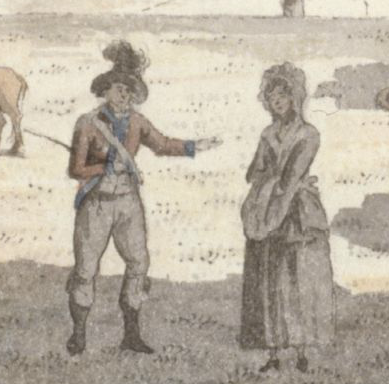
As I contemplate the troublesome Bridget Mahoney, I find the detail below of a solder and a woman rather pleasing.

Does she solemnly swear she is up to no good?

Does she solemnly swear she is up to no good?

Share this:

  • Share on Facebook (Opens in new window) Facebook
  • Share on Pinterest (Opens in new window) Pinterest
  • Email a link to a friend (Opens in new window) Email
  • Share on X (Opens in new window) X
Like Loading...

The Pleasure of Your Company

31 Saturday Aug 2013

Posted by kittycalash in Events, History, Living History, Museums, Research

≈ 1 Comment

Tags

Events, interpretation, John Brown House Museum, living history, Museums, Rhode Island

WCD Two

Friday afternoon we did a photo shoot at work for promotional materials for our upcoming What Cheer! Day program on Saturday, October 5. We’ll be occupying the house in first person for a day, with members of the Brown family and their servants. I think we’re all a little overwhelmed by the prospect of playing real characters about whom we know less than we’d like, but too much not to pay attention to.

There are a lot of details in building a character, and I’m very lucky to be playing the housekeeper, who really is anonymous. We know the names of some of the servants, but not all. It’s liberating, but it’s also making a character up out of the whole cloth. This just means imagining someone new, and that’s where the aspiring fiction writer in me gets to play.

I’ve written about the process here and here, and there will be more to come. But for now, we request the pleasure of your company on Saturday October 5, where you can learn what secrets those maids know, and find out why the gentleman in the blue coat so hates the man in the green coat.

Share this:

  • Share on Facebook (Opens in new window) Facebook
  • Share on Pinterest (Opens in new window) Pinterest
  • Email a link to a friend (Opens in new window) Email
  • Share on X (Opens in new window) X
Like Loading...

Women’s Work

22 Tuesday Jan 2013

Posted by kittycalash in Events, History, Living History, Reenacting

≈ 5 Comments

Tags

18th century, Events, interpretation, living history, women's history, work

Cooking. Gets you every time.

Cooking. Gets you every time.

Three holes (at least; there might be four) and mending to do. The patches are cut, but I’m thinking now that a wool apron might be a good thing to have. The other thing I’ve been thinking about is what James Thurber called The War Between Men and Women, and how even in educated, enlightened North America, it plays on. [i]

At living history events or reenactments, the work and activities are divided along gender lines. Participants are supposed to follow “the rules,” which keep women on the observer side of the rope line and the men free to run around with muskets. Women sometimes seem purely decorative at the military events, and the relationships between men and women are curious. There’s the sexism between reenactors, and the sexism of the public, who can often assume women know nothing about what’s happening.  Women should, after all, know their place, just as the men know theirs.  Women can cook and clean up after the men, and the men will do all the talking, even when they’re wrong.[ii]

In a more domestic setting, this same historical dynamic can play out: women cook and serve the meals, wash the dishes, fetch the wood and water, and clean the kitchen, while men muck about outdoors until their tools break. Then they lounge about smoking, drinking, and talking.

Sandby, Washing at Sandpit Gate, 1765. Royal Collection.

Sandby, Washing at Sandpit Gate, 1765. Royal Collection.

That’s all OK, to a degree.  But we’re not in the 18th century, and the women in the kitchen don’t enjoy washing other people’s dirty dishes as well as all the cooking pots and tools. We had a system on Sunday evening, but I did notice that some men just can’t be the only guy helping: once the other guys leave the room, they’re out, too, with a kind of desperation, even as the light wanes and we need all the help we can get to finish up.

So what to do? Interpreting the 18th century means facing gender roles that most American women today don’t like or embrace. What’s the best way to interpret women’s history and women’s roles in the past to people today?

On Sunday, I left the house to call the guys to the first meal, and a visitor asked if the sheep in the field were part of the site. “Yes,” I said. “ But I don’t know where the sheep are today; I don’t get to leave the house much.” And that is true: aside from fetching water when I didn’t have a man or boy to ask to do it, there was hardly need, reason, or even time, to leave the house.

I think we do a disservice to the visitors to living history sites of all kinds if we don’t find a way to talk about women’s history, and the roles—proscribed or not—that women could take on. At a RevWar encampment, we can talk about the reasons women followed the armies, the kinds of work they did for pay or rations, and what the Revolution meant for women. At the farm and at the manor, I think it’s important to talk about women’s lives in the Early Republic. How this would work at the farm, exactly, I’m not yet certain; at the manor it is easy enough, for the women who lived there were born just before the Revolution. They were well-educated and expected to choose their own husbands. We know who they were; we know less about the women at the farm, though we know about their work.

How we experience that work isn’t really the point, but the chasm between choosing to spend a day never looking beyond the scope of the hearth and having to spend days that way is enormous. It’s a point I want to make,  in a way more sophisticated than “life was hard and greasy.” It’s something to work on.


[i] This is in no way meant to equate the petty first world problems of a bunch of reenactors/living historians with the larger and more brutal problems elsewhere in the world. But relationships can change when situations change…

[ii] Fortunately, the Second Helping Regiment doesn’t work quite this way, and not just because they’re busy chewing whatever has been made for them. Cooking, and the subsequent chewing, can be used strategically.

Share this:

  • Share on Facebook (Opens in new window) Facebook
  • Share on Pinterest (Opens in new window) Pinterest
  • Email a link to a friend (Opens in new window) Email
  • Share on X (Opens in new window) X
Like Loading...
Newer posts →

Archives

wordpress statistics

Creative Commons License
Kitty Calash blog by Kirsten Hammerstrom is licensed under a Creative Commons Attribution-NonCommercial-ShareAlike 4.0 International License.

Website Built with WordPress.com.

  • Subscribe Subscribed
    • Kitty Calash
    • Join 621 other subscribers
    • Already have a WordPress.com account? Log in now.
    • Kitty Calash
    • Subscribe Subscribed
    • Sign up
    • Log in
    • Report this content
    • View site in Reader
    • Manage subscriptions
    • Collapse this bar
 

Loading Comments...
 

    %d