• Home
  • Completed Costumes/Impressions
  • Emma and Her Dresses
  • Free Patterns and Instructions

Kitty Calash

~ Confessions of a Known Bonnet-Wearer

Kitty Calash

Tag Archives: John Brown House Museum

Missing the ‘maid’?

17 Tuesday Sep 2013

Posted by kittycalash in Events, History, Living History, Museums, Research

≈ 3 Comments

Tags

18th century, embroidery, John Brown, John Brown House Museum, Rhode Island, Ruth Smith, Sarah Brown, servant girls, servants, widows

Ruth’s seat is for a side chair. But there’s value in them thar seats. MMA 50.228.3

Sarah Brown had a sister, Ruth Smith. Ruth was good with a needle, and there is an extant chair seat made by Ruth. I’d always thought, in a fuzzy, not-thinking-too-hard kind of way, that Ruth had made the chair seat for her sister and brother-in-law because they were family, and how else would a lady spend her time but with her needle?

My thinking sharpened radically late last week when a colleague said, “Didn’t Ruth make shirts for John and James [Brown]?”

Yes, she did. In Ruth Smith’s 1785 daybook there are two entries, though the pages are lined for more.

The first records 5 shirts made for John Brown February; against this, in March, Ruth received a pair of shoes, and a pound of Hyson tea.

In April, she made 4 shirts for John Brown’s son, James; in May, she received 9 yards of lutestring from James.

The values didn’t seem to quite line up, so I’ll have to pull the day book again, but what seemed most important was Ruth’s trading shirts for shoes, silk, and tea. In “Dress of the People,” John Styles writes about servants drawing goods from merchants on their masters’ credit; did this transactional relationship allow Ruth wider access to the world of goods than her means might otherwise allow?

Shirt, ca. 1780. MMA 2009.300.62

And if Ruth makes shirts for John and James, are there other, less-well-off relations doing other work for the Browns? There are records of servants or slaves of African descent working in the house on Power Street, but we can only find evidence of three, one dedicated to the horses. That’s not nearly enough people to run a house with a dozen fireplaces and a kitchen, and six or seven occupants. It seems unfathomable that the Browns tended their fireplaces, hauled their water and cooked all their food themselves. John Brown writes to a daughter of “your Marr baking pies,” but it seems radically unlikely that Mrs John Brown, wife of the wealthiest man in Providence, would handle the heavy round of chores required to keep a household and its visitors fed, clothed, cleaned, and entertained.

Direct it, yes. Do it all herself, no.

Could we be missing the maids? Could we be overlooking evidence of work being done by extended family members “visiting” or “come to stay?” Could the poor and widowed and never married women of the Brown and Smith families be the people we should be looking for along with the servants or slaves of African descent? (By 1790 and later, it is not clear if the Browns’ slaves are working in the Power Street house, or if they are at the farm at Spring Green or Bristol, Rhode Island. Many records remain in private hands and others remain badly processed and arranged. I have referred herein to collections publicly held and well-processed.)

What this means, as always, is more research and more looking. It also means that the relationships between Mrs Brown and her ‘maids’ might be more complicated and more interesting. She knows these women, and their families, and how they fit into her world and her family. Could one be a distant cousin, a daughter of a mother no longer living, whose father is abroad, perhaps on a boat owned by John Brown or his companies? Might a young, unmarried woman in her twenties exchange work for room and board and credit with Brown & Francis? Perhaps.

Mourning Embroidery by Ann Barton, 1800. RIHS 1840.1.14

Mourning Embroidery by Ann Barton, 1800. RIHS 1840.1.14

That takes care of one or two of us–I’m looking for a widowed niece, with a son gone to  sea on a Brown ship to India. Mr S will have to tell me which battle he wants to widow me in, as he has rejected “lost at sea” and “frozen to death on the Oswego expedition” as possibilities. Actually, at my advanced age, I might have been widowed twice already. You’d think I would have done better with it.
Share this:

  • Share on Facebook (Opens in new window) Facebook
  • Share on Pinterest (Opens in new window) Pinterest
  • Email a link to a friend (Opens in new window) Email
  • Share on X (Opens in new window) X
Like Loading...

Chemisettes

16 Monday Sep 2013

Posted by kittycalash in Events, Making Things, Museums, Research

≈ 1 Comment

Tags

1800 event, 18th century clothing, bib and tucker, fashion, John Brown House Museum, patterns of fashion, Rhode Island, Rhode Island Historical Society, style, What Cheer Day

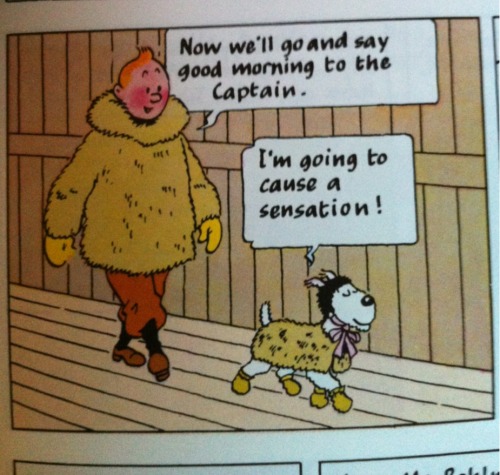
The Shooting Star: Snowy in his “best bib and tucker.”

Chemisette or tucker? By the time The Shooting Star was published in 1941-42, “bib and tucker” had wandered away from their original meanings. Tuckers were worn under women’s and girl’s bodices, taking on the role of neck handerchiefs or fichus, and what some people like to call “modesty pieces,” though the phrase always makes me think of the front panel of desks.

Janet Arnold includes chemisettes in Patterns of Fashion I, and you can buy a very nice one indeed from Cassidy at her Etsy store. (Reviewed here, and modeled, too!) But can you have one in Rhode Island in 1800? That is, of course, the question.

Hannah Weaver Peckham, RIHS 1958.3.2

Hannah Weaver Peckham, RIHS 1953.8.2

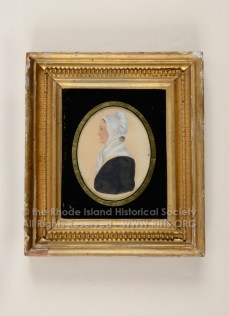
Turns out you probably can. Scrolling through the miniatures gallery, there was Hannah Weaver Peckham in her best tucker, and Miss Rhodes, while later, is also sports a chemisette or tucker. (Mrs Peckham looks a bit cranky, doesn’t she? Perhaps her busk is poking her.)

What you’d call it remains an open question.

The 1933 Oxford dictionary we have in the office defines “tucker” as “A piece of lace or the like, worn by women within or around the top of the bodice of the 17-18th C.”

Phoebe Smith Rhodes, RIHS  1918.3.6

Phoebe Smith Rhodes, RIHS 1918.3.6

The same dictionary tells me “chemisette” is 1807, from the French, diminutive of chemise. “1. A bodice, more or less like the upper part of a chemise. 2. An article, usually of lace or muslin, made to fill in the open front of a woman’s dress 1844.”

While I think that one could, in Rhode Island in 1800, wear a garment that filled in the upper part of a bodice, I’m not sure what one wold call that garment. The simplest thing to do is to wear a white kerchief  like Phoebe Smith Rhodes. Have I ever settled for the simplest thing? Not if I can help it.

Share this:

  • Share on Facebook (Opens in new window) Facebook
  • Share on Pinterest (Opens in new window) Pinterest
  • Email a link to a friend (Opens in new window) Email
  • Share on X (Opens in new window) X
Like Loading...

What Cheer Day 2013

10 Tuesday Sep 2013

Posted by kittycalash in Events, Living History, Museums

≈ Comments Off on What Cheer Day 2013

Tags

18th century, John Brown House Museum, JohnBrownHouse, Rhode Island, Rhode Island Historical Society, What Cheer Day

WCD2013

The event poster, designed by my colleague in the deerskin breeches! You’ll be joining us, right?

Share this:

  • Share on Facebook (Opens in new window) Facebook
  • Share on Pinterest (Opens in new window) Pinterest
  • Email a link to a friend (Opens in new window) Email
  • Share on X (Opens in new window) X
Like Loading...

What (Cheer) to Wear?

07 Saturday Sep 2013

Posted by kittycalash in Clothing, History, Living History, Reenacting, Research

≈ Comments Off on What (Cheer) to Wear?

Tags

18th century, 18th century clothes, authenticity, John Brown House Museum, living history, resources, Revolutionary War, What Cheer Day, work

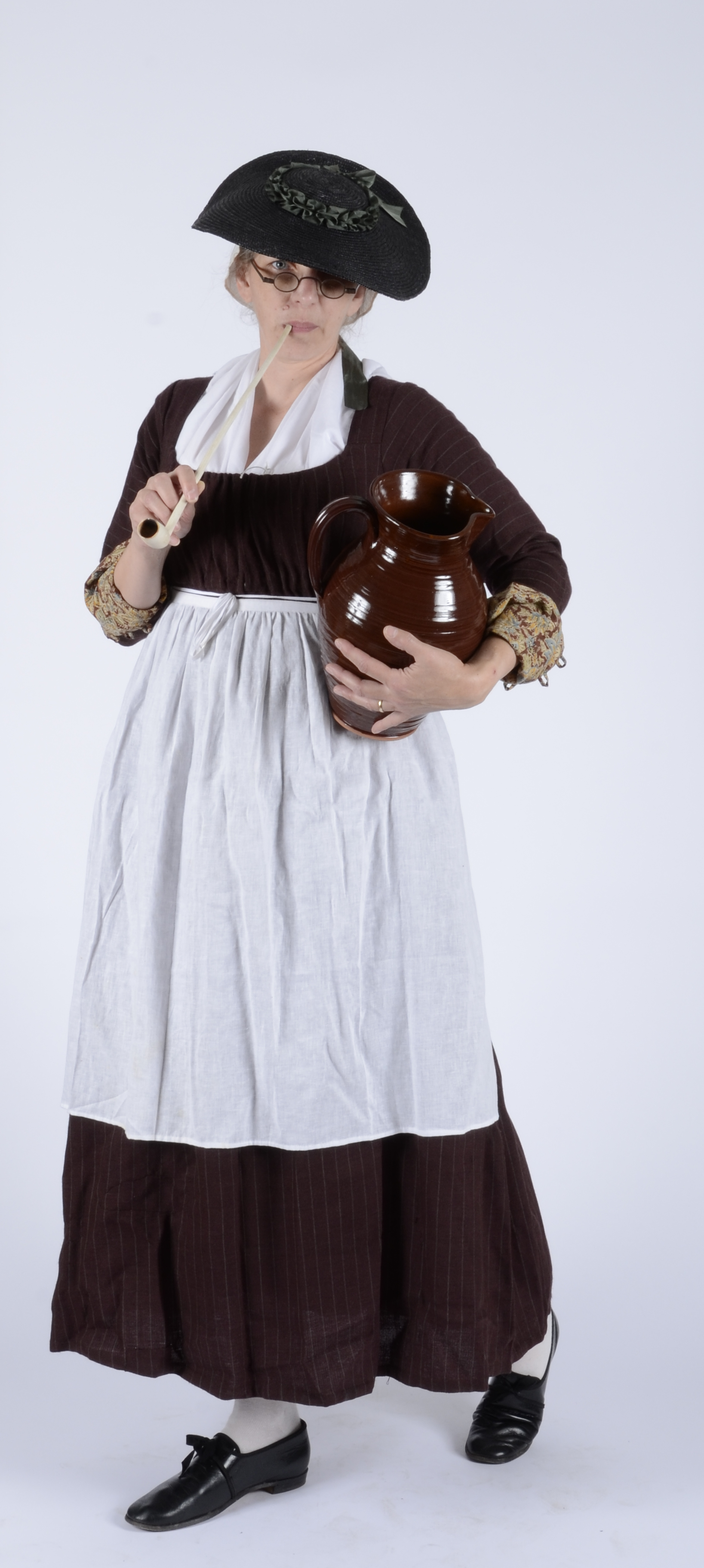
JBs HousekeeperIt’s 1800. Do you know what your housekeeper is doing? I don’t. Or, more accurately, I can’t decide.
I’m hung up on stays, and not wanting to make another pair. I’m indecisive about style, and though Mrs Garnett has her charms, it’s her bonnet I love more than anything.

Here’s what I’ve found, in servant-land:
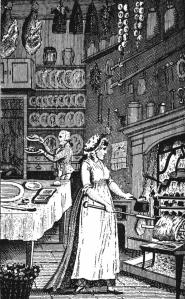
18th-century-kitchen-servants-prepare-a-meal-jane-austen-cookbook-cover-page

Note that this woman is, in the kitchen, wearing an open robe and quilted petticoat.The style of her bodice–which looks  like a cross-over bodice–and the train of the robe suggest the 1790s. Score one for style.

That open robe, where have I seen that before? Why, yes, Mr Sandby showed us that style for a nurserymaid. (It’s interesting, too, that both images show women with their hair quite visible under their caps, and not pulled up and out of sight.)
20130109-061710.jpg

Why does “robe stye” matter? Because I only found 3 and a quarter yards of a brown fabric I like, and even with the most careful cutting, that’s unlikely to make a full gown. However, I have some lightweight black wool that will make a decent petticoat. The bodice style is a bit of a stumper, though: the wool has good drape, so it might work for something other than the usual bodice I make. I did consider whether a very smooth, edge-to-edge, front-closing style of the 1780s would be more appropriate, but I think that I can move the bodice style forward, style-wise, and be correct.

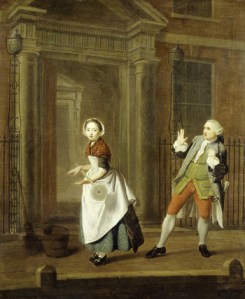
138263

Brown gowns are a fine tradition in the sartorial habits of questionable servants. This young housemaid twirls her mop dry while wearing a brown gown over what could be a dark blue or a black quilted petticoat. The red “bandannoe” is a nice touch, though I don’t think I’ll wear one myself for this event.

In all this there is a compromise: using fabric I like, in a style I know I can make and document, perhaps even without having to make new stays. That would be ideal, because although it’s four weeks to the event, I’ll lose a week of sewing time to other commitments. Three weeks to pattern and hand sew a petticoat, gown, apron and cap seems just manageable.

Share this:

  • Share on Facebook (Opens in new window) Facebook
  • Share on Pinterest (Opens in new window) Pinterest
  • Email a link to a friend (Opens in new window) Email
  • Share on X (Opens in new window) X
Like Loading...

The Pleasure of Your Company

31 Saturday Aug 2013

Posted by kittycalash in Events, History, Living History, Museums, Research

≈ 1 Comment

Tags

Events, interpretation, John Brown House Museum, living history, Museums, Rhode Island

WCD Two

Friday afternoon we did a photo shoot at work for promotional materials for our upcoming What Cheer! Day program on Saturday, October 5. We’ll be occupying the house in first person for a day, with members of the Brown family and their servants. I think we’re all a little overwhelmed by the prospect of playing real characters about whom we know less than we’d like, but too much not to pay attention to.

There are a lot of details in building a character, and I’m very lucky to be playing the housekeeper, who really is anonymous. We know the names of some of the servants, but not all. It’s liberating, but it’s also making a character up out of the whole cloth. This just means imagining someone new, and that’s where the aspiring fiction writer in me gets to play.

I’ve written about the process here and here, and there will be more to come. But for now, we request the pleasure of your company on Saturday October 5, where you can learn what secrets those maids know, and find out why the gentleman in the blue coat so hates the man in the green coat.

Share this:

  • Share on Facebook (Opens in new window) Facebook
  • Share on Pinterest (Opens in new window) Pinterest
  • Email a link to a friend (Opens in new window) Email
  • Share on X (Opens in new window) X
Like Loading...
← Older posts
Newer posts →

Archives

wordpress statistics

Creative Commons License
Kitty Calash blog by Kirsten Hammerstrom is licensed under a Creative Commons Attribution-NonCommercial-ShareAlike 4.0 International License.

Website Built with WordPress.com.

  • Subscribe Subscribed
    • Kitty Calash
    • Join 621 other subscribers
    • Already have a WordPress.com account? Log in now.
    • Kitty Calash
    • Subscribe Subscribed
    • Sign up
    • Log in
    • Report this content
    • View site in Reader
    • Manage subscriptions
    • Collapse this bar
 

Loading Comments...
 

    %d