• Home
  • Completed Costumes/Impressions
  • Emma and Her Dresses
  • Free Patterns and Instructions

Kitty Calash

~ Confessions of a Known Bonnet-Wearer

Kitty Calash

Tag Archives: living history

Saturday Afternoon in the Park with Kitty

27 Friday Sep 2019

Posted by kittycalash in Clothing, Events, Living History, Reenacting

≈ Comments Off on Saturday Afternoon in the Park with Kitty

Tags

18th century, 18th century clothes, 18th century clothing, Clothing, living history, Making Things, millinery, Museums, Van Cortlandt House Museum

The strawberries and cream hat, with pinballs and pincushions

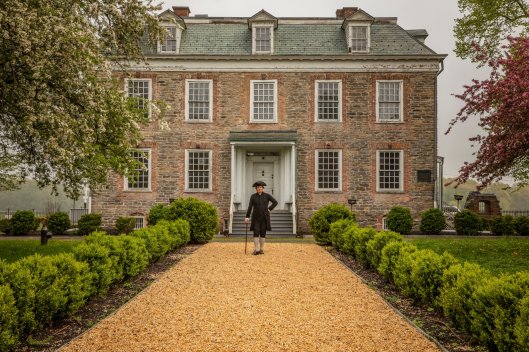
Last Saturday, I enjoyed a beautiful late summer afternoon on the lawn at Van Cortlandt House Museum in the Bronx. Built in 1748 for Frederick Van Cortlandt and his family, the house served as Washington’s headquarters in 1776, and again in 1783.

was  The Van Cortlandt House, dating from 1748, is the oldest building in the Bronx.CreditTony Cenicola/The New York Times

It’s an idyllic site, and waking up to the sound of cricket bats and Canada geese, a visitor could be fooled into thinking you were not in the Bronx at all. Mist rose above the cricket pitch when I woke up, a large flock of geese picking at the grass. It was Netherland come to life, men beating bats on their cleats and laughing. I’m really grateful to Mrs M. for the place to sleep and chance for adventure.

This trip was a remarkable cultural experience for me, and one I really needed. Growing up on the north side of Chicago, I was used to urban density and scale, so after two years in Northern Virginia suburbs, a dose of urban life was welcome. It was all the more welcome because instead of spending my time judged by cats, I got to play with dogs (and earned a sore bicep for all the stick and giraffe throwing I did for one). The trip to Stew Leonard’s was remarkable, after the tame mercantile experiences of tiny Rhode Island, and even Wegman’s paled in comparison. It was a good set up for thinking about mercantile enterprises, impulse purchases, and the ways merchants (including milliners) and shop owners needed to keep customers coming back, tempting them with new goods. (Or, in the case of Stew Leonard’s, singing cows and/or milk cartons.)

More bonnets, most of which are available on Etsy

I managed, somehow, to finish a red silk satin quilted petticoat in time (lined with red “stuff” from Burley and Trowbridge, it was not too bed-covering like until the late afternoon) to dress up the Nancy Dawson dress. I didn’t manage to locate my sleeve ruffles in time ( stitched on a garment ) but in other regards, I was pleased with how this turned out.

Bathroom selfie, but you can see that sweet silk petticoat

Dressing my clothes up– that is, moving them up the social ladder– can be a challenge, but good accessories make a big difference. Eventually I will get a finer apron made, one with a ruffle, but for now, that has to wait.

With Lark, perhaps the sweetest little rescue pup I’ve ever met.

I have a trip to Philadelphia to make, bottles to label, and receipts to write. Elizabeth Weed returns to Carpenters Hall this weekend as part of the Occupied Philadelphia programming.

Share this:

  • Click to share on Facebook (Opens in new window) Facebook
  • Click to share on Pinterest (Opens in new window) Pinterest
  • Click to email a link to a friend (Opens in new window) Email
  • Click to share on X (Opens in new window) X
Like Loading...

“Now Selling at Prime Cost”

28 Wednesday Aug 2019

Posted by kittycalash in Clothing, Living History, material culture, Reenacting, Research

≈ 2 Comments

Tags

18th century, kickstarter, living history, merchants, milliner, millinery, millinery shop, women's history, women's work

Although I’ve portrayed a milliner before, the earliest iteration has been as a shopkeeper in August, 1804, so I thought it best to refresh my knowledge of what 18th century milliners advertised. (Deep dives into bonnets help me focus on bonnets, but necessarily what else was being sold.)

Pennsylvania [Philadelphia] Packet, January 15, 1772.


One of my favorite ads is from the January 15, 1772 Pennsylvania Packet. Mary Symonds of Philadelphia published an extensive list of goods, many of which will lead you down a rabbit hole. Three of the listings had particular appeal.

“Womens’ and childrens’ black and coloured silk, Dunstable and chip hats, and bonnets”

“Black and coloured silk” almost surely encompasses the range of colored silk bonnets seen in Boston advertisements, but what’s the difference between Dunstable and chip hats? Price, of course. What most of us think of, or call, “chip” hats should be called Dunstable or simply straw.

Silk covered chip hat, Snowshill Wade Costume Collection, NT 1349840
Detail, silk covered chip hat, Snowshill Wade Costume Collection, NT 1349840

Chip hats like the one above in the Snowshill Wade Costume Collection, were made of plaited (woven) thin strips of wood, more like flat baskets or chair seats.

Straw hat, Snowshill Wade Costume Collection, NT 1349843
Detail of straw hat, Snowshill Wade Costume Collection, NT 1349843

Straw hats, like the one above (also in the Snowshill Wade Costume Collection) are clearly finer than chip and do not need to be covered. The earliest description of the distinctions between hat types that I’ve found thus far is from 1815, in “An Encyclopæaedia of Domestic Economy, Comprising Such Subjects as are Most Immediately Connected with Housekeeping etc etc” which goes into some detail.


The most entertaining discussion I found was in  The Sessional Papers Printed By Order Of The House Of Lords, Or Presented By Royal Command, In The Session 4 And 5 Victoriae And The Session 5 Victoriae 1841. The recorded exchange resonates with current discussions of tariffs on imports, but the really revelatory bit is this:

Class distinctions expressed in materials and apparel are eternal.

“Tobines” were new to me (or at least forgotten) and have nothing at all to do with the bishop of Providence. Thankfully, Textiles in America has the answer: “A wide variety of dress materials from fine silks to silk and worsted, and linen and cotton combinations that have warp-float patterns of small flowers or intermittent stripes and dots.” (p 367). Once you’ve seen it, you realize you’ve seen it before.

Berch papers, Nordiska Museet.

“Childbed baskets” were also a new concept to me, but The Female Reader, Or, Miscellaneous Pieces in Prose and Verse; Selected from the Best Writers, … for the Improvement of Young Women illuminated the term; the current equivalent is a layette set that includes bedding, and goes beyond the crocheted sweater, cap and booties some of us came to fear receiving. (Mint green acrylic? really?)

It’s a wide range of goods for women to buy (including small accessories for the men and boys in their families), and somewhat beyond the bonnets-hats-jewelry-trimmings we typically associate with milliners. While I don’t have any plans to start manufacturing chip bonnets or making up childbed baskets, I am definitely intrigued by the possibility of expanding my “offerings.”

Share this:

  • Click to share on Facebook (Opens in new window) Facebook
  • Click to share on Pinterest (Opens in new window) Pinterest
  • Click to email a link to a friend (Opens in new window) Email
  • Click to share on X (Opens in new window) X
Like Loading...

Making Plans….

26 Monday Aug 2019

Posted by kittycalash in Living History, Making Things, material culture, Museums, personal, Reenacting

≈ 1 Comment

Tags

historic house museums, kickstarter, living history, milliner, millinery, millinery shop, Van Cortlandt House Museum

I have set my sights on being at Van Cortlandt House Museum’s Second Annual History and Culture Fair on Saturday, September 21. This is a bit of a stretch: It’s farther than Philadelphia, where I’m scheduled to be the following weekend at the Museum of the American Revolution– and I want tweak that impression and its material culture a bit, too. Still: setting up a ca. 1777-1780 milliner and mantua maker or merchant display has been on my to-do wish list for years, and I’m pretty sure I can pull this off as long as I modify/upgrade items already in my closet.

There are enough images to provide good inspiration and ways to start accessorizing.

Several prints  from the British Museum provide guidance.

It’s clear– as I knew already– that my accessory game requires major upping. But this is solvable! It’s not ideal, being in a situation where I can’t buy new fabric, and I don’t have the time to make up the fabric I do already have in the garment styles I need. This is no time to start a new patterning project!

So this means making accessories to upgrade a gown and petticoat already on hand and known to fit (though they should be fit-tested once again before committing!).

Which dress? Why, Nancy Dawson, of course. She’s the brightest and most stylish gown I have. Thankfully, I have upgraded my cap collection, and could even– probably– manage a new cap in the time allotted.

So what do I need? A well-decorated, possibly floofier cap, a LBB (™) of the kind worn in “The Rival Milleners”, a breast knot or bow, a new fine silk or cotton apron, and some kind of sleeve treatment.

The maid in the back of “A Morning Visit,” carrying in the tea tray, demonstrates the more understated upgrades I think I will be able to manage in the time I have. In a year, a trimmed silk gown can happen. In a month, it cannot.

The main upgrade I’d like to make is to add a red silk quilted petticoat, since they appear in so many prints with cotton print gowns, including a print of Nancy Dawson herself.

Miss Nancy Dawson, aquatint print. Victoria and Albert Museum. E.4968-1968

I almost assuredly have red silk in my stash: the question is, can I find it, back it, and quilt it in time? Probably not. So there are choices to be made, like the sensible one of simply upgrading sleeve finish and apron and adding bow knots.

Those are just the upgrades I hope to make to my personal kit! I need a dome top trunk (underway; I need the one I have for Elizabeth Weed), and there are inventory items to make that have been on the list for a while.

All of this has to get done while I’m splitting my 55-60 hour weeks between commissions and a retail gig (which I am trying to streamline!).

Once again, I start down the path of madness. Won’t you join me? I think it’ll be a blast!

Share this:

  • Click to share on Facebook (Opens in new window) Facebook
  • Click to share on Pinterest (Opens in new window) Pinterest
  • Click to email a link to a friend (Opens in new window) Email
  • Click to share on X (Opens in new window) X
Like Loading...

Living the History Life

29 Saturday Jun 2019

Posted by kittycalash in Living History, personal

≈ 2 Comments

Tags

authenticity, interpretation, living history, personal, philosophy

man in historical clothing smoking a pipe

Pre-event PR photoshoot. Photo by J. D. Kay

The recent BBC video making the rounds on social media got me thinking about how we live our lives, and what commitments we make to being our true selves, how we follow our bliss, if you will. It takes a lot of courage, willpower, and hard work to achieve one’s deepest inner dreams and although I have taken some steps towards mine, I have not let go all the way (as one does not when one is putting a child through college). 

I think about this desire to be true to one’s own internal vision, and I think about my friend Justin, who found a place and fell in love with what he saw, past and future. It’s hard work to run a farm and a business, but Justin does it beautifully, with grace and integrity. What he achieves makes me ache with want, not for the house, or the frozen cat’s water dish, or the work, but for the courage. 

Working with Justin pushed me into places where I found, if not fear, at least discomfort. As we said, It isn’t history till it hurts. The first What Cheer Day we ran, I remember standing behind the door on the second floor landing of the servants’ quarters, knowing it was show time. I looked at Justin and said, “What the hell have we done?” terrified to go out and “be” John Brown’s housekeeper. But, out we went, and it was amazing. That work inspired me to push myself harder, to try the things that scared me and made me uncomfortable. That’s where the meat is, and the truth: where things hurt.

woman and man in historical clothing looking at a book

The housekeeper was caught reading naughty novels. Photo by J. D. Kay.

As with all things I tackle, I could push myself harder, not to sew better or more authentically (that’s the easy part, really) but to live the way I want to, authentically. To decide what matters and what doesn’t, and stick to it. That’s the real lesson of these men, and why they’re inspiring. I just happen to prefer the one with mud. 

Share this:

  • Click to share on Facebook (Opens in new window) Facebook
  • Click to share on Pinterest (Opens in new window) Pinterest
  • Click to email a link to a friend (Opens in new window) Email
  • Click to share on X (Opens in new window) X
Like Loading...

Hints for a New Hobby

29 Monday Apr 2019

Posted by kittycalash in Living History, Making Things, material culture, Reenacting, Research

≈ 7 Comments

Tags

costuming, living history, Making Things, progressive reenacting, Research, sewing

The historical costuming/living history/reenacting hobby can be a daunting one to pick up. When I started, I was fortunate to have a background making things, including sewing my own clothes, as well as a career that taught me research skills, and gave me easy access to primary sources. Those factors made skill building relatively easy, though I definitely had a learning curve specific to what I was doing. As the season opens and people start to ease into new units, I thought about things I found that made this hobby a little easier to manage, and skills easier to acquire.

Same years....
Same years….
different class levels

Know who (and when) you are. When you step into the past, who are you? Where are you from? What year are you representing? With answers to these questions, you can begin to sort out what you need to know, and where you need to look for answers. What you’ll wear in North Carolina is not what you will wear in coastal New England. The styles of 1750 are not the same as those of 1780– and fashion information traveled quickly from England to America. American colonists were as stylish (or more so) than their English counterparts. Wearing a gown 20 years out of date without alterations is only going to work well if that gown really shows its age (and you do, too).

Learn to do research. If you are going to strike out totally on your own, you need to be able to do research and sift through the sources you find to understand and interpret them appropriately for your situation. What is right for Costume College may well not be right for a camp follower, no matter how accurate the fabrics or construction. It seems so obvious (and in the case of a silk sacque back gown, it really is) but in other ways it’s not. Jackets aren’t going to be right in New England, and calicos are more common in Philadelphia and Rhode Island than they are in Boston.

Lance needles: the best I've used.
Lance needles: the best I’ve used.
Rowenta steam iron
Rowenta steam iron

Buy good tools. Really: tools matter. Sharp shears, sharp thread snips, good, sharp needles, sturdy pins, a pin cushion, a cutting grid, a steam iron, a sleeve board, a sturdy ironing board: all of these things make my sewing life so much better. (I actually own three ironing boards: a full size board, a table top board, and a sleeve board and use them all.) Tailor’s hams are also useful– that’s what I steam my caps on.

Ruffle attachment in progress. Possible thanks to the material and the needle.

Use good materials. Good fabric is expensive, but what’s your time worth? If you calculate the per-wearing cost of a garment, you’ll find that the “cost” decreases over time. One of my favorite gowns is made of $2.99/yard fabric from a mill store in Rhode Island. (I was very lucky to find a woven check that matched one in a RI sample book.) I bought five yards, so $15. I’ve worn that gown more times than I can count, and it is perfectly filthy. If we calculate $450 for hand sewing, the total cost is $465. Since April 2014, I have worn that gown 12 times (that I recall), making the per-wearing cost $38.75. I’d call that a good value. If we count just the yardage, it’s $1.25 a wearing and honestly, you cannot do better that that.

IMG_7948
IMG_7947

When it comes to shifts, the ultimate per-wearing cost is even less. My most recent shift of hand-woven linen with vintage linen sleeves would have been $450 in materials, and $425 in hand-sewing. $875 seems crazy, right? Consider the shift I made in 2011, worn to almost every 18th century event I’ve attended (I had two); I’ve worn that shift….45 times that I can recall. That’s $20.83 per wearing, a better value over time than the $2.99/yard gown. If a soldier’s coat can cost $800, and you are going to every event your soldier goes to, an $800 shift is as good a value as the coat, and possibly more essential.

Cost aside, the value of good materials is in the time they save in making. Well-woven linen is easier to sew and will need less mending over time. Sharp shears cut cleaner. Sharp needles sew better, and smaller needles give you finer stitches.
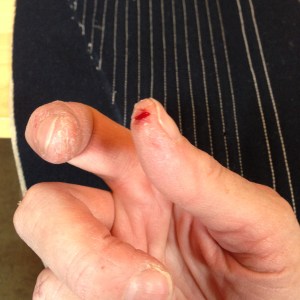
d’oh! surgical tape made this *much* better later.

Learn to sew with a thimble. Your fingers will thank you. I use a leather thimble with a metal tip (from the quilting notions section) and it helps. Thimbles are essential when sewing heavier fabrics like broadcloth and indispensable if you make your own stays (and you can expect bleeding even with a thimble).

Practice patience. Learning a new skill, or refining one you already have, takes time. It isn’t always fun. I get sick of sewing, and have to switch to something else (like cutting out, or research, or patterning) or take a break. Recognize that frustration is often the moment before you master something new, but also know when frustration means it’s time to stop. Just as we build muscle on rest days, our brains process skills when we stop. Then, the next time we pick something up, we’ll be stronger, or more skillful, than if we hadn’t stopped. (This New York Times article was helpful, and inspired this post.)

A purchased bonnet because it’s one I can’t make.

Buy what you cannot make. I thought I needed to make everything myself (with the exception of men’s hats and buttons) but that’s just not true. If you can’t manage fine sewing, buy a cap! If you hate assembling tricky things, buy mitts or a bonnet. I bought caps when I couldn’t make them as well as I wanted, and it saved me hours of frustration. I love flamestitch pinballs, but I can’t manage that needlework yet; lucky for me, I know someone who excels at it, so I can buy from her. Other people have skills, and buying things from them will save you time and frustration, so you can focus on what you really want to do.

Share this:

  • Click to share on Facebook (Opens in new window) Facebook
  • Click to share on Pinterest (Opens in new window) Pinterest
  • Click to email a link to a friend (Opens in new window) Email
  • Click to share on X (Opens in new window) X
Like Loading...
← Older posts
Newer posts →

Archives

wordpress statistics

Creative Commons License
Kitty Calash blog by Kirsten Hammerstrom is licensed under a Creative Commons Attribution-NonCommercial-ShareAlike 4.0 International License.

Website Built with WordPress.com.

  • Subscribe Subscribed
    • Kitty Calash
    • Join 621 other subscribers
    • Already have a WordPress.com account? Log in now.
    • Kitty Calash
    • Subscribe Subscribed
    • Sign up
    • Log in
    • Report this content
    • View site in Reader
    • Manage subscriptions
    • Collapse this bar
 

Loading Comments...
 

    %d