• Home
  • Completed Costumes/Impressions
  • Emma and Her Dresses
  • Free Patterns and Instructions

Kitty Calash

~ Confessions of a Known Bonnet-Wearer

Kitty Calash

Tag Archives: Massachusetts

Breaking Up By Letter

09 Wednesday Jul 2014

Posted by kittycalash in Events, Living History, Reenacting

≈ 2 Comments

Tags

10th Massachusetts, 18th century clothing, history, living history, Massachusetts, Revolutionary War

Mr S, always slightly suspicious

Mr S and I joined other members of the 10th Mass and National Park Service staff and volunteers at the North Bridge in Concord, Mass last Saturday for the postponed reading of the Declaration of Independence. It was one of those perfect New England summer days, breezy blue skies and dry wind smelling of grass and flowers: days like that I finally get the Transcendentalists.*

Some of those present in modern and historic clothes alike had never heard or read the Declaration all the way through; it is one of my favorite documents, and not just because I was in a 5th grade play about the document. Questions of slavery and principles aside, the Declaration is a great poem of a break-up letter. It makes poetry of the list of King George III’s crimes and reminds us of the core principles that undergird our government and that began with the Magna Carta, limiting the power of the king.

Governments are instituted among Men, deriving their just powers from the consent of the governed

Leaning against a tree near the North Bridge, you could close your eyes to the shorts and kayaks and baseball caps and listen to a document being read as it would have been 238 years ago, and imagine what it was like to hear this for the first time (at least until the airplane passed overheard).

I have a complicated relationship with patriotism, which makes me a curious candidate for this living history business. But that moment in Concord reminded me of the enthusiasm I had for history as a child, and the passion I had for what educators now call narrative play, and what some of us now grown up call reenacting, and others call historical re/creation.

There is something we can learn, as participants, and that the public can learn, as we go about this business of re-investigating the past, through making clothing and reading and cooking and re-learning historic processes and crafts. We may not always learn what we expect to about the past or about our selves, but if some in the audience enjoyed the smell of grass in the wind, and heard the true poetry of Jefferson’s text, maybe that’s enough to be getting on with. Because for all the questions about how a musket works, the real point of all of these events isn’t the musketry, it’s the history.**

*They clearly did not wake up to the “what the hell’s that smell?” game tidal canals like to start on summer mornings.

** Sorry, lads, but I think it’s true: wars are about words backed by muskets or other weapons.
Share this:

  • Click to share on Facebook (Opens in new window) Facebook
  • Click to share on Pinterest (Opens in new window) Pinterest
  • Click to email a link to a friend (Opens in new window) Email
  • Click to share on X (Opens in new window) X
Like Loading...

Fashionable Friday: Floral Embroidery Galore

27 Friday Jun 2014

Posted by kittycalash in Clothing, Frivolous Friday, History, Museums, Research

≈ Comments Off on Fashionable Friday: Floral Embroidery Galore

Tags

18th century clothes, 18th century clothing, 19th century clothing, Bostonian Society, Costume, Events, exhibits, fashion, Massachusetts, museum collections, Museums, style

Colonial Wedding dress altered 1830

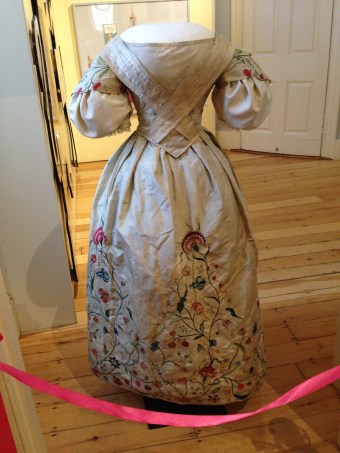
Elizabeth Bull Price’s Wedding Dress. Bostonian Society, 1910.50.35

On Tuesday evening, sensibility won over sense as my friend and I boarded the T for Boston to make a long day longer. The trip was worth it, though, for the One Night Only engagement of Elizabeth Bull’s wedding dress at the Bostonian Society. In truth, I bought the tickets for the event before I was even back at work and navigating our Fair City on my own– and who wouldn’t? That dress is amazing! (Tons more images of the embroidery are in the catalog record.)

Perhaps even more wonderful than the 14-year-old ElizabethBull’s needle skills is that the dress remains with us today. Kimberley Alexander and Tricia Gilrein reminded us on Tuesday of the many ways this dress, and other remnants of Bull’s wardrobe (oh, the petticoat, and the wonderful kerchief) connect us to the past in surprising ways. Elizabeth Bull was wealthy, married to Roger Bull, a Church of England official 22 years her senior: though they lived in Boston, they were British. (They were married in the 1730s, and Elizabeth died in 1780 at about 67.)

It’s a little hard to see past the 1830s alterations, but the embroidery of the gown helps chart that course, as well as the petticoat. As important to remember is that this wedding gown was not white: it has faded from a celadon green to its current off-white color. Wedding dresses weren’t white in the 18th century, or even long into the 19th, and it’s helpful to remember that as we look at what remains and reconstruct this in our mind’s eye.

It’s easy to forget we were British first here in the United States, and that the American War for Independence did not have a foregone conclusion. We forget, too, that churchmen and their wives were socialites as much as they were people of the cloth. Put Mr Collins out of your mind, and remember (my favorite minister & fashion maven) Reverend Enos Hitchcock and his pink satin waistcoat and suits of black silk.

Photograph of the altered gown. Bostonian Society, 1910.0050.057

Photograph of the altered gown. Bostonian Society, 1910.0050.057

Like many 18th century gowns, this one was remodeled in the 19th century, its shape altered to reflect the current fashion. We are lucky to have so much preserved, not just in the gown but also in the petticoat. Paths to understanding of women’s education, the customs and habits of Boston’s colonial elite, and the persistence of past can all be found within this object.


Share this:

  • Click to share on Facebook (Opens in new window) Facebook
  • Click to share on Pinterest (Opens in new window) Pinterest
  • Click to email a link to a friend (Opens in new window) Email
  • Click to share on X (Opens in new window) X
Like Loading...

History is Not a Competition

15 Sunday Jun 2014

Posted by kittycalash in Events, History, Living History, Reenacting

≈ 1 Comment

Tags

10th Massachusetts, 18th century, 18th century clothes, Amasa Soper's Company, Boston, historic houses, history, living history, Massachusetts, Paul Revere House, Reenacting, Revolutionary War

IMG_1583

Drilling by the Sergeant

Saturday was my first post-operative foray into costumed interpretation, up to Paul Revere House on Flag Day. This went much better than my first attempt at Paul Revere House, which ended in ignominy as I missed the train. In April, I managed to convince Mr S to drive in Boston, which he usually refuses to do (in fact, he nearly abandoned me once at the Old State House one Saturday after a miserable drive that had us stuck in the Downtown Crossing vortex).

I’m so glad we managed this, Despite anticipatory near-tears and epic pouting by the Young Mr, we managed to have a rather nice time.

Poise, with extra elevation by the Young Mr

Poise, with extra elevation by the Young Mr

We were in the courtyard, and Mr HC and Mr FC told the story of Amasa Soper’s company and its members several times to the streams of tourists. They solicited recruits and ran them through the 1764 drill using the nicest wooden muskets I’ve ever seen, though with mixed results. Some new volunteers held their muskets backwards, and the Young Mr’s ramrod got stuck in the barrel, though that is a known issue with that particular musket.

I sat on my ladder-back chair near the house and made the tiniest hems I could on Mr S’s next shirt, which will be for best. People asked about the sewing and my clothes, and I had a chance to talk about what women wore, typical fabrics and fibres, supplying the army, and who made what.

The day was warm, but fortunately not overwhelming, and as a museum person, I found the crowd quite interesting. This is a facet of Boston I don’t usually see: the tourist experience.

In one memorable moment, a pair of young women stood just outside the door to the house.
Young Woman Number One: “Is this really his house?”
Young Woman Number Two: “Yes, this is where Paul Revere lived.”
YWNO: “Oh, my God! I’m so excited! This is so neat!”
Kitty Calash: <eats heart out with jealousy> “Why can’t my museum do that?”

The celebrity factor of Paul Revere is undeniable. There were tourists with guide sheets in Chinese, and tourists who made me wish I still remembered my college German. Some seemed to be hitting every Boston landmark they could in one day, carrying white cardboard pastry boxes; some seemed to be going more slowly, looking, and trying to figure out what they were seeing, and what it meant.

Virtue Rewarded

Virtue Rewarded

What living history means is something I’ve been thinking about lately, or trying to. It’s tangled up with questions of authenticity and appropriateness, but what I learned on Saturday, or re-learned, was how very happy this business makes me. I like history, and historic costume. It doesn’t matter to me if we are talking Revolutionary War or New Republic or Lewis and Clark.

My favorite visitors were a mother and daughter from Steamboat Springs, Colorado, visiting Boston for the first time with a young man from New Hampshire. The mother said, “There’s so much more history here than where we’re from. Our town’s only 100 years old.”

That’s a challenge I’m always ready for, so I asked where they were from. Colorado to me means Native American settlements reaching back a thousand years, Spanish explorers and conquistadors, French, and then American, fur traders. It means hundreds of years of history, and a chance to remind people this isn’t a competition for “oldest” or “mostest.”

Knowing where our country came from is important: so yes, please visit Boston, and Paul Revere House, and Providence and Newport, too! But knowing where you are is just as important. There’s history all around you, and your local historical site, society and museum would love to tell you about it.

Share this:

  • Click to share on Facebook (Opens in new window) Facebook
  • Click to share on Pinterest (Opens in new window) Pinterest
  • Click to email a link to a friend (Opens in new window) Email
  • Click to share on X (Opens in new window) X
Like Loading...

Book Review: Book of Ages

17 Sunday Nov 2013

Posted by kittycalash in Book Review

≈ 1 Comment

Tags

18th century, book review, Boston, common people, history, Massachusetts, Research, resources, women's history

Book of Ages, by Jill Lepore.

Book of Ages, by Jill Lepore.

This is a book about reading and writing as much as it is a book about Jane Franklin, Benjamin Franklin’s little sister. Book of Ages has been reviewed elsewhere, and Lepore wrote a really lovely piece in the New Yorker called The Prodigal Daughter that is unfortunately behind a subscription firewall, but which I have read on actual paper. If you can get hold of it, I do recommend reading it before you read Book of Ages. It makes the book all the more poignant to know something about Lepore’s process.

This is, in many ways, another book about mud and misery (see the best bits of Longbourn). Because Jane Franklin Mecom (her married name– she married at 15) left behind so little, Lepore builds much of her story out of the context of Boston and New England in the mid-18th century.

It’s not exhaustive in its detail, and that’s fine: the book is an easy, comfortable read that still provides well-researched information about the lives of women in the 18th century. I finished it over a week ago, but details still remain (and that is a testament to Lepore– these could have been supplanted in my mind by details of exterior water meters, skunk removal techniques, or indexes for early vital records). Among the details I recall: Funerary and mourning customs, from published sermons to the distribution of mourning gloves and rings; soap making and trades practiced by small holders in home workshops; Jane Franklin Mecom’s wartime flight to Rhode Island; the power and practice of extended family networks.

It also reminded me of the differences in educational methods or standards for boys and girls, which helps remind us all of the importance and significance of the ideal of free public education for all. (We had some early proponents here in Rhode Island.) What might Jane Franklin’s life have been like in other circumstances? Honestly, even if she’d been well-off and well-educated, as as woman in the 18th century, she would never have had the same chances as her brother, no matter how evenly their intellects might have been matched.

If anything, that’s reason alone to read Lepore’s book, to celebrate the life of a woman who was both ordinary and extraordinary, and to recognize how much closer to all the anonymous, disappeared women of the past we can get through this example.

Share this:

  • Click to share on Facebook (Opens in new window) Facebook
  • Click to share on Pinterest (Opens in new window) Pinterest
  • Click to email a link to a friend (Opens in new window) Email
  • Click to share on X (Opens in new window) X
Like Loading...

‘Countryside at War’ Saturday

26 Monday Aug 2013

Posted by kittycalash in Clothing, Events, Living History, Research

≈ 3 Comments

Tags

10th Massachusetts, 18th century clothes, authenticity, common dress, common people, living history, Massachusetts, Revolutionary War, Rhode Island

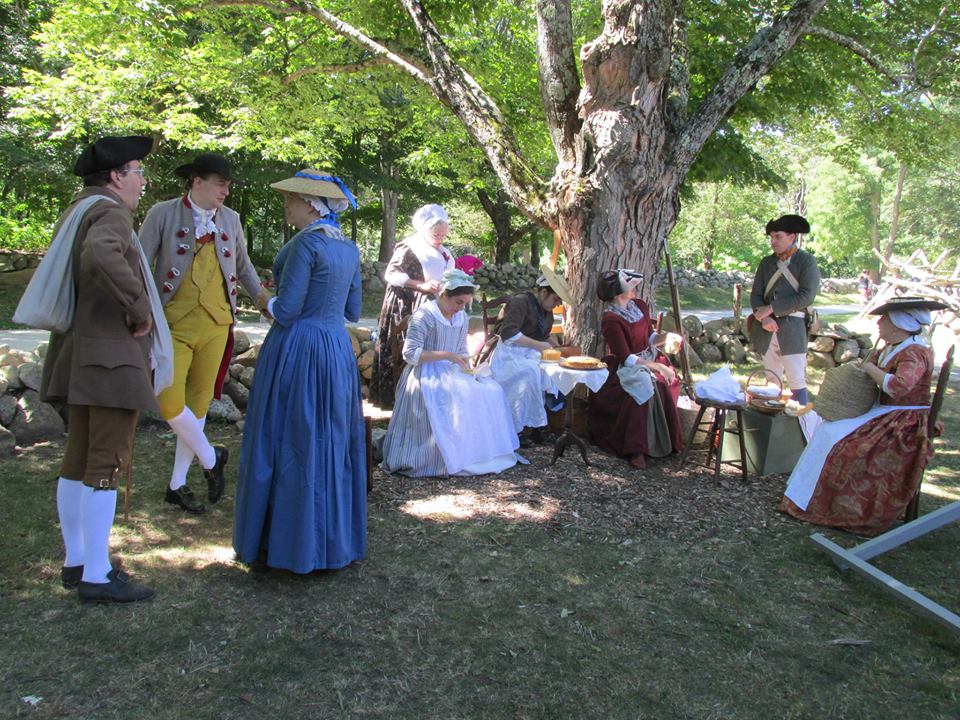
The Countryside at War, Hartwell Tavern, MMNHP, August 24, 2013

The Countryside at War, Hartwell Tavern, MMNHP, August 24, 2013

We came, we saw, we sewed, we ate cake. No, it was more than that, though there was any quantity of excellent cake on a lovely Saturday.

I had a chance to spend the whole day with people I really enjoy talking to, like Sharon Burnston and Sew18thCentury. (I love that silk gown. I really do.) We are all preparing for an event we will be part of in Providence in October, and I think and hope it will be great fun! But I’m getting several weeks and 25 years ahead of myself.

On Saturday, Sharon was a widow who had traveled from New Hampshire to visit her daughter, who was but one month from her confinement. She had a portmanteau of clothes for the soon to be born child, and food, as the blockade and closing of the city had made obtaining anything very difficult.

Before the jacket was applied

Visitors came and asked interesting questions, but there wasn’t much I could answer. Reader, I had not studied. I had sewn instead, vain woman that I am, laboring to produce new trousers and a new waistcoat for the Young Mr. He spent the day reading his school book, recovered in craft paper and blue check linen. Saving grace, that cover, and I plan to make many more. The Young Mr (after hauling carts and goods for people) found  some handy stones and settled in to get his work done.

His father plans to make him a full-size wooden musket from some mahogany that was left over from construction at work: there are no rules to prevent him learning to drill will a dummy musket. At events when he’s not trying to do his school work, he does enjoy being put to work. He likes to feel useful, and I am grateful to people who recognize that, and help me keep him in the hobby. This was all his idea in the first place…

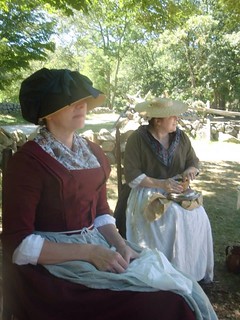
Sew18thCentury and I had a long walk on the bike path, which was mildly dangerous. Bonnets block a great deal of your vision, and change your hearing, so bicycles are particularly troubling. And when wearing a bonnet, one has to peer out from under it to see anything above you, or your lap, as you can see here.

Our clothing was documented, as you know from posts on this blog. I assembled sheets for each of us, and they can be found here: The Young Mr, Mr S and Kitty. I finished it all late on Friday night, so by the time I reached my own, well…there’s always next year to tidy that up. I still like the gown, and I really like the lightweight wool olive/brownish petticoat with the gown. Hooray! Clothing I like, in wool, that can be worn in summer. What’s not to like? (Well, pins, for one thing. They bend and pop out.)

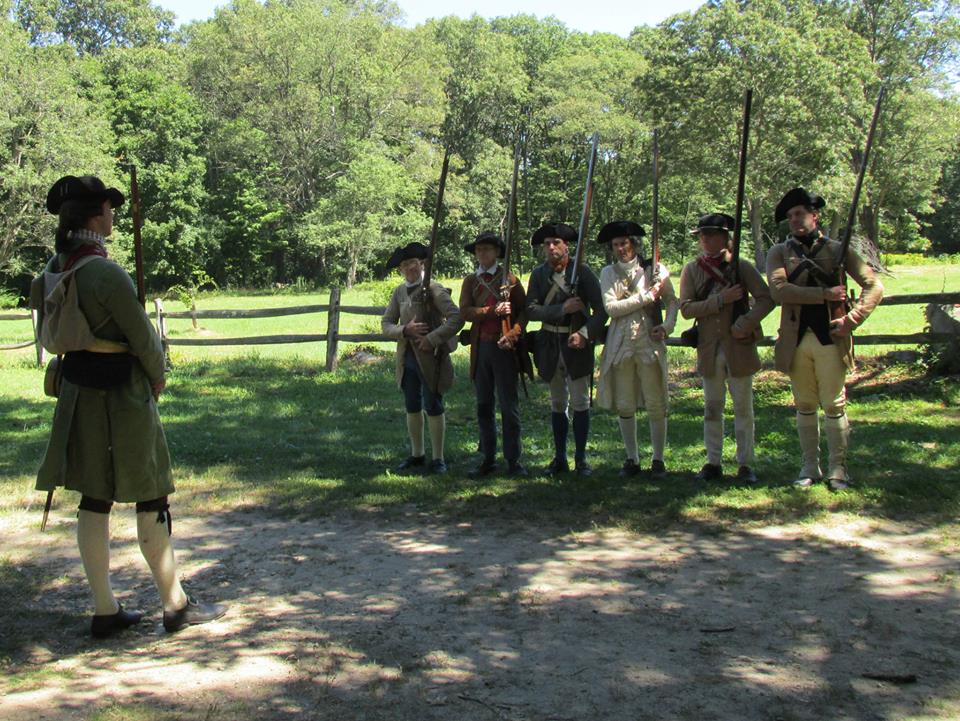
Drilling in the shade, Shirley-style

Drilling in the shade, Shirley-style

The men were drilled for the September 28 event, which rolls forward, sort of. I expect or hope for a schedule this week, which will be helpful. Fingers crossed…though no matter what, I will have to hope a train back to Providence by 3 to make rehearsal for the event at work. That should be interesting…

Now it’s down to finishing and fixing projects in process, and deciding on fabric for a housekeeper’s gown from 1800. I think I’ve settled on a year and style, but the fabric eludes me still. I have to find it pretty soon, because on Saturday, I’ll start making coats for Saratoga. I’m a sucker for beauty, and the Adjutant got me with sea foam green and dark brown wool. The facings are false, so really, a button-hole-free, single-year, described in a letter, regimental coat? The artist in me won, and I am so making that.

Many, many thanks to Sharon Burnston and Friends of Minute Man National Park for the photos! I took none, except of the Young Mr in our yard.

Share this:

  • Click to share on Facebook (Opens in new window) Facebook
  • Click to share on Pinterest (Opens in new window) Pinterest
  • Click to email a link to a friend (Opens in new window) Email
  • Click to share on X (Opens in new window) X
Like Loading...
← Older posts
Newer posts →

Archives

wordpress statistics

Creative Commons License
Kitty Calash blog by Kirsten Hammerstrom is licensed under a Creative Commons Attribution-NonCommercial-ShareAlike 4.0 International License.

Website Built with WordPress.com.

  • Subscribe Subscribed
    • Kitty Calash
    • Join 621 other subscribers
    • Already have a WordPress.com account? Log in now.
    • Kitty Calash
    • Subscribe Subscribed
    • Sign up
    • Log in
    • Report this content
    • View site in Reader
    • Manage subscriptions
    • Collapse this bar
 

Loading Comments...
 

    %d